
 Worksheets
Biology Now CUE Review- Chapters 18-21
Total questions: 91
Worksheet time: 2hrs 47mins

I. variation in the angle of sunlight that reaches Earth
II. variation in the amount of surface area over which the Sun's rays are distributed
III. variation in the amount of sunlight reflected from clouds

Why are the locations in high latitudes so much colder than the locations in low latitudes?
They receive less direct sunlight.
They receive more direction sunlight.
The sun never shines there.
The sun doesn't like those areas.
What happens to air as it rises in the atmosphere?
It descends to Earth's surface
It becomes more dense
It carries moisture to form clouds
It flows towards the poles

What is the circulation pattern of Hadley Cells?
From east to west
From the equator to the poles
From the poles to the equator
From west to east
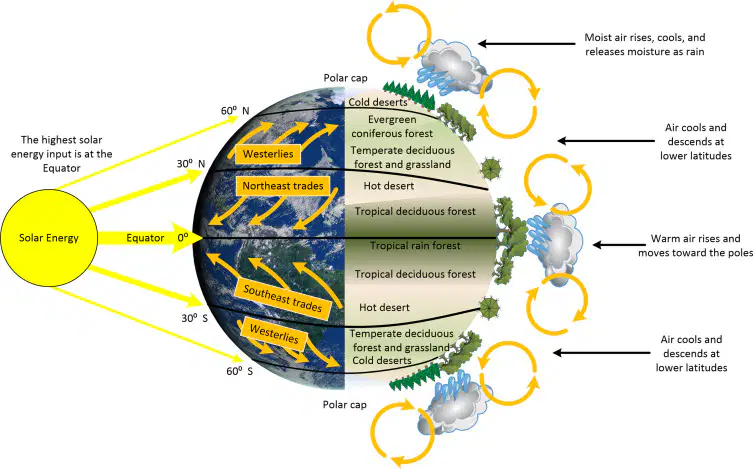
What is the main reason for the formation of clouds and precipitation in the tropics?
The aridity of the region
The rotation of the Earth
The convergence of air
The density of water
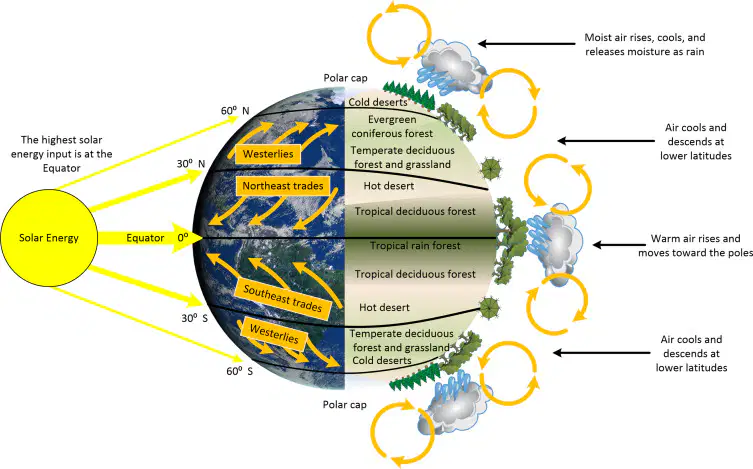
What is the result of the convergence of air from the northern and southern hemispheres? Text P.348- Fig 18.7
Increase in ocean salinity
Formation of tropical rainforests
Formation of deserts
Decrease in ocean salinity

I. annual precipitation
II. distinctive animal species
III. distinctive plant species

I. dominant plant growth forms
II. depth
III. salinity
If Fort Collins consistently experiences above average temperatures and rainfall for the next 25 years, that would represent a change in...
weather
climate
Which of the following best describes the measurements of CO2 levels in the atmosphere since 1958?
CO2 levels have shown steady increase since accurate measurements began.
Co2 levels are higher in winter and lower in the summer, but the winter "highs" have increased each year and the summer "lows" have not fallen as far.
CO2 levels are higher in the winter and lower in the summer, but the winter "highs" are higher each year and the summer "lows" are lower each year.
Which of the following is true about greenhouse gasses?
They reradiate infrared radiation back to Earth.
They are not affected by human activity.
They convert sunlight into energy in the form of heat that warms the earth.
A natural process in which certain gases in the atmosphere keep heat near the surface of the Earth and prevent it from radiating into space.
climate
the greenhouse effect
El Nino
emission
The release of products of combustion into the air often causes the formation of ozone near the surface of Earth. This ground-level ozone damages plants and affects their ability to absorb carbon dioxide. What most likely caused the doubling of ground-level ozone since 1850?
greater use of nuclear fuel
Emissions from vehicles & industrial processes
extinction of certain animal species
composition of the upper atmosphere
Which of the following are greenhouse gases?
carbon dioxide
ozone
methane
carbon dioxide and methane
Melting glaciers are causing ___________ to rise around the world.
Carbon Dioxide
Greenhouse Effect
greenhouse gases
sea levels
Which of the following has caused repeating 100,000-year cycles of ice ages in the past?
an increase in sunspots
several major volcanic eruptions
changes in Earth’s orbit and the tilt of its axis
continental drift

Which of the following is FALSE about the greenhouse effect? you can choose more than one
It is a natural process
It is caused by gasses trap heat from infrared radiation
It has a positive impact on Earth as it allows for temperatures that make life possible to exist
It has a negative impact on Earth as it is the cause of global warming
What are some potential consequences of climate change?
The sea levels will rise putting seaside towns and cities at risk of drowning
The sea levels will drop putting seaside towns and cities at risk of drowning
More extreme weather
Animals will be able to adapt to the changes

How is ocean water becoming more acidic?
Marine calcifiers are dying, causing an increase in ocean pH
The ocean is mixing with CO2 in the air and increasing the amount of carbonic acid
The ocean is getting too hot, which dissolves oxygen and increases pH
Humans are dumping large amount of acid in the ocean

Ocean acidification is what happens when excess CO2 is absorbed by the oceans. This change in pH can have devastating impacts on aquatic plants and animals. Based on the information in the graph which statement best predicts biodiversity of ocean life now versus the 1960’s?
A. Biodiversity has been unaffected by ocean acidification
B. Biodiversity has been unaffected because there has been no ocean acidification
C. Biodiversity has increased because acidification leads to new opportunities to fill niches
D. Biodiversity has decreased because ocean acidification has made the ocean uninhabitable by some life
Which is a natural source of greenhouse gases that cause climate change?
burning fossil fuels
deforestation
volcanic eruptions
evaporation at the surface of the ocean
In 2018 several large volcanoes erupted including the Popocateptl volcano in Mexico, which is still erupting today. It continues to pump ash and gas into the atmosphere. If nothing else was affecting the climate, how would the global temperature be affected by these volcanic eruptions?
A. The temperature would lower due to the ash reflecting UV radiation
B. The pH of the atmosphere will change
C. The carbon dioxide that it emits will help to raise the temperature
D. Volcanoes only affect plate tectonics, not global temperatures
Studies show that if humans were to stop greenhouse emissions today it could take hundreds of years for the Earth to begin to cool to pre industrial revolution temperatures. The major contributor to this is the ocean. Which of the following explains why this is the case?
A. The ocean stores most of the extra CO 2 and it would begin releasing it back to the atmosphere.
B. The ocean absorbs most of the excess heat and would begin releasing it back into the atmosphere.
C. The ocean holds most of the organisms that do photosynthesis and they would die without the extra greenhouse gasses.
D. The ocean is full of rock and rocks store most of the excess heat and would begin releasing it back into the atmosphere.
__________________ is the process by which moisture is carried through plants from roots to small pores on the underside of leaves, where it changes to vapor and is released to the atmosphere. ______________ is essentially evaporation of water from plant leaves.
P.348 Fig. 18.6: Hydrologic Cycle
Transpiration
Percolation
Infiltration
Plant Uptake
Water that flows across the land and enters rivers and streams. It eventually flows into lakes and the ocean.
Snowmelt runoff
Surface Runoff
Deposition
Precipitation
________________ is movement of water past the soil going deep into the groundwater.
Evaporation
Transpiration
Percolation
Sublimation
What would happen if the Sun is removed from the water cycle?
The water cycle would not include precipitation but would continue with groundwater flow.
The water cycle would no longer occur because the Sun provides the energy for evaporation and transpiration.
The water cycle would no longer occur because the Sun provides energy for the formation of clouds.
The water cycle would not include evaporation and transpiration but would continue with condensation.
How does carbon get into the ocean?
Diffusion - Shells and other carbon containing organism dissolve into the water
Cellular Respiration - animals in the ocean breath out carbon dioxide
Fossil Fuels - Human's burn fossil fuels and the oil ends up in the ocean
Rain - Rain water contains carbon that ends up in the ocean
How do carbon emissions lead to global warming?
By trapping the sun's heat in the atmosphere
By causing very hot volcanic eruptions
By catching fire in the atmosphere
By increasing the amount of carbon in Earth's crust
How do animals add carbon dioxide to the atmosphere?
Through breathing
Through photosynthesis
Through cellular respiration
Through transpiration

This graph shows ....
When one population increases, the other decreases.
When one population decreases, the other increases.
When one population increases, the other increases instantly.
When one population increases, it causes the other to increases shortly after.
How do animals get carbon?
By eating plants and or other animals.
They absorb it from the atmosphere.
From the ground
They do not get carbon from anywhere.
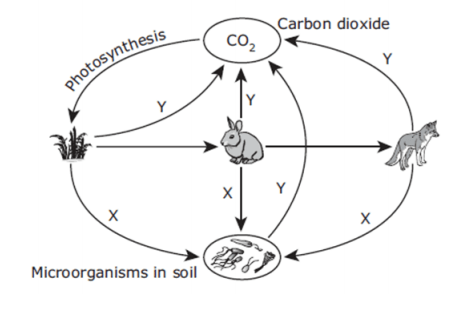
Y : Predation
Y : Decomposition
Y : Nitrogen Fixation
Y : Respiration
How does carbon become locked inside the earth?
Tree roots expel carbon into the soil as they grow.
Humans use machines to pump carbon dioxide into large underground rocks.
Rocks become richer in carbon as time goes by.
The carbon-rich bodies of plants and animals decay into the earth after they die.

Forests are carbon sinks because they remove carbon dioxide from the atmosphere through ____________.
combustion
respiration
photosynthesis
decomposition
Human activities add greenhouse gases to the atmosphere, therefore we are carbon ________.
sinks
sources
How does ocean acidification affect marine organisms with calcium carbonate shells?
shells dissolve as the carbonate combines with hydronium to make bicarbonate
thickening of shells as layer of carbonic acid coats the organisms
increases resilience to predation
coral bleaching due to the lower pH range in the ater
Primary succession is...
P.398, Fig. 20.15
The secondary succession is ___.
P.399 Fig. 20.16
Study of populations in relation to environment, including environmental influences on density and distribution, age structure, and population size.
population ecology
community ecology
ecosystem ecology
biosphere ecology
Processes that add individuals to a population.
birth and immigration
death and emigration
Number of individuals per unit area or volume.
denisty
dispersion
survivorship
immigration

Why don't populations grow indefinitely?
limiting factors
only biotic factors
only abiotic factors
none of the above

What is the carrying capacity mean?
The number of individuals an area can carry
the number of births
The number of deaths an area has
not sure

Which statement best describes the relationship between species A and B?
Species A is the prey of Species B
Species A is a parasite of Species B
Species A is a consumer and B is a producer
Species A and B has a mutualistic relationship
Why are bees considered a keystone species?
The honey they make supports the bear population
They pollinate flowers that produce fruit which supports the ecosystem
They sting when threatened
They live in hives


The total quantity of all living matter in an area is called:
Troposphere
Net Primary Productivity
Biomass
Ecosystem


In a forest ecosystem, which of the following is the BEST example of a limiting factor for a rabbit population?
a neighboring squirrel Population
sunlight
trees
presence of predators

parasites, disease, predators, are examples of what type of limiting factors?
density dependent
density independent
survivorship
type 1 curve

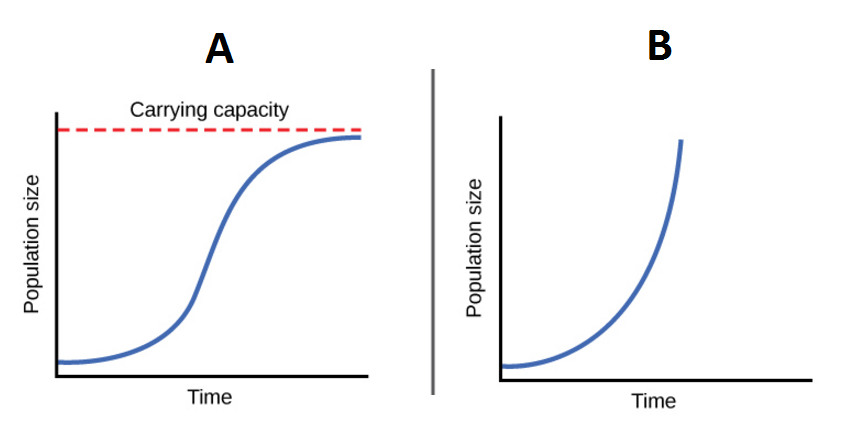
What type of growth model is shown in image A?
Exponential
Logistic
Why are some sharks considered a keystone species?
Because they are a top predator
They scare off smaller fish that may overgraze an area of sea grass
They are tertiary consumers
They are cartilaginous
Which one of the following keystone examples is a keystone predator found in the tidal pools of northwestern North America and was the species that launched Robert Paine’s keystone species concept?
starfish
sea otters
beavers
wolves
elephants
A life form that is very sensitive to environmental changes in its ecosystem. They can give us early-warning messages that a habitat is suffering.
Indicator Species
Flagship Species
Predators
Ecosystem Engineers

What happened to the trees and plants in Yellowstone National Park when the elk population increased?
The trees and plants flourished due to supporting a larger primary consumer population
The trees and plants declined due to supporting a larger primary consumer population
The trees and plants remained the same
The trees and plants migrated to a different area


If these remora fish are hanging with the shark to get scraps but don't hurt the shark, this is an example of
competition
mutualism
parasitism
commensalism

What type of relationship is this?
commensalism
mutualism
parasitism
competition

Ladybugs are often brightly colored with black spots to warn predators that they do not taste good. What color strategy do ladybugs use?
P.394-395
Camouflage
Disguise
Warning Coloration
Disruptive Coloration
Mimicry

Sand crabs have patterns on their body that help them to blend into their environment. What color strategy do sand crabs use?
P.394-395
Camouflage
Disguise
Warning Coloration
Disruptive Coloration
Mimicry

King snakes are not poisonous, but they look a lot like coral snakes which are poisonous. What color strategy do king snakes use?
P.394-395
Camouflage
Disguise
Warning Coloration
Disruptive Coloration
Mimicry


The arrows in a food web display
Symbiotic relationships
That nutrients move from predator, to prey
The direction energy is moving
Trophic levels
Which process do plants use to turn sunlight into food energy?
photosynthesis
cellular respiration
transpiration
evaporation
Why are mushrooms important to the food chain?
They recycle nutrients into the ecosystem.
They produce food energy for other living things.
They recycle oxygen into the atmosphere.
They consume excess herbivores in the ecosystem.

What would happen to this food chain if we doubled the population of the rabbits?
The populations of the snakes and hawks would also increase.
The populations of the grass, snakes, and hawks would decrease.
The grass population would decrease. The snake and hawk population would increase.
The grass and hawk population would decrease. The snake population would increase.

Which most likely caused the rabbit population (light green line) to decrease over the first time unit (0 to 1) in the graph?
A disease in the rabbit population
A decrease in the amount of grass available
A decreasing population of hawks
A higher population of snakes than normal

One characteristic feature of the tundra is that only the surface thaws in the summer and refreezes in the winter, leaving a permanently frozen subsoil. This characteristic is known as
Hoarfrost
Glaciation
Permafrost
Crystallization

The kangaroo rat is able to get all of the water it needs through its food and therefore, never needs to drink liquid. This animal has adapted to survive in which biome?
Forest
Tundra
Desert
Grassland


Which biome covers most of the land mass near Earth's equator?
Desert
Grassland
Tropical rainforest
Temperate forest
A large region characterized by a specific type of climate and certain type of plants.
boreal forest (taiga)
climate
biome
canopy

