
 Worksheets
Complete Economic Quiz Multiple Choice
Total questions: 132
Worksheet time: 11hrs 0mins
Which of these is not one of the key economic decisions?
what to produce?
how to produce?
who is to benefit from the goods and services produced?
how much to charge for the goods and services produced?
What happens every time we make a decision?
We win!
We incur an opportunity cost
We incur an opportunity loss
We incur an opportunity cost of multiple other options
Which of these is a description of a 'trade-off'?
Having more than you want, or need.
When people work in jobs where they produce a few special goods, or services.
When you get a little less of one thing in order to get a little more of something else.
Something one person does for someone else.
What is the world's 3rd largest economy?
USA
China
UK
Japan

What is this?
A supply curve
A demand curve
A supply shift line
A demand shift line

What does this show?
A shift in supply
An expansion of demand
A shift in demand
An expansion of supply

What does this show?
An increase shift in demand
A decrease shift in demand
An expansion of demand
A contraction of demand

The _______ considers the weighted averages of a group of consumer goods and services.
Consumer price index
Aggregate supply
Producer price index
Aggregate demand
Which of the following causes of inflation is often described as “too much money chasing too few goods”?
Demand-pull inflation
Cost-push inflation
Demand-push inflation
Cost-pull inflation
Fill in the blank: When inflation is high the _______________of the pound decreases.
cost value
purchasing power
importance
validity
Which of the following groups DO NOT suffer from high inflation?
Businesses
Lenders
Borrowers
Consumers

What causes cost-push inflation?
An increase in demand for goods and services
An increase in supply
A rise in production costs passed on to consumers
A fall in the price of imports

Price stability occurs when
Prices are rising rapidly
Inflation is high
There is significant deflation
Price level in an economy does not change much over time.
Wages rise by 3%, when inflation is 7%. Real wages
are rising faster than inflation
have fallen by 4%
have risen by 10%
have fallen by 7%
The CPI is a weighted index, this means
Some price changes are given more importance than others in the index
All price changes are equally important
price changes in energy would have less relevance than price changes of window cleaning
Cassie is going to start a business and can buy either wood or cloth. If she buys wood, she can make toy boats. If she buys cloth, she can make dolls. What is the opportunity cost of Cassie’s buying cloth?
The cost of making toy boats and dolls
The opportunity to make toy boats
The cost of starting a business
The opportunity to make dolls

Based on the map above, what is a major source of income for Ohio?
Mining
Tourism
Industry
Fishing
Tom, the owner of Tom’s Pizza, recently bought a faster dough maker and a larger pizza oven for his shop. His sales have doubled. Which statement describes why Tom decided to buy a faster dough maker and larger pizza oven?
As a producer, he invested in capital goods to increase production
As a producer, he paid less for ingredients to make a profit
As a consumer, he wanted to have a successful restaurant
As a consumer, he wanted to spend less time cooking
A company makes a popular fruit juice. It makes cough drops. A main ingredient in both products is oranges. Because of a drought, the company has enough oranges to produce only fruit juice or cough drops. The company chooses to make fruit juice. What is the opportunity cost of the company’s decision to make fruit juice?
The demand for fruit juice will increase.
The company will earn less money selling fruit juice.
The farmers will decrease the amount of oranges that they grow.
The company will be unable to earn money by selling cough drops.
What does an increase in supply of an item usually mean for consumers?
The item will be bought by fewer customers.
The item will be removed from the market.
The item will be difficult to buy.
The item will be lower in price.
A product that is brought into a country to be sold is called an import.
True
False
Using income for purchases, expenses, and debt
Spending
Savings
Services
Goods
The iPhone 7 came out a few years ago, the demand for it is down, so the price is now...
Up
Down
The Same

The class took a vote on their favorite sports and created a pie graph. How many total students are in the class?
24
25
10
28
When you spend your money to buy a piece of candy, you are acting as a...
Producer
Importer
Consumer
Exporter
Which of the following best describes gross domestic product?
The growth in the number of goods and services bought over a period of time
The value of good and services bought over a period of time
The number of goods and services produced over a period of time
The value of goods and services produced over a period of time
Which formula is the correct way to measure economic growth rate?
Original GDP / Change in GDP x 100
Original GDP - Change in GDP x 100
Change in GDP / Original GDP x 100
Change in GDP - Original GDP x 100
What is GDP per capita?
GDP x population
GDP / population
GDP + population
GDP - population
If GDP is £300 billion and the population is 30 million. What is GDP per capita?
£270 billion
£100,000
£10,000
£1,000
Which of the following DOESN’T cause economic growth?
Increased investment
Improved technology
Increased labour productivity
Less investment in education
Which of the following is a benefit of economic growth?
A rise in the standard of living
Increased pollution
Increased congestion
Inequalities in income and wealth
Which of the following is a cost of economic growth?
A fall in unemployment
A rise in employment
A reduction in poverty
Loss of non-renewable resources
Calculate the economic growth rate if GDP was £60 billion in Year 1 and £63 billion in Year 2.
1%
5%
10%
15%
Calculate the economic growth rate if GDP was £100 billion in Year 1 and £102 billion in Year 2.
1%
2%
10%
20%
Calculate GDP per capita if GDP is £200 billion and the population is 40 million.
£1,000
£2,000
£5,000
£10,000
Which of the following is the correct definition of inflation?
A sustained rise in the general price level over time
A increase in prices of goods and services
An addition to the number of goods in a ‘basket’
What is the rate of inflation?
The change in inflation over time
The percentage rise in the general price level over time
The change in the price level over time
The percentage change in the general price level over time
What is a nominal value?
One that takes inflation into account
One that does not take inflation into account
One that is referred to as a number
One that is referred to in money terms
What is a real value?
One that takes inflation into account
One that does not take inflation into account
One that is referred to as a number
One that is referred to in money terms
If the original value is £100 and the new nominal value is £102 what is the percentage change in nominal income?
1%
2%
3%
4%
If the original value is £100, the new nominal value is £102, and the rate of inflation is 3%, what is the percentage change in real income?
-1%
-2%
1%
2%
What is the correct definition of ‘demand-pull’ inflation?
When aggregate (total) supply exceeds aggregate demand
When aggregate demand exceeds aggregate supply
When there is a rise in aggregate demand
When there is a rise in the exchange rate
What is the correct definition of ‘cost-push inflation’?
When there is a rise in aggregate supply
When firms seek to rise prices to increase profits
When costs of production rises
When workers ask for wage increase
What is a consequence of inflation for consumers?
Increase in consumer confidence
Shoe leather costs
Real incomes increase
Consumers who are debtors lose
What is a consequence of inflation for producers?
Menu costs decrease
Less flexibility
Producers lack business confidence
Producers gain as creditors
Which is the correct definition of fiscal policy:
A policy that aims to control the total supply of money in an economy to try and achieve the government’s economic objectives
A government policy affecting the amount of supply in an economy
A policy that uses government spending and taxation to affect the economy as a whole
Laws to control the way people and organisations behave
What is the main source of government spending?
Education
Social protection
Health
Defence
‘A tax on income and wealth’ is describing indirect tax
True
False
What is the definition of a budget surplus?
When tax revenue is greater than government spending
When government spending is greater than tax revenue
The source of finance for government spending
A tax on spending, on goods/services
Which of these is not a government objective that fiscal policy is used to achieve?
A balance in the balance of payments
Price stability
Low unemployment
Income and wealth distribution
An increase in government spending and a reduction in tax is likely to lead to a budget deficit. True or false?
True
False
Fiscal policy can be used to achieve economic growth by:
Increasing government spending and increasing tax
Increasing government spending and decreasing tax
Decreasing government spending and increasing tax
Decreasing government spending and decreasing tax
Fiscal policy can be used to achieve low unemployment by:
Increasing government spending and increasing tax
Increasing government spending and decreasing tax
Decreasing government spending and increasing tax
Decreasing government spending and decreasing tax
Fiscal policy can be used to achieve price stability by:
Increasing government spending and increasing tax
Increasing government spending and decreasing tax
Decreasing government spending and increasing tax
Decreasing government spending and decreasing tax
Fiscal policy can be used to create a healthier balance of payments by:
Increasing government spending and increasing tax
Increasing government spending and decreasing tax
Decreasing government spending and increasing tax
Decreasing government spending and decreasing tax
Which of these is the correct definition of monetary policy:
A policy that aims to control the supply of money in the economy
A policy that aims to achieve economic growth
A policy that controls taxes
A policy that aims to contribute to the supply of money
In order to achieve economic growth, monetary policy changes interest rates. Would these be increased or reduced?
Increased
Reduced
In order to achieve low unemployment, monetary policy changes interest rates. Would these be increased or reduced?
Increased
Reduced
In order to achieve price stability, monetary policy changes interest rates. Would these be increased or reduced?
Increased
Reduced
In order to achieve a healthier balance of payments, monetary policy changes interest rates. Would these be increased or reduced?
Increased
Reduced
Nominal interest rates are different from real interest rates because:
Real interest rates are the current bank lending rates
Real interest rates take into account inflation
Real interest rates take into account changes in house prices
Nominal rates are rates which only apply to borrowers and not lenders
Quantitative easing is the common name for which policy instrument?
Lowering the interest rate at which commercial banks lend to each other
Asset selling by a central bank
Asset purchasing by a central bank
When a central bank reduces interest rates
A significant rise in interest rates is most likely to lead to an increase in:
Consumer spending
Investment spending
Unemployment
Short run aggregate supply
Which of the following scenarios would cause the nation’s money supply to increase?
Decreasing government spending
Lowering interest rates
Raising interest rates
Selling bonds to investors
_________ is a general rise in prices that can be caused by a number of things, but one of them is the amount of money that circulates:
Inflation
Deflation
Foreclosure
A situation of market failure is said to exist if;
buyers and sellers pay for the true opportunity costs of their actions
there are no externalities
the government provides merit goods free
third parties in society are affected and not compensated
Which of the following statements is true about externalities?
When externalities exist, resources are allocated efficiently
When positive externalities exist, efficiency is improved by taxing the product
From society's point of view, the output of goods for which a positive externality exists is too low
The price system overproduces goods with positive externalities
In which of the following situations is market failure least likely to occur? A situation where;
externalities exist
many producers compete in the market
there is a sole producer in market
there is a very uneven distribution of income and wealth
When social costs are greater than private costs, there is a;
positive externality
negative externality
less than socially optimal output
socially optimal output

In a market for a product with positive externalities;
all benefits are not internalized
there is too much production
profits are too low
profits are too high

When there is a _______ production externality, the free market _________ resources to the production of the good and too ______ of it is produced relative to the social optimum. This is shown by _______and _______ at the point of production, Qm, *
negative; misallocate; little; Qm > Qopt; MSC < MSB
positive; underallocate; much; Qm > Qopt; MSB > MSC
negative; overallocate; much; Qm > Qopt; MSC > MSB
positive; misallocate; much; Qm > Qopt; MSC > MSB

Public goods, such as defence, are not supplied by the price system because;
the capital cost is too high
the benefits would - ceteris paribus - not be restricted to buyers but would be available to non-buyers as well
public goods are necessities and therefore cannot be left to the price system
monopolies would make supernormal profits

Which of the following is a characteristic of a merit good?
It could be provided by the free market, but not in sufficient quantities
It is always provided free to consumers
It tends to generate negative externalities, so governments restrict its consumption
Once the good has been supplied to one consumer, there is no additional cost in supplying it to others

Governments use cost-benefits analysis to;
measure the net social benefit of a project
make consumers pay for the net social benefit they receive
minimize social costs
make producers pay for the social costs of a project
Fill in the blank. Economies of scale is when as output _________, unit costs ________ in the long run.
increases; decrease
increases; increase
decreases; increase
decreases; decrease
Internal economies of scale are those that
Result from changes in production techniques
Increase due to the growth of the industry as a whole
Generate lower per unit production costs
Reduce production costs in the short run
Large firms can afford to advertise and sell in larger quantities to develop brand loyalty. This is an example of
Purchasing economies of scale
Technical economies of scale
Managerial economies of scale
Marketing economies of scale
Risk bearing economies of scale
Large firms can negotiate better interest rates on loans; this reduces the costs of borrowing for larger companies. This is an example of
Financial economies of scale
Technical economies of scale
Managerial economies of scale
Marketing economies of scale
Risk bearing economies of scale
Fill in the blank. __________ economies of scale occur due to an increase in the scale of production within a single firm
Internal
External
Complex
Simple
Which is the correct definition of demand?
The quantity of a product that consumers are willing and able to demand at a given price.
The quantity of a product that consumers are willing and able to purchase at a given prices at a given period of time.
The quantity of a product that suppliers are willing and able to supply at a given price at a given period of time.
The amount of a given product or service that suppliers are willing to offer to consumers at a given price level at a given period.
For normal goods, as price increases demand will typically (a)
What is the definition of price elasticity of demand?
The amount that price changes when demand changes
The change in demand that impacts on price changes
The responsiveness of consumer demand to a change in the price of a good or service
The responsiveness of price to a change in consumer demand
What is the equation for PED?
% Change in quantity demanded ÷ % Change in income
% Change in price ÷ % Change in quantity demanded
For normal goods, the PED number will always be (a)
If PED > 1, demand for a good is said to be price (a)
The definition of AS is which of the following?
Total supply of goods and services produced within an economy at a given price in a given period
Total of consumer spending, investment, government spending, and net exports
Total demand for goods and services produced within an economy at a given price in a given period
Total supply of goods and services produced for export within an economy
Why does the AS curve slope upwards?
Due to the wealth effect on consumption
As the price level falls the interest rate also tends to fall
Lower prices leads to an increase in demand for exports
Firms do not have flexibility to vary inputs in short run, so will only increase production by varying intensity of utilisation of inputs in response to higher prices
A shift in the AD curve will have what impact on AS?
Shift left
Contraction / expansion
Shift right
The long run aggregate supply curve is influenced by which of the following factors? Choose three.
Size of the workforce
Level of education and training
Prices
Consumer expenditure
Labour productivity

The type of government that has total control over the people and the police use power by force is called what?
Anarchy
Monarchy
Limited
Authoritarian
Which type of economy has central ownership, the government, and lack of individual choice?
Market
Mixed
Command
Traditional
Capitalism is in what type of economy?
Traditional
Command
Market
Authortarian
What do you call to the payment for the use of land?
rent
spending
income
capital

According to the table, what is the Euro equivalent of 1 USD?
1.32 Euros
0.53 Euros
.76 Euros
1.59 Euros
If the AUD were to appreciate in the relation to the USD, what effect would this have?
Australian imports become cheaper.
Australian exports become more expensive to American buyers.
Australian imports become more expensive.
Australian exports become less expensive to American buyers.
What is the aim of contractionary monetary policy?
Stimulate the economy
Encourage people to buy more, increasing inflation
Lower demand and reduce inflation
Raise employment levels
Which of these is a fiscal policy tool?
Interest rates
Exchange rate
Money supply
Taxation

The graphs show how consumer prices and real GDP changed in a country between 1995 and 2005. Which conclusion may be drawn from the graphs?
Living standards remained roughly constant between 1995 and 2005.
The level of GDP was lower in 2005 than in 2000.
The country experienced continuous economic growth between 1995 and 2005.
The price level fell between 2000 and 2003.

What is a tariff?
Tax on imported goods
To stop trading with a business or country
A limit on imported goods

A quota is a limit on an imported good. Which is an example of a quota helping local farmers?
Taxing corn from another country.
Allowing less corn to be bought from other countries' farms.
To stop buying corn from another country
1 A village is over 10 miles away from the nearest two towns. The village shop sells bread. For someone living in the village wanting to buy bread, the shop is a
competitor
monopolist
oligopolist
specialist
Firms need to survive in a market. Which of the following is an example of a suitable method to survive?
Encourage existing customers to return
Enter into competition with consumers
Provide an external economy of scale
Reduce total supply
An oligopoly differs from a competitive market because
a competitive market has larger firms than an oligopoly
a competitive market has lower barriers to entry than an oligopoly
firms in an oligopoly do not differentiate their products
firms in an oligopoly only compete on price
A market is an oligopoly if
each of the firms in the market has only a few customers
each of the firms in the market makes many products
most of the market is supplied by a small number of firm
there is only one firm in the market
A characteristic of a monopoly is that there is an absence of
competition
economies of scale
opportunity cost
productivity
A market starts in equilibrium and then demand falls. Which of the following is most likely to happen?
A higher equilibrium price and equilibrium quantity
A higher equilibrium price and lower equilibrium quantity
A lower equilibrium price and equilibrium quantity
A lower equilibrium price and higher equilibrium quantity
You put £100 into a bank account at the start of the year. One year later your account is worth £105. What is the interest rate you have received?
0.5%
5 %
10 %
15 %
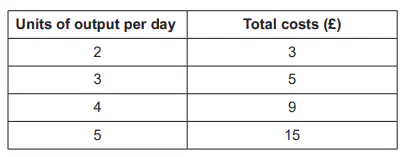
The table shows the total costs of a firm. It sells its output for £5 each. How many units of output per day does the firm need to sell to maximise profits?
2
3
4
5
In a competitive market...
the government must control the price
the item that is traded must be a good
the item that is traded must be a service
there must be many sellers
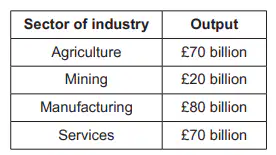
The table shows the value of the output of an economy. Which of the following statements is true for this economy?
The primary sector is the largest
The tertiary sector is the largest
The tertiary sector is the same size as the primary sector
The value of the primary sector is £70 billion

