
 Worksheets
3rd BM Review-HMH U3L3&4, U4
Total questions: 55
Worksheet time: 58mins
How can the structure of a molecule or compound change the substance completely?
It does not change the substance.
It changes the shape.
It changes the properties of the molecule or compound.
It changes the volume and the mass.
What is the difference between a molecule and a compound?
One is radioactive.
Molecules are made of the same atoms, while compounds are made up of two or more different types of atoms.
They are both made of only a single atom.
One makes you up and the other makes the thing that make you up.
What is a crystal?
A crystal is a pure substance that is a solid.
A crystal has particles that are arranged in a specific, repeating order (molecular structure).
A substance in which the particles are arranged in an orderly, geometric, and repeating pattern.
All of the descriptions above describe crystals.
What is a pure substance?
2 or more atoms joined together.
A sample of matter that has specific and physical properties.
An attractive force that holds atoms together.
A substance.

Polyvinyl chloride (PVC) is a polymer used to make water pipes and other products. Polymer molecules are made of groups of atoms that repeat many times in long chains as shown in the formula.
Which circle, left to right, shows the repeating group of atoms that forms PVC?
first circle
second circle
third circle
fourth circle

This is an example of a(n)...
simple molecule.
extended structure.

Compounds can be broken down into simpler substances. True or False?
True
False

Matter is anything that has...
weight and texture.
mass and weight.
mass and takes up space (volume).
only mass.

This is an example of a(n)...
simple molecule.
extended structure.

This is an example of a(n)...
simple molecule.
extended structure.

All molecules are compounds.
agree
disagree
What is the smallest?
an atom
a molecule
a speck of dust
a copound
What are examples of elements?
CO2
Ca
H
O
What are examples of compounds? (check all that apply)
water (H2O)
Oxygen (O2)
Iron (Fe)
Carbon Dioxyde (CO2)
Based on the chemical formula of carbon dioxide CO2. Choose the correct model below.


Choose the correct image of an element.


Choose the correct image of a compound.


Why are oxygen molecules (O2) different than ozone molecules (O3) even though they are made up of the same atoms.
They have different structures.
They have different amounts of atoms.
They have different chemical formulas.
All of the above answers are correct.
You have a sample of a substance that you cannot physically separate into components. You also cannot chemically separate that substance into components. Which of the following are true about your sample? (select all that apply)
A. The sample is made up of one type of atom.
B. The sample is made up of multiple elements.
C. The sample is made up of a single element.
D. The sample is made up of several types of atoms.

Look at the image to the left for this question...
How many Oxygen atoms would you have to have to make Nitrate?
3
2
1
none

Which sentence describes this substance (a diamond)?
An extended structure made of the same element.
An extended structure made of molecules that are attracted to each other.
A simple molecule made of different elements.
An extended structure made of different elements.
Which statement best describes the arrangement of elements in the periodic table?
Elements are arranged in decreasing atomic mass from left to right.
Elements are arranged in decreasing atomic number from left to right.
Elements are arranged in increasing atomic number from left to right
Elements are arranged in increasing number of neutrons from left to right.

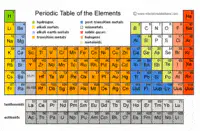
In an element box, the number at top is the
atomic number
atomic name
atomic mass
atomic symbol

What are the horizontal rows on the periodic called?
groups
periods
nonmetals
metals
metalloids
What are the vertical columns on the periodic called?
groups
periods
nonmetals
metals
metalloids
Elements within a group have similar properties.
TRUE
FALSE
What is the difference between Co and CO?
CO is an element but Co is a compound
Nothing is different. They are the same thing.
CO is two elements and Co is only one element
Co is not a pure substance


Physical Properties can be ________
observed without changing the matter being studied
observed and measured but the matter has to be changed
observed and measured without changing the matter being studied
Why is a basketball more dense than a beach ball?
It has more matter
It has less matter
It contains less air
How are chemical properties observed?
during chemical reactions
when a chemical is poured in a beaker
when a chemical is at room temperature
All of the following are examples of physical properties EXCEPT
Density
Heat conductivity
pH (acidic or basic)
Boiling point
Which of the following is a chemical property of water?
Reacts with pure sodium
Boils at 100 oC
Is liquid at room temperature
Has a density of 1 gm/mL
Which is NOT an indication of a chemical change?
Temperature Change
Shape Change
Formation of a precipitate
Production of light
What is the left part of a chemical equation called?
2H2 + O2 --> 2H2O
Reactants
Yields
Products
Chemical Equation
What is the right part of a chemical equation called...
2H2 + O2 --> 2H2O
Reactants
Yields
Products
Chemical Equation
True or False
In a chemical reaction, no new atoms are created, and no atoms are destroyed.
TRUE
FALSE
Which statement is not a description of a chemical reaction?
A solid is dropped into a beaker of liquid and a gas is released.
A solid is dropped into a beaker of liquid and an explosion occurs.
Two liquids are mixed in a beaker and a solid forms at the bottom of the beaker.
A liquid is heated in the sun and half of it evaporates.
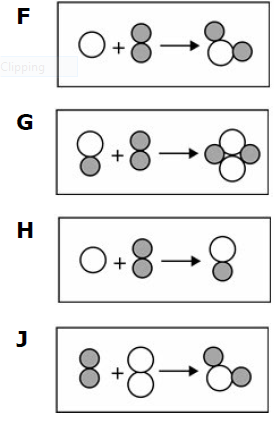
Al + O2 → 2Al2O3

Which observation(s) might be used as evidence that a chemical reaction occurred?
Color change
Odor change
change in temperature
All of the above

Is a copper penny turning greenish after a few years a chemical or physical change?
Chemical Change
Physical Change
How would you describe this chemical formula?
3 H2O
3 H2O molecules
3 H2O atoms
3 H2O elements
3 H2O parts

Which chemical equation matches the model shown?
3C + 4O --> 3CO2
3C + 2O2 --> 3CO2
C3 + 4O --> 3CO6
C3 + 2O2 --> 3CO6

6CO2+ 6H2O → C6H12O6 + 6O2
The carbon atoms are balanced with ____ on each side of the reaction.
1
6
2
Determine whether the following equations is balanced or unbalanced. H4 + O2 ---> 2H2O
Balanced
Unbalanced
Determine whether the following equation is balanced or unbalanced. 2Fe + 3Cl2 ---> FeCl3
Balanced
Unbalanced

