wayground logo

Free Printable Worksheets

Font size

S
M
L
XL
Worksheets

Science 8 OST Review

Total questions: 98

Worksheet time: 51mins

Name
Class
Date
1.

Where would you have the least mass?

a)

Mass never changes regardless of location.

b)

At sea level

c)

On the space shuttle in outer space

d)

On top of a very high mountain

2.

What is force?

a)

a push or a pull

b)

motion

c)

acceleration

d)

interaction

3.

An object at rest stay at rest and an object in motion stays in motion until acted upon by an unbalanced force.

a)

Newton's 3rd Law

b)

Force

c)

Newton's 2nd Law

d)

Newton's 1st Law

4.

The acceleration of an object as produced by net force. F = m*a

a)

Newton's 1st Law

b)

Motion

c)

Newton's 2nd Law

d)

Newton's 3rd Law

5.

For every action there is an equal and opposite reaction.

a)

Newton's 2nd Law

b)

Newton's 1st Law

c)

Newton's 3rd Law

d)

None of the above

6.

What units is Force measured in?

a)

Grams

b)

Miles

c)

Hours

d)

Newtons

7.

The force that attracts objects to the center of the Earth

a)

Friction

b)

Air resistance

c)

Motion

d)

Gravity

8.
What type of forces cancel each other out and do not cause motion to occur?
a)
Balanced forces
b)
Jedi forces
c)
Unbalanced forces
d)
Balanced porches
9.
What type of forces can change the position, direction, or speed of an object?
a)
Banana forceps
b)
Balanced forces
c)
Umbrella forces
d)
Unbalanced forces
10.
This is an example of what type of force?
a)
Gravitational
b)
Magnetic
c)
Electric
d)
Lightning
11.
This picture is an example of what type of force?
a)
Friction
b)
Gravitational
c)
Electric
d)
Magnetic
12.
Which of the following is an example of a non-contact force?
a)
Friction
b)
Gravitational
c)
Motivational
d)
Acceleration
13.

To make an object move you must first apply ---

a)

an opposing force

b)

an unbalanced force

c)

a stationary force

d)

a vertical force

14.

Which law of motion predicts that a moving hockey puck will continue to move in the same direction at the same speed unless acted upon by another force?

a)

Newton's First Law of Motion

b)

Newton's Second Law of Motion

c)

Newton's Third Law of Motion

d)

Newton's Law of Universal Gravitation

15.

The diagram below show the forces acting on a soccer ball.


In which of the diagrams will the ball remain motionless?

a)

W

b)

X

c)

Y

d)

Z

16.

Many bicycles use a hand brake to control their speed. When the brake is engaged, a rubber pad presses against the tire. What force of motion does the hand brake rely upon to slow the bicycle?

a)

Gravity

b)

Friction

c)

Electricity

d)

Magnetism

17.

A force between two objects that are TOUCHING is a

a)

Non-contact Force

b)

Contact Force

c)

Gravitational Force

d)

Jedi Force

18.

Magnetic Force is

a)

A force of attraction between any two objects in the universe

b)

A force that acts between objects that are electrically charged

c)

The force of attraction or repulsion between unlike or like poles

d)

A contact force that resist motion between two objects that are touching

19.

A force applied to another object that is NOT in direct contact with it is a

a)

Contact Force

b)

Jedi Force

c)

Non-contact Force

d)

Gravitational Force

20.

An area surrounding an electron that exerts a force on nearby charges is a(n)

a)

Electric Field

b)

Magnetic Field

c)

Gravitational Field

d)

Baseball Field

21.

The region around a magnet where magnetic forces act is called a(n)

a)

Gravitational Field

b)

Magnetic Area

c)

Electrostatic Field

d)

Magnetic Field

22.

This image represents electrical field lines that will

a)

Attract

b)

Repel

23.

As distance between two objects DECREASES, the gravitational force between them

a)

Decreases

b)

Stays the same

c)

Ceases to exist

d)

Increases

24.

As the masses of two objects INCREASE, the gravitational force between them

a)

Increases

b)

Stays the same

c)

Ceases to exist

d)

Decreases

25.
What is the HARD,RIGID outer layer of Earth called?
a)
asthenosphere
b)
mantle
c)
crust 
d)
lithosphere
26.
Name the soft pliable layer directly below the lithosphere.
a)
 lower mantle
b)
outer core
c)
lithosphere
d)
asthenosphere
27.
Who came up with the Continental Drift Hypothesis?
a)
Pangaea
b)
Wegener
c)
Glossopteris
d)
Megaladon
28.
What is the name of Wegener's supercontinent?
a)
Pangaea
b)
Megaladon
c)
Glossopteris
d)
Eurasia 
29.
How do scientists know that there are different layers inside Earth?
a)
Studying meteorites
b)
Samples from inside Wells
c)
Going into deep mines
d)
Tracking earthquake waves
30.
As we travel deeper into Earth, the temperature _____________.
a)
increases
b)
decreases
c)
goes up and down
d)
stays the same
31.
Which layer of Earth has the GREATEST density?
a)
crust
b)
mantle
c)
outer core
d)
inner core
32.
What causes tectonic plates to move along the Earth's surface?
a)
wind
b)
ocean currents
c)
convection in the mantle
d)
expansion of the Earth
33.
What type of boundary occurs when two plates move away from each other?
a)
transform
b)
subduction
c)
convergent
d)
divergent
34.
What forms at a divergent boundary between two oceanic plates?
a)
rift valley
b)
mountain
c)
mid-ocean ridge
d)
trench
35.
Which type of crust is more dense?
a)
oceanic
b)
continental
c)
divergent
d)
pizza
36.
What type of boundary occurs when two plates move toward each other?
a)
convergent
b)
divergent
c)
transform
d)
lateral
37.
What forms at a convergent boundary between a continental plate and an oceanic plate?
a)
volcanoes
b)
rift valleys
c)
faults
d)
mid-ocean ridges
38.
A rift valley occurs at a ____________ boundary.
a)
divergent
b)
convergent
c)
transform
d)
horizontal
39.
What is the process in which hot molten rock rises, then cools and sinks back to the core?
a)
plate tectonics
b)
continental drift
c)
convection
d)
divergence
40.
A trench forms at a _________ boundary.
a)
convergent
b)
divergent
c)
transform
d)
vertical
41.
What type of boundary occurs when two plates slide past each other?
a)
divergent
b)
transform
c)
lateral
d)
convergent
42.
A fault forms at a _________ boundary.
a)
transform
b)
divergent
c)
horizontal
d)
convergent
43.
What type of boundary is shown at A?
a)
transform
b)
convergent
c)
divergent
d)
subduction
44.
What is happening at point B?
a)
subduction
b)
a divergent boundary
c)
convection
d)
an earthquake
45.
What is the process in which two plates move toward each other but one sinks under the other?
a)
subduction
b)
convection
c)
divergence
d)
transformation
46.

Scientists think that the continents once formed a giant landmass that broke apart, and then slowly drifted apart. What is the name given to this hypothesis?

a)

sea-floor Spreading

b)

plate tectonics

c)

continental drift

d)

Pangaea

47.
Used to determine whether an object is older or younger than other objects
a)
Superposition
b)
Relative Dating
c)
Fossil
d)
Unconformity
48.
States that younger rocks lie above older rocks if the layers have not been disturbed
a)
Law of crosscutting
b)
Law of superposition
c)
Relative Dating
d)
Unconformity
49.
Traces or remains of organisms that lived long ago
a)
Fossil
b)
Unconformity
c)
Superposition
d)
Column
50.
Analyze the seashell found in the white layer.  Which statement is true of the rock layer that contains this fossil?
a)
It could also contain a fossil from the bottom layer.
b)
It is older than the layers below it.
c)
It is younger than the layers above it.
d)
It is older than the layers above it.
51.
How do geologists use relative dating?
a)
Placing rocks in order from youngest to oldest
b)
Placing rocks in order by minerals they contain
c)
Classifying rocks by different textures
d)
Classifying rocks by different isotopes
52.
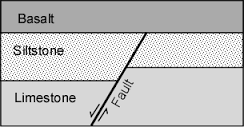
What are the relative ages of the features in order from oldest to youngest?
a)
Limestone, Basalt, Fault, Siltstone
b)
Siltstone, Fault, Basalt, Limestone
c)
Limestone, Fault, Basalt, Siltstone
d)
Limestone, Siltstone, Fault, Basalt
53.
Relative dating of rock layers tells us that the deeper we dig, _______.
a)
the younger the rocks get
b)
the smellier the rocks get
c)
the harder the rocks get
d)
the older the rocks get
54.
Which rock layer in the diagram seems to be the oldest?
a)
F
b)
E
c)
B
d)
A
55.
According to the law of superposition, which layer is the youngest?
a)
A
b)
B
c)
C
56.

What is the process where animals live or die based on their adaptations to their environment.

a)

Genetic Drift

b)

Natural Selection

c)

The Circle of Life

d)

Mammoth

57.

Which word describes the word "variation"?

a)

Adaptations

b)

Differences

c)

Traits

d)

Genetics

58.
Do organisms "decide" to evolve and change?
a)
Yes, they know they need to change to survive 
b)
No, they change because of natural selection
59.

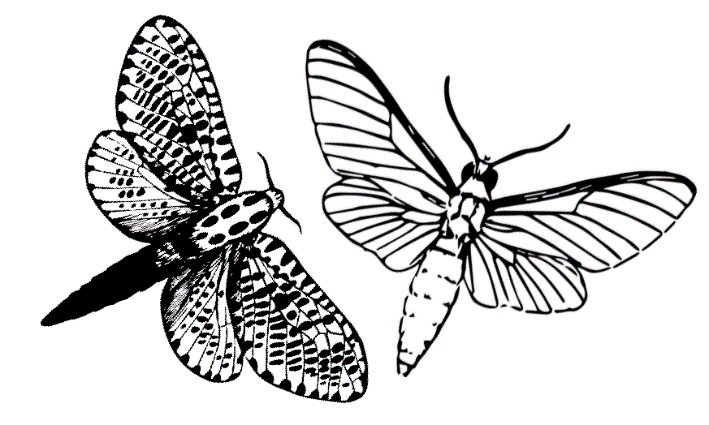
According to natural selection, light colored tree trunks would favor

a)

light colored moths

b)

dark colored moths

c)

red colored moths

d)

red and light colored moths

60.

What is the advantage of having different shaped beaks?

a)

To look different from other species.

b)

To protect itself against predators.

c)

To protect itself against prey

d)

To be able to eat the food readily available in the environment.

61.

Variations are caused by . . .

a)

Kaleidoscopes

b)

Variety Shows

c)

Mutations

d)

A change in phenotypic expression

62.
Why are advantageous traits more likely to be passed onto offspring?
a)
Because they are more likely to survive and reproduce.
b)
Because they come from dominant alleles.
c)
Because they come from recessive alleles.
d)
Because the trait is an acquired phenotype.
63.

What is the cell process called that produces identical cells?

a)

Mitosis

b)

Meiosis

c)

Photosynthesis

d)

Cellular Respiration

64.

Which results in offspring that are genetically unique and display a combination of traits from each parent?

a)

Sexual

b)

Asexual

c)

Neither

d)

Both

65.

A bee flies from one apple blossom to another and transfers pollen as it goes. Which type results from pollination?

a)

Sexual

b)

Asexual

c)

Neither

d)

Both

66.

Which type of reproduction results in offspring that are identical to the parent?

a)

Sexual

b)

Asexual

c)

Neither

d)

Both

67.

Which type of reproduction tends to be a longer process?

a)

Sexual

b)

Asexual

c)

They occur at the same rate

d)

Both are slow processes

68.

What is the cell process called that produces sex cells?

a)

Mitosis

b)

Meiosis

c)

Photosynthesis

d)

Cellular Respiration

69.
What is one disadvantage of sexual reproduction?
a)
Only one parent needed
b)
Off spring are exact copies of parents
c)
Happens very quickly
d)
Needs two parents
70.

can be easily wiped out by disease

a)

advantage of sexual reproduction

b)

advantage of asexual reproduction

c)

disadvantage of sexual reproduction

d)

disadvantage of asexual reproduction

71.

takes longer to reproduce offspring

a)

sexual reproduction advantage

b)

asexual reproduction advantage

c)

sexual reproduction disadvantage

d)

asexual reproduction disadvantage

72.

Allows for diversity and evolution of a species

a)

sexual reproduction advantage

b)

asexual reproduction advantage

73.

Meiosis ensures a constant amount of genetic material in future generations by reducing the number of chromosomes in the daughters cells to ________ that of a parent cell.

a)

1/3

b)

1/4

c)

1/2

74.

What is something that is similar between meiosis and mitosis?

a)

the type of daughter cells they make

b)

the amount of genetic material the resulting cells have

c)

the replication of DNA

d)

the location where these two types of cell division take place.

75.

What is the main purpose of meiosis?

a)

To create identical copies of cells

b)

To repair damaged DNA in cells

c)

To produce cells with double the number of chromosomes

d)

To produce gametes with half the number of chromosomes

76.

How many divisions occur in meiosis?

a)

5

b)

3

c)

2

d)

4

77.

What is the end result of meiosis?

a)

Four daughter cells with half the number of chromosomes

b)

Two daughter cells with the same number of chromosomes

c)

Eight daughter cells with double the number of chromosomes

d)

One daughter cell with the same number of chromosomes

78.

How many daughter cells are produced in mitosis?

a)

3

b)

4

c)

5

d)

2

79.

What is the role of mitosis in the body?

a)

Mitosis is involved in oxygen transport in the body.

b)

Mitosis is responsible for cell division and the production of new cells in the body.

c)

Mitosis is responsible for digestion in the body.

d)

Mitosis is related to nerve signaling in the body.

80.
How many chromosomes are in a normal human body cell?
a)
23
b)
46
c)
92
81.
How many chromosomes are in a human egg cell and passed down from a mother to her child?
a)
23
b)
46
c)
92
82.
Which is a heterozygous or hybrid genotype?
a)
Bb
b)
BB
c)
bb
83.
Which describes a genotype with two identical alleles for a trait, such as PP?
a)
heterozygous
b)
homozygous
84.
Which is a phenotype?
a)
Purple
b)
Pp
85.
Which of the following would show a dominate trait?
a)
B
b)
b
86.
Which of the following would show a recessive trait?
a)
B
b)
b
87.

Only takes 1 in a gene pair for a trait to show up

a)

recessive genes

b)

DNA

c)

offspring

d)

dominant genes

88.

A physical feature that you are born with

a)

acquired trait

b)

inherited trait

c)

instinct

d)

learned behavior

89.

Aa, DD, Bb, yy are all examples of _______

a)

genotypes

b)

phenotypes

90.
G = green, g = yellow
The genotype for a yellow plant is...
a)
GG
b)
Gg
c)
gg
d)
all of the choices result in yellow
91.
Which of the following genotypes is homozygous dominant?
a)
A
b)
Aa
c)
AA
d)
aa
92.
In a flowering plant species, red flower color (R) is dominant over white flower color (r). What is the genotype of any red-flowering plant resulting from this species?
a)
rr
b)
R
c)
RR
d)
RR or Rr
93.
How many alleles (letters) do each person carry for a trait?
a)
1
b)
2
c)
3
d)
4
94.
How many alleles (letters) does a child get from each parent for each trait?
a)
1
b)
2
c)
3
d)
4
95.
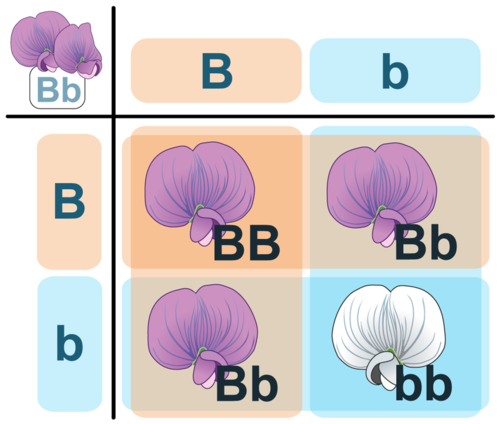
In this punnett square, which is the dominant trait?
The B stands for bud.
a)
purple flower bud
b)
white flower bud
c)
dominant
d)
recessive
96.
A dog gives birth to 5 puppies. What percentage of the chromosomes does each puppy share with the mother?
a)
25%
b)
50%
c)
75%
d)
100%
97.
this image is an example of
a)
codominance
b)
dominance
c)
incomplete dominance
98.

Which of the following seismic waves can travel through gases, liquids, and solids?

a)

P-wave

b)

S-wave

c)

both

d)

none