
 Worksheets
7th Grade Review #2
Total questions: 76
Worksheet time: 2hrs 46mins


The pictures below show a rainforest tree canopy on the left and a toucan that lives in this tree canopy on the right. Select three explanations for why this rain forest tree canopy best supports populations of toucans.
It has trees with fruits for food
It provides many places to nest and reproduce
It has a lot of sunlight to stay warm
It has tall plants to stay above ground predators

The picture shows where oranges are grown in the United States. Oranges require a very long growing season with mild to hot weather.What is the most likely reason many of the oranges are grown in California?
There are more organisms that eat oranges in California than in any other states.
California has a climate that creates a good environment for growing oranges.
Oranges will only grow in states on the coast with environments near water.
Oranges will only grow in sandy soil that few of the other states have.

This picture shows a desert environment, which is home to many lizards, small mammals, and cacti and other plants with short roots. This environment allows some plants and animals to live there because the soil in the desert is
dry and hard, allowing small animals to lay on the hard soil to get sunlight while allowing plants with short roots to sit on top of the soil and hold onto water.
dry and sandy, allowing small animals to burrow and hide from the Sun while allowing plants with short roots to reach and hold onto water.
wet and hard, allowing small animals to rest and stay cool on the wet soil while allowing plants with short root systems to push through the hard soil to soak up water.
cold and wet, allowing small animals to remain cool when it rains while allowing plants with short root systems to easily push through sandy soil to soak up water

The picture below shows a scoop of soil that a student dug up from her school yard. How does the soil environment support the earthworm in the student's hands?
It is moist and cool with decaying debris
It gets a lot of sunlight so the earthworm can see
It has excessive oxygen for the earthworm to breath
It has clay for the earthworm to form holding tunnels
Tropical rain forests have the greatest biodiversity of any type of land ecosystem. How does biodiversity contribute to the sustainability of an ecosystem?
All of the above
The presence of a variety of herbivore species that can feed on a large number of different producer species helps ensure abundant prey for predators in the ecosystem.
Greater genetic variation within species makes it more likely that some individuals will survive a disease outbreak.
The presence of more species with different adaptations makes it more likely that some organisms will survive an ecological disaster.
When an ecosystem contains many different species, there are usually a high number of links in its food web. How does this affect the sustainability of the ecosystem?
Typically, if one link in the food web is removed, the ecosystem will no longer exist.
Typically, if one link in the food web is added, the ecosystem will destabilize.
Typically, if one link in the food web is removed, the ecosystem will remain stable.
Typically, if one link in the food web is added, the ecosystem will change its location.
An ecosystem's sustainability is most dependent on?
warm temperatures.
the amount of water there.
having a large number of a single plant species.
the number and variety of organisms that live there.

Which ecosystem would most likely survive if the grasses were destroyed by a plant virus?
Ecosystem 2, because there are not many predators.
Ecosystem 2, because the grasses could grow back quickly.
Ecosystem 1, because there is a variety of producers that support the ecosystem
Ecosystem 1, because there are fewer primary consumers.
Both primary and secondary succession begin with pioneer species that
use up all the existing resources and prevent establishment of non-native organisms
modify the area and allow larger and more complex organisms to appear
change the area and make it safer from predatory organisms
invade the area so that new organisms cannot be established
Frederick is studying how ecological succession will change a freshly-plowed piece of land. Which data table represents what Frederick is most likely to record about the plant life in each stage of ecological succession?


After pioneer plants begin their role in the process of ecological succession, what are the least likely organisms to follow? Select three correct answers.
Trees
Moss
Shrubs
Weeds
Biodiversity can include genetic diversity within a population or variation of populations within an ecosystem. Given this information, which of the following is likely to have the most biodiversity?
a tropical forest
an arctic tundra
a deciduous forest
a residential backyard
Which of these explains why an ecosystem is healthy when it has a variety of species?
An increased number of species allows for fewer food chains.
A larger number of species reduces competition for abiotic resources.
A larger number of species allows for greater diversity in interdependence.
An increased number of species contributes to greater chances for adaptability.
After a forest fire, which type of organisms will begin secondary succession?
small shrubs
mature oaks
evergreens
wildflowers
A student kept a notebook during an investigation. Which recorded observation
was most likely a physical change?
The solution was heated for two minutes until it boiled.
A solid formed when two liquids were mixed together.
Two solutions were mixed and the resulting solution felt hot.
The color of two mixed solutions changed from clear to white.
A rock has most likely traveled a long distance from its place of origin if it is
very small.
partially faded.
rounded and smooth.
rough and dense.
A certain species of endangered parrots lives on an island that can be seriously affected by large floods. Which of these is considered a negative impact to the parrot population from flooding?
a decrease in the availability of food
a decrease in populations of predators
an increase in suitable nesting locations
an increase in places to hide from danger

According to the Environmental Protection Agency, water is unsafe to drink if nitrate concentrations are above 10 parts per million (ppm). Science students at Concord High tested the water for nitrates in eight private wells. Their results are shown below.
Given the EPA standard, how many of these wells have water that is unsafe to drink?
2
3
4
6
Increased human populations can lead to the depletion of locally available resources within communities. Compared to other communities, which of these locally available resources is most likely to be depleted in desert communities?
mineral
oxygen
gasoline
water
Which gas makes up the greatest percentage of Earth’s atmosphere?
argon
nitrous oxide
nitrogen
carbon dioxide
Scientists noted that muscles and bones would need physical stress to remain healthy during manned space flights. Which of these had to be planned for because of this need?
practicing space walking
counseling activities for tension
exercising to maintain strength
monitoring circadian rhythms

The diagram below shows a cross section of land. Numbers show four zones in this diagram.
Which set of labels below accurately identifies the zones that are shown?
1—groundwater zone; 2—unsaturated zone; 3—water table; 4—surface water
1—unsaturated zone; 2—surface water; 3—groundwater zone; 4—water table
1—water table; 2—surface water; 3—groundwater zone; 4—unsaturated zone
1—unsaturated zone; 2—groundwater zone; 3—water table; 4—surface water
Deer are introduced into a grassland ecosystem and their population increases considerably. If the deer population continues to grow, which is the most likely outcome for the ecosystem?
Biodiversity would decrease, and sustainability would increase.
Biodiversity would increase, and sustainability would increase.
Biodiversity would increase, and sustainability would decrease.
Biodiversity would decrease, and sustainability would decrease.
Which of these conditions is most responsible for Earth having an environment that supports life?
oceans regulating climate on land
the percentage of nitrogen in the atmosphere
water that exists in all three physical states of matter
erupting volcanoes moderating atmospheric temperatures
Which of these natural disasters are the most difficult to predict?
earthquakes
hurricanes
tornados
blizzards
Which of these is the best example of physical weathering?
ice fracturing a stone
insects eating a dead tree
a bulldozer pushing soil
acid rain dissolving limestone
As humans travel in space, which gas is provided in the atmosphere of the
spacecraft and which gas is removed from the atmosphere of the spacecraft?
Carbon dioxide is provided. Oxygen is removed.
Carbon dioxide is provided. Nitrogen is removed.
Oxygen is provided. Nitrogen is removed.
Oxygen is provided. Carbon dioxide is removed.
When frozen carbon dioxide is heated, it changes directly into a gas.
Which statement best indicates that a physical change has taken place?
Heat caused an increase in gas production.
Heat caused a new substance to form.
Heat caused a decrease in energy.
Heat caused a change in state.
After which event will primary succession most likely occur?
thunderstorm
crop harvest
volcanic eruption
urban development

Which properties are most important to sustaining life on Earth?
1 and 2
2 and 3
3 and 4
4 and 5
The outer layers of astronauts’ space suits are reflective in order to protect them from
the vacuum of space.
intense sunlight.
micrometeoroids.
water loss.
Photosynthesis is a process converting _______ energy to ______.
chemical; mechanical
thermal; chemical
radiant; chemical
chemical; thermal
Radiant energy used in photosynthesis is captured by the
leaves
chlorophyll
roots
cytoplasm
Plants utilize ____________ given off by humans to assist in making glucose.
oxygen
water
carbon dioxide
nitrogen

Which of these equations does the diagram support?
Oxygen + Water + Sunlight = Carbon dioxide + Glucose
Glucose + Water + Sunlight = Carbon dioxide + Oxygen
Water + Carbon dioxide + Sunlight = Glucose + Oxygen
Carbon dioxide + Glucose = Sunlight + Water + Oxygen



The glucose produced in the leaf can be described as –
potential chemical energy
kinetic nuclear energy
potential nuclear energy
kinetic chemical energy
Photosynthesis is a process converting _______ energy to ______ energy.
radiant to chemical
thermal to radiant
mechanical to chemical
chemical to mechanical
Plants take in radiant energy from the sun and convert it to ______ which is food for the plant.
hydrogen
water
carbon dioxide
glucose
Sheila eats a sandwich and then rides her skateboard. Which type of energy transformation is occurring?
chemical to thermal to mechanical
mechanical to thermal to chemical
radiant to chemical to thermal
none of the above
When looking at energy pyramids, only _____ of the energy is passed from one tropic level to the next. This is because organisms uses 90% of the energy for mechanical and thermal energy.
10%
50%
1%
none of the above
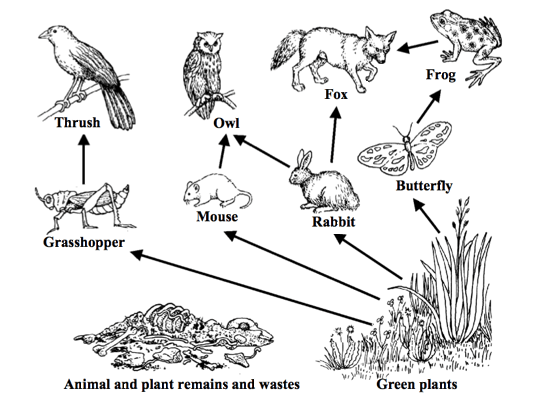
What do the arrows in a food chain or food web indicate?
The loss of energy in the chain or web.
The importance of organisms in the chain or web.
The flow of energy in the chain or web.
None of the above

In the energy pyramid, each level receives 100% of the energy from the level below it.
True
False


Experiment: Two items are dropped (Construction paper and normal paper) from 5 feet in the air. You use a stop watch to see how long it takes each to hit the ground. Select all that are true or correct
If I drop construction paper and normal paper at the same time, then construction paper will hit the ground first.
The control group is the type of paper.
The MIX is the type of paper.
The MIX is the time it takes each to hit the ground.
The control group is how high the paper the is dropped.
Experiment: Will a tennis ball or a ping pong ball travel farther on carpet after going down a 12" ramp?
Choose all true or correct answers.
If a ball travels the farthest, then it will be the ping pong ball
The carpet is a control in this experiment.
If a tennis ball and ping pong ball travel on carpet, then the ping pong ball will travel the furthest.
If a tennis ball and ping pong ball travel on carpet, then the tennis ball will travel the furthest.
The variable that you change for the experiment.
manipulated
responding
controlled
data
Information collected during an experiment.
variable
purpose
controlled variable
data
List the steps in ORDER FROM START TO END!!!!!!!!!!!
Observation, hypothesis, test, retest (with results), results, conclusion, question.
Observation, Question, Hypothesis, Test, Results, Retest (with results), Conclusion.
Test, Retest (with results), Results, Question, Observation, Hypothesis, Conclusion.
The number of protons in the nucleus of an atom is known as the ________. atomic
subatomic hadron particle
atomic number
nucleon
neutron factor
These have the same number of protons in each atom but the neutron numbers can vary
elements
isotopes
atomic numbers
subatomic hadron particles
A substance that consists of a single type of atom is _________.
a chemical element
an element
a nuclei
an isotope
This is a particle that carries a negative electrical charge.
ion
electron
proton
neutron
This is a particle that carries a positive electrical charge.
Neuron
Ion
Proton
Electron

A school held a fundraiser for their recycling program. Three teams (baseball, soccer, and volleyball) and three clubs (science, math, and ecology) collected money. The results of the fundraiser are shown in the bar graph. Which is greater, the percent of money collected by teams by the baseball team or the percent of money collected by clubs by the science club?
science club
volleyball team
baseball team

The bar graph shows a company's income and expenses over the last 5 years.
Which statement is supported by the information in the graph?
Expenses have increases $200,000 each year over the last 5 years.
The income in Year 5 was twice the income in Year 1.
The combined income in Years 1, 2, and 3 are equal to the combined expenses in Years 1, 2, and 3.
The combined expenses in Years 3 and 4 were $300,000 more than combined income in Years 3 and 4.

The graph shows the favorite colors chosen by some middle school students.
Which statement is supported by the information in the graph? Select all that apply.
Fewer than 30% of students chose red, yellow, or orange as
their favorite color.
Less than 1/10 choose pink as their favorite color.
More than half of the students chose Black, Red, Blue, and
Orange as their favorite color.
Exactly ⅖ of the students chose green, black, or purple as
their favorite color.
Exactly 18% of the students chose blue as their favorite
color.

Maribel surveyed 55 people to find out their favorite types of music. The results are shown in the bar graph below.
Based on the information in the graph, which types of music were chosen by the 40% of the people surveyed?
Country and opera
Jazz and opera
Jazz, opera, and rock
Country, jazz, and rock

Based on the circle graph, if 45 girls played basketball, how many girls are there total in athletics?
150
100
70

Based on a recent survey of 500 students, the circle graph below shows how students communicate
with friends.
How many more students chose social media apps than phone calls to communicate with friends?
36 students
12 students
180 students
300 students

