wayground logo

Free Printable Worksheets

Font size

S
M
L
XL
Worksheets

rocks

Total questions: 124

Worksheet time: 1hrs 9mins

Name
Class
Date
1.

what is igneous rock?

a)
Igneous rock is formed through the cooling and solidification of wind.
b)
Igneous rock is formed through the cooling and solidification of water.
c)
Igneous rock is formed through the cooling and solidification of plants.
d)
Igneous rock is formed through the cooling and solidification of magma or lava.
2.

how can you identify igneous rock

a)
By smelling the rock to identify its origin
b)
By tasting the rock to determine its composition
c)
By observing the crystalline texture and visible mineral grains in the rock.
d)
By listening to the rock's sound when struck with a hammer
3.

what is sedimentary rock?

a)
Sedimentary rock is a type of rock that forms from the accumulation of sediment over time and through the process of lithification.
b)
Sedimentary rock is formed by volcanic activity.
c)
Sedimentary rock is a type of metamorphic rock.
d)
Sedimentary rock is created through the process of evaporation.
4.

what are the features of metamorphic rock?

a)
Foliation, recrystallization of minerals, presence of new minerals
b)
Formation from sedimentary rocks
c)
Absence of new minerals
d)
Lack of mineral recrystallization
5.

what are the features of sedimentary rock?

a)
Always have a smooth texture
b)
Do not contain any minerals
c)
Formed through volcanic activity
d)
Formed through deposition and solidification of sediment, contain fossils, exhibit layers, and can be classified into clastic, chemical, and organic types.
6.

how is metamorphic rock formed?

a)
Metamorphic rocks are formed by sedimentation and compaction
b)
Metamorphic rocks are formed by erosion and weathering
c)
Metamorphic rocks are formed through volcanic eruptions
d)
Metamorphic rocks are formed through the process of metamorphism, which involves the alteration of existing rock types due to high pressure, high temperature, or chemically active fluids.
7.

what is chalk?

a)
Chalk is a soft, white, porous sedimentary carbonate rock.
b)
Chalk is a type of fruit
c)
Chalk is a type of fabric
d)
Chalk is a type of metal
8.

where do you find igneous rock?

a)
On mountain peaks
b)
In underground caves
c)
Areas with volcanic activity
d)
In the ocean
9.

where do you find sedimentary rock?

a)
Near bodies of water where layers of sediment accumulate over time and solidify.
b)
In the desert where there is no water
c)
In underground caves far from any water source
d)
On mountain peaks where sediment cannot accumulate
10.

where can you find metamorphic rock?

a)
In the ocean
b)
On mountain peaks
c)
In the Earth's mantle
d)
Deep within the Earth's crust or at the surface in areas of tectonic plate collision
11.

what is dolerite?

a)
Dolerite is a type of igneous rock.
b)
Dolerite is a type of metamorphic rock.
c)
Dolerite is a type of volcanic rock.
d)
Dolerite is a type of sedimentary rock.
12.

what is flint?

a)
Flint is a type of fish.
b)
Flint is a soft, fluffy material.
c)
Flint is a hard, sedimentary cryptocrystalline form of the mineral quartz.
d)
Flint is a type of fruit.
13.

where do you find flint?

a)
Volcanic rocks
b)
Desert sands
c)
Mountain peaks
d)
Sedimentary rocks, gravel deposits, riverbeds
14.

where do you find dolerite?

a)
Volcanic pipes
b)
Granite
c)
Marble
d)
Dikes and sills
15.

what does the term 'weathering' mean?

a)
The term 'weathering' means the process of building up rocks, soil, and minerals.
b)
The term 'weathering' means the process of freezing rocks, soil, and minerals.
c)
The term 'weathering' means the process of heating up rocks, soil, and minerals.
d)
The term 'weathering' means the process of breaking down rocks, soil, and minerals.
16.

what does erosion mean?

a)
Erosion means the growth of rocks and soil
b)
Erosion means the creation of rocks and soil
c)
Erosion means the preservation of rocks and soil
d)
Erosion means the wearing away of rocks and soil by natural forces.
17.

what is a volcanic plug?

a)
A volcanic plug is a type of musical instrument used in volcanic rituals.
b)
A volcanic plug is a type of volcanic rock used in construction.
c)
A volcanic plug is a type of volcanic eruption caused by underground pressure.
d)
A volcanic plug is a solidified magma core left behind after erosion.
18.

how is a cave formed?

a)
Caves are formed through erosion and dissolution of soluble rocks by water.
b)
Caves are formed by wind erosion.
c)
Caves are formed by meteor impacts.
d)
Caves are formed by volcanic activity.
19.

what is the structure of the Earth?

a)
The structure of the Earth consists of the inner core, outer core, and atmosphere.
b)
The structure of the Earth consists of the inner core, outer core, and lithosphere.
c)
The structure of the Earth consists of the inner core, outer core, mantle, and crust.
d)
The structure of the Earth consists of the inner core, outer core, and crust.
20.

describe the Earth's crust

a)
The Earth's crust is made of liquid magma
b)
The Earth's crust is composed of gases
c)
The Earth's crust is a hollow shell
d)
The Earth's crust is the outermost layer of the Earth, consisting of solid rock.
21.

what is the thinnest part of the Earth's crust?

a)
Mantle
b)
Continental crust
c)
Outer core
d)
Oceanic crust
22.

how thick is the Earth's crust?

a)
The Earth's crust is about 10 km thick under the continents
b)
The Earth's crust is about 35 km (22 miles) thick under the continents and about 7 km (4 miles) thick under the oceans.
c)
The Earth's crust is about 50 km thick under the oceans
d)
The Earth's crust is about 100 km thick under the continents
23.

what are the thickest part of the Earth's crust?

a)
oceanic crust
b)
mantle
c)
outer core
d)
continental crust
24.

what is the thickest part of the Earth's crust?

a)

Himalayas (continental crust) 75km

b)
mantle
c)
outer core
d)
oceanic crust
25.

what is the Earth's mantle?

a)
A layer of gas that protects the Earth from harmful radiation.
b)
The outermost layer of the Earth composed of water and ice.
c)
A layer of solid rock beneath the Earth's crust and above the Earth's core.
d)
A layer of liquid metal surrounding the Earth's core.
26.

what does the Earth's mantle look like?

a)
The Earth's mantle is made of ice and snow.
b)
The Earth's mantle is a layer of liquid magma.
c)
The Earth's mantle is a layer of pure gold.
d)

The Earth's mantle is a layer of solid rock which flows, composed of silicate minerals rich in iron and magnesium. (sticky liquid)

27.

The convection of heat from the centre of Earth drives the movement of...

a)
volcanic eruptions
b)
ocean currents
c)
tectonic plates
d)
magnetic fields
28.

what causes earthquakes?

a)
Tectonic plate movements
b)
Global warming
c)
Alien invasions
d)
Volcanic eruptions
29.

how are mountains formed?

a)
Mountains are formed through tectonic plate movements, volcanic activity, and erosion over millions of years.
b)
Mountains are formed by meteor impacts
c)
Mountains are formed by underground explosions
d)
Mountains are formed by giant creatures burrowing underground
30.

how thick is the Earth's mantle?

a)
4,500 kilometers (2,800 miles)
b)
2,900 kilometers (1,800 miles)
c)
3,200 kilometers (2,000 miles)
d)
1,500 kilometers (930 miles)
31.

what is the Earth's mantle made of?

a)
Gaseous substance composed of silicate minerals rich in iron and magnesium
b)

semi-molton rock called magma

c)
Solid rock composed of carbonate minerals
d)
Liquid metal composed of silicate minerals rich in iron and magnesium
32.

what is a viscous liquid?

a)
A viscous liquid is a substance that has a thin, watery consistency.
b)
A viscous liquid is a substance that is highly volatile and evaporates quickly.
c)
A viscous liquid is a substance that is solid at room temperature.
d)
A viscous liquid is a substance that has a thick, sticky consistency between a solid and a liquid.
33.

what is the outer core?

a)
The outer core is a layer of solid rock.
b)
The outer core is composed of water and ice.
c)
The outer core is a layer of molten iron and nickel.
d)
The outer core is a layer of gas.
34.

the Earth's core is?

a)
Gold and silver
b)
Platinum and palladium
c)

solid Iron and nickel

d)
Aluminum and copper
35.

why is the Earth's inner core solid?

a)
The Earth's inner core is solid due to immense pressure.
b)
The Earth's inner core is solid due to high levels of oxygen.
c)
The Earth's inner core is solid due to lack of gravity.
d)
The Earth's inner core is solid due to low temperature.
36.

what temperature is the inner core?

a)
5,700°C to 6,000°C
b)
6,500°C to 7,000°C
c)
3,000°C to 3,500°C
d)
4,800°C to 5,200°C
37.

Draw a representation of the structure of Earth with lables

38.

what is geology?

a)
Geology is the study of cooking techniques.
b)
Geology is the study of the Earth's physical structure, history, and processes that have shaped it over time.
c)
Geology is the study of ancient languages.
d)
Geology is the study of stars and galaxies.
39.

what is a rock?

a)
A rock is a type of bird
b)
A rock is a type of fish
c)
A rock is a type of tree
d)
A rock is a naturally occurring solid aggregate of one or more minerals or mineraloids.
40.

where does the word igneous come from?

a)
Greek word 'igneous'
b)
French word 'igné'
c)

Latin word 'ignis' meaning fire

d)
Spanish word 'igneo'
41.

what two groups of igneous rocks are there?

a)
Sedimentary rocks and metamorphic rocks
b)
Volcanic rocks and plutonic rocks
c)
Granite rocks and basalt rocks
d)
Intrusive rocks and extrusive rocks
42.

what is the difference between intrusive and extrusive rocks?

a)
The color of the rocks
b)
The weight of the rocks
c)
The main difference is in where they form and the cooling rate, resulting in different crystal sizes and textures.
d)
The sound the rocks make when tapped
43.

which kind of rocks form below the ground from magma?

a)

intrusive Volcanic rocks

b)

extrusive Metamorphic rocks

c)

extrusive Sedimentary rocks

d)

intrusive Igneous rocks

44.

which rocks form above the ground from lava

a)

intrusive Volcanic rocks

b)

instrusive Metamorphic rocks

c)

extrusive Sedimentary rocks

d)

extrusive Igneous rocks

45.

what does intrusive mean

a)
Causing disruption or annoyance by being unwelcome or uninvited.
b)
Being polite and considerate
c)
Causing joy and happiness
d)
Having a positive impact
46.

what does extrusive mean?

a)
Sedimentary rocks formed from magma cooling slowly beneath the Earth's surface
b)
Metamorphic rocks formed from the weathering and erosion of existing rocks
c)
Minerals that are found deep within the Earth's mantle
d)
Igneous rocks formed from lava cooling quickly on the Earth's surface
47.

do intrusive igneous rocks have large or small crystal grains?

a)
large
b)
tiny
c)
smooth
d)
medium
48.

do extrusive igneous rocks have small or large crystal grains?

a)
small
b)
rough
c)
transparent
d)
medium
49.

why do intrusive igneous rocks have large crystals

a)
They are exposed to high pressure.
b)
They are formed from sedimentary rocks.
c)
They cool slowly beneath the Earth's surface.
d)
They cool quickly beneath the Earth's surface.
50.

why do extrusive ingeous rocks have small crystal gains?

a)
Extrusive igneous rocks have small crystal grains due to slow cooling.
b)
Extrusive igneous rocks have small crystal grains due to lack of minerals.
c)
Extrusive igneous rocks have small crystal grains due to high pressure.
d)
Extrusive igneous rocks have small crystal grains due to rapid cooling.
51.

features of basalt

a)
Light-colored, high silica content, low in iron and magnesium
b)
Coarse-grained, contains minerals like quartz and feldspar
c)
Commonly found in continental crust and mountain ranges
d)
Dark-colored, low silica content, high in iron and magnesium, fine-grained, contains minerals like olivine and pyroxene, commonly found in oceanic crust and volcanic islands
52.

which kinds of rocks are intrusive

a)

Granite, periodite and obsidian

b)
Marble
c)
Sandstone
d)
Basalt
53.

which kinds of rocks are extrusive?

a)

Basalt

b)
Slate and marble
c)
Sandstone and limestone
d)
Granite and obsidian
54.

what are the features of granite

a)
Granite is commonly used in clothing manufacturing
b)

Features of granite include durability, hardness, composition of pink quartz, speckled grey, black and pink

c)
Granite features softness and flexibility
d)
Granite is known for its transparency and fragility
55.

what are the features of periodite?

a)
Green, coarse-grained, composed mainly of gypsum and halite minerals
b)
Red, medium-grained, composed mainly of calcite and dolomite minerals
c)

Dark, coarse-grained, composed mainly of olivine and high in silicia

d)
Light, fine-grained, composed mainly of quartz and feldspar minerals
56.

what are the features of obsidian ?

a)
Green color, brittle texture, used in cooking
b)

Black color, dense, smooth glassy texture, sharp edges, used in making tools and weapons

c)
White color, soft texture, used in construction
d)
Red color, rough texture, used in jewelry making
57.

what are sedimentary rocks?

a)
Sedimentary rocks are rocks formed by metamorphism.
b)

Sedimentary rocks are rocks formed from ore-existing rocks or pieces of once-living organisms

c)
Sedimentary rocks are rocks formed by volcanic activity.
d)
Sedimentary rocks are rocks formed by crystallization of magma.
58.

sedimentary rocks often have...

a)
sharp edges
b)
volcanic origin
c)

distinct layers or bedding

d)
smooth surface
59.

what turns sediments into solid rock

a)
Petrification
b)
Fossilization
c)

Lithification

d)
Mineralization
60.

what are the steps to make sedimentary rocks

a)
Sublimation, deposition, and lithification
b)
Melting, crystallization, solidification, and lithification
c)
Evaporation, condensation, and precipitation
d)
Weathering, erosion, deposition, compaction, and cementation
61.

how are fossils formed

a)
Fossils are formed when organisms are launched into space
b)
Fossils are formed when organisms are cryogenically frozen
c)
Fossils are formed when a dead organism is buried in sediment, which eventually hardens into rock. Over time, the organic material decays and minerals replace the bone or tissue, creating a fossil.
d)
Fossils are formed when organisms turn into ghosts
62.

how can sedimentary layers help us determine the age of fossils?

a)
By counting the number of layers above the fossil
b)
By observing the position of fossils in relation to the sedimentary layers, we can infer their relative ages.
c)
By measuring the temperature of the layers
d)
By analyzing the color of the layers
63.

where does the word metamorphic come from ?

a)
German words 'meta' meaning 'around' and 'morph' meaning 'composition'
b)
French words 'meta' meaning 'after' and 'morph' meaning 'structure'
c)
Latin words 'meta' meaning 'beyond' and 'morph' meaning 'shape'
d)
Greek words 'meta' meaning 'change' and 'morph' meaning 'form'
64.

What rocks can change to become metamorphic rocks?

a)
Sedimentary rocks and igneous rocks
b)
Sedimentary rocks and sedimentary rocks
c)
Metamorphic rocks and sedimentary rocks
d)
Igneous rocks and sedimentary rocks
65.

what are metamorphic rocks?

a)
Metamorphic rocks are rocks that have been changed by wind erosion.
b)
Metamorphic rocks are rocks that have been changed by heat, pressure, or chemical processes.
c)
Metamorphic rocks are rocks that have been changed by volcanic activity.
d)
Metamorphic rocks are rocks that have been changed by sedimentation.
66.

what occurs in the Earth to change rocks to metamorphic

a)

High heat (but not too much to melt the rock); pressure from overlying rock layers, rock may be flattened or bent or atoms exchanged to form new minerals

b)
Only chemically inactive fluids
c)
No change occurs
d)
Low heat and pressure
67.

granite can change to ....

a)
gneiss
b)
slate
c)
marble
d)
quartzite
68.

limestone can change to....

a)
granite
b)
sandstone
c)
quartzite
d)
marble
69.

sandstone turns to...

a)
quartzite
b)
slate
c)
marble
d)
granite
70.

clay turns to....

a)
ceramics
b)
mud
c)
glass
d)

schist or slate

71.

shale turns to...

a)
sandstone
b)
slate
c)
marble
d)
granite
72.

Heat and ____________ can change sedimentary rock into metamorphic rock.

a)

Pressure

b)

Melting

c)

Coolig

73.

Igneous rocks form from the __________ of magma or lava.

a)

Pressure

b)

Cooling

c)

Heat

74.

Which type of rock often contains fossils and how do you think this occurs?

a)

Sedimentary rocks

b)

Metamorphic

c)

Igneous

75.
Each rock type can follow only one pathway of the rock cycle.
a)
True
b)
False
76.

LABEL THE TYPE OF ROCK MARKED BY THE RED X IN THE DIAGRAM

a)

sedimentary

b)

igneous intrusive

c)

metamorphic

d)

igneous extrusive

77.

LABEL THE TYPE OF ROCK MARKED BY THE RED X IN THE DIAGRAM

a)

sedimentary

b)

igneous intrusive

c)

metamorphic

d)

igneous extrusive

78.

LABEL THE TYPE OF ROCK MARKED BY THE RED X IN THE DIAGRAM

a)

sedimentary

b)

igneous intrusive

c)

metamorphic

d)

igneous extrusive

79.

LABEL THE TYPE OF ROCK MARKED BY THE RED X IN THE DIAGRAM

a)

sedimentary

b)

igneous intrusive

c)

metamorphic

d)

igneous extrusive

80.

LABEL THE TYPE OF ROCK MARKED BY THE RED X IN THE DIAGRAM

a)

sedimentary

b)

igneous intrusive

c)

metamorphic

d)

igneous extrusive

81.

What type of rock would these examples be: granite, obsidian, and pumice.

a)

igneous

b)

metamorphic

c)

sedimentary

d)

deposition

82.

What type of rock would these examples be: gneiss, marble, schist, and slate

a)

igneous

b)

metamorphic

c)

sedimentary

d)

deposition

83.

When rocks on Earth's surface are broken down into smaller rocks and stay in the same area.

a)

deposition

b)

erosion

c)

frozen water

d)

weathering

84.

When sediments or rocks are moved from one place to another

a)

deposition

b)

erosion

c)

frozen water

d)

weathering

85.

This type of rock forms from sediments, or particles, of sand, shells, pebbles, and other fragments; it is fairly soft and may break easily; it can contain fossils.

a)

sedimentary

b)

igneous

c)

metamorphic

86.

Which of the following would be the correct label for Letter D?

a)

Sediments

b)

Weathering and Erosion

c)

Metamorphic Rocks

d)

Sedimentary Rocks

87.

Which of the following would be the correct label for Letter A?

a)

Sediments

b)

Weathering and Erosion

c)

Metamorphic Rocks

d)

Sedimentary Rocks

88.

Which of the following would be the correct label for Letter C?

a)

Sediments

b)

Weathering and Erosion

c)

Metamorphic Rocks

d)

Sedimentary Rocks

89.

Which of the following would be the correct label for Letter B?

a)

Sediments

b)

Weathering and Erosion

c)

Metamorphic Rocks

d)

Sedimentary Rocks

90.

Which of the following would be the correct label for Letter C?

a)

Sediments

b)

Weathering and Erosion

c)

Metamorphic Rocks

d)

Sedimentary Rocks

91.

What is the SOURCE of energy drives the changes in matter going from C to D?

a)

The Sun

b)

The Earth's Hot Interior

c)

Coffee

d)

Wind and Water

92.

What is the SOURCE of energy drives the changes in matter going from B to A?

a)

The Sun

b)

The Earth's Hot Interior

c)

Coffee

d)

Wind and Water

93.

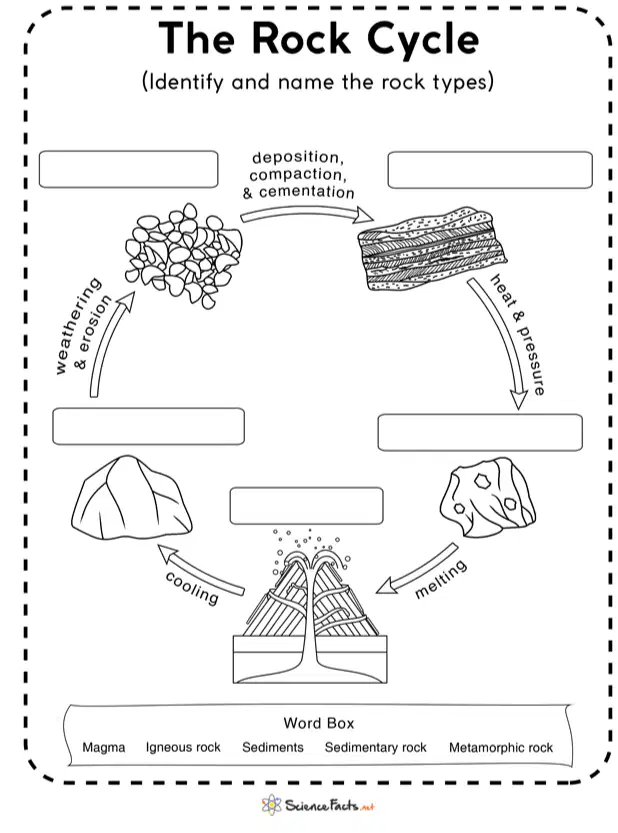
label the rock cycle

94.

what are the 4 main processes of coastal erosion?

a)
friction, erosion, dissolution, and compaction
b)
infiltration, dissolution, corrosion, and weathering
c)

hydraulic action, abrasion, attrition, and corrosion

d)
corrosion, deposition, weathering, and sedimentation
95.

what is abrasion?

a)
Abrasion is the process of heating a surface
b)
Abrasion is the process of polishing a surface
c)
Abrasion is the process of painting a surface
d)

Abrasion is the process of scraping or wearing away a surface through friction. (waves through pebbles at cliffs)

96.

what is hydraulic action?

a)
The movement of sediment downstream due to the force of gravity
b)
The force of flowing water wearing away the bed and banks of a river or stream.
c)
The process of water seeping into cracks in rocks and freezing, causing the rock to break apart
d)
The erosion of soil caused by wind
97.

what is attrition erosion?

a)

Attrition erosion is the process of wearing down rock particles by friction during movement between two or more rocks eg. rocks in ocean knock together to make smooth pebbles

b)
Attrition erosion is caused by earthquakes.
c)
Attrition erosion is the result of volcanic activity.
d)
Attrition erosion is the process of chemical weathering.
98.

what is corrosion erosion?

a)
Corrosion erosion is the process of material strengthening due to chemical reactions.
b)
Corrosion erosion is the result of mechanical wear and tear on materials.
c)
Corrosion erosion is the enhancement of material properties through exposure to the environment.
d)

Corrosion erosion is the degradation of material due to chemical reactions with the environment (weak acids in the sea)

99.

what causes weathering?

a)
Weathering is caused by volcanic eruptions
b)
Weathering is caused by cosmic radiation
c)
Weathering is caused by magnetic fields
d)

Various factors such as wind, water, temperature, bacteria, atmospheric gases, ice, plants, and animals breaking down rocks into smaller pieces.

100.

what are the 3 types of weathering?

a)
Physical weathering, chemical weathering, and atmospheric weathering.
b)
Biological weathering, erosion weathering, and mechanical weathering.
c)
Chemical weathering, physical weathering, and thermal weathering.
d)

physical, chemical and biological

101.

what is physical weathering?

a)
Physical weathering is the process of rocks turning into liquid form due to high temperatures.
b)

Physical weathering is the process of rocks being stressed by wind, rain and sunshine

c)
Physical weathering is the process of rocks growing in size without any external factors.
d)
Physical weathering is the process of rocks changing their chemical composition without breaking down into smaller pieces.
102.

how can the process of freeze-thaw break down rock?

a)
Freeze-thaw cycle causes water to expand and contract in rock cracks, leading to mechanical weathering.
b)
Freeze-thaw cycle attracts animals that break down rocks
c)
Freeze-thaw cycle creates a protective layer on rocks
d)
Freeze-thaw cycle causes rocks to melt and evaporate
103.

what is chemical weathering?

a)

Chemical weathering is the process by which rocks are broken down by weak acids in rain or sea water which weakens rocks and speeds up disintegration.

b)
Chemical weathering is the process of physical erosion of rocks.
c)
Chemical weathering is caused by excessive rainfall.
d)
Chemical weathering is the result of volcanic activity.
104.

what are the chemical processes called in chemical weathering?

a)
evaporation
b)
sublimation
c)
condensation
d)

dissolution, oxidation, and hydration

105.

what type of rock is most impacted with chemical weathering?

a)
Volcanic rocks
b)
Metamorphic rocks
c)
Igneous rocks
d)

limestone and chalk

106.

what is biological weathering?

a)
Biological weathering is the process by which living organisms contribute to the breakdown of rocks and minerals.
b)
Biological weathering is the process of changing the weather forecast based on plant growth.
c)
Biological weathering is the study of animal behavior in different climates.
d)
Biological weathering is the process of creating new weather patterns through genetic modification.
107.

some examples of biological weathering are....

a)
Volcanic eruptions causing rock fragmentation
b)

Tree roots growing into cracks in rocks, lichens secreting acids, burrowing animals breaking apart rocks, humans trampling over well-worn paths

c)
Chemical reactions between rocks and water
d)
Wind erosion breaking down rocks
108.

list the coastal landforms

a)

cliff, cave, arch, headland, stack, stump,

b)
reefs
c)
plateaus
d)
canyons
109.

what is a volcano?

a)
A volcano is a rupture in the crust of a planetary-mass object that allows hot lava, volcanic ash, and gases to escape from a magma chamber below the surface.
b)
A volcano is a type of cloud formation
c)
A volcano is a man-made structure
d)
A volcano is a type of tree
110.

what happens when a volcano erupts?

a)
It releases magma, ash, and gases due to pressure buildup.
b)
It causes the temperature to drop significantly
c)
It creates a rainbow effect in the sky
d)
It leads to an increase in plant growth
111.

how long do volcanoes erupt for?

a)
Volcanic eruptions can last for centuries.
b)
Volcanic eruptions typically last for a few seconds.
c)
Volcanic eruptions usually last for a few days.
d)
Volcanic eruptions can last from a few minutes to several years.
112.

why are volcanos important?

a)
Volcanoes are important for causing global cooling
b)
Volcanoes are important for reducing air pollution
c)
Volcanoes are important for promoting wildlife diversity
d)
Volcanoes are important for enriching soil, creating new landforms, and providing geothermal energy.
113.

how many continents have volcanos?

a)
5 continents have volcanoes.
b)
9 continents have volcanoes.
c)
3 continents have volcanoes.
d)
7 continents have volcanoes.
114.

how many active volcanoes are there today?

a)
1,800
b)
1,500
c)
1,200
d)
2,000
115.

how do volcanoes form?

a)
Volcanoes are formed by the impact of meteorites on the Earth's surface.
b)

volcanoes form along plate boundaries

c)
Volcanoes are created by underground nuclear explosions.
d)
Volcanoes form due to excessive drilling for oil and gas.
116.

why is volcanic ash dangerous?

a)
It provides essential nutrients for plant growth
b)
It contains tiny particles of glass and rock that can cause respiratory issues, damage machinery, disrupt air travel, and impact agriculture.
c)
It has a pleasant smell that can be misleading
d)
It is used in cosmetic products for skin rejuvenation
117.

what are some dangers of volcanic eruptions?

a)

lava flows

b)

pyroclastic flows

c)

avalanches of hot rocks

d)

ash

e)

toxic gas

118.

what is a pyroclastic flow

a)
A pyroclastic flow is a slow-moving current of cold gas and volcanic matter
b)
A pyroclastic flow is a type of cloud formation caused by volcanic eruptions
c)
A pyroclastic flow is a term used to describe the movement of lava during a volcanic eruption
d)
A pyroclastic flow is a fast-moving current of hot gas and volcanic matter that flows down the side of a volcano during an eruption.
119.

what are volcanic mudflows?

a)
Volcanic mudflows are solid rock formations that flow down from a volcano during an eruption.
b)
Volcanic mudflows are slow-moving mixtures of water and lava that flow down from a volcano during an eruption.
c)
Volcanic mudflows are caused by earthquakes and not related to volcanic activity.
d)
Volcanic mudflows are fast-moving mixtures of water, volcanic debris, and mud that flow down from a volcano during an eruption or heavy rainfall.
120.

where are volcanoes mostly located?

a)
Mountains
b)
Deserts
c)
Underwater
d)
Tectonic plate boundaries
121.

what is dolerite?

a)
Dolerite is a type of sedimentary rock.
b)
Dolerite is formed by the cooling of magma underground.
c)
Dolerite is commonly found in coral reefs.
d)
Dolerite is a type of volcanic rock.
122.

how does a volcano become extinct?

a)
When it no longer has any magma supply to erupt.
b)
When it gets tired of erupting
c)
When it decides to take a break
d)
When it runs out of lava
123.

how can you tell if a volcano cooled slowly

a)
By counting the number of trees around the volcano
b)
By tasting the rocks formed by the volcano
c)
By listening to the sound of the volcano erupting
d)
By observing the size of crystals in the rocks formed by the volcano.
124.

what are the features of dolerite

a)
Fine-grained, light-colored rock composed of quartz, feldspar, and mica
b)
Coarse-grained, pink-colored rock composed of quartz, feldspar, and biotite
c)
Medium-grained, green-colored rock composed of amphibole, plagioclase feldspar, and quartz
d)

Medium-grained, dark-colored rock, very hard and slow to erode