wayground logo

Free Printable Worksheets

Font size

S
M
L
XL
Worksheets

5th 6 Weeks Review 2024

Total questions: 60

Worksheet time: 46mins

Name
Class
Date
1.
What is suspect 1's Blood Type?
a)
A+
b)
O+
c)
A-
d)
O-
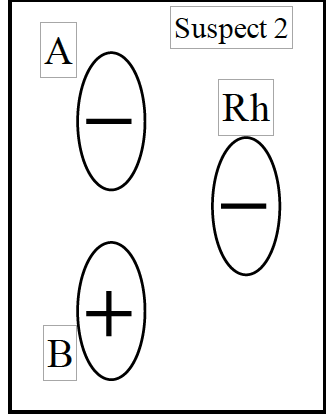
2.
What is suspect 2's Blood Type?
a)
A-
b)
B-
c)
A+
d)
B+
3.
What is suspect 3's Blood Type?
a)
AB+
b)
AB-
c)
O+
d)
O-
4.
What is clumping of Red Blood Cells Called?
a)
Agglutination
b)
Antigen
c)
Antibody
d)
Thrombocyte
5.
What is the most common of the ABO blood types?
a)
Type A
b)
Type B
c)
Type AB
d)
Type O
6.
The least common form of the ABO blood type is:
a)
Type A
b)
Type B
c)
Type AB
d)
Type O
7.
Which test is used to detect invisible blood stains?
a)
Kastle-Meyer
b)
Luminol
c)
Precipitin
d)
Huminal
8.
Blood Typing is considered what type of evidence?
a)
Indiviual
b)
Class
c)
Trace
d)
Physical
9.
Given the following scenario who COULD POSSIBLY be the baby's father?
Mom- Type A
Baby- Type B
a)
Sammy- Type O
b)
Georgie- Type AB
c)
The Waiter- Type A
d)
All of these men could be the dad
10.
Given the following scenario who COULD NOT possibly be the father?
Mom-Type B
Baby- Type AB
a)
The Cab Driver- Type A
b)
The Flight Attendant- Type B
c)
The Bartender- Type AB
d)
All of these men could possibly be the father
11.
Which test would be considered a presumptive test for blood.
a)
DNA
b)
Blood Antigen Test
c)
Luminol
12.
Investigators can individualize blood evidence by:
a)
Determining the blood group
b)
Observing the blood cells
c)
Comparing the DNA from the cells
d)
Using the Kastle-Meyer test
13.

DNA can be found in

a)

nucleus

b)

mitochondria

c)

both the nucleus and mitochondria

d)

neither the nucleus or mitochondira

14.

Mitochondrial DNA is inherited from

a)

the mother

b)

the father

c)

both the mother and the father

15.

DNA can be used to

a)

match a crime scene DNA with a suspect

b)

eliminate a suspect

c)

free a falsely imprisoned individual

d)

determine maternity or paternity

e)

All of the above

16.

Electrophoresis is a process that separates RFLPs (restriction fragment length polymorphisms) according to their

a)

weight

b)

length

c)

shape

d)

color

17.

When collecting DNA evidence, if evidence cannot be dried, it may be

a)

disregarded

b)

heat treated

c)

frozen

d)

sealed in plastic

18.

Analyzing trace evidence destroys the evidence sample, including DNA. Therefore, prior to DNA fingerprinting, ___________________ is used to make thousands of copies of segments of DNA.

a)

Electrophoresis

b)

Polymerase Chain Reaction (PCR)

c)

tissue matching

19.
What is a recessive allele?
a)
A trait that is always shown (capital letter)
b)
A trait that can be hidden (lower case letter)
c)
Alleles that are the same
d)
Alleles that are different
20.
What is a dominant allele?
a)
A trait that is always shown (capital letter)
b)
A trait that can be hidden (lower case letter)
c)
Alleles that are the same
d)
Alleles that are different
21.
A method of separating DNA fragments according to their size and charge using an electric current passed through a gel containing the samples a
a)
Chromosome
b)
DNA Probe
c)
Electrophoresis
d)
Restriction Enzyme
22.
A chimera is a person who has two complete sets of DNA
a)
True
b)
False
23.
How many STR markers does the FBI use to identify criminals in America?
a)
17
b)
4
c)
26
d)
13
24.
Which two bear species are most closely related?
a)
Bear 1 and Bear 2
b)
Bear 1 and Bear 3
c)
Bear 2 and Bear 3
d)
There’s no way to tell
25.
Based on these results whose blood was found in the blood stain at the crime scene?
a)
Bob
b)
Sue
c)
John
d)
Lisa
26.

If one parent is homozygous for type A blood (AA) and their spouse is heterozygous for type A blood (Ao), what are the possible blood types of their children?

a)

AA only

b)

Ao only

c)

AA or Ao

d)

oo

27.

If a mother is type AB blood and the father is type B (genotype unknown) is it possible for their children to have type A blood?

a)

Yes, if dad is BB

b)

Yes, if dad is Bo

c)

Yes, does not matter what dad's genotype is

d)

No, not possible

28.

The function of platelets is...

a)

Bloodclotting

b)

Transporting oxygen

c)

Fighting infection

29.
What part of blood is responsible for fighting infections?
a)
Red Blood Cells
b)
White Blood Cells
c)
Platelets
d)
Plasma
30.
Which is the best presumptive test for identification of blood at a crime scene?
a)
Luminol
b)
Bluestar
c)

Kastle-Meyer (Phenolphthalein)

d)
Leuchomalachite Green
31.
If you have the rH factor then your blood is +.
a)
False
b)
True
32.
What you see, or the physical appearance.
a)
Genotype
b)
Phenotype
c)
Homozygous
d)
Heterozygous
33.
Mrs. Jones has blood type AA.
Mr. Jones has blood type AB.
What are the genotypes of her offspring?
a)
100% AB
b)
25% AO; 25% BO; 25% AA; 25% AB 
c)
50% AA; 50% AB
d)
100% AA
34.

Which sample is B-

a)
b)
c)
d)
35.

Which sample is O+

a)
b)
c)
d)
36.

What type of blood spatter pattern is seen the image?

a)

transfer pattern

b)

void pattern

c)

swipe pattern

d)

low velocity

37.
What blood stain pattern is created or formed by the force of gravity acting alone?
a)
Passive Drop
b)
Low Velocity Impact Spatter
c)
Flow Pattern
d)
Drip Pattern
38.
What blood spatter pattern is created when a source of blood remains stationary over a surface causing an accumulation of blood?
a)
Saturation
b)
Flow
c)
Pool
d)
Drip Pattern
39.
What blood spatter pattern is seen in the picture?
a)
Transfer/Contact
b)
Swipe
c)
Wipe
d)
Saturation
40.
What blood spatter pattern is seen in the photo?
a)
Wipe
b)
Swipe
c)
Walking Drip
d)
Flow
41.
What bloodstain pattern is created when an object moves through an existing stain, removing or altering its appearance?
a)
Swipe
b)
Walking Drip
c)
Wipe
d)
Contact
42.
What blood spatter pattern is seen in the picture?
a)
Low Velocity
b)
Cast-Off
c)
Arterial Spurting
d)
Medium Velocity
43.
What bloodstain pattern is created when blood is released or thrown from a blood-bearing object?
a)
Cast-Off
b)
Walking Drip
c)
Medium Velocity
d)
Void
44.
What blood spatter pattern is seen in the picture?
a)
Medium Velocity
b)
Expirated Blood
c)
Low Velocity
d)
Arterial Spurt
45.
What blood spatter pattern is seen in the photo?
a)
Low Velocity
b)
Expirated Blood
c)
High Velocity
d)
Medium Velocity
46.
What type of blood spatter is typically created from a gunshot?
a)
Medium Velocity
b)
High Velocity
c)
Cast-Off
d)
Void
47.

A blood droplet has a width of 5 mm and a length of 6 mm.  What is the angle of impact?

angle of impact = sin-1(w/l)

a)
90 degrees
b)
56 degrees
c)
65 degrees
d)
46 degrees
48.
From what angle was this blood most likely dropped?
a)
90°
b)
70°
c)
30°
d)
10°
49.
How does the velocity of impact change the blood stain pattern?
a)
Higher velocity, larger diameter
b)
higher velocity, smaller diameter
c)
lower velocity, smaller diameter
d)
Medium velocity, small diameter
50.

A drop of blood that strikes a surface at an angle of impact approximately 90-degrees will be close to _______ in shape.

a)

circular

b)

teardrop

c)

elliptical

d)

elongated

51.
What is the acute angle formed between the directon of a blood drop and the surface it strikes called?
a)
Cast - off
b)
Wipe
c)
Medium Velocity Impact
d)
Angle of Impact
52.
Small secondary droplets around the main blood spatter drop are called:
a)

Spikes

b)

Splats

c)

Satellites

d)

Gushes

53.

The origin of the blood was to the __________ of the blood drops.

a)

right

b)

left

54.

The arrow is pointing to a

a)

satellite

b)

spine

c)

parent drop

55.
The drop shown above would have more than likely been dropped from an angle of around
a)
90
b)
50
c)
30
d)
10
56.

As blood drops from increasing heights, what happens to the size of the blood stain?

a)

Gets larger.

b)

Gets smaller.

c)

Stays the same size.

57.

Draw in the line to find the area of convergence, then circle the area of convergence.

58.

Lines of convergence can pinpoint:

a)

The exact or approximate place of origin

b)

The location of the crime

c)

The type of object used in the crime

d)

The velocity of blood flow

59.

What direction was this blood spatter moving?

a)

left to right

b)

right to left

60.

Let us say that we find a blood stain 10 ft away from the source and we have determined that the angle of impact is 70 degrees. Determine the height. H=D x Tan(angle)

a)

2.747ft

b)

892ft

c)

27.47ft

d)

3.64ft