
 Worksheets
8.5AB Atoms Review
Total questions: 37
Worksheet time: 30mins

The mass number of Atom A is (a) because there are 6 positive (b) and 6 neutral (c) in the nucleus. Since the atomic number of Atom A is (d) then Atom A can be identified as (e) .

The mass number of Atom B is (a) because there are 7 positive (b) and 7 neutral (c) in the nucleus. Since the atomic number of Atom B is (d) then Atom B can be identified as (e) .
Which part of an atom is most reliable in giving you the identity of the atom? (Choose the correct column)

Which is more reactive, boron or lithium?
Boron
Lithium
Which property makes lithium more reactive than boron?
Lithium has a smaller atomic number
Lithium only has 3 electrons
Lithium only has 1 valence electron
Lithium has a negative charge.
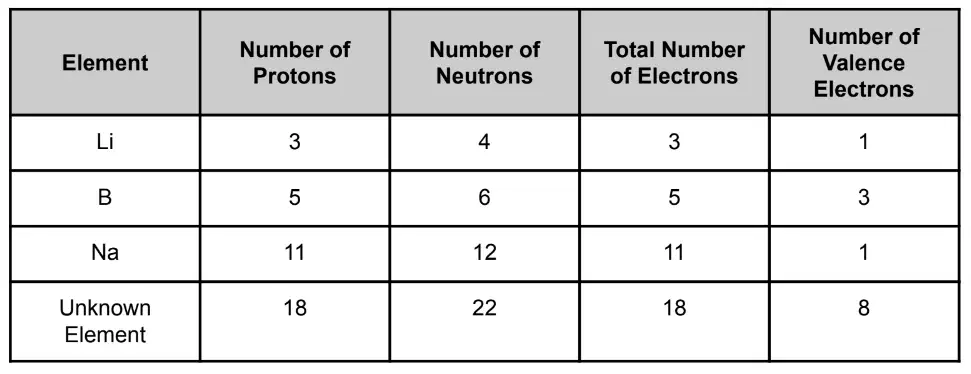
Which is the least reactive element in the table?
Lithium
Boron
Sodium
Unknown Element
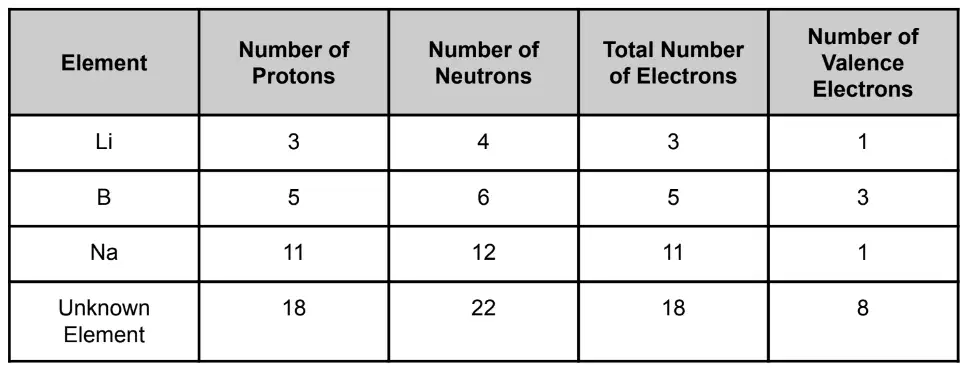
What is the identity of the unknown element? You may need to refer to the periodic table.
Titanium
Argon
Oxygen
Zirconium

Which elements have similar reactivities?
Lithium
Boron
Sodium
Argon (Unknown)

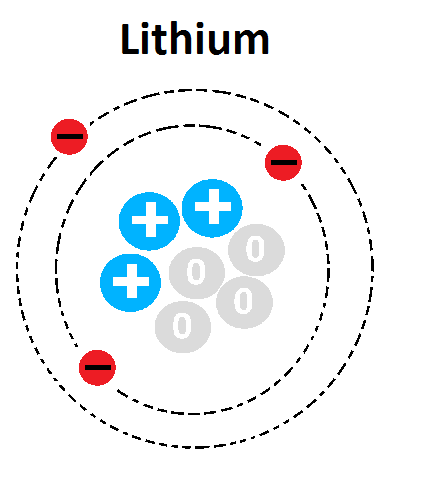
What is the atomic mass of this atom?
1
3
4
7
Valence electrons are:
Electrons on the outermost electron shell
Electrons closest to the nucleus
Electrons that are found at all electron shells
Electrons in the second shell


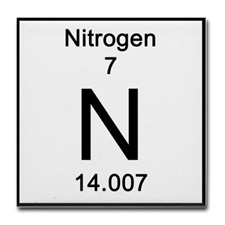

Which element is this?
Nickel
Neon
Sodium
Nitrogen

Name this element.
Neon
Magnesium
Sodium
Manganese


An atom of a certain element has 36 protons, 36 electrons, and a mass number of 84. At room temperature this element is a very stable gas. How many neutrons are in this atom? (8.5A)
84
36
48
72

Four students were asked to name the parts of an atom that determine the atom’s identity and chemical properties. The students’ responses are shown in the table below.
Student 1
Student 2
Student 3
Student 4

Place the elements in the correct order by LEAST (left) number of Protons to MOST (right) number of protons.
Hydrogen
Carbon
Aluminum
Potassium
Xenon

