
 Worksheets
7th Grade Semester 2 Review 2024
Total questions: 55
Worksheet time: 55mins

Samantha and Jason were researching and investigating for their upcoming science in February. They both decided to investigate bacterial growth from the school’s water fountains after learning about genetics and reproduction at McLane Middle School. Both grew the samples in petri dishes from the same source (their teacher) and counted the number of bacteria for their individual samples for the same period. Below is the number of cells that grew in 4 days .Based on the graph, what conclusion can be made about the two experiments?
By providing more nutrients they can replicate the experiment and double growth.
Another student repeats the experiment with bacteria from a different school.
The measurements are not accurate because they do not repeat the experiment.
Bacteria growth was greater for one student than the other therefore the results are not replicated.
Biologists study living organisms. To learn more about humans, biologists often have mice in their labs. Why might a biologist use mice in their pursuit of scientific explanations of humans?
Mice and humans look alike.
Mice are smarter than humans.
Mice and humans are genetically similar.
Mice eat a lot and do not move very much.
Building models can help scientists make discoveries about the natural world. For example, scientists used cardboard cutouts of the chemical substances that make up the molecule responsible for heredity. This molecule is known as DNA. The scientists put together the cardboard cutouts along with other materials to build their model. This model helped the scientists determine the structure of the DNA molecule. What type of model did scientists construct to help them determine the structure of the DNA molecule?
a physical model
a computer model
a conceptual model
a mathematical model
Explain the relationship between DNA, chromosomes, genes, and the traits passed from parent to offspring.
Chromosomes are comprised of segments of DNA called genes that control the traits that will be passed from parent to offspring.
DNA comprises segments of chromosomes called genes that control the traits passed from parents to offspring.
Genes are comprised of segments of chromosomes called DNA that control the traits that will be passed from parents to offspring.
Chromosomes are comprised of segments of genes called DNA that control the traits that will be passed from parents to offspring.
The expected number of chromosomes in human body cells is 46. Fruit flies have only 8 chromosomes, mulberry trees have 308, and protists can have thousands. Dogs are in the middle of the range, with 78 chromosomes. How many chromosomes are in the sex cells of each of these organisms?
always 23
always half as many as in the body cells
always as many as in the body cells
What is the relationship between genes and chromosomes?
Genes are made up of thousands of chromosomes.
Genes are segments of DNA on each cell's chromosomes.
Genes correspond to the phenotype, while chromosomes correspond to the genotype.
Chromosomes correspond to the phenotype, while genes correspond to the genotype.
Which reason best explains why the ability to reproduce asexually is a desirable characteristic for a research organism?
Researchers will not have to find mating pairs.
All offspring of an individual will be genetically identical.
There will be fewer generations than there would be with sexual reproduction.
Organisms that reproduce asexually have less DNA than organisms that reproduce sexually.
Which statement correctly describes the mechanisms of cell division?
Mitosis produces sex cells; meiosis produces body cells.
Meiosis produces genetically identical cells; mitosis does not.
Meiosis is a form of asexual reproduction; mitosis is a form of sexual reproduction.
Mitosis produces genetically identical cells; meiosis does not.
The gene for a large-size fruits (L) in tomato plants is dominant over the gene for small-size fruits in tomato plants (l). If Marcus crosses a heterozygous parent plant with a homozygous recessive parent plant, what is the probability of the offspring having large-size fruits?
100%
50%
75%
25%
What is the definition of a DNA mutation?
The original DNA strands.
The strand with four pairs.
Change in the DNA strand.
The strand in a double helix.
A student set up an experiment to determine which type of plant is best adapted to thrive and grow based on the soil nutrient and content in his mom’s garden. He took careful measurements of the plants each day and compiled his data in a journal. What is the independent (test) variable in this experiment?
The day
The type of plant
The height of the plant
The soil nutrients in the garden
An evolutionary biologist recently discovered fossils of a now extinct organism. She was very excited because these fossils were found on top of a mountain, several hundred feet above sea level. After she gathered all the fossils, she used complex computer software and constructed the following model based upon all the evidence she had. What is a limitation that all models have?
They are always accurate.
They can predict future events with certainty.
They cannot account for all variables or unknowns.
They are easy to construct.
Models must be physical objects.
True
False
Sometimes true
Only in science
Which of the following statements is true about the fossil record?
The fossil record shows no evidence of how organisms evolved.
The fossil record shows only animal life that has become extinct.
The fossil record shows only evidence of traces of animals in rock.
The fossil record shows patterns that are like data that can be analyzed.
Luis goes to the Museum of Natural History and sees a display of bones from a dolphin's flipper and a cat's leg. They are very different, but the display shows that their bones have homologous structures in their limbs. What can you infer about these two organisms from their homologous structures?
They evolved rapidly.
They evolved at the same time.
They evolved to live in similar environmental conditions.
They evolved, are related, and share a common ancestor.
What units of genetic material determine what living things look like?
traits
genes
variations
mutation
How do fossils support evolution?
Organisms in the fossil record are identical to living organisms.
Individual species disappear and reappear in the fossil record over time.
The fossil record provides evidence that organisms have changed over time.
The fossil record provides evidence that all organisms developed at the same time.
A student used this model of a wooly mammoth for a research project on the ecosystems and wanted to find out if elephants are related to Wooly Mammoth’s. What is the benefit of this model?
It shows the actual size of a woolly mammoth.
It helps the student understand what mammoths ate.
It predicts what mammoths will look like in the future.
It helps the student understand what mammoths looked like.
Mandy is investigating migration for her project on ecosystems. She thinks that birds instinctively fly south for the winter and hypothesizes that they do so because they cannot survive in cold weather, thus disrupting the local habitat and food web. Which of the following could serve as empirical evidence to support her hypothesis?
inferences made about the birds based on observations of flocks of flying geese
data from another scientist’s experiment on bird anatomy
feelings based on her own reactions to winter weather
charts displaying birds’ migratory patterns in relation to weather
At one time, fungi, like the mushrooms shown below, were classified in the same kingdom as plants. Today, fungi are classified in their own kingdom and are described as decomposers in what?
ecosystems
food chains
plant systems
animal hierarchies
Which statement best summarizes why fungi and plants are now classified in separate kingdoms?
The discovery of new evidence led to the reclassification of fungi.
Advancements in technology showed that fungi and plants are closely related.
The plant kingdom was getting too large, so scientists divided it into two kingdoms.
Plants and fungi both contain cell walls and share more characteristics than separate them.
Dr. Yang conducted a field study of the nesting habits of red cardinals. Why did Dr. Yang choose a field study over other types of investigation for the nesting habits of red cardinals?
because she wanted to manipulate variables in the field
because she wanted to observe the birds in their natural habitat
because she wanted to simulate the life cycle of the birds in a lab
because she wanted to observe a simplified version of the environment
What term is used to describe the relationship where a tiny shrimp lives among the poisonous spines of a sea animal called the fire urchin, where the shrimp gets protection from enemies and the fire urchin gains no benefit nor harm?
mutualism
competition
predator-prey
commensalism

Which organism is at the base of the food web shown in the first diagram?
Anchovy
Shrimp
Snail
Algae

Which of the following is most likely to cause the greatest decrease in the population of species B?
increase in species E
decrease in species C
decrease in species D
decrease in species A

Which statement correctly describes one way that energy from the sun might flow through the food web from a producer to the owl?
The snake eats the frog, and the owl eats the snake.
The snake eats the rodent, and the rodent eats the owl.
The rabbit eats the plant, and the grasshopper eats the plant.
The rabbit eats a leafy green plant, and the owl eats the rabbit.
Aphids are small insects that feed by burrowing their heads into the stems of plants, like orange trees, and feed on sap. When an orange tree loses its sap, it gets weaker because sap contains all the nutrients that a plant needs. As aphids live in large colonies, their number can quickly cause extensive damage to orange trees. Which type of relationship best describes the interaction between the Aphids and the orange tree?
Mutualism because the Aphids get energy from consuming the sap, and the orange tree gets protection from even more harmful insects.
Parasitism because one organism benefits and the other organism is harmed.
Parasitism because one organism benefits and the other organism is not affected.
Commensalism because one organism benefits and the other organism is not affected.
Ostriches and gazelles are two animals that live in Africa. They graze for food near each other because they help each other spot predators. The gazelle has excellent eyesight, but poor hearing, and the ostrich has excellent hearing, but poor eyesight. These two animals will alert one another when danger is near. Which term best describes this relationship?
Competition
Commensalism
Parasitism
Mutualism
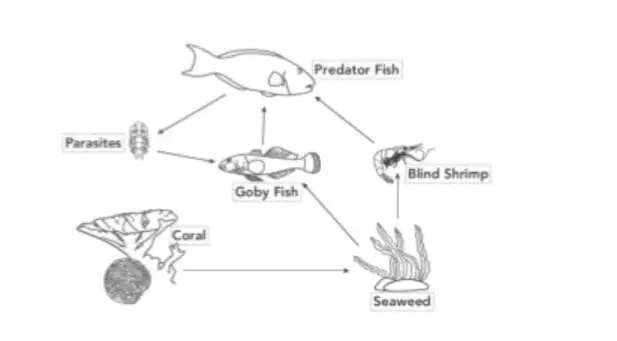
Goby fish live in close proximity to many other water animals. They often lay their eggs in burrows built by blind shrimp. The blind shrimp have feelers that sense when the goby fish flee predator fish. Some goby fish eat the parasites of other, larger predator fish. Based on the information provided, what would be considered a limiting factor in the goby fish’s ecosystem?
The length of the predator fish because their parasites infect the goby fish.
The number of blind shrimp because goby fish often lay their eggs in blind shrimp burrows.
The size of the predators because they eat the goby fish and the blind shrimp.
The species of seaweed because they could poison the goby fish.
Which of the following could serve as empirical evidence?
A well-reasoned hypothesis
A mathematical model
Anecdotal observations
Data collected through experiments and observations
A student set up an experiment to test the effect of different liquids on plant growth. He placed identical plants into individual test tubes containing sugar water, salt water, tap water, bottled water, and pond water. He took measurements of the plants’ height every day for three weeks and recorded the measurements. What is the independent (test) variable in the experiment set up by the student to test the effect of different liquids on plant growth?
The type of plant
The type of liquid
The amount of sunlight
The height of the plants
Photosynthesis is a process in which plants make food in the form of sugar. In this process, light energy is converted to chemical energy that is stored in the bonds of the sugar molecules. What could a scientist do to verify that photosynthesis requires light energy?
Observe plants growing in a forest.
Study fossils of extinct plants and compare them to modern plants.
Observe the differences in plants placed in darkness with plants exposed to light.
Observe the effects of different kinds of fertilizers on several groups of plant.
Students set up an experiment to answer the scientific question “Is water a limiting factor in the local ecosystem?” They use plants that are native to the ecosystem in their experiment. Their initial set-up is shown below. The pots of plants are placed on a tray near a window. Each tray of seedlings receives different amounts of water per day. They also receive different amounts of sunlight due to plants in the pots being a different distance to the window. Students measure the height of the plants daily for a month. Which of the following best explains why the experiment to determine if water is a limiting factor in the local ecosystem is NOT valid?
The plants are native to the ecosystem in the experiment.
The pots of plants are placed on a tray near a window.
Each tray of seedlings receives different amounts of water per day.
The plants receive different amounts of sunlight due to their distance from the window.
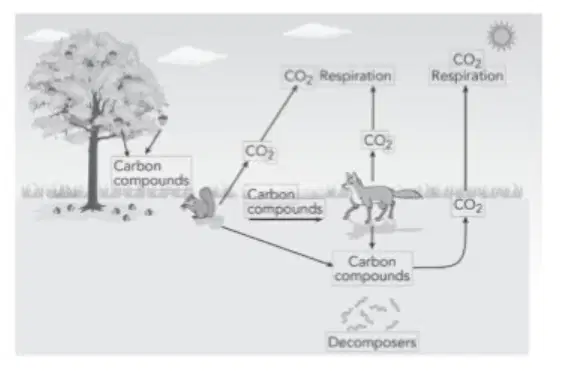
Which of the following could NOT be added to the diagram to show the trees contribution to the carbon cycle?
arrows to show carbon dioxide entering the tree during photosynthesis
arrows to show carbon dioxide leaving the tree during photosynthesis
arrows to show carbon moving from the tree to the squirrel as it consumes its acorns
arrows to show carbon moving from the tree as its dead leaves are broken down by decomposers
What is the primary source of carbon for living organisms?
Atmosphere
Water
Soil
Plants
Which process releases carbon dioxide into the atmosphere?
Photosynthesis
Respiration
Decomposition
Transpiration
Which of the following observations demonstrates that living systems follow the law of conservation of mass?
The total mass of all organisms in an ecosystem remains the same over time.
Most plants and animals begin their life cycle with a smaller mass and gain mass during development.
Living animals must consume food with a mass much greater than the mass of their body over their lifetime.
The total mass of a dead organism equals the total mass of matter released to the environment by decomposition.
Living systems obey the law of conservation of energy. Which of the following best summarizes the law of conservation of energy?
Energy does not change form in living systems.
Energy can be created or destroyed in living systems.
Energy cannot be created or destroyed in living systems.
Energy can be destroyed as you move through the trophic levels in living systems.

The picture shows an ecosystem that has been recently changed by human activity. The change has impacted native populations living in the area. Which limiting factor was MOST affected by this human activity?
Water supply for deer
Nesting sites for birds
Amount of space for trees
Number of predators that eat fish
How does a food chain illustrate the law of conservation of energy?
It shows that energy is destroyed by the last animal in the chain.
It shows that the energy used by plants for photosynthesis disappears.
It shows how sunlight is converted into the matter making up organisms.
It shows how energy stored in food moves from one organism to another
What happens to most of the energy that is not passed on to organisms at the next feeding level in an ecosystem?
It is used up by organisms at the earlier level.
It is stored in the food that is eaten by organisms.
It is dissipated as heat.
It is used for growth and reproduction by the organisms at the current level.
Charles Darwin's theory of evolution by natural selection was introduced more than 100 years ago. Although it was originally questioned, today it is considered an important biological principle. Which statement BEST explains why an idea that was once questioned would be accepted as scientific knowledge today?
The idea had been debated and well supported by other scientists' data.
There had been little additional research in this field since the idea was introduced.
The scientist was well-educated and spent many years studying biology.
The scientist collected and published large amounts of data supporting the idea.
Which of the following is empirical evidence for the hypothesis that exposure to ultraviolet rays causes skin cancer?
a model of a skin cell that shows where the DNA is found in the cell
a survey at a beach that asks people how long they spend at the beach each day
a skin cancer survivor with a hunch that her many sunburns resulted in the disease
data demonstrating a relationship between sun exposure and incidence of skin cancer
Which of the following is NOT an example of empirical evidence?
a hunch
numerical data
an observation
measurable results
What is the probability of an offspring with the genotype Hh resulting when parents with the genotypes Hh and Hh are crossed?
0%
25%
50%
75%
How does the genetic information of a new organism produced through sexual reproduction compare to the genetic information of its parents?
It is an exact copy.
It is completely different.
It is opposite from its parents.
It is a blend of the genetic information of its parents.
Mandy is investigating the migration of birds. She thinks that birds instinctively fly south for the winter and hypothesizes that they do so because they cannot survive in cold weather. Which of the following could serve as empirical evidence to support Mandy's hypothesis about bird migration?
feelings based on her own reactions to winter weather
data from another scientist's experiment on bird anatomy
charts displaying birds' migratory patterns in relation to weather
inferences made about the birds based on observations of flocks of flying geese
How does an offspring produced by asexual reproduction compare to the parent organism?
It is an exact copy.
It is completely different.
It is opposite from its parent.
It is a blend of the genetic information of its parents.
An asexual organism is one that reproduces without the involvement of another organism. Which of the following statements is true about an asexual organism?
All of its genetic information is the same as the parent organism.
Its genetic information is completely different from the parent organism.
One-half of its genetic information is the same as the parent organism.
One-quarter of its genetic information is the same as the parent organism.
Genetic engineering is one type of biotechnology. Which of the following is an example of genetic engineering?
A gene for pesticide resistance is inserted into a crop plant.
A genetic code of a desirable plant is used to produce many identical plants.
A plant with desirable traits is crossed with another plant displaying the same traits.
A plant that is successful at meeting its needs in its ecosystem survives and reproduces.
Scientists use genetic engineering in many ways. One common method is the insertion of a gene into the genome of an organism. Which BEST summarizes the goal of this type of biotechnology?
to produce many identical organisms
to add a desired trait to the organism’s characteristics
to gradually change the traits of a group of organisms
to learn the DNA sequence of the individual organism

The process of natural selection is based on how organisms respond to changes in their environment. The graph below shows length in a population of fish. Which of the following conclusions is supported by the graph?
There is no variation among the members of the population.
There is an equal distribution of males and females in the population.
There is a variation in the characteristics of the members of the population.
There is greater chance of survival for the larger members of the population
What is a likely result of a rapid and drastic change in the environment, such as the one brought about by an asteroid or other body striking the Earth?
the extinction of one or more species
the introduction of new species on Earth
increased genetic variations among a species
the separation of species by geographic barriers
Which of the following would be an example of additional, empirical evidence to support the extinction hypothesis related to the dinosaurs?
finding fossils that had been crushed
finding fossils of early mammals with the dinosaur fossils
finding a large crater that dates from the time of the dinosaur extinction
finding dinosaur fossils in rock layers younger than the layer with the meteoroid material
Which of the following changes in scientific thinking did new evidence from the 1970s support regarding the relationship between birds and dinosaurs?
birds are a type of dinosaur
birds and dinosaurs are not related
some birds have evolved from dinosaurs
dinosaurs went extinct later than originally believed

