
NEW
Font size
 Worksheets
Sponges Quiz
Total questions: 28
Worksheet time: 14mins
What does the phylum name "Porifera" mean?
Water-flow
Pore-bearer
Spore-former
Sponge-like
What is the skeletal structure of sponges made of that gives them a "spongy" feel?
Calcium carbonate
Silicon
Spongin
Chitin
What are the specialized cells in sponges called that produce spicules?
Pinacocytes
Choanocytes
Amoebocytes
Porocytes
Which structure in sponges acts like the epidermis, providing protection and support to the sponge?
Mesohyl
Endoderm
Pinacocytes
Choanocytes
What is the name of the large central cavity inside the sponge through which water moves?
Osculum
Spongocoel
Porocyte
Mesohyl
What is the term used to describe the jelly-like matrix between the ectoderm and the endoderm in sponges?
Spongocoel
Osculum
Mesohyl
Spicule
What is the function of choanocytes in sponges?
Producing spicules
Providing structural support
Helping water move through the cavity
Contracting and expanding the porocytes
How does water typically enter a sponge?
Through the osculum
Through the spongocoel
Through the spicules
Through the ostia
What is the role of flagella in the collar cells of a sponge?
To produce a water current that brings in food particles
To discharge waste products into the seawater
To capture sperm for fertilization
To move the sponge to a new location
What type of symbiosis is most common in sponges?
Mutualism
Parasitism
Commensalism
Predation
What do sponges primarily feed on?
Algae and coral
Detritus, bacteria, and plankton
Fish and small crustaceans
Seaweed and aquatic plants
How do sponges respire?
Through gills
Through lungs
Through diffusion
Through spiracles
Through which structure do sponges excrete carbon dioxide and nitrogenous wastes?
Flagella
Osculum
Collar cells
Pores
What do choanocytes use to trap food particles in sponges?
Osculum
Mucus of the collar portion
Pores or canals
Amoebocytes
Which one is NOT the role of pinacocytes in sponges?
Transport nutrients
Directly phagocytize food
Provides support
Provides structure
Which of the following is NOT a characteristic of Phylum Porifera?
Asymmetrical body
Filter feeders
Multicellular
Have a mouth and specialized tissues
What is the osculum in sponges?
A type of canal
A flagellated cell
A large hole in the top
A nutrient transport cell
How do sponges differ from other animals?
They are multicellular
They reproduce sexually
They are sessile as adults
They are organized beyond the cellular level
What type of canal system is characterized by being the simplest and having a small, tube-shaped structure?
Syconoid canal type
Asconoid canal type
Radial canal type
Chamber canal type
Which canal type in sponges has a thicker body wall with radial canals that empty into spongocoels?
Asconoid canal type
Syconoid canal type
Radial canal type
Leuconoid canal type
What do spicules provide to sponges?
Coloration
Nutrition
Support
Energy
Leuconoid sponges are characterized by which of the following features?
They are the smallest and least complex sponges.
They have a single flagellated chamber.
They are large and the most complex sponges.
They are found only in deep waters.
Which class of sponges is known for having a skeleton that may consist of elastic fibers, silicon dioxide, or a combination of the two?
Class Calcarea
Class Demospongiae
Class Hexactinellida
Class Sclerospongiae
Class Hexactinellida sponges are also known as what?
Coral sponges
Glass sponges
Rock sponges
Spongin sponges
What are the spicules of Class Calcarea sponges made of?
Silicon dioxide
Spongin
Calcium carbonate
Chitin
Which type of canal system is found in Class Demospongiae sponges?
Asconoid-type
Syconoid-type
Leuconoid-type
None of the above
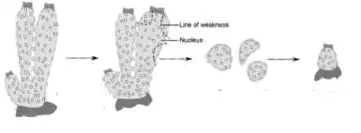
What type of reproduction is shown?
Sexual reproduction
Budding
Gemmules
Fragmentation
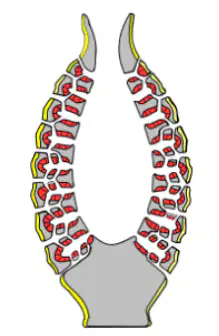
What type of canal is shown?
Asconoid
Syconoid
Leuconoid

