
 Worksheets
8th Grade End of Levels Review
Total questions: 67
Worksheet time: 1hrs 7mins
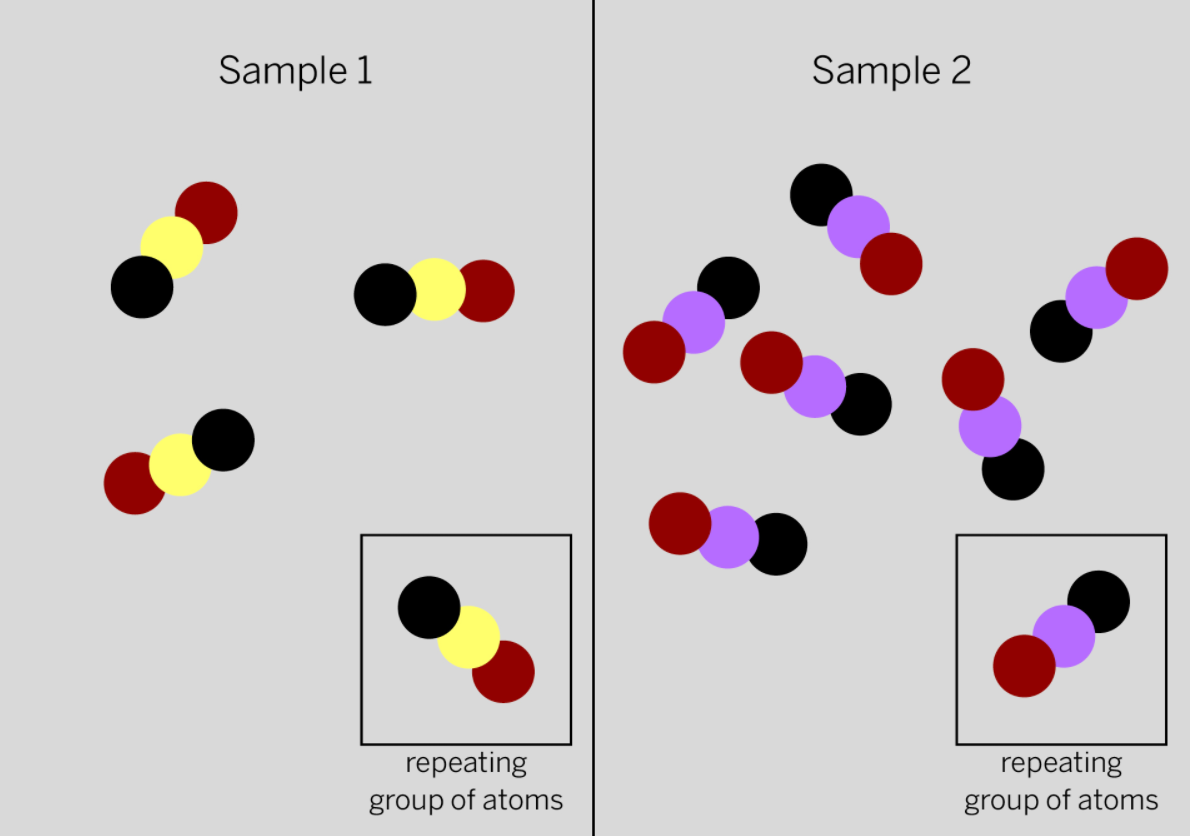
The diagram above shows the repeating groups of atoms that make up two samples. Will the properties of the two samples likely be the same or different? (Examples of properties are smell, color, and the temperature at which a substance melts.)
The properties will likely be different because the repeating groups of atoms that make up each sample are different.
The properties will likely be different because there are more repeating groups of atoms in Sample 2.
The properties will likely be the same because the repeating groups of atoms that make up the two samples have the same number of atoms.
The properties will likely be the same because the repeating groups of atoms that make up the two samples have two of the same types of atoms.
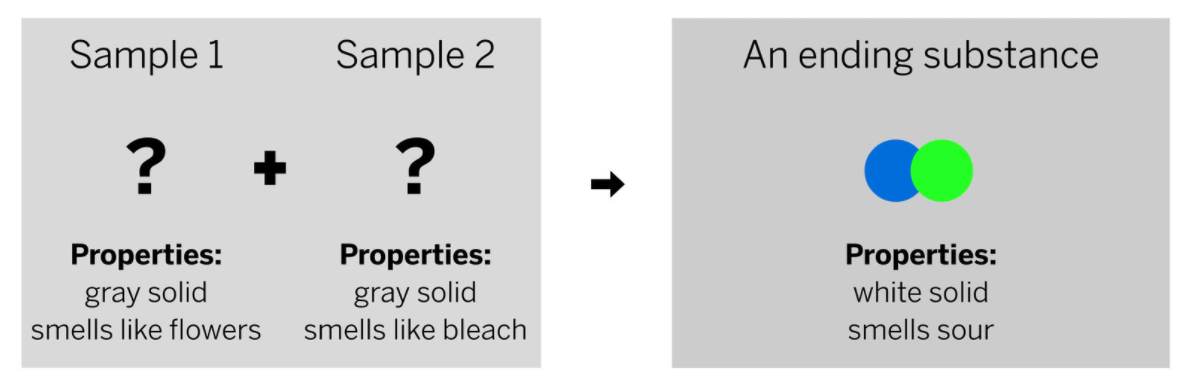
Serena mixed two samples together: a gray solid that smells like flowers and a gray solid that smells like bleach. She analyzed the results and found two ending substances. One of the ending substances was a white solid. This ending substance is made up of the repeating group of atoms shown above. Which of the diagrams to the left shows the repeating groups of atoms that make up the samples Serena mixed together?




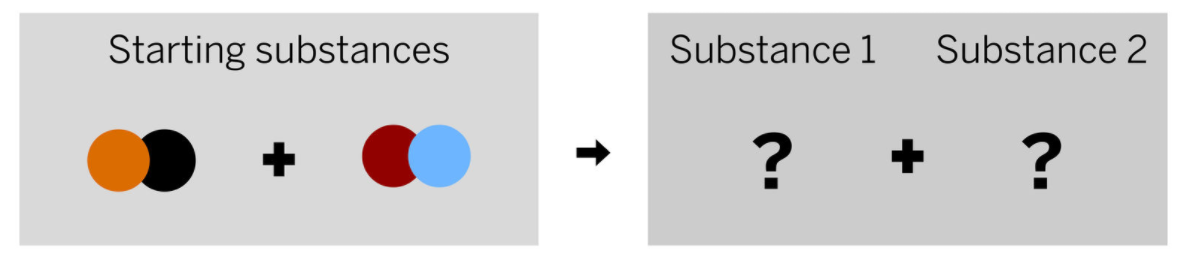
Tiana is a chemist who is making a chemical to add to swimming pools in order to make the water safer. She mixed two solid substances together in a sealed container. The diagram above shows the repeating groups of atoms that make up the two starting substances.
After mixing, Tiana found two liquid substances in the sealed container. (Nothing had escaped.) Which of the diagrams to the left shows the repeating groups of atoms that make up the ending substances?




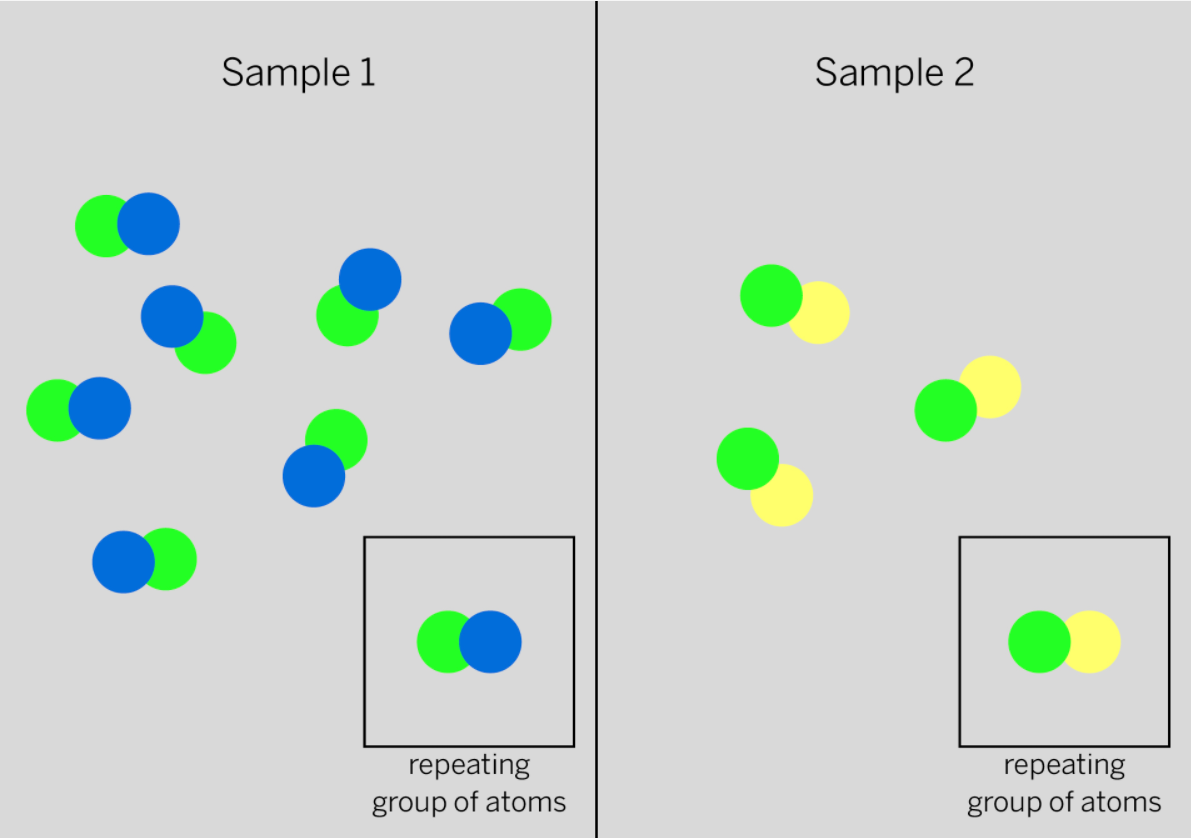
The diagram above shows the repeating groups of atoms that make up two samples. Will the properties of the two samples likely be the same or different? (Examples of properties are smell, color, and the temperature at which a substance melts.)
The properties will likely be different because the repeating groups of atoms that make up each sample are different.
The properties will likely be different because there are more repeating groups of atoms in Sample 1.
The properties will likely be the same because the repeating groups of atoms that make up the two samples have one of the same types of atoms.
The properties will likely be the same because the repeating groups of atoms that make up the two samples have the same number of atoms.
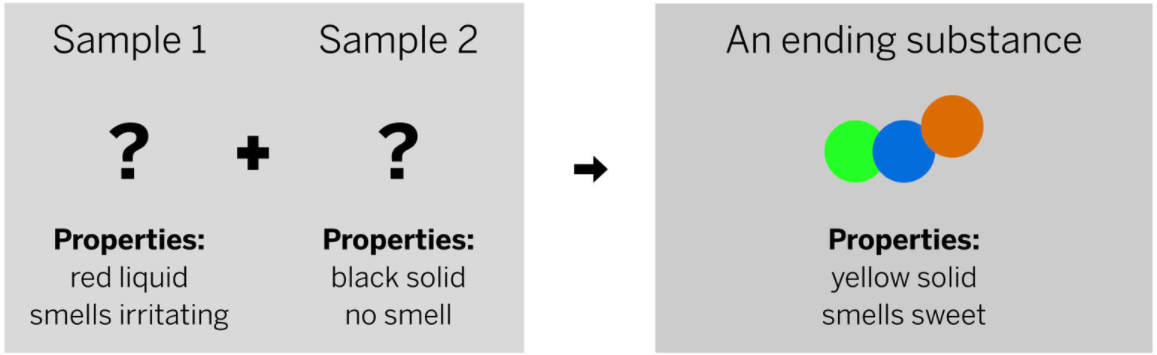




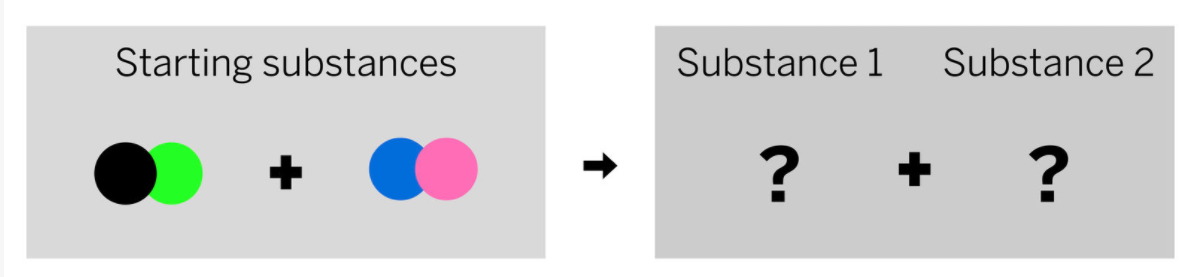
Santiago is a chemist working to make a new kind of antacid, which is a medicine that helps with stomach pain. He mixed two powdery solid substances together in a sealed container. The diagram above shows the repeating groups of atoms that make up the two starting substances.
After mixing, Santiago found two liquid substances in the sealed container. (Nothing had escaped.) Which of the diagrams to the left shows the repeating groups of atoms that make up the ending substances?




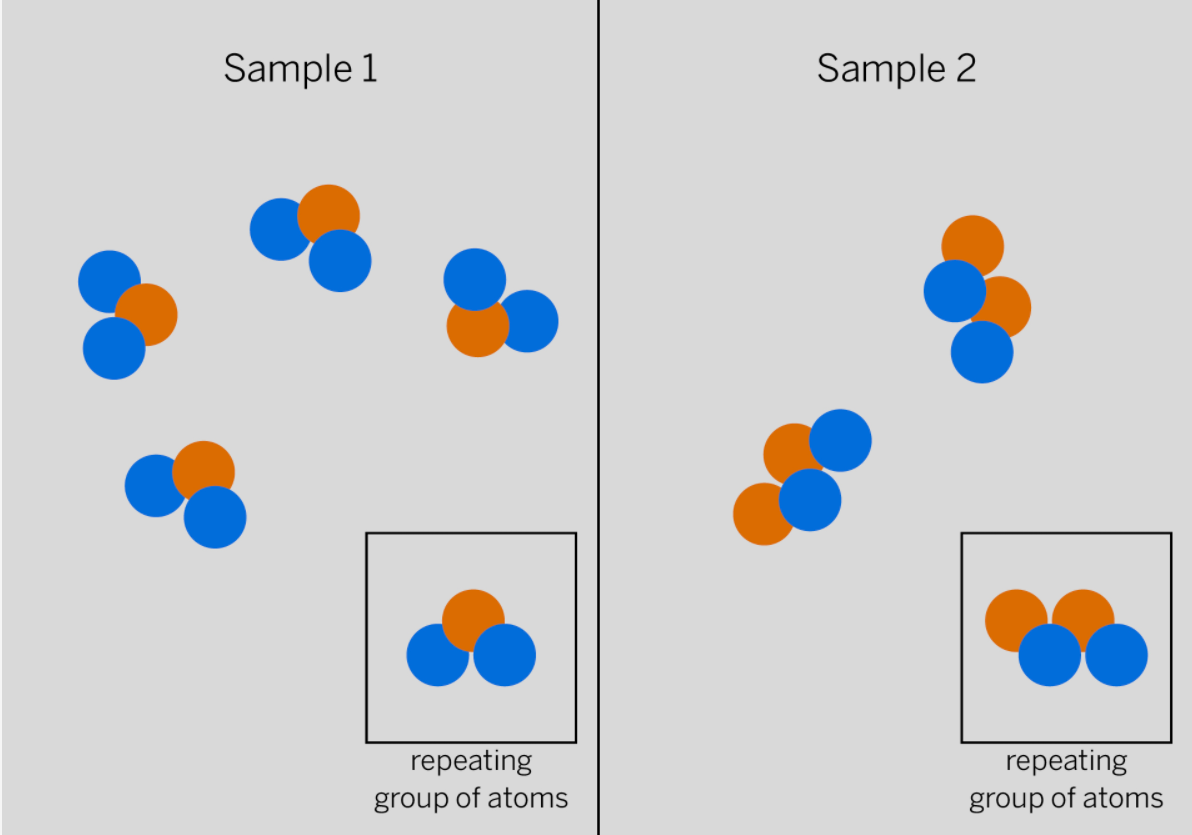
The diagram above shows the repeating groups of atoms that make up two samples. Both samples are liquid at room temperature. Will the properties of the two samples likely be the same or different? (Examples of properties are smell, color, and the temperature at which a substance melts.)
The properties will likely be the same because the repeating groups of atoms that make up the two samples have the same types of atoms.
The properties will likely be the same because both samples are liquids at room temperature.
The properties will likely be different because the repeating groups of atoms that make up the two samples have different numbers of atoms.
The properties will likely be different because there are more repeating groups of atoms in Sample 1.
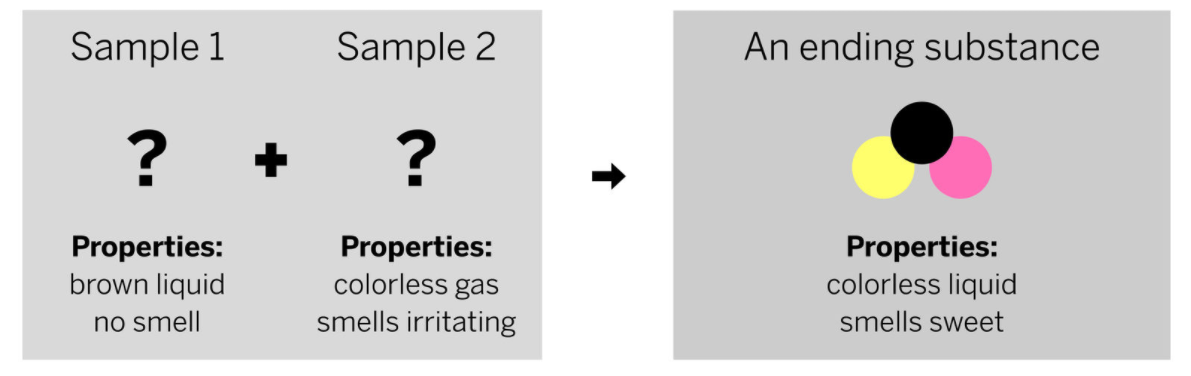
Marisol mixed two samples together: a brown liquid with no smell and a colorless gas that smells irritating. She analyzed the results and found two ending substances. One of the ending substances smelled sweet. This ending substance is made up of the repeating group of atoms shown above. Which of the diagrams to the left shows the repeating groups of atoms that make up the samples Marisol mixed together?




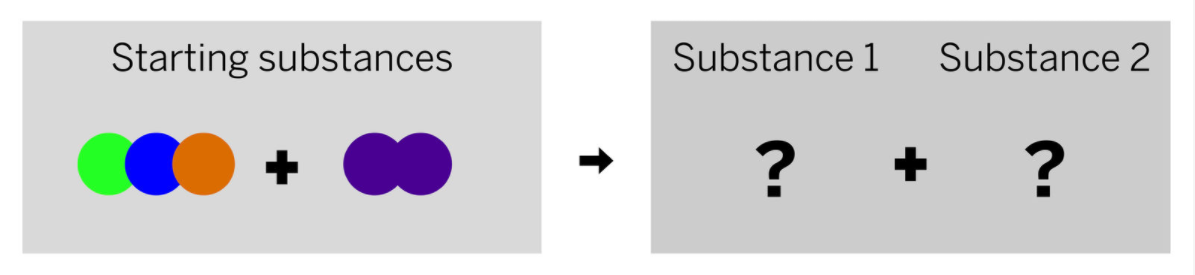
Jamie works at a company that makes cleaning chemicals. She is trying to make a chemical that smells like flowers. She took two samples that were gases at room temperature and mixed them in a sealed container. The diagram above shows the repeating groups of atoms that make up the two starting substances.
After mixing, Jamie found two substances that smelled like flowers in the sealed container. (Nothing had escaped.) Which of the diagrams to the left shows the repeating groups of atoms that make up the ending substances?




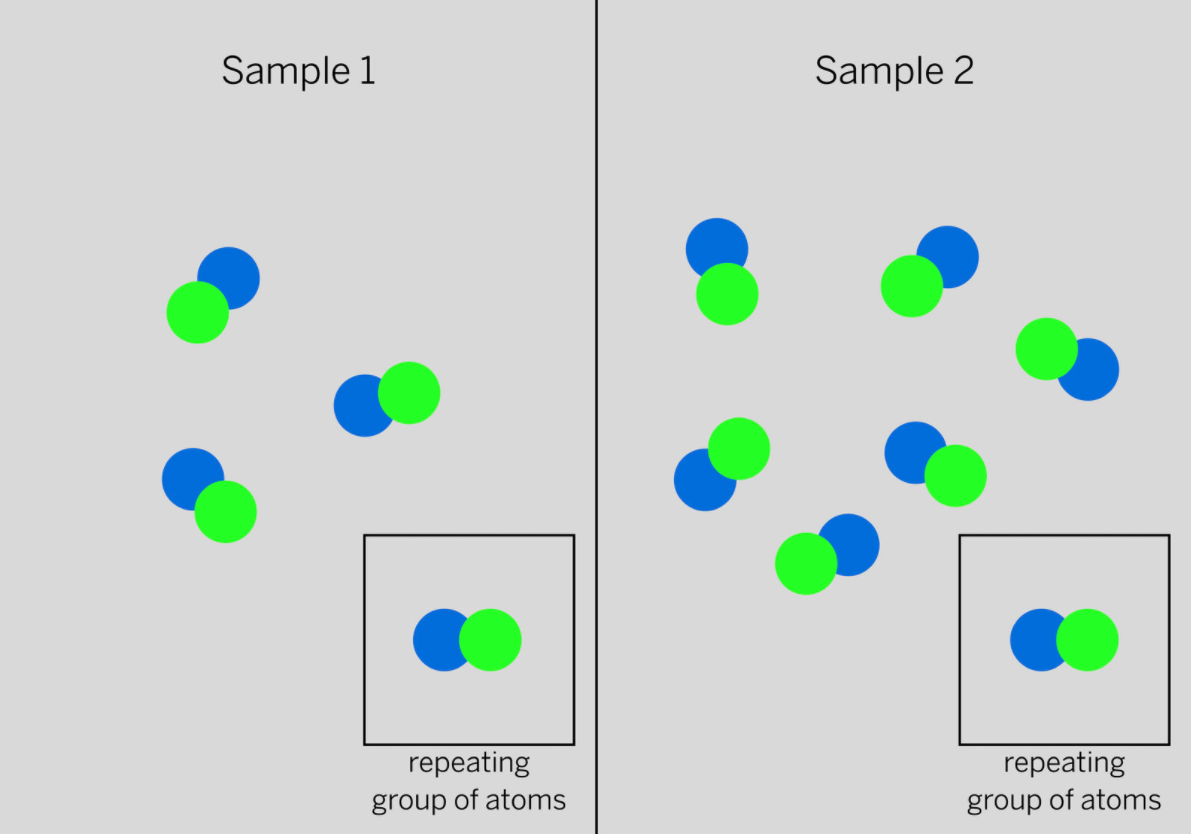
The diagram above shows the repeating groups of atoms that make up two samples. Both samples are green gases at room temperature. Will the other properties of the two samples be the same or different? (Examples of properties are smell, color, and the temperature at which a substance melts.)
The other properties will be the same because the repeating groups of atoms that make up the two samples are the same.
The other properties will be different because there are more repeating groups of atoms in Sample 2.
The other properties will be the same because both samples are green at room temperature.
The other properties will be the same because both samples are gases at room temperature.
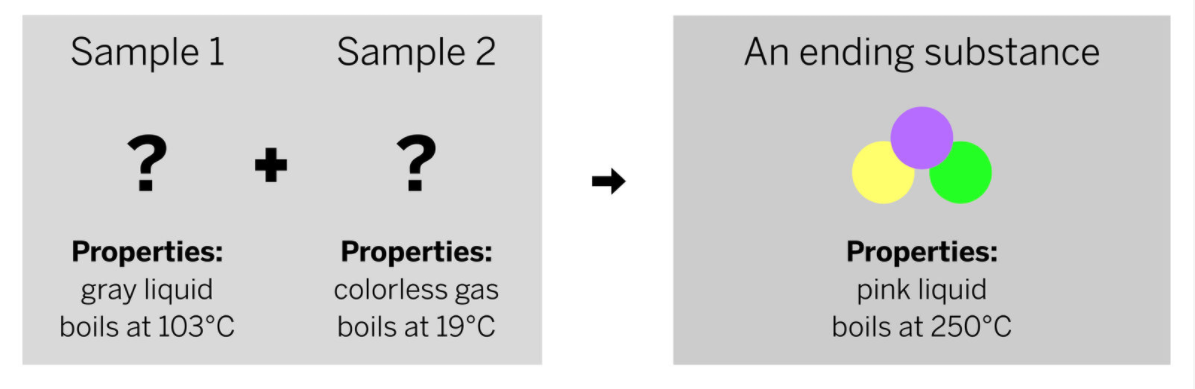
A chemist mixed two samples together: a gray liquid that boils at 103°C and a colorless gas that boils at 19°C. She analyzed the results and found two ending substances. One of the ending substances was a pink liquid. This ending substance is made up of the repeating group of atoms shown above. Which of the diagrams to the left shows the repeating groups of atoms that make up the samples the chemist mixed together?




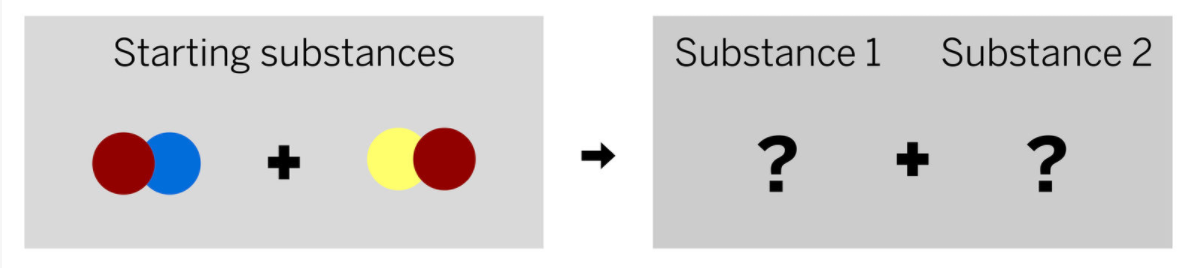
Patrik works at a company that makes paper and needs a chemical to make the paper brighter. He mixed two colorless substances together in a sealed container. The diagram above shows the repeating groups of atoms that make up the two starting substances.
After mixing, Patrik found two white substances in the sealed container. (Nothing had escaped.) Which of the diagrams to the left shows the repeating groups of atoms that make up the ending substances?





If a car sits out in the sun every day for a long time, can light from the sun damage the car’s paint?
Yes. The paint can take in energy from the light, causing it to be damaged.
No. Light can only change things by warming them up, so it cannot damage the car's paint.
No. Light is not a physical thing, so it cannot change physical things like paint.
Yes. Light from the sun can pull energy out of the paint, causing it to be damaged.

Alex has a type of rock called calcite, that sometimes glows. He puts the calcite under a desk lamp but the calcite does not glow. Then he puts it under an ultraviolet lamp and the calcite glows. Why does ultraviolet light make the calcite glow when light from the desk lamp does not?
Because ultraviolet light carries energy, and light from the desk lamp does not.
Because ultraviolet light pulls energy out of the calcite, and light from the desk lamp does not.
Because calcite can take in energy from ultraviolet light but not from the light from the desk lamp.
Because ultraviolet light carries glowing molecules, and light from the desk lamp does not.

Based on this information, which type of light is more likely to damage the material?
The gamma ray light is more likely to damage the material because the gamma ray light can pull energy out of the material when it passes through the material.
The X-ray light is more likely to damage the material because the X-ray light bounces off of the material, which means that it has more energy.
There is no way to know because they are two different types of light, and different types of light can change a material in different ways.
Neither type of light is likely to damage the material because the material does not take in energy from either the X-ray light or the gamma ray light.
Your friend says that she heard about a special type of ink that is only visible when it is out in the sun. Can light from the sun cause this ink to become visible?
No. Light can only change things by warming them up, so it cannot make the ink become visible.
No. Light is not a physical thing, so it cannot change physical things like ink.
Yes. The ink can take in energy from the light, causing it to become visible.
Yes. Light from the sun can pull energy out of the ink, causing it to become visible.
Alina notices that when she shines a desk lamp on a mirror, nothing happens. When she shines an infrared lamp on the mirror, the mirror starts to get warmer. Why does light from the infrared lamp warm the mirror when light from the desk lamp does not?
Because the mirror can take in energy from infrared light but not from the light from the desk lamp.
Because infrared light carries energy, and light from the desk lamp does not.
Because infrared light carries heat molecules, and light from the desk lamp does not.
Because infrared light pulls energy out of the mirror, and light from the desk lamp does not.

Omar has a piece of rock called quartz. He wonders whether light can cause the quartz to become warm. The table shows what happens when different types of light hit the quartz. Based on this information, which type of light is more likely to cause the quartz to become warm?
The visible light can cause the quartz to become warm because the visible light can pull energy out of the quartz when it passes through the quartz.
The infrared light can cause the quartz to become warm because the infrared light bounces off the quartz, which means that it has more energy.
There is no way to know because they are two different types of light, and different types of light can change a material in different ways.
Neither type of light can cause the quartz to become warm because the quartz does not take in energy from either the infrared light or the visible light.
Your friend shows you a special kind of paper that can change color. He says that it will change color if it is out in the sun. Can light from the sun cause the paper to change color?
Yes. Light from the sun can pull energy out of the paper, causing it to change color.
Yes. The paper can take in energy from the light, causing it to change color.
No. Light is not a physical thing, so it cannot change physical things like paper.
No. Light can only change things by warming them up, so it cannot cause the paper to change color.
Khaled has a red toy that is painted with a special kind of paint. When he puts the toy under a desk lamp, it stays red. When he puts the toy under an infrared lamp, it turns blue. Why does the infrared light cause the toy to turn blue when the light from the desk lamp does not?
Because infrared light pulls energy out of the paint, and light from the desk lamp does not.
Because infrared light carries colored molecules, and light from the desk lamp does not.
Because the paint can take in energy from infrared light but not from the light from the desk lamp.
Because infrared light carries energy, and light from the desk lamp does not.

Based on this information, which type of laser light can cut a hole in the silicone?
The helium-neon laser can cut a hole in the silicone.
The carbon dioxide laser can cut a hole in the silicone.
The diode laser can cut a hole in the silicone.
Any of these types of light can cut a hole in the silicone, because all light carries energy that can cause materials to change.
Your friend says that there is a kind of glue that only dries when it is exposed to a special type of light. Can light cause glue to dry?
No. Light can only change things by warming them up, so it cannot cause glue to dry.
Yes. The glue can take in energy from the light, causing it to dry.
Yes. Light can pull energy out of the glue, causing it to dry.
No. Light is not a physical thing, so it cannot change physical things like glue.
Santiago’s teacher showed him a kind of cloth that changes color if it is placed out in the sun, but does not change color if it is placed under a desk lamp. Why will light from the sun change the color of the cloth when the light from the desk lamp does not?
Because light from the sun carries colored molecules, and light from the desk lamp does not.
Because light from the sun pulls energy out of the cloth, and light from the desk lamp does not.
Because the sun gives off a type of light that carries energy, and light from the desk lamp does not.
Because the cloth can take in energy from the light from the sun but not from the light from the desk lamp.

Based on this information, which type of light might cause the glass to melt?
The infrared light can cause the glass to melt.
The yellow light can cause the glass to melt.
The X-ray light can cause the glass to melt.The X-ray light can cause the glass to melt.
Any of these types of light can cause the glass to melt, because all light carries energy that can cause materials to change.
The sun has been up for several hours, and it has been shining on these trees. What can the trees do because they are in sunlight? What does this mean for the number of energy storage molecules in the trees?
The trees can . . .
give off carbon to the air. Giving off carbon allows them to make energy storage molecules.
give off carbon to the air. Giving off carbon uses up energy storage molecules.
take in carbon from the air. The carbon is used to make energy storage molecules.
take in carbon from the air. The carbon is used to break down energy storage molecules.
These goats are eating grass on a sunny day. What is happening to the carbon in the air around the living things on the mountain? Is carbon moving into the air, moving out of the air, or both?
Carbon is only moving into the air; it is not moving out of the air.
Carbon is moving into the air and out of the air at the same time.
Carbon is not moving into the air; it is only moving out of the air.
With this information, there is no way to know for sure.
Will has an aquarium with water, plants, and fish that eat the plants. It is sealed so no material can get in or out, and has glass sides that allow sunlight to come in. The aquarium can also be covered to prevent light from entering.
The amount of carbon in the aquarium’s water started out high. Now, the amount of carbon in the water is decreasing.
Is the aquarium now in sunlight or is it covered? What is happening to the number of energy storage molecules in the plants and fish as a result?
The aquarium is now in sunlight, and there are more energy storage molecules in the plants and fish.
The aquarium is now in sunlight, and there are fewer energy storage molecules in the plants and fish.
The aquarium is now covered so no light can get in, and there are more energy storage molecules in the plants and fish.
The aquarium is now covered so no light can get in, and there are fewer energy storage molecules in the plants and fish.
Scientists are studying photosynthesis in a forest ecosystem that has plants, animals, and decomposers (which consume dead things). Which group or groups of organisms in the forest carry out photosynthesis?
all organisms in the forest
animals and decomposers
plants and decomposers
plants
A herd of deer lives in a forest where they eat the leaves of trees. The number of energy storage molecules in the trees and in the deer has increased. What has happened to the amount of carbon in the trees and in the deer?
The amount of carbon in the trees and in the deer . . .
has increased.
has decreased.
has not changed.
is not related to the number of energy storage molecules.
This sea grass has had the sun shining on it for most of the day. What can the sea grass do because it is in sunlight? What does this mean for the number of energy storage molecules in the sea grass?
The sea grass can . . .
take in carbon from the air. The carbon is used to break down energy storage molecules.
take in carbon from the air. The carbon is used to make energy storage molecules.
give off carbon to the air. Giving off carbon allows the sea grass to make energy storage molecules.
give off carbon to the air. Giving off carbon uses up energy storage molecules.
This tortoise is eating cactus on a sunny day. Is carbon moving into the air, moving out of the air, or both?
Carbon is not moving into the air; it is only moving out of the air.
With this information, there is no way to know for sure.
Carbon is only moving into the air; it is not moving out of the air.
Carbon is moving into the air and out of the air at the same time.
Lily has an aquarium with water, plants, and fish that eat the plants. The aquarium is sealed so no material can get in or out, and has glass sides that allow light to come in.
The aquarium can also be covered to prevent light from entering. The number of energy storage molecules in the plants and fish started out low, but that number has been increasing over time.
Has the aquarium been in sunlight or has it been covered during this time? What has happened to the carbon in the water?
The aquarium has been covered so no light gets in, and there is less carbon in the water.
The aquarium has been covered so no light gets in, and there is more carbon in the water.
The aquarium has been in sunlight, and there is more carbon in the water.
The aquarium has been in sunlight, and there is less carbon in the water.
Scientists are studying cellular respiration in a jungle ecosystem that has plants, animals, and decomposers (which consume dead things). Which group or groups of organisms in the jungle carry out cellular respiration?
plants
animals and decomposers
all organisms in the jungle
animals
Giant pandas eat bamboo plants in the mountains of China. The number of energy storage molecules has decreased in both the bamboo and the pandas. What has happened to the amount of carbon in the bamboo and the pandas?
The amount of carbon in the bamboo and pandas . . .
has not changed.
is not related to the number of energy storage molecules.
has increased.
has decreased.
Giant kelp are plantlike organisms that grow in clear ocean water. Over the last few hours some kelp has been taking in carbon from the water around it. Is the kelp in sunlight? What has happened to the number of energy storage molecules in the kelp?
The kelp . . .
is in sunlight, and the number of energy storage molecules in the kelp has decreased.
is in sunlight, and the number of energy storage molecules in the kelp has increased.
is not in sunlight, and the number of energy storage molecules in the kelp has decreased.
is not in sunlight, and the number of energy storage molecules in the kelp has increased.
A rabbit is eating leafy plants on a sunny day. What is happening to the carbon in the plants and the rabbit?
Carbon is only moving out of the living things; it is not moving into them.
With this information, there is no way to know for sure.
Carbon is moving into and out of the living things at the same time.
Carbon is only moving into the living things; it is not moving out of them.
An ivy plant has been taking in carbon from the air for several hours. Is the ivy in sunlight? What has happened to the number of energy storage molecules in the ivy? The ivy . . .
is in sunlight. The number of energy storage molecules in the ivy has decreased.
is in sunlight. The number of energy storage molecules in the ivy has increased.
is not in sunlight. The number of energy storage molecules in the ivy has decreased.
is not in sunlight. The number of energy storage molecules in the ivy has increased.
A group of giraffes feeds on leaves and grasses during the daytime. Right now, it is dark out and the giraffes are not eating. Is carbon moving into the living things, moving out of the living things, or both?
Carbon is moving into and out of the living things at the same time.
Carbon is only moving into the living things; it is not moving out of them.
Carbon is only moving out of the living things; it is not moving into them.
With this information, there is no way to know for sure.
Reza has a glass ball filled with water that contains tiny plants and shrimp that eat those plants. No material can get in or out, but light can get through the glass when it is placed in sunlight.
The number of energy storage molecules in the plants and shrimp started out high, but then the glass ball was moved, and the number of energy storage molecules decreased. Was the glass ball moved into the light or into the dark?
What happened to the amount of carbon in the water?
The glass ball was moved into the dark, and there is less carbon in the water.
The glass ball was moved into the dark, and there is more carbon in the water.
The glass ball was moved into the light, and there is less carbon in the water.
The glass ball was moved into the light, and there is more carbon in the water.
Although there are many ___________, there is a ________ toward increasing temperatures and decreasing ice on Earth since about 1880.
fluctuations, trend
trends, fluctuation
During the Eocene period more energy entered than exited the Earth system. What could have caused this?
Carbon dioxide increased, leading to more energy absorbed by Earth’s surface.
Carbon dioxide increased, leading to less energy absorbed by Earth’s surface.
Carbon dioxide decreased, leading to more energy absorbed by Earth’s surface.
Carbon dioxide decreased, leading to less energy absorbed by Earth’s surface.

When carbon dioxide in the atmosphere increases, the amount of energy absorbed by Earth’s surface should…
Decrease
Increase
Change unpredictably
Stay at a constant level
Which changes will INCREASE the energy in a system?
When MORE energy ENTERS than exits
When LESS energy ENTERS than exits
When MORE energy EXITS than enters
When LESS energy EXITS than enters

Which of the following explanations best shows the role of carbon dioxide in the atmosphere?
Carbon dioxide does not interact with the energy entering or exiting the atmosphere.
Carbon dioxide reflects the exiting energy back to Earth and traps it into the atmosphere.
Carbon dioxide absorbs the energy that is reemitted by Earth and redirects it back to Earth making Earth warmer.
Carbon dioxide absorbs the energy that is reemitted by Earth. Carbon dioxide traps this energy, keeping Earth cooler.
How does energy interact with sulfur dioxide in our Earth’s system?
Sulfur dioxide transmits energy when entering the Earth’s system by allowing the energy to pass through the molecule.
Sulfur dioxide traps some energy and holds it in the atmosphere.
Sulfur dioxide stops energy from entering the Earth system by redirecting energy that would have entered the system.
When energy hits sulfur dioxide, more energy is created.
Sophia wants to do an experiment in order to analyze what is in the atmosphere. What do you think she will find?
The atmosphere is made up of one type of gas.
The atmosphere is made up of different kinds of gasses and each forms their own layer.
The atmosphere is made up of different kinds of gasses and they are evenly spread out throughout the atmosphere.
The atmosphere is not made of anything.
What is one cause for the rise in carbon dioxide in the atmosphere today?
Riding your bike instead of using a car.
Using solar panels as our primary source of energy.
There are more people doing things that use combustion.
Volcanoes have erupted in a very short period of time to cause carbon dioxide to increase.
True or False? Energy is always entering the Earth system as light from the sun.
True
False
Which gasses have a WARMING EFFECT on Earth’s global temperature?
Carbon dioxide and Nitrogen dioxide
Carbon Dioxide and sulfur dioxide
Carbon Dioxide and Methane
Methane and Sulfur dioxide

What is this graph showing?
The graph shows a trend of increasing arctic sea ice over time.
The graph shows the arctic sea ice going up and down (fluctuating), with no trend.
The graph shows a trend of decreasing arctic sea ice over time.
The graph shows that the amount of sea ice has stayed constant over time.

