
 Worksheets
Evolution Review
Total questions: 193
Worksheet time: 16hrs 59mins

The picture shown is an example of
Vestigial structures
Homologous structures
Analogous structures
Fossils

Which process of evolution is demonstrated below?
Comparative anatomy
Homologous structures
Comparative embryology
Vestigial structures

Which statement provides the best evidence that Ambulocetus natans is an ancestor of Basilosaurus isis?
Homologous structures occur in each fossil
Similar nitrogenous bases are found in the DNA of each fossil
The fossils were found in different locations
The youngest fossils is larger than the older fossils

Which evidence for evolution is shown below?
Comparative embryology
Homologous structures
Biochemical evidence
Vestigial structures

See picture for question
Live in the same type of ecosystem
Have slowly evolved to become herbivores
Have a common ancestor
Exchanged DNA at some point in the past
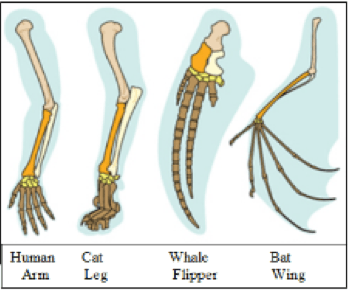
The bones in the figure above are-
Evidence of a common ancestor
Evidence that animals can walk
Evidence that fossils are old
Evidence of nothing
Genome maps provide the DNA sequences of chromosomes. Some scientists have compared the genome maps of a hedgehog and a sloth. What do these genome maps allow the scientists to determine?
The color patterns of the offspring of each species
How much the size ranges of the two species differ
The methods of protein synthesis that each species uses
How closely related the two species are to each other.
What conclusion can you draw from the fact that many modern whale species have vestigial pelvic and leg bones?
The ancestors of whales may have been land mammals
Whales could walk if they wanted to
Whales are preparing to evolve into land animals
Someday whales will be able to walk and will have legs
Scientists discover that cells from two species of organisms are made up of similar proteins, suggesting a close evolutionary relationship. If the scientists do further biochemical analyses, which additional finding would support this conclusion?
The fossils of both organisms are found relatively close to each other in the fossil record.
The anatomical structure of both organisms is similar.
The DNA nucleotide sequence of both organisms is similar.
Both populations of organisms have undergone natural selection over time.

A food web showing feeding relationships of organisms where the fossil skull was found
Population and migration data for small wild cats living in the ecosystem where the skull was found
The fossil record and DNA comparisons of big cats and small cats
The historical record of interactions between different species of big cats

The picture shows similarities among the forelimbs of three animals. The similarities provide evidence for which of the following hypotheses?
Legs and wings may have evolved from flippers.
All mammals have evolved from an ancestor that was a bat.
A cat’s leg, a whales’sflipper, and a bat’s wing have identical functions
Cats, whales, and bats had the same ancestor millions of years ago.

Redi's hypothesis that spontaneous generation does not occur
Haeckel's hypothesis that embryological development mimics the evolution of species
Wallace's hypothesis that geography affects the distribution of species
Darwin's hypothesis that the development of a species is a slow, gradual process
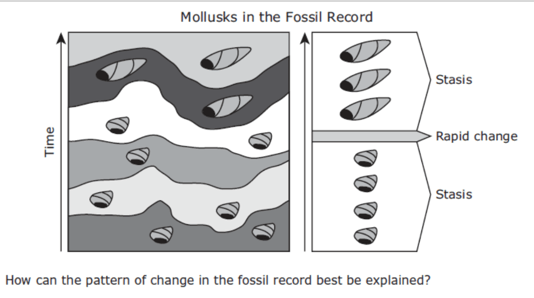
How can the pattern of change in the fossil record best be explained?
The mollusks were well adapted to their stable environment. A large, sudden change occurred in their environment. After the change the mollusks with the bigger shells were better adapted for the new environment.
The mollusks were well adapted to their stable environment. The mollusks hybridized with a smaller species of mollusk. A new species of mollusk with a bigger shell resulted.
The mollusks were not well adapted to their environment. The length of the mollusks' shells changed gradually over time. The mollusks in the original population that had small shells died over a period of many years.

The fact that both these mammals incubate their immature offspring in a pouch provides evidence that they-
Belong to the same species
Must range great distances to eat
Have very similar skeletal structures
Are descended from a common ancestor
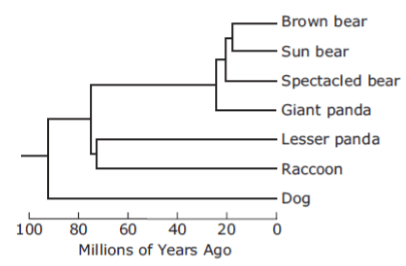
Based on this phylogenetic tree, which statement is true?
Lesser pandas are more genetically similar to giant pandas than they are to raccoons
Brown bears are more genetically similar to giant pandas than they are to sun bears
Lesser pandas are more genetically similar to raccoons than they are to giant pandas
The bear species are all more genetically similar to dogs than they are to giant pandas
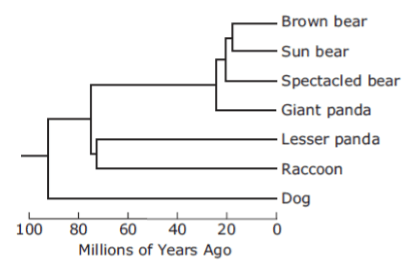
Who is the closest relative to the brown bear?
Giant panda
Dog
Lesser panda
Sun bear

Which is the most recent common ancestor for the giant panda and the raccoon?
A
B
C
None of these are correct

Which of these is the most recent common ancestor between the sun bear and the spectacled bear?
A
B
C
None of these are correct

Which organism is the most distantly related to all the others?
Raccoon
Dog
Giant Panda
Sun Bear
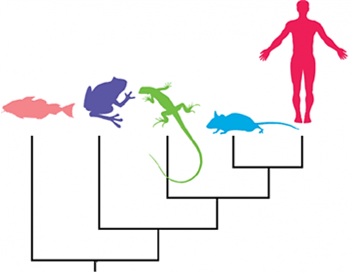
According to this phylogenetic tree, which creature is the least related out of all pictured?
Fish
Frog
Salamander
Human

Some female peacocks prefer males with large, colorful tales while other female peacocks prefer males with no tail at all. Females are now mating only with the tail they prefer. What type of reproductive barrier is this?
behavioral isolation
hybrid sterility
temporal isolation
mechanical isolation
In the Great Lakes region of North America, gray wolves and coyotes are similar species but do not mate because their breeding periods occur at different times of the year.
Geographic isolation
Behavioral isolation
Temporal isolation

individuals with alleles for an extreme type are more likely to survive and reproduce
stabilizing selection
directional selection
disruptive selection
genetic drift

the selection pressure favors the extreme phenotypes, dividing the population into 2 distinct groups
directional selection
stabilizing selection
geographic selection
disruptive selection

Individuals with intermediate traits are more likely to survive and reproduce
stabilizing selection
directional selection
adaptive radiation
disruptive selection
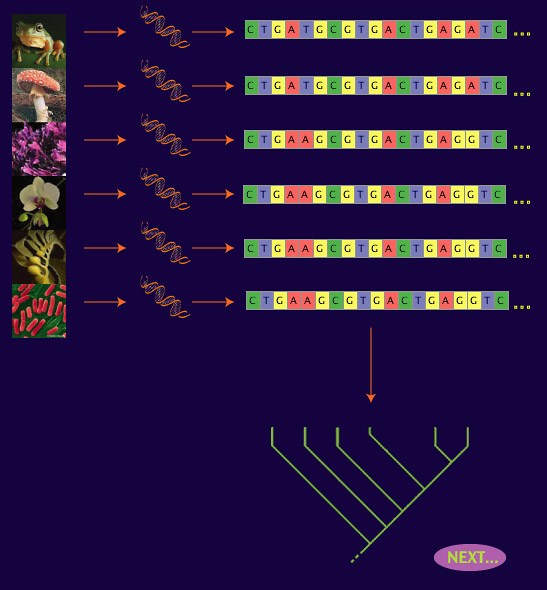
What is the term for a feature that allows an organism to survive better in its environemtn?
variation
adaptation
homologous structure
vestigial structure
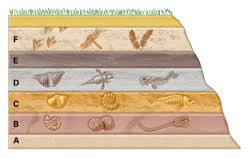
Which rock layer contains the newest fossils?
have the ability to interbreed.

Images of the embryo and adult stages of three different organisms are shown.
Which of the following is the best conclusion that can be drawn from this evidence?
Having similar embryos indicates that these organisms eat the same types of food.
Having similar embryos indicates that these organisms live in a similar environment.
Having similar embryos indicates that these organisms share a recent common ancestor.
Having similar embryos indicates that a certain protein controls how many legs the adult organisms will have.
Researchers discovered that the legs of birds are homologous to the feet of reptiles. Which claim is BEST supported by this fact?
Birds do not require legs
Birds and reptiles have a common ancestor
They randomly developed the same structures
Selection pressures have acted on birds, but not on reptiles
Which type of rock are most fossils found?
sedimentary rock
metamorphic rock
igneous rock
fossils
What happens to new traits that HELP organisms survive over time?
They become MORE COMMON
They become LESS COMMON
They are EQUALLY COMMON


Gigantopithecus were very large primates that lived 500,000 years ago. Since none of these mammals are still today, they are said to be....
Extinct
Threatened
Endangered
Declining

Scientists have collected millions of fossils of different organisms, and have developed a timeline of life on Earth. What do we call this?
Mutation
Natural Selection
The theory of evolution
Fossil Record
What most likely caused the finches on the Galapagos Islands to have beaks that were different from the finches on the mainland?
There were different types of predators on the island.
There were different types of food available on the island.
The finches had no water to drink.
The finches on the mainland could not fly high enough.
When looking at two birds of the same species, you notice that one has darker feathers than the other one. You also notice that one has a beak that is just a little longer. These slight differences within members of the same species are called.....
Fossils
Extinction
Meiosis
Variations

How do we measure the age of a fossil in years?
variation
absolute dating
selection
mutation

Hibernation is an example of which type of adaptation?
Behavioral Adaptation
Physical Adaptation

Beak shape, camouflage, and webbed feet are all examples of which type of adaptation?
Behavioral Adaptation
Physical Adaptation


A change in the genetic material of a cell is called a
mutation.
meiosis.
gene flow.
bottleneck effect.
Which of the following is required for a population to diverge into two separate species?
The two populations must have evolved different physical appearances.
The two populations must have mutated at least 10 times.
The two populations must have become reproductively isolated.
The two populations must have evolved analogous structures.
Which of the following organisms are most likely LEAST closely related?
organisms that share a domain
organisms that share a family
organisms that share a genus
organisms that share a species

The science of describing, classifying, and naming living things is called:
Geology
Biology
Taxonomy
Chemistry

This organism is multicellular, heterotroph, that has a cell wall made of chitin. What kingdom does it belong in?
fungi
plantae
animalia
eubacteria

I am prokaryotic and am found everywhere. What kingdom do I belong to?
Eubacteria
Archaebacteria
Fungi
Protista
What kingdom do unicellular, prokaryotic organisms that live in extreme environments?
Animal
Archaea
Eubacteria
Plant

What is the correct order of taxonomy?
Domain, kingdom, phylum, class, species, genus, family, class
Species, genus, family, order, class, phylum, kingdom, domain
Domain, kingdom, phylum, class, order, family, genus, species
species, phylum, order, class, domain, kingdom, family, genus
Which one of the following is the most general category of living things?
Kingdom
Domain
Phylum
Species

What are the three domains we find in biology?
Archaea, Bacteria, Eukarya
Protista, Eubacteria, Animalia
Prokarya, Bacteria, Archaea
A change in the genetic material of a cell is called a
mutation.
meiosis.
gene flow.
bottleneck effect.

The diagram shows fossils in different rock layers. Which of these statements about the age of these fossils is most likely correct?
Fossil A and C are the same age
Fossil A is older than Fossil B
Fossil B is older than Fossil C
Fossil D is older than Fossil C
Which of the following is required for a population to diverge into two separate species?
The two populations must have evolved different physical appearances.
The two populations must have mutated at least 10 times.
The two populations must have become reproductively isolated.
The two populations must have evolved analogous structures.
The Galapagos finches arrived at that island and fairly rapidly evolved into new species. This is an example of:
Natural Selection
Adaptive Radiation
Survival of the Fittest
Convergent Evolution
Darwin's Theory of Natural Selection says that the number of offspring an organism has ___________________
stays the same
is more than can survive
is less than needed
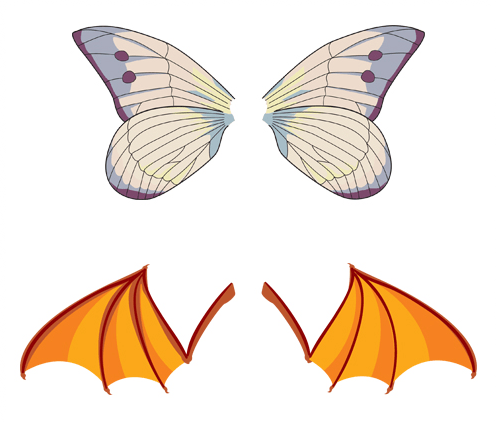
An anatomical feature that no longer seams to have a purpose in the current form of an organism
Homologous structure
Analogous structure
Vestigial structure
None of the above
Which of the following are vestigial structures humans have? Select all that apply.
Appendix
Tailbone
Forearm bones
Goosebumps

Whales have pelvic bones. What type of structure does this best represent?
Homologous structure
Analogous structure
Vestigial structure
None of the above
A species does not change over millions of years. This is an example of:
convergent evolution
analogous structures
stasis
dynamic equilibrium
character chane
The flowers on maple trees are pollinated by the wind, yet they have petals. The petals:
are homologous structures.
are vestigial.
are the result of convergent evolution.
attract pollinators.
Water boatmen (an insect) and whales have flippers. This is an example of:
convergent evolution
vestigial structures
stasis
analogous structures
homology
To be a species, a group of organisms must be able to ...
experience gene flow.
interbreed.
produce infertile offspring.
move and breathe oxygen.

Select the best answer based on the image.
Gene Flow
Genetic Drift
A new river forms and splits two populations, causing ______________ speciation
Sympatric
Allopatric
Extreme
Convergent
Orcas occur in the same habitat but some are avoiding each other and do not interbreed. They have different diets, vocal behavior, and social structures. What type of speciation is this?
Allopatric
Sympatric
Complex
Covergent
Butterflies, bats, and birds all have wings that allow them to fly. Butterfly wings, however do not have bones like bat and bird wings do. What kind of evolution is this?
Convergent Evolution
Divergent Evolution
Punctuated Equilibrium
Gradualism
A population of mollusks are living in a stable ecosystem in the ocean. A rapid drop in sea level causes the formation of a lake, which isolateds a group of mollusks from the rest. This quick environmental change causes rapid evolutionary change. What pattern of evolution is this?
Convergent Evolution
Divergent Evolution
Punctuated Equilibrium
Gradualism
4000 years ago a population of cichlid fish were isolated in Lake Nagubago in central Uganda. Since then 5 new species have formed, distinguished by their differing coloration and mating rituals. These five groups of fish are considered unique species because they do not naturally interbreed.
Convergent Evolution
Divergent Evolution
Punctuated Equilibrium
Gradualism
The Dodo was a flightless bird, first spotted by Dutch sailors in 1598. Dodos had no known predators until sailors started hunting them and new invasive species were introduced. The last sighting of a Dodo was in 1662. What pattern of evolution is this?
Coevolution
Convergent Evolution
Divergent Evolution
Extinction
Male bumblebees go to flowers, such as orchids, to pick up chemicals that allow them to create attractive scents to put off for female bumblebees. Flowers have waxy pollen to stick to the bumblebee's heads and abdomens in order to spread their pollen to other flowers. What pattern of evolution is this?
Convergent Evolution
Coevolution
Gradualism
Punctuated Equilibrium
Type of speciation that occurs without geographic isolation.
Allopatric Speciation
Sympatric Speciation
Prezygotic Speciation
Postzygotic Speciation
Type of speciation caused when populations of a species become geographically isolated and evolve independently
Allopatric Speciation
Sympatric Speciation
Prezygotic Speciaiton
Postzygotic Speciation
Fossil evidence suggests that whales evolved from land mammals. This was a slow process over thousands of years that resulted from continual reduction of the ancestral mammals forelimbs over time, until they were reduced to fins. What pattern of evolution is this?
Coevolution
Convergent Evolution
Gradualism
Punctuated Equilibrium
This type of Prezygotic Barrier is when two species have different courtship behaviors.
Behavioral Isolation
Gametic Isolation
Temporal Isolation
Habitat Isolation
This type of Prezygotic Barrier is when two species have gametes that cannot fertilize each other.
Behavioral Isolation
Gametic Isolation
Temporal Isolation
Habitat Isolation
This type of Prezygotic Barrier is when two species mate at different times of the day/year.
Behavioral Isolation
Gametic Isolation
Temporal Isolation
Habitat Isolation
This type of Prezygotic Barrier is when two species prefer different habitats and are unlikely to meet in the wild.
Behavioral Isolation
Gametic Isolation
Temporal Isolation
Habitat Isolation
This type of Prezygotic Barrier is when two species have reproductive structures or bodies that are not compatible for mating.
Behavioral Isolation
Gametic Isolation
Temporal Isolation
Mechanical Isolation
These are barriers that occur after a zygote has formed
Prezygotic Barriers
Postzygotic Barriers
Behavioral Isolation
Temporal Isolation
These are barriers that occur before a zygote has formed
Prezygotic Barriers
Postzygotic Barriers
Hybridization
Chromosomal Mismatch
Forming of a new species by evolution from pre-existing species is known as
Adaptation
Variation
Speciation
Extinction
Organisms with traits that make them better adapted to their environment will live longer and reproduce more than organisms less adapted to their environment is known as
Natural selection
Genetic Equilibrium
Coevolution
Migration
All genes available in a population is called
Gene pool
Genetic Variation
Gene Flow
Genetic Equilibrium
Migration is also called
Gene pool
Genetic Variation
Gene Flow
Genetic Equilibrium
When allele frequencies in a population are stable and unchanging, and no evolution is occurring a population is said to be in
Gene pool
Genetic Variation
Gene Flow
Genetic Equilibrium
A physical characteristic that helps an organism survive better in its environment is called a/an
Adaptation
Gene Pool
Variation
Gene Flow
Sudden elimination of a species due to a catastrophic event is called
Gradual Extinction
Mass Extinction
Speciation
Gradualism
Slow elimination of a species caused by small environmental changes over time is called
Gradual Extinction
Mass Extinction
Speciation
Gradualism
What are the five factors that can cause extinction?
Disease, Competition, Predators, Meteor, Climate Change
Behavior, Competition, Predators, Adaptation, Reproduction
Gametic, Behavioral, Mechanical, Temporal, Habitat Isolation
Evolution on a large scale affecting changes in species across populations is called (a) .
Differences in the physical traits of organisms are called
Adaptation
Variation
Overproduction of Offspring
Descent with Modification
When all organisms cannot survive due to limited resources it is called
Adaptation
Variation
Overproduction of Offspring
Descent with Modification
A change in gene frequency over time so more beneficial traits become more common in a population is called
Adaptation
Variation
Overproduction of Offspring
Descent with Modification
The selection of traits that aren’t necessarily good for survival fitness, but without them, you can’t pass on your genes at all because you can’t reproduce is known as
Sexual Selection
Variation
Adaptation
Mutation
What is the ultimate form of genetic variation?
Gene flow
Genetic Recombination
Crossing Over
Random Mutation
What theory proposes that evolution occurs steadily in tiny changes over long periods of time?
gradualism
relative dating
natural selection
punctuated equilibria
How does the fossil record help to support the theory of evolution?
the fossil record shows that organisms slowly change over time
The fossil record shows that species evolve very quickly
The fossil record does not support the theory of evolution

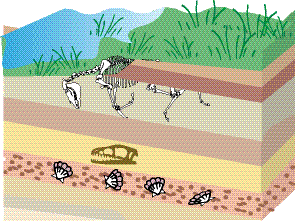
Which rock layer most likely contains fossils of the oldest organisms?
1
2
3
4

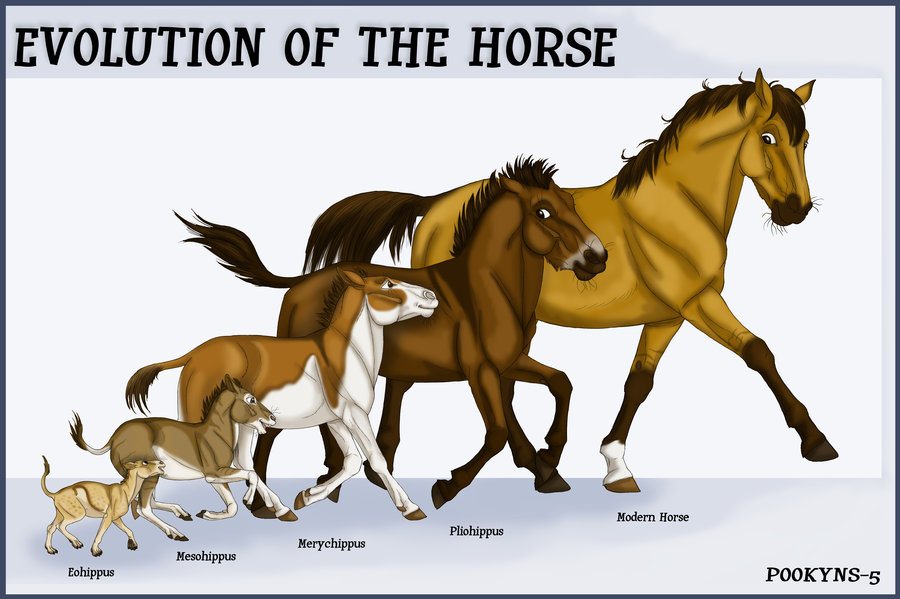
The evolution of the horse is the most complete fossil record we have of a single organism. Using the picture, what can you conclude happened to the horse over time?
The horse grew larger and lost its toes
The horse shrank and lost its toes
The horse grew larger and gained toes
The horse shrank and gained toes
What is the difference between gradualism and punctuated equilibrium?
Gradualism is slowly but surely and P.E. are rapid changes preceeded followed by long periods of little or no change
P.E. is slowly but surely and Gradualism are rapid changes preceeded followed by long periods of little or no change
Gradualism had no intermediate forms of species
punctuated equilibria has intermediate forms of species

Age of Earth
2.1 billion years old
3.5 billion years old
4.6 billion years old
5.3 billion years old
Earliest traces of life found
2.1 billion years ago
3.5 billion years ago
4.6 billion years ago
5.3 billion years ago
Which occurred first?
prokaryotes
eukaryotes
The Endosymbiotic theory focuses on these TWO organelles
nucleus
mitochondria
ribosomes
chloroplast

Evolution occurring gradually and slowly over long periods of time
Homeostasis
Stasis
Punctuated Equilibrium
Gradualism

According to evolutionary theory, all living things have a common
Purpose
Function
Ancestor
Phone Number

Gradualism occurs when geologic and climatic conditions are _______________.
stable
unstable
long
short
Which form of evolution can occur quickly?
gradualism
punctuated equilibrium
allopatric speciation
sympatric speciation
When looking at the following: First dinosaurs, first fish, first modern humans, first reptiles, simple prokaryotes
Which on occurs first?
First dinosaurs
first fish
first modern humans
first reptiles
simple prokaryotes
When looking at the following: First dinosaurs, first fish, first modern humans, first reptiles, simple prokaryotes
Which on occurs second?
First dinosaurs
first fish
first modern humans
first reptiles
simple prokaryotes
When looking at the following: First dinosaurs, first fish, first modern humans, first reptiles, simple prokaryotes
Which on occurs third?
First dinosaurs
first fish
first modern humans
first reptiles
simple prokaryotes
When looking at the following: First dinosaurs, first fish, first modern humans, first reptiles, simple prokaryotes
Which on occurs fourth?
First dinosaurs
first fish
first modern humans
first reptiles
simple prokaryotes
When looking at the following: First dinosaurs, first fish, first modern humans, first reptiles, simple prokaryotes
Which on occurs last?
First dinosaurs
first fish
first modern humans
first reptiles
simple prokaryotes

