
 Worksheets
Thermo Review #2
Total questions: 67
Worksheet time: 1hrs 6mins
Do molecules generally move faster at 45oC or 106oC?
45oC because molecules have more energy than in 106oC
106oC because molecules have more energy than in 45oC
106oC because molecules have less energy than in 45oC
45oC because molecules have less energy than in 106oC
Frying an egg on a skillet. Referring to the egg, would the enthalpy change be positive or negative?
Skillet is absorbing heat energy from the egg. Absorbing energy is Endothermic. Endothermic has a positive Enthalpy
Egg absorbing heat energy from the skillet. Absorbing energy is Endothermic. Endothermic has a positive Enthalpy
Egg absorbing heat energy from the skillet. Releasing energy is Exothermic. Exothermic has a positive Enthalpy
Egg absorbing heat energy from the skillet. Releasing energy is Exothermic. Exothermic has a negative Enthalpy
Define ΔH
Change in Specific Heat; Heat by one Degree Celsius
Change in Temperature; the energy we calculate; Degree Celsius
Change in Enthalpy; the energy/heat we calculate
Change in Time; time travel
Specific Heat is..
the temperature initial minus temperature final
the amount of heat/energy required to raise 1 gram of a substance by 1°C (or K) aka "C"
the temperature final minus temperature initial
the item in a system with given weight in grams
How much energy is needed to raise the temperature of a 20.0-g piece of copper from 15.0oC to 25.0oC? The specific heat of copper is 0.385 J/goC.
-62.0 J
77.0 J
62.0 J
-77.0 J
Is the phase change representing an exothermic or endothermic reaction?
SOLID to LIQUID
Endothermic
Exothermic
Is the reaction exothermic or endothermic?
H2 + S + O2 -> H2SO4 ΔH = -811.13kJ
ΔH is negative so it is exothermic
ΔH is positive so it is exothermic
ΔH is positive so it is endothermic
ΔH is negative so it is endothermic

Is this reaction endothermic or exothermic?
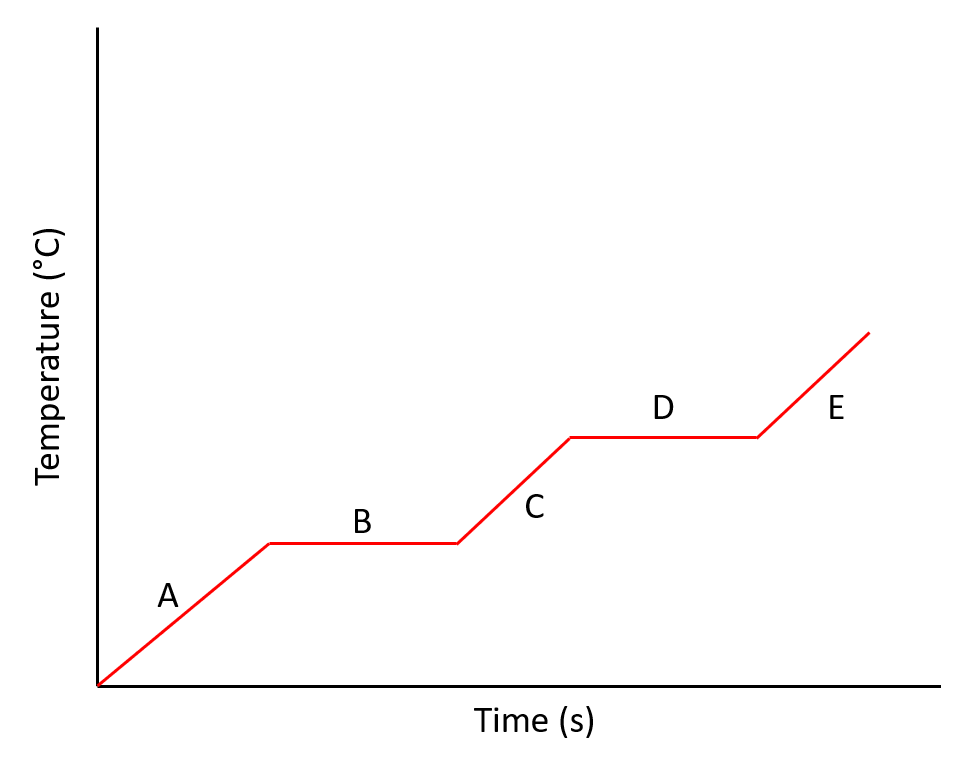
The diagram shows a heating curve for ice. Which line represents the ice melting?
A
B
C
D
E
How many equations would need to be added together to move ice at -15.0oC to room-temperature water at 21.0oC?
1
2
3
4
The diagram shows a heating curve for ice. Which line would require the use of the equation q=nΔHovap?
A
B
C
D
E
Water has a specific heat of 4184 J/kgºC. Wood has a specific heat of 1760 J/kgºC. What material needs more energy to raise the temperature 1ºC (a)
it requires more energy to change temperature
it requires less energy to change temperature

Which will heat up the fastest? (a)
Heat will always transfer from the ___________ object to the ________ object.
The hottest object to the coolest object.
The coolest object to the hottest object.
The solid object to the liquid object.
The liquid object to the solid object.
Thermal energy
Temperature
Heat
Convection
Which one has more thermal energy?
an ice cube in a glass of lemonade
a bathtub full of warm water
a pot of soup boiling on the stove
a cup of hot coffee

What happens if I add ice cubes to a glass of soda
The heat transfers from the coke to the ice
The cold transfers from the ice to the coke
The equation for cellular respiration is shown:
C6H12O6 + 6O2 --> 6CO2 + 6H2O + heat
What can be concluded about the heat energy in the reaction?
The reaction absorbs heat and is, therefore, endothermic.
The reaction absorbs heat and is, therefore, exothermic.
The reaction releases heat and is, therefore, exothermic.
The reaction releases heat and is, therefore, endothermic.
The specific heat of platinum is 0.133 J/g°C. How much heat(Q) is absorbed when a 10 g piece of platinum warms from 100°C to 150°C?
66.5 J
0.0266 J
665 J
0.665 J
Calculate ΔH for the process
Zn (s) + S (s) + 2O2 (g) → ZnSO4 (s)
from the following information:
Zn (s) + S (s) → ZnS (s) ΔH = – 206.0 kJ
ZnS (s) + 2 O2 (g) → ZnSO4 (s) ΔH= – 776.8 kJ
570.8 kJ
-570.8 kJ
-982.8 kJ
982.8 kJ
Students are trying to calculate the heat of reaction for the following overall reaction.
4A + 5B → C + 3D
They find the heat of reactions for the two reactions as shown.
2A + 2B → C + 2D ΔH= -100 kJ
2A +3B → D ΔH= 65 kJ
-35 kJ
-165 kJ
35 kJ
165 kJ

Ammonium nitrate and sodium chloride are each combined with water to make two solutions. The initial and final temperatures of the water are recorded in the table to the left. Based on the data, which is a true statement(s)?
Dissolving ammonium nitrate is endothermic
Dissolving sodium chloride is exothermic
Dissolving ammonium nitrate is exothermic
Dissolving sodium cloride is endothermic
Select all which are endothermic...
H2O(L)-->H2O(g)
H2O(s)-->H2O(L)
H2O(g)-->H2O(L)
H2O(L)-->H2O(s)

Use the graphs to help answer:
In an exothermic reaction, which has more potential energy?
neither
products
reactants
both are equal
.
A hot piece of metal is placed into cooler water. Which statement describes how the second law of thermodynamics relates to this process?
The temperature change of the metal is equal to the temperature change of the water.
The amount of energy lost by the metal is equal to the amount of energy gained by the water.
Energy flows from the metal to the water until they are at the same temperature.
Energy flows from the water to the metal until they are at the same temperature.

The diagram above represents the reaction X2 + Y2 --> 2XY. Which statement describes this reaction?
It is endothermic and energy is absorbed.
It is endothermic and energy is released.
It is exothermic and energy is absorbed.
It is exothermic and energy is released.

Calculate the heat of reaction.
0 KJ
100 KJ
130 KJ
50 KJ

Which letter represents the Activation Energy?
a
b
c
d

Which letter represents the potential energy of the reactants?
a
b
c
d

What type of reaction is this?
Endothermic
Exothermic

In the Image, will the heat (+177.8 KJ) be a product or a reactant?
Product
Reactant
Define the term Exothermic by picking the correct statements. (Choose 3)
Products have less energy than the reactants
ΔH is negative
ΔH is positive
Energy is given out to the surroundings (temperature goes up).
products have more energy than the reactants
Define Endothermic by picking the correct statements. (Choose 3)
ΔH is positive
Energy is taken in from the surroundings (temperature goes down).
Energy is given out to the surroundings (temperature goes up).
· Products have less energy than the reactants
products have more energy than the reactants

Based on the information in the table above, which of the following expressions gives the approximate ΔH° for the reaction represented by the following balanced chemical equation?
Fe2O3(s)+3 CO(g)→2 Fe(s)+3 CO2(g)
ΔH°rxn=[(0kJ/mol)+(−394kJ/mol)]−[(−826kJ/mol)+(−111kJ/mol)]
ΔH°rxn=[2(0kJ/mol)+ 3(−394kJ/mol)]−[(−826kJ/mol)+ 3(−111kJ/mol)]
ΔH°rxn=[(−826kJ/mol)+ 3(−111kJ/mol)]−[2(0kJ/mol)+ 3(−394kJ/mol)]
ΔH°rxn=[(−826kJ/mol)+(−111kJ/mol)]−[(0kJ/mol)+(−394kJ/mol)]
Calculate the enthalpy of reaction (ΔH).
4CO2 (g) + 6H2O (g) → 2C2H6 (g) + 7O2 (g)
ΔHfo [CO2(g)] = -393.5 kJ
ΔHfo [H2O(g)] = -241.8 kJ
ΔHfo [C2H6(g)] = -84.7 kJ
550.647 KJ/mol
2855.584 KJ/mol
-550.647 KJ/mol
-2855.584 KJ/mol
Consider the following equations.
Mg(s) + O2(g) → MgO(s) ∆H = –602 kJ
H2(g) + O2(g) → H2O(g) ∆H = –242 kJ
What is the ∆H value (in kJ) for the following reaction?
MgO(s) + H2(g) → Mg(s) + H2O(g)
-844
-360
+360
+844
4 NH3 (g) + 5 O2 (g) ⟶ 4 NO (g) + 6 H2O (g)
Using the following information, calculate ΔH for the reaction shown above:
N2 (g) + O2 (g) ⟶ 2 NO (g) ΔH = -180.5 kJ
N2 (g) + 3 H2 (g) ⟶ 2 NH3 (g) ΔH = -91.8 kJ
2 H2 (g) + O2 (g) ⟶ 2 H2O (g) ΔH = -483.6 kJ
256.0 kJ
-1628.2 kJ
-6387 kJ
None of these
The enthalpy of reactions for the synthesis two oxides of phosphorus are:
P4(s) + 3O2(g) → P4O6(s) ΔHf = –1600 kJ mol–1
P4(s) + 5O2(g) → P4O10(s) ΔHf = –3000 kJ mol–1
What is the enthalpy change, in kJ mol–1, for the reaction below?
P4O6(s) + 2O2(g) → P4O10(s)
+4600
+1400
–1400
–4600
P4 + 6Cl2 --> 4PCl3 + 2439 kJ

NaCl was heated starting at an initial temperature of 0°C. The heating curve is shown in the picture. What is the melting point of this substance?
0°C
801°C
1000°C
1465°C
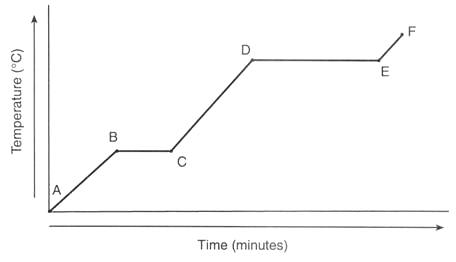
Which section has the lowest energy?

The graph shows the heating curves for benzene and water.
Which substance has a higher boiling point?
benzene
water
A reaction that gives out energy to the surroundings causes the temperature of the surroundings to
increase
decrease
remain constant
What is the term for the amount of energy gained or released in a chemical reaction?
enthalpy of vaporization
enthalpy of condensation
enthalpy of reaction
enthalpy of sublimation
2N2 + 3H2 --> 2NH3 + 46 kJ
How much energy would be produced if only 1 mol of nitrogen was reacted?
C + O2 → CO2
ΔH = -393.5 kJ
When 26 g of a metal at 90 ◦C is added to 46 g of water at 22 ◦C, the temperature of the water rises to 26.5 ◦C. What is the specific heat capacity of the metal? Assume no heat was lost to the surroundings.
0.525J/g◦C
4.18J/g◦C
0.148J/g◦C
2.47J/g◦C


What is the total energy required to raise the temperature of 135 g of water from 22.0°C to 133.0°C?
358,100 J
44,100 J
53,450 J
335,100 J
When carbon disulfide (CS₂) is formed, heat is absorbed. How much heat is absorbed when 5.66 g of carbon disulfide is formed?
C(s) + 2S(s) → CS₂(l), ΔH=89.3 kJ
89.3 kJ
54.9 kJ
37.5 kJ
6.61 kJ
How many equations need to be added together to determine how much heat must be absorbed to bring 50.0 g of water to a boil if it starts at 21.0oC?
1
2
3
4
Which enthalpy change is equal and opposite to the heat of fusion?
heat of combustion
heat of reaction
heat of solidification
heat of vaporization
The heat of combustion is the amount of heat required to burn _____ of a substance
1 mole
1 gram
1 kilogram
25 grams
Which formula represents the calculation of specific heat capacity?
c=QΔTm
c=m+ΔTQ
c=mΔTQ
c=mQΔT
How is temperature related to heat?
Temperature is a measure of the heat of an object.
Heat causes a change in the temperature of an object.
Raising the temperature causes the heat of an object to increase.
Temperature and heat are two different ways to measure the same thing.
In thermodynamics, what does the first law state?
Energy cannot be created or destroyed, only transformed.
Entropy of an isolated system always increases.
Heat cannot spontaneously flow from a colder location to a hotter location.
The total energy of a system and its surroundings is constant.

