
 Worksheets
REVIEW DNA, RNA, PROTEIN SYNTHESIS
Total questions: 70
Worksheet time: 59mins
What sugar does DNA have in its backbone?
Ribose
Deoxyribose
Glucose
Fructose
What sugar does RNA have in its backbone?
Ribose
Deoxyribose
Glucose
Fructose
Which nucleic acid is double-stranded?
DNA
RNA
Which nucleic acid is single-stranded?
DNA
RNA
Which combination of nucleotides does RNA have?
A, C, U, and T
G, U, A, T
A, C, G, T
A, C, G, U
What combination of nucleotides does DNA have?
A, C, U, and T
G, U, A, T
A, C, G, and T
A, C, G, and U
What make the backbone of DNA? Check all that apply.
Deoxyribose
Ribose
Phosphate Groups
Nitrogenous Base
What makes the backbone of RNA?
Deoxyribose
Ribose
Phosphate Groups
Nitrogenous Base
Which molecule can only ever be found in the nucleus?
RNA
DNA
Protein
Water
Which molecule exits the nucleus after being made?
RNA
DNA
Water
Energy

The images Rosalind Franklin captured help determine that DNA was a double helix. What method did she use?
X-ray crystallography
Karyotyping
Electricity
DNA fingerprinting

A nucleotide consists of what 3 components?
Sugar
Phosphate Group
Nitrogenous Base
Hydrochloric Acid
What is the purpose of DNA?
To insulate against the cold
To make reactions happen quickly
To store and transmit genes
Structural Support
What shape is DNA?
A single helix
A crstyal
A double helix
Primary Structure
Which molecules help to replicate DNA and build RNA?
Acids & Bases
Enzymes
Carbohydrates
Lipids
Which nitrogenous base does Thymine always pair with?
Cytosine
Guanine
Adenine
Uracil
What nitrogenous base does Uracil always pair with?
Cytosine
Guanine
Adenine
Thymine
A scientist analyzes a DNA molecule and discovers that 25% of its nitrogenous bases are Cytosine. How many bases must be Guanine?
0% Guanine
25% Guanine
50% Guanine
75% Guanine
DNA Polymerase, Helicase, and Ligase are all examples of which type of molecule?
Carbohydrates
Nucleic Acids
Lipids
Enzymes
After replication, what is a DNA molecule made out of?
(The Semi-Conservative Model.)
Two new strands
Two old strands
One old strand and one new strand.
Your body is using your DNA to make a piece of RNA (transcription). If the DNA code is TAAAG, then what will the matching RNA code be?
TAAAG
ATTTC
AUUUC
UTTTC

What Sub-type of mutation is this?
Substitution
Deletion
Insertion
Three Nucleotides in a row of DNA or mRNA are called a...
(a)
Match the following Mutations
Deletion
Entire sequence shifts to the left
Insertion
Entire sequence shifts to the right
Substitution
One Nucleotide is swapped for another
Point
Only one nucleotide is affected
Frameshift
More than one nucleotide is affected and entire sequence shifts
Match the following Mutations
Missense
Causes chance in amino acid sequence ; results in different protein
Nonsense
Causes an amino acid to change into a "STOP" codon
Silent
Has no effect on amino acids or proteins
What Type of mutation is this?
Point
Frameshift
The purpose of replication is to
eliminate DNA
make more DNA
change the DNA
Where does replication happen in human cells?
the cell membrane
the ribosome
the nucleus

When does replication happen?
mitosis
cell division
interphase
The enzyme that unzips DNA by breaking hydrogen bonds is
ligase
helicase
DNA polymerase
primase
DNA polymerase is called "the builder" because it
digs a foundation
makes new strands of DNA
breaks hydrogen bonds
Which of the following are the correct pairings of DNA nucleotides?
A-T
A-C
C-T
C-G
Polymerase
builds the complimentary DNA strand
Ligase
bonds DNA fragments together
Primase
Indicates whee DNA replication begins
Helicase
"unzips" the DNA
DNA is unzipped
Primase marks region to begin replication
Polymerase builds complimentary DNA strand
Ligase bonds DNA fragments
What are the nucleotides made of?
Sugar, Phosphate, nitrogen base
Phosphate, Adenine, nitrogen base
Thymine, Adenine, Cytomine
Phosphate, Nitrogen, Adenine
Which sequence of DNA bases would pair with this partial strand
CAT TCA CTG
ATG TGA CAG
TAC ACT GTC
GTA AGT GAC
CAT TCA CTG
CAT TCA CTG
In what process is mRNA synthesized?
Transcription
Translation
DNA Replication
Mitosis
Where does TRANSCRIPTION occur?
Nucleus
Ribosome
Cytoplasm
Mitochondria
Why must transcription occur where DNA can be found?
because DNA can't leave
because ribosomes are in the nucleus
because DNA polymerase is found there
because helicase unzips the DNA
How many nucleotides equal 1 amino acid?
1
2
3
4

A polypeptide is a sequence of ____________________ held together by a ______________ bond.
amino acids; peptide
fatty acids; ionic
proteins; hydrogen
fatty acids; covalent
TRANSCRIBE this DNA sequence: TACGTTACT
AUGCAAUGA
ATGCAATGA
AUGGATUGA
TACGTTACT
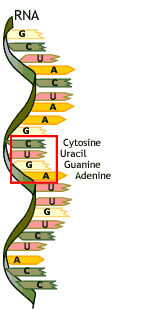
TRANSLATE this RNA sequence: AUGCAAUGA
Met-Glu-Stop
Met-His-Stop
Thr-Glu-Stop
Thr-Pro-Stop
GTAGTCA
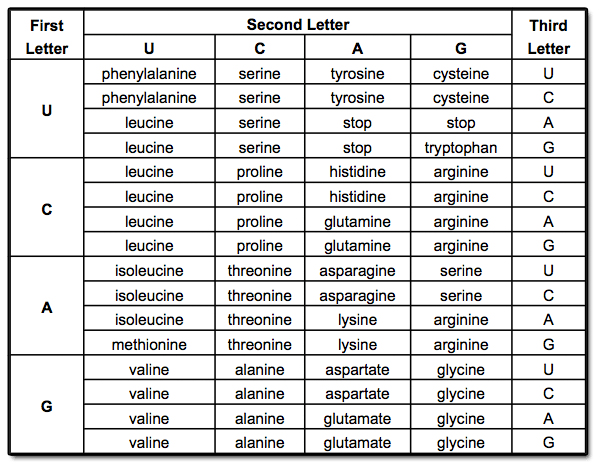

Select the RNA sequence or sequences for STOP.
UCC
UAA
UGA
UAG
Proteins are mode of
nucleotides
glucose
fatty acids
amino acids
Select the DNA sequence or sequences for Lysine.
TTC
AAC
TTT
TAT

Find the amino acid that this segment of DNA codes for: CGT
Alanine
Stop
Valine
Leucine
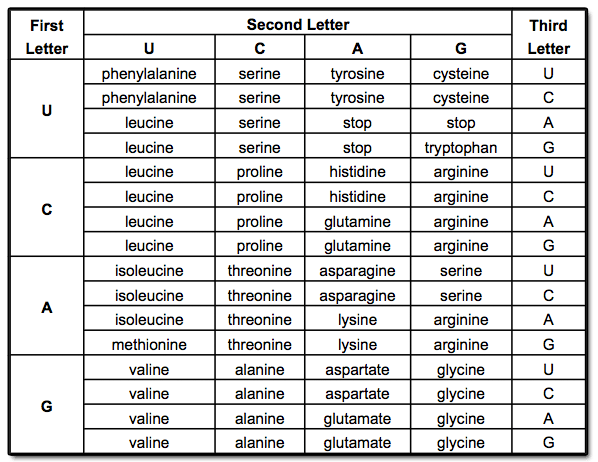
Find the amino acid that this segment of RNA codes for: UUG
Glycine
Asparagine
Lysine
Leucine
Find the amino acid that this segment of DNA codes for: GAC
Leucine
Serine
Aspartic Acid
Histine
MET is know as the __________ codon.
stop
main
start
most common
Where is RNA made into protein?
Cytoplasm
Nucleus
Ribosome
Cell Membrane

A student performed a gel electrophoresis experiment. The results are represented in the diagram
below. Compared to the fragments at the top of the gel, the fragments at the lower end are
larger, and move slower
larger, and move faster
smaller, and move faster
smaller, and move slower

This laboratory procedure is known as
CLONING
gel electrophoresis
chromatography
use of a dichotomous key


Clones have the exact same:
Personalities
Physical appearances
Intelligence levels
Genetic material


What is the process of making an exact genetic copy of a living thing?
Genes
Cells
Tissues
Cloning
A breeder of a champion german shepard wants to make an exact copy of his champion dog. Which process can solve this problem.
organism cloning
genome sequencing
gene therapy
DNA fingerprinting

