
 Worksheets
4/15 - HW - Reporting Category 5 - Environmental Systems
Total questions: 75
Worksheet time: 56mins

If farmers use a controlled burn to prevent forest fires, what would most likely be the first plants to return?
trees
shrubs
mosses
grasses
Which would result in primary succession?
volcano destroying habitat leaving only soil and ash
Tornado destroying a crop leaving very little soil
Glacier retreating exposing bare rock
limiting factors
Primary succession occurs in areas with:
very little soil
lots of soil
no soil
soil that has been disturbed
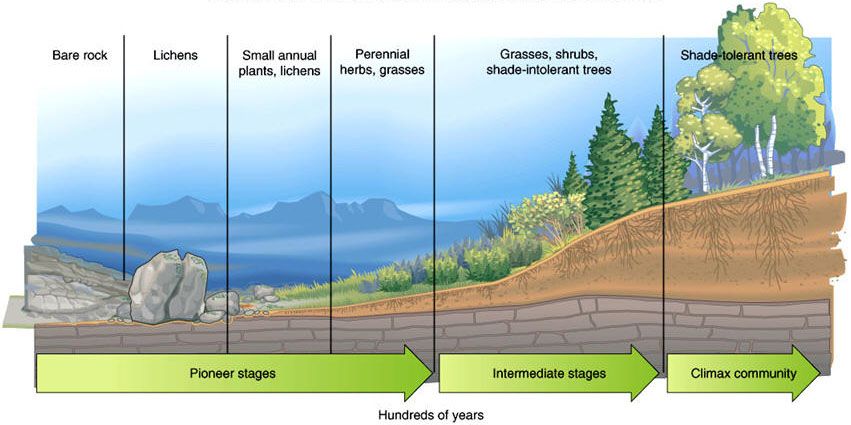
The picture shows what type of succession?
primary
secondary
tertiary
quadanary
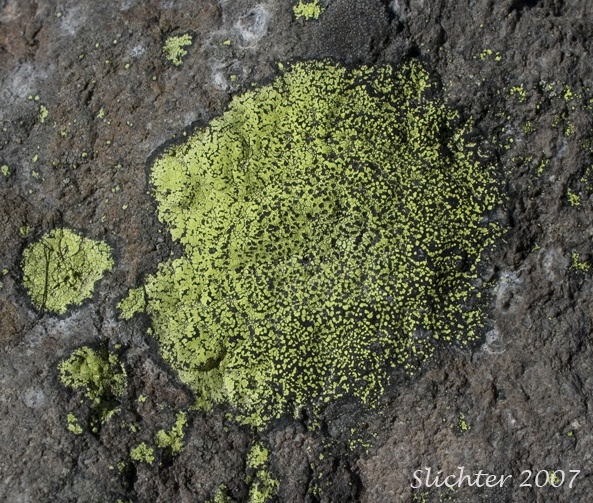
After a volcanic eruption, lava covers the land. What is the order that plants grow to repopulate the area?
Lichens → Shrubs → Grasses → Trees
Lichens → tree → shrubs→Grasses
Grasses → Lichens → Shrubs → Trees
Lichens → Grasses → Shrubs → Trees


Primary succession

pioneer species

abiotic factor

secondary sucession

climax community
What are the 3 major relationship types?
Mutualism
Predation
Commensalism
Competition
Symbiosis
Competition
A lion and a hyena pack fight over a fresh kill.
Predator-Pray
An anteater consuming the ants in an anthill
Symbiosis
Bacteria in our gut that helps us digest food
Beneficial bacteria in our gut
Mutualism
Bacterial infection in an open wound
Parasitism
Bacteria on our skin
Commensalism
Different bacteria filling in any open space first
Competition
Shellfish feading on bacteria through filtration
Predation
Type of relationship: A wolf eating a rabbit.
Predator/prey
Parasite/host
Producer/consumer
Competitors

Type of relationship: cow eating grass.
Predator/prey
Parasite/host
Producer/consumer
Competitors


Mistletoe takes water and nutrients from the spruce, harming the tree. This is an example of -
Mutualism
Commensalism
Parasitism
Predation
Which model correctly shows energy flow in a food chain?


red fox
black bear
deer
rabbit
Decomposers are important in the food chain because they:
produce their own food using light from the Sun.
stop the flow of energy from one organism to another.
break down dead organisms and recycle nutrients into the soil.
are microscopic and other organisms cannot consume them.

What trophic level do the crabs belong to?
Producer
Primary consumer
Secondary consumer
Tertiary consumer

kelp to have less food.
crabs to have more food.
sea ducks to have less food.
arctic foxes to have more food.


Which of the following would you most likely see at the bottom of an energy pyramid?
Grass
Mice
Snakes
Hawk
Which of the following would you most likely see at the top of a biomass pyramid in an ocean food chain?
Plankton
Small fish
Large fish
Great white shark

If the seeds, nuts, roots, grass, leaves, and flowers level had 1,000 kcal, how many kcal would be in the hawks and owls level?
1,000 kcal
100 kcal
10 kcal
1 kcal
There are 4 types of heterotrophs. Match each with its description
herbivore
gets energy from eating vegetation
omnivore
gets energy from eating meat and vegetation
carnivore
gets energy from eating meat
detritovore (scavenger)
gets energy/nutrients from dead matter
What
happens to the amount of energy in the pyramid as it moves up through the
different levels?
Energy increases by 10% each level.
Energy decreases by 90% each level.
Energy increases by 90% each level.
Energy decreases by 10% each level.
The arrows in a food chain or web represents what?
They point to the organism that is being eaten.
It shows how sunlight flows within an ecosystem.
They show the direction the energy is flowing between organisms.
They represent how water is transferred within a habitat.
A ___ is an organism that makes its own food.
A ___ is an organism that eats other organisms to gain energy.
A ___ is an organism that breaks down dead organisms to gain energy.
producer, consumer, decomposer
producer, decomposer, consumer
consumer, producer, decomposer
decomposer, producer, consumer
Organisms that make their own food are called ___.
Organisms that eat other organisms to gain energy are called ___.
carnivores, herbivores
heterotrophs, autotrophs
autotrophs, heterotrophs
herbivores, carnivores

The blue line on the graph shows the rabbit population, and the red line shows the wolf population. Which statement about the graph is true?
When the wolf population begins to increase, the rabbit population begins to decrease.
When the rabbit population is at its lowest, the wolf population is also at its lowest.
When the rabbit population is at its highest, the wolf population is also at its highest.
When the wolf population begins to increase, the rabbit population also begins to increase.

In this food web, how many different organisms feed on the producer?
2
3
4
5

which number on the diagram below sows the level of secondary consumers?
3
2
1
Match the following!
Second level of the food chain
Primary Consumers
First level of the food chain
Producers
Third level of the food chain
Secondary Consumers
Fourth level of the food chain
Tertiary Consumers
Fifth level of the food chain
Quaternary Consumers

Enchanted Rock State Natural Area is located in central Texas. Enchanted Rock is a dome of granite. The area consists of four easily identifiable communities. The table describes the characteristics of each type of community in the area.
A student studying primary succession should focus on which of these communities?
Open oak woodland
Mesquite grassland
Floodplain
Granite rock
Decomposer
This is an organism that breaks down and gains nutrients from dead organisms.
Predator
This is an animal that lives by preying on other animals.
Producer
This is an organism that supplies matter and energy, also known as an autotroph.
Consumer
This is an organism that relies on other organisms for its food and energy supply; heterotroph
Parasite
This is an organism which feeds on, but usually does not kill, a larger organism
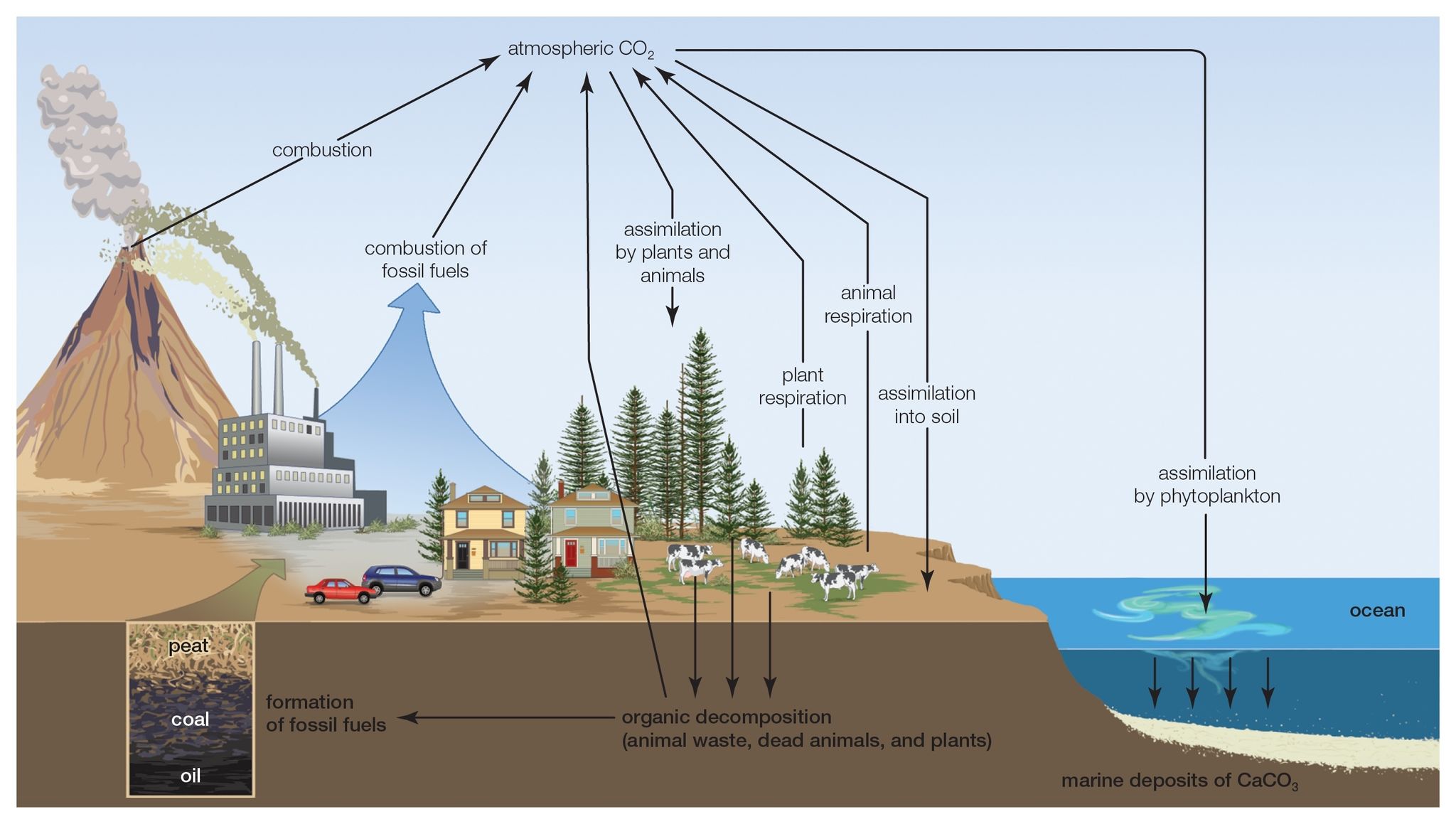
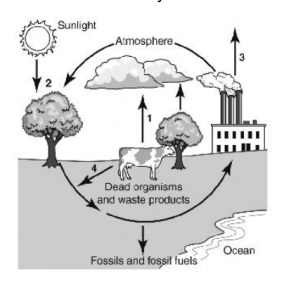


What process converts nitrogen gas into a biologically useful (fixed) form?
Respiration
Assimilation
Denitrification
Nitrogen fixation
Which organisms play the largest role in converting nitrogen into various usable forms and back to a gas form?
rabbits
bacteria
plants
worms
Which gas is most abundant in the atmosphere?
carbon dioxide
methane
nitrous oxide
nitrogen gas
The process that releases carbon and nitrogen into the soil through decay is...
erosion
photosynthesis
decomposition
assimilation
Why do heterotrophs need nitrogen?
to build proteins
to get energy
to conduct cell processes
to absorb excess nitrogen from the soil

A bee receives nectar from a flower and carries the pollen to other flowers:
predation
parasitism
mutualism
commensalism
Mistletoe grows and spreads on trees, taking their nutrients:
predation
parasitism
mutualism
commensalism
What would happen within a few months after the formation of a volcanic island?
pioneer species would grow
no pioneer species would grow
trees and large plants would grow
rich, organic soil would be present
What would be a good example of a primary consumer?
carnivore
detrivore
decomposer
herbivore

Which organisms would be at the top or last trophic level?
plant
herbivore
omnivore
carnivore

The monkey would be a
decomposer
producer
primary consumer
secondary consumer
Introduced species disrupt ecosystems because they are a/an
Keystone Species
Endemic Species
Invasive Species
Native Species
Which is an example of where primary succession could occur?
a glacier melts and exposes new rocks
natural fire burns a prairie
a corn field is abandoned and left to overgrow
flood covers a piece of land

Barnacles do not affect whales as they grow, but receive the benefit of a food source. This is
parasitism
mutualism
commensalism
neutralism

Mice might grow in population and destroy the community by eating all of the berry bushes if
wolves and snakes were removed from the food web
another predator migrated in to the community
the snake population grew
none of these

These organisms are often not shown in a food chain, but are important for recycling nutrients
producers
decomposers
primary consumers
carnivores
Which event would not cause secondary succession?
forest fire
flooding of a valley
volcanic lava flow
tornado
A lion that eats a zebra that eats grass is a
primary consumer
secondary consumer
tertiary consumer
quaternary consumer

90% of the energy that gets lost as you move up a food pyramid or chain gets lost as
pollution to the environment
heat to the environment
energy for decomposers
gets recycled
What percentage of energy is passed on to the next trophic level?
5%
10%
50%
90%

