
 Worksheets
R 4.1: REVIEW: UNIT 4: CELLULAR REPRODUCTION: 5D 20W S2 24
Total questions: 42
Worksheet time: 21mins
Name
Class
Date
1.
Fission, budding, and fragmentation are all forms of _____ reproduction.
a)
asexual
b)
sexual
c)
sporous
d)
diverse
2.
What word choice below has a prefix that means “without”?
a)
asexual
b)
sexual
c)
sporous
d)
diverse
3.
What statement of evidence below supports the claim "An advantage of sexual reproduction is that it increases the variety of individuals in a population."
a)
It is an easier method of reproduction for non-moving organisms.
b)
It creates lower genetic diversity within the population.
c)
It creates greater genetic diversity within the population.
d)
It allows for a greater number of identical individuals to survive in a stable environment.
4.
Which of the following is NOT a form of asexual reproduction?
a)
Fertilization
b)
Fragmentation
c)
Fission
d)
Budding
5.
What claim below can be applied as strong evidence to the claim ”Genetic variation can influence a species' survival.”
a)
Makes reproduction more likely.
b)
Increases the number of individuals available to reproduce with.
c)
Increases the ability to adapt to environmental changes.
d)
Decreases the ability to adapt to environmental changes.
6.
Which of the following statements of evidence can be considered TRUE concerning sexual reproduction?
a)
It results in offspring that are genetically identical to the parent
b)
It requires two parents
c)
It can result when a single organism splits into two identical organisms
d)
It is always seen in one-celled organisms like amoebas
e)
All of the answers are true concerning sexual reproduction
7.
Which type of asexual reproduction involves an organism forming a growth that develops into a new organism and then breaks off? (THINK YEAST CELLS)
a)
Metastasis
b)
Fragmentation
c)
Vegetative Propagation
d)
Budding
e)
Binary Fission
8.
Which of the following is a way for plants to reproduce without seeds?
a)
Splitting
b)
Vegetative Propagation
c)
Fragmentation
d)
Budding
e)
Binary Fission
9.
TRUE OR FALSE: An advantage of sexual reproduction is that it provides an opportunity for genetic diversity of the species.
a)
True
b)
False
10.
TRUE OR FALSE: When fertilization in humans occurs, the male (sperm) and the female (egg) sex cells (gametes) unite, the fertilized egg is called a zygote.
a)
True
b)
False
11.
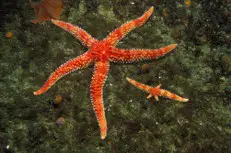
Identify the type of cellular reproduction in the picture.
a)
Binary Fission
b)
Budding
c)
Fragmentation
d)
Regeneration
12.
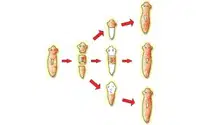
A parent cell breaks into pieces and each piece becomes a new offspring. (THINK PLANARIA)
a)
Binary Fission
b)
Budding
c)
Fragmentation
d)
Vegetative Reproductions
13.
Changes in an organism that affect its appearance, how it behaves, and its functions.
a)
Complication
b)
Gamete
c)
Mutation
d)
Zygote
14.
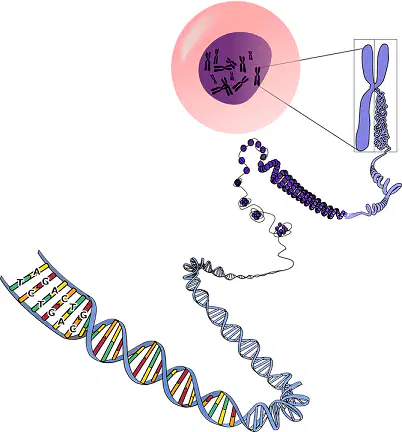
TRUE OR FALSE: Chromosomes are constructed of tightly wound strands of deoxyribonucleic acid.
a)
TRUE
b)
False
15.
The cell cycle consists of mitosis and which other phase?
a)
Anaphase
b)
Interphase
c)
Metaphase
d)
Prophase
16.
Which of these could NOT be achieved by the process of mitosis?
a)
Formation of gametes
b)
Growth of an organism
c)
Repair of a tissue
d)
Asexual reproduction in some species
17.
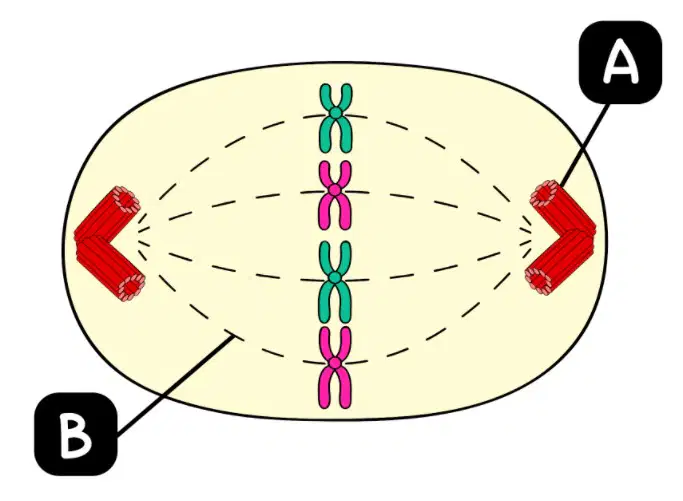
Which stage of mitosis is shown in the image?
a)
Metaphase
b)
Telophase
c)
Prophase
d)
Anaphase
18.
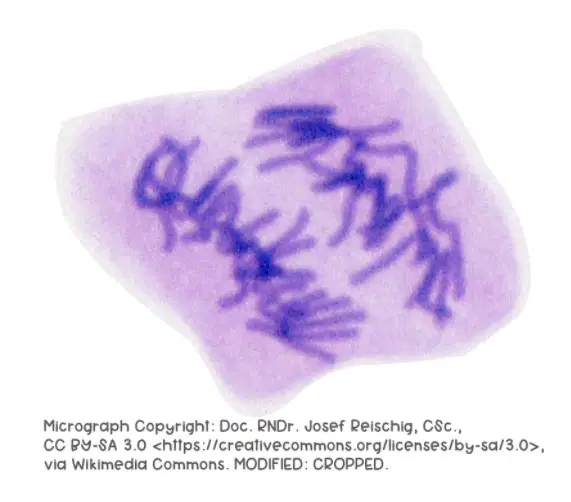
Which stage of mitosis is shown in the image?
a)
Metaphase
b)
Telophase
c)
Prophase
d)
Anaphase
19.
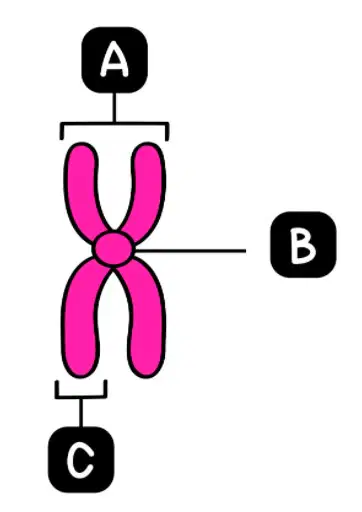
Identify the structure labeled A
a)
Chromosome
b)
Centromere
c)
Centrosome
d)
Chromatid
20.
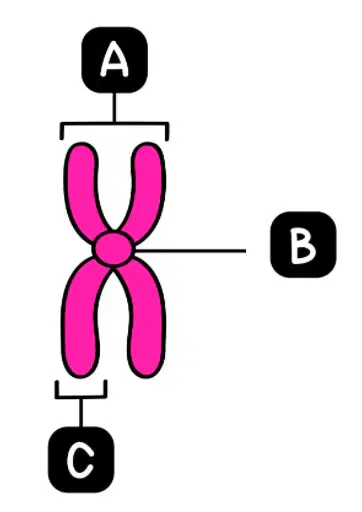
Identify the structure labeled B
a)
Chromosome
b)
Centromere
c)
Centrosome
d)
Chromatid
21.
Following the four phases of mitosis, which process occurs to physically divide the cytoplasm to form new cells?
a)
Apoptosis
b)
Cytokinesis
c)
Meiosis
d)
Gluconeogenesis
22.
How many daughter cells are produced in mitosis?
a)
1
b)
2
c)
3
d)
4
23.
Starting with one cell that underwent six divisions, how many cells would result?
a)
12
b)
48
c)
64
d)
128
24.
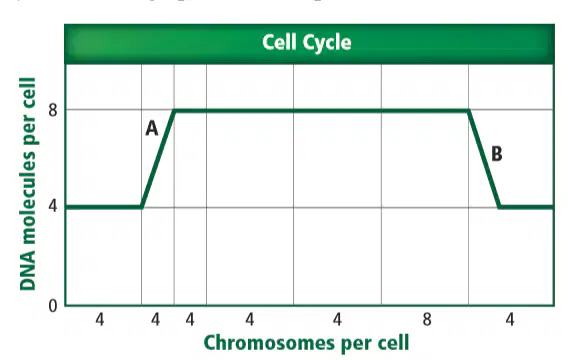
What stage occurred in the area labeled B?
a)
interphase
b)
cytokinesis
c)
mitosis
d)
metabolism
25.
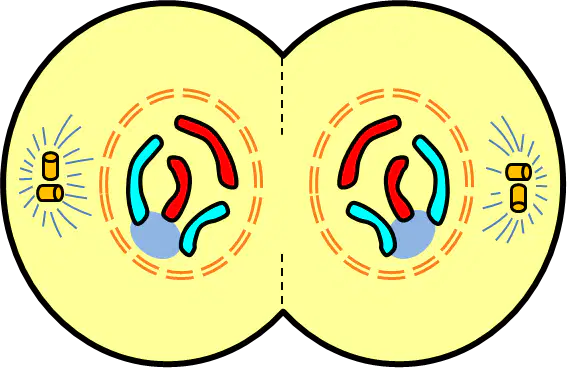
Identify the stage that the cell is in.
a)
telophase
b)
anaphase
c)
prophase
d)
prometaphase
26.
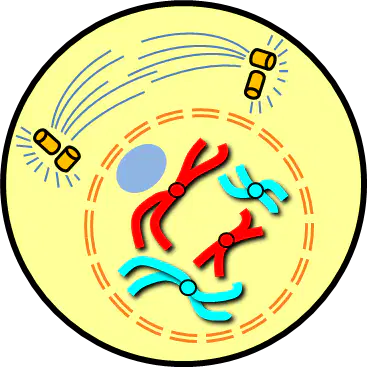
Identify the stage that the cell is in.
a)
telophase
b)
anaphase
c)
prophase
d)
prometaphase
27.
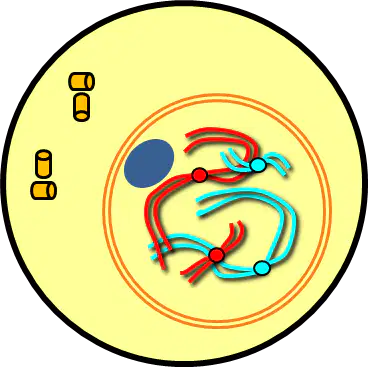
Identify the stage that the cell is in.
a)
interphase
b)
telophase
c)
anaphase
d)
prophase
e)
prometaphase
28.
In which phase do cells spend most of their life?
a)
Interphase
b)
Prophase
c)
Metaphase
d)
Anaphase
e)
Telophase
29.
Which type of cell is produced by meiosis?
a)
Sex cells
b)
Somatic cells
c)
Stem cells
d)
Skin cells
30.
Normal human body cells have 46 chromosomes. What is the haploid number of chromosomes?
a)
46
b)
23
c)
92
d)
12
31.
TRUE or FALSE: Meiosis produces daughter cells that are genetically identical to each other.
a)
True
b)
False
32.
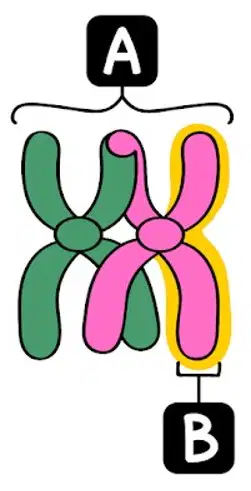
What process is occurring in the diagram?
a)
Crossing over
b)
Independent assortment
c)
Fertilization
d)
Genetic inheritance
33.
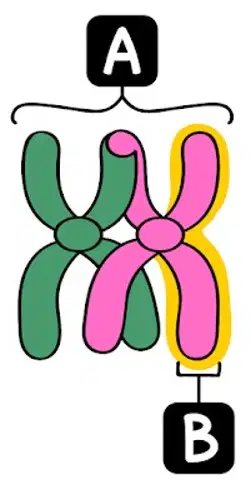
How many chromosomes are shown in the diagram?
a)
1
b)
2
c)
3
d)
4
34.
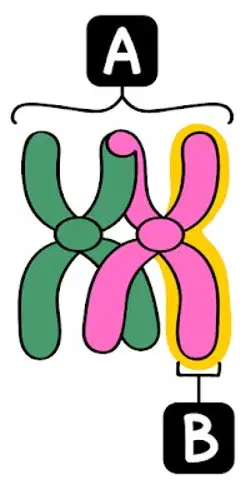
What is the name for the object labelled as "A"?
a)
Homologous chromosomes
b)
Sister chromosomes
c)
A chromatid
d)
Recombinant chromosomes
35.
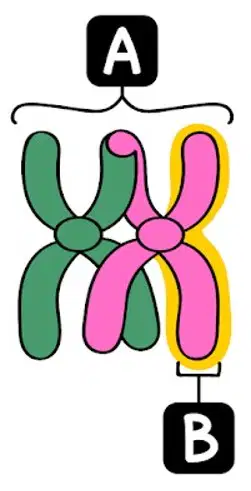
What is the name for the object labelled as "B"?
a)
Homologous chromosomes
b)
Sister chromosomes
c)
A chromatid
d)
Recombinant chromosomes
36.
How many daughter cells are produced in meiosis?
a)
1
b)
2
c)
4
d)
8
37.
How many cellular divisions phases take place during meiosis?
a)
1
b)
2
c)
4
d)
8
38.
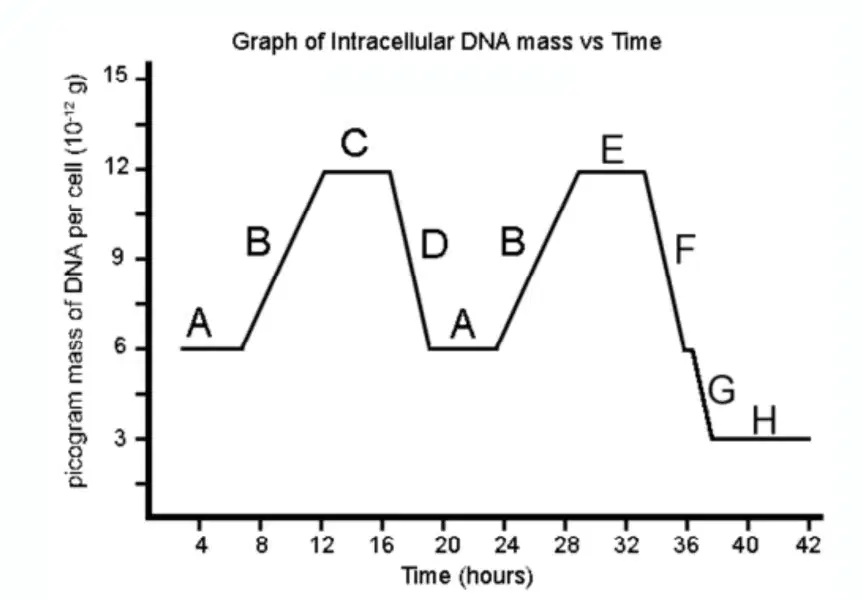
According to the graph, how much DNA is present at point C?
a)
3 picograms
b)
6 picograms
c)
9 picograms
d)
12 picograms
39.
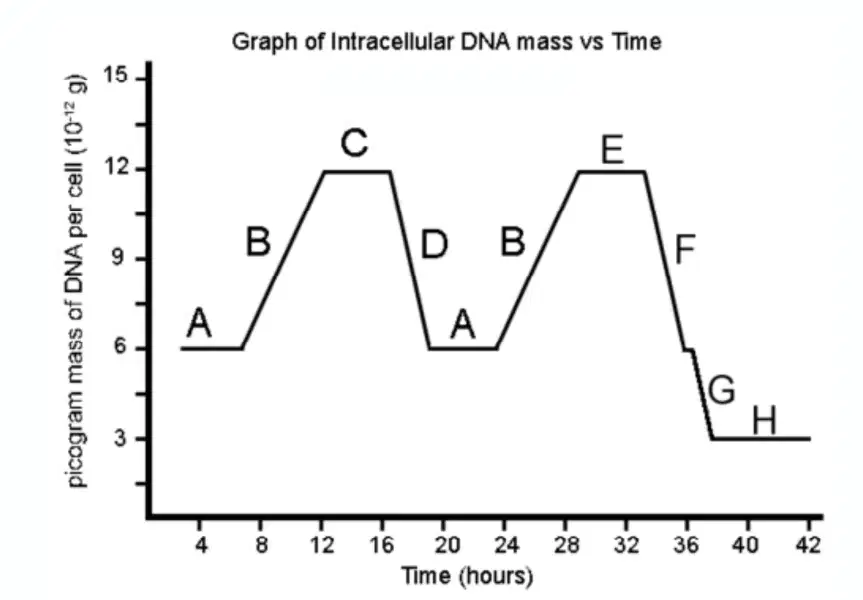
Which stage of meiosis may the cell be in at point C?
a)
End of Interphase
b)
Middle of Prophase
c)
Start of Metaphase
d)
End of Anaphase
40.
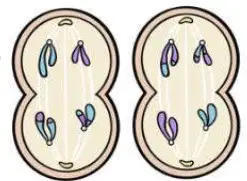
Identify the following phase of meiosis
a)
Interphase II
b)
Prophase
c)
Metaphase
d)
Anaphase II
41.
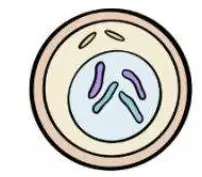
Identify the following phase of meiosis
a)
Interphase
b)
Prophase
c)
Metaphase
d)
Anaphase I
42.
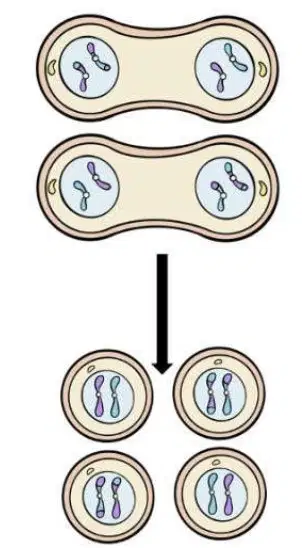
Identify the phase of meiosis.
a)
Prophase II
b)
Metaphase II
c)
Anaphase II
d)
Telophase II
100 %

