
 Worksheets
Thermochem & Gases Review
Total questions: 55
Worksheet time: 2hrs 13mins
What mass of aluminum (c= 0.89 J/g·°C) is needed if the temperature changes from 17°C to 45 °C when 450 J of heat is absorbed by the metal? Is this process endothermic or exothermic?
50 g, endothermic
100 g, endothermic
150 g, endothermic
200 g, exothermic
How much heat is released when 56 g of copper (c= 0.39 J/g·°C) is cooled from 100°C to 15 °C? Is this process endothermic or exothermic?
-1516.8 J, exothermic
1516.8 J, endothermic
-1516.8 J, endothermic
1516.8 J, exothermic
What is the change in temperature when 15 g sample of water (c=4.18 J/g°C) absorbs 875 J of heat? Is this process endothermic or exothermic?
14.0 °C, endothermic
14.0 °C, exothermic
58.7 °C, endothermic
58.7 °C, exothermic
Aluminum metal (c= 0.89 J/g·°C) at 100.0 °C is added to 250.0 g of water (c=4.18 J/g·°C) at 17 °C. If the final temperature of the system is 23°C, what was the mass of Aluminum?
50 g
100 g
150 g
200 g
A 55.0 g sample of an unknown metal at 85°C is added to a 220 g sample of water (c=4.18 J/g·°C) at 22 °C. If the final temperature of the system is 26 °C, what is the specific heat value of the metal?
0.385 J/g·°C
0.450 J/g·°C
0.215 J/g·°C
0.328 J/g·°C
On which line would you use the following formulas? q = m∙ΔH_fusion and q = m∙ΔH_vaporization
When calculating the heat absorbed or released during melting or freezing and evaporating or condensing
When determining the speed of an object in motion
When calculating the gravitational force between two objects
When measuring the electrical resistance in a circuit
Given the following information, calculate how much energy is needed to raise the temperature of 10g of ice at -15°C to steam at 120°C.
15,403.75
30,807.5
45,210.25
60,614
When calculating heat using a cooling curve, the q value should always be _______.
positive
negative
zero
variable
What will happen to the volume of a balloon if it is heated?
It will decrease
It will increase
It will stay the same
there will be no change
What will happen to the pressure of a gas when the volume is decreased?
The pressure will increase
The pressure will decrease
The pressure will remain the same
The pressure will initially decrease then increase
What will happen to temperature of a gas when pressure is decreased?
The temperature will increase
The temperature will decrease
The temperature will remain the same
It depends on other conditions
A 4.58 mL sample of a gas is collected when the pressure is 855 torr. What will be the volume when the pressure is 760 torr?
4.58 mL
5.15 mL
6.00 mL
3.50 mL
A 450 mL is collected when the temperature is 5.5°C and the pressure is 0.8 atm. What will be the volume at 0°C and 1.5 atm?
19.8 mL
450 mL
200 mL
150 mL
A 5.0 L sample of a gas is collected when the temperature is 15°C. What will be the volume of the gas when the temperature is 45 °C?
5.0 L
5.52 L
6.0 L
4.5 L
How many moles of hydrogen gas are collected when the temperature of the gas is 15 °C, the pressure is 1.2 atm, and the volume is .350 L?
0.014 moles
0.0178 moles
0.020 moles
0.025 moles
The pressure of a sample of a gas at 350 K is 0.934 atm. What will be the pressure at 280 K?
0.75 atm
0.934 atm
1 atm
0.5 atm
Using the equations below:
C(s) + O2(g) → CO2(g) ∆H = –400 kJ
Mn(s) + O2(g) → MnO2(s) ∆H = –500 kJ
what is ∆H (in kJ) for the following reaction?
MnO2(s) + C(s) → Mn(s) + CO2(g) ∆H = ??? kJ
-900 kJ
900 kJ
–100 kJ
100 kJ
Using the equation below:
C(s) + O2(g) → CO2(g) ∆H = –400 kJ
what is ∆H (in kJ) for the following reaction?
CO2(g) → C(s) + O2(g) ∆H = ?? kJ
+400 kJ
–400 kJ
4001 kJ
–800 kJ
Using the equations below:
Mn(s) + O2(g) → MnO2(s) ∆H = –500 kJ
what is ∆H (in kJ) for the following reaction?
MnO2(s) → Mn(s) + O2(g) ∆H = ??? kJ
+500 kJ
–500 kJ
5001 kJ
−5001 kJ
Using the equations below:
Mn(s) + O2(g) → MnO2(s) ∆H = –500 kJ
what is ∆H (in kJ) for the following reaction?
3 MnO2(s) → 3 Mn(s) + 3 O2(g) ∆H = ??? kJ
+ 500 kJ
–500 kJ
–1500 kJ
+ 1500 kJ
Using the equation below:
C(s) + O2(g) → CO2(g) ∆H = –400 kJ
what is ∆H (in kJ) for the following reaction?
4 CO2(g) → 4 C(s) + 4 O2(g) ∆H = ?? kJ
+400 kJ
–400 kJ
–1600 kJ
+ 1600 kJ

Which segment of the graph represents a time when both the solid and liquid phases are present?
AB
BC
DE
EF
Which segment of the graph represents a time when both the liquid and gas phases are present?
AB
BC
DE
EF
Which states of matter are present between line segment BC?
Solid and Liquid
Solid and Gas
Liquid and Gas
Solid only
Which states of matter are present between line segment DE?
Solid and Liquid
Solid and Gas
Liquid and Gas
Solid only
Which segment of the graph represents both melting and freezing?
AB
BC
DE
EF
Which segment of the graph represents both vaporization and condensation?
AB
BC
DE
EF

What is the melting point of the substance?
-60 oC
60 oC
- 100 oC
100 oC
What is the boiling point of the substance?
-60 oC
60 oC
- 100 oC
100 oC

This curve indicates what about the heat energy?
Heat energy is being added or absorbed
Heat energy is being released

NaCl(s) was heated up starting at an initial temperature of 0°C. The heating curve is shown in the picture. What is the melting point of this substance?
0°C
801°C
1000°C
1465°C

The melting point of the sample is
-60 ºC
-100 ºC
60 ºC
100 ºC
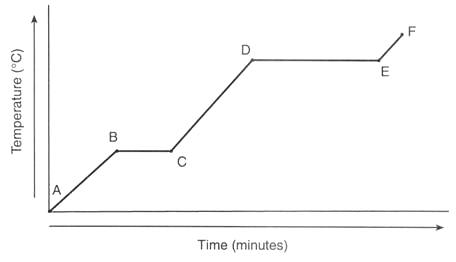

From point A to point F, the sample is going through an __________ process by __________.
exothermic, releasing heat to the surroundings
exothermic, absorbing heat from the surroundings
endothermic, releasing heat to the surroundings
endothermic, absorbing heat from the surroundings

In which region(s) does temperature increase?
Region C only
Regions B and D
Regions A, C, and E
Regions A and B
In a heating curve, diagonal lines indicate temperature is __________, while flat lines indicate temperature is __________.
Constant, changing
Changing, constant

Which container will have lower pressure?
First container
second container
A sample of gas with a volume of 30.0 mL at 25.0oC is heated to 50.0oC. What is the new volume of the gas?
60.0 mL
15.0 mL
27.5 mL
32.5 mL
Match the following units to their names.
Pressure
mmHg
Volume
L
Temperature
K
Pressure
atm
Moles
mol
What does the unit Kelvin, K, measure?
Pressure
Volume
Mass
Temperature
The pressure on a tank containing 0.3 moles of oxygen is 4.5 atm, and the temperature is 150 K. What is the volume of the gas?
(R = 0.0821)
0.821 L
8.21 L
82.1 L
821 L
If you have 40 L of a gas at 6 atm, and 275K, how many moles will you have?
(R = 0.0821)
10.6 mol
0.1 mol
150.5 mol
81.2
A sealed container holds a mixture of Neon and Helium. The Neon has a Pressure of 2.25 atm. If the total Pressure in the container is 7 atm, what is the Partial Pressure of Helium?
4.75 atm
9.25 atm
3.11 atm
15.75 atm
What does the unit Liters, L, measure?
Volume
Pressure
Temperature
Moles
8 L of Helium gas are stored under a pressure of 3.3 atm. If there are 9.4 moles of Helium, what is the temperature of this sample of gas?
(R = 0.0821)
34.2 K
100 K
273 K
20.4 K
Which of the following changes would cause a decrease in the Volume of a gas?
SELECT ALL THAT APPLY!!!
Lowering the Temperature
Increasing the Pressure
Increasing the Temperature
Lowering the Pressure
A rubber tire holds 2.3 moles of CO2 at a temperature of 273 K. The volume of the tire is 8 L. What is the Pressure?
(R = 0.0821)
6.4 atm
412.4 atm
43.5 atm
3.1 atm
Pressure is
defined as the mass that an object exerts when at rest.
not a measurable in gases.
defined as the number of moles of substance divided by the mass of the substance.
created by the force of the gas particles impacting the walls of the container.
If a hairspray can is heated, what can be expected of the pressure of the gas inside the can?
The pressure will increase
The pressure will decrease
The pressure will remain constant
The pressure will equalize


