wayground logo

Free Printable Worksheets

Font size

S
M
L
XL
Worksheets

Unit 7 Practice Test Questions

Total questions: 65

Worksheet time: 49mins

Name
Class
Date
1.

Which of the following elements are found in all macromolecules? (Select all that apply).

a)
b)
c)
d)
2.

Which macromolecule is used as our main source of energy?

a)

Lipids/Fats

b)

Nucleic Acids

c)

Proteins

d)

Carbohydrates

3.

Which macromolecule stores energy?

a)

Carbohydrates

b)

Proteins

c)

Lipids/Fats

d)

Nucleic Acids

4.

This macromolecule breaks down into sugars such as glucose.

a)

Lipids/Fats

b)

Nucleic Acids

c)

Protein

d)

Carbohydrates

5.

Match the following

a)
1.

carbohydrate

b)
2.

lipid

c)
3.

protein

6.

Match the MACROMOLECULES and their MONOMERS.

Hint: Monomer = a single unit

a)

carbohydrate

1.

monosaccharide

b)

lipid

2.

fatty acid & glycerol

c)

protein

3.

amino acid

d)

nucleic acid

4.

nucleotide

7.

An enzyme is a ______________.

a)

carbohydrate

b)

lipid

c)

nucleic acid

d)

protein

8.

Which statement is true?

a)

Simple sugars are made of polysaccharides.

b)

Glycerol is made of fatty acids.

c)

RNA molecules are made of nucleotides.

d)

Amino acids are made of proteins.

9.
Proteins are made of... 
a)
C H O
b)
C H O N
c)
C H O N P
d)
C H O N S
10.

What macromolecule is shown?

a)

Protein

b)

Nucleic Acid

c)

Carbohydrate

d)

Lipid

11.

What macromolecule is shown?

a)

Nucleic Acids

b)

Lipids

c)

Proteins

d)

Carbohydrates

12.
Proteins are made of monomers called ___________
a)
Nucleotides
b)
Monosaccharides
c)
Amino Acids
d)
Glycerol and fatty acids
13.
Nucleotides are monomers of
a)
Carbohydrates
b)
Lipids
c)
Proteins
d)
Nucleic Acids
14.
Monosaccharides are monomers of
a)
Carbohydrates
b)
Lipids
c)
Proteins
d)
Nucleic Acids
15.
Waxes, oils and fats are examples of
a)
Carbohydrates
b)
Lipids
c)
Proteins
d)
Nucleic Acids
16.
What is the function of nucleic acids?
a)
store genetic information
b)
store energy (long-term)
c)
store energy (short-term)
d)
build skin, hair, nails, muscles
17.
Which of the following organic compounds is the main source of energy for living things?
a)
carbohydrates
b)
lipids
c)
nucleic acids
d)
proteins
18.
Which macromolecule stores energy, insulates us, and makes up the cell membrane?
a)
lipids
b)
proteins
c)
carbohydrates
d)
nucleic acids
19.
All polymers are made up of...
a)
monosaccharides
b)
monomers
c)
proteins
d)
None of these
20.
All organic compounds contain the element
a)
carbon
b)
nitrogen
c)
phosphorus
d)
sulfur
21.

Which macromolecule is shown?

a)

lipid

b)

protein

c)

nucleic acid

d)

carbohydrate

22.
Is found in the cell membrane as a bilayer. 
a)
lipids
b)
protein
c)
nucleic acid
d)
carbohydrate
23.

Which of the following is an example of carbohydrates?

a)

Steak

b)

Olive oil

c)

Bread

d)

DNA

24.

Protein is found in...

a)

DNA

b)

Olive Oil

c)

Bread

d)

Steak

25.

The monomer of proteins is...

a)

Polymers

b)

Monosaccharides

c)

Fatty Acids

d)

Amino Acids

26.

Nucleic acids make up which of the two molecules listed below?

a)

RNA

b)

FDA

c)

DNA

d)

RDA

27.
The characteristic that all lipids have in common is----
a)
made of lots of double bonds
b)
acidic when mixed with water
c)
no high energy content
d)
do not dissolve in water
28.
An important carbohydrate polymer is 
a)
lactose
b)
glucose
c)
starch
d)
fructose
29.
_________ is a carbohydrate polymer that humans cannot digest and that make up cell walls of plants.
a)
Starch
b)
Cellulose
c)
Glucose
d)
Lactose
30.
Which has more energy, 1.0 g of carbohydrate or 1.0 g of lipid?
a)
Carbohydrate
b)
Lipid
31.
What suffix (word ending) is used in the names of most carbohydrates?
a)
-ase
b)
-nic
c)
-ose
d)
-yme
32.
Any substance that is acted upon by an enzyme is called a(n)?
a)
Coenzyme
b)
Substrate
c)
Vitamin
d)
Polypeptide
33.
What will most likely happen if an appropriate enzyme is added to a chemical reaction? 
a)
The reaction rate will increase.
b)
The equilibrium of the reaction will be maintained. 
c)
The reaction rate will decrease.
d)
The reaction will stop. 
34.
Which of the following best explains why enzymes are necessary for many cellular reactions?
a)
Enzymes supply the oxygen necessary for the reactions
b)
 Enzymes change reactants from solid to liquids during the reactions.
c)
The reactions take up too much space in the cell if the enzymes are missing.
d)
The reactions are too slow to meet the needs of the cell if enzymes are missing. 
35.
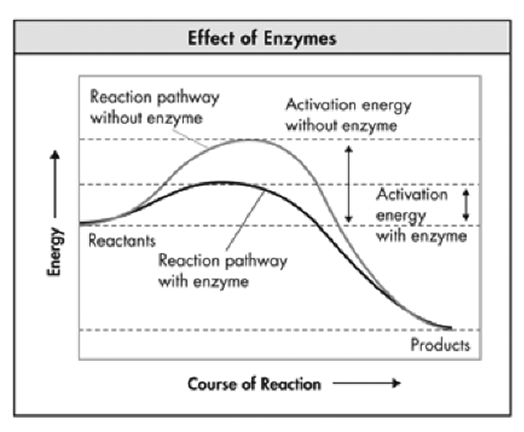
The graph shows how enzymes affect reactions in cells. Which statement best summarizes the information shown in the graph?
a)
Enzymes increase the energy of the reactants.
b)
Enzymes decrease the energy level of the products.
c)
Enzyme decrease the activation energy of the reaction.
d)
Enzymes reverse the direction of the reaction.
36.
Which enzyme is most efficient in a basic solution?
a)
A
b)
B
37.
What happens when enzymes are heated to a high temperature?
a)
The enzymes die.
b)
The shapes of the enzyme are altered denature
c)
The enzymes' amino acid sequence changes.
d)
The enzymes remain the same
38.
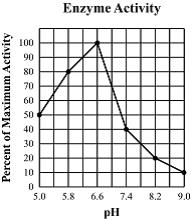
Which of the following conclusions can be drawn from this graph?
a)
The optimum pH of the enzyme is 6.6.
b)
The optimum pH of the enzyme is 5.8
c)
The enzyme’s activity increases as pH increases 5.0 to 9.0
d)
The enzyme’s activity is greater around pH of 8.0 .
39.
How do enzymes increase the speed of chemical reactions?
a)
reducing the number of products   
b)
reducing the activation energy
c)
increasing the temperature of the cell
d)
increasing the concentration of reactants 
40.
As food travels through the digestive system, it is exposed to a variety of pH levels. The stomach has a pH of 2 due to the presence of hydrochloride acid (HCl), and the small intestine has a pH ranging from 7 to 9. HCl converts pepsinogen into pepsin, an enzyme that digests proteins in the stomach. Which of the following most likely happens to pepsin as it enters the small intestine?
a)
 It becomes inactive.
b)
It begins to replicate.
c)
 It's shape changes to engulf large proteins.
d)
It's activity increases to digest more proteins.
41.
The activity of which enzyme decreases in both acidic and basic environments?
a)
chymotrypsin
b)
pepsin
c)
 cholinesterase
d)
papain
42.

During Transcription, DNA is converted into ____

a)

mRNA

b)

tRNA

c)

rRNA

d)

a Protein

43.

During transcription, DNA is converted in mRNA inside the _______.

a)

Cell Membrane

b)

Ribosome

c)

Nucleus

d)

Cytoplasm

44.

Which nitrogen base is in the DNA, but is NOT in the mRNA?

a)

Thymine

(T)

b)

Cytosine

(C)

c)

Guanine

(G)

d)

Adenine

(A)

45.

Match the DNA codon ATC to the correct mRNA codon.

a)

UAG

b)

AUC

c)

TAG

d)

UUG

46.

Use your codon chart to find the amino acid that codes for AGU

a)

Tyr

b)

Gly

c)

Arg

d)

Ser

47.

Use your codon chart to find the amino acid that codes for the mRNA codon GCA

a)

Thr

b)

Ala

c)

Pro

d)

Ser

48.

Ribosomes make ________

a)

DNA

b)

Proteins

c)

Amino Acids

d)

Lipids

49.

How many nitrogen bases are needed to specify 1 amino acid?

a)

1

b)

2

c)

3

d)

9

50.
Which best describes the information contained in genes? 
a)
instructions for assembling pyrimidines
b)
instructions for assembling purines
c)
instructions for assembling proteins
d)
instructions for assembling plasmids
51.
Which best describes the role of free floating nucleotides (A, C, G, & T) in the illustration?
a)
They are recycled when the DNA is composed. 
b)
They are molecular machines the tare used to read ATP. 
c)
They are enzymes that are produced when the DNA is read. 
d)
They are the building blocks that are used to make new strands.
52.

Transfers and brings amino acids to ribosomes during protein synthesis

a)

messenger RNA (mRNA)

b)

ribosomal RNA (rRNA)

c)

transfer RNA (tRNA)

d)

RNA Polymerase

53.

Why must transcription occur in the nucleus?

a)

because DNA can't leave the nucleus

b)

because ribosomes are in the nucleus

c)

because DNA polymerase is found there

d)

because helicase unzips the DNA

54.

Which anticodon would be placed in spot #2

a)

GGC

b)

CCA

c)

GGA

d)

GGT

55.

Which process does this diagram illustrate?

a)

transcription

b)

DNA replication

c)

translation

56.

How can a mutation in the DNA sequence result in NO change to the protein that is made?

a)

There are multiple codons that can code for the same amino acid and result in the same protein

b)

There is always a change in the protein when a mutation occurs

c)

Only the mRNA is used in protein synthesis so a mutation in the DNA would have no effect on the protein

57.

ATTTGAGCC- Original

ATTGAGCC - Mutated

The example above is an example of a

a)

Insertion- Frameshift

b)

Deletion- Substitution

c)

Deletion -Frameshift

d)

All of the above

58.

Why are insertion and deletion (frameshift) mutations so harmful?

a)

They change all of the codons from the mutation on down the line, which changes the amino acid sequence

b)

They insert things that an organism doesn't need.

c)

They often delete things that organisms need.

d)

Insertion and deletions are not any more harmful than substitution mutations.

59.

Part of a chromosome

is deleted

a)

Deletion Mutation-Gene

b)

Translocation

c)

Deletion Mutation -Chromosomal

d)

Crossing Over

60.

Part of a chromosome is repeated

a)

Gene Mutation

b)

Point Mutation

c)

Deletion Mutation

d)

Duplication Mutation

61.
The process of changing the genetic material of a living organism 
a)
Genetic Modification
b)
Taxonomy
c)
Adapting
d)
Bioremediation
62.
What is recombinant DNA?
a)
Adding DNA from one organism into the DNA of another
b)
DNA which has been changed over generations by natural selection
c)
DNA that causes genetic disorders
d)
DNA that has been sequenced
63.

Which suspect left the blood stain?

a)

Bob

b)

Sue

c)

John

d)

Lisa

64.

Which kitten is most likely the offspring of this cat?

a)

1

b)

2

c)

3

d)

4

65.

What is this technique an example of?

a)

chromatography

b)

gel electrophoresis

c)

genetic engineering