
Font size
 Worksheets
Cell Biology Quiz
Total questions: 80
Worksheet time: 45mins
What is the smallest unit that can perform all the processes necessary for life?
cell
nucleus
organelle
prokaryote
Which of the following statements is not part of the cell theory?
Animals and plants share the same kinds of cells.
All organisms are made up of one or more cells.
The cell is the basic unit of all living things.
All cells come from existing cells.
Most cells are a very small size because
they don’t have hard shells like eggs.
their volume does not increase.
their volume is limited by how large their surface area is.
their surface area-to-volume ratio is too small.
The protective layer that covers a cell’s surface is called
DNA
cell membrane
nucleus
cytoplasm
The fluid inside a cell is known as
DNA
cytoplasm
RNA
organelle
The structure that performs a specific function in a cell
nucleus
organelle
tissue
flagella
The genetic material that carries information needed to make new cells or new organisms
RNA
tissue
DNA
ATP
An organelle that contains DNA and has a role in growth, metabolism, and reproduction
mitochondria
nucleus
ribosome
Golgi complex
Anything that can perform life processes is
a cell.
an organ system.
a tissue.
an organism.
Which of these is the lowest level of organization?
cells
tissues
organs
systems
Which of these is the highest level of organization?
cells
tissues
organs
organ systems
Energy released by a cell’s mitochondrion is stored as
ATP.
DNA.
the ER.
RNA.
Larger size, longer life, and specialization are three advantages to being a
eukaryote.
prokaryote.
single-celled organism.
multicellular organism.
Various tissues that work together to perform a specific job constitute a(n)
DNA.
cell membrane.
nucleus.
organs.
The role of this organelle is to release energy that can be used to power various cellular processes.
ribosome.
mitochondria.
Golgi complex.
nucleus.
DNA, the genetic material in cells, is located in which eukaryotic organelle?
nucleus.
mitochondria.
ribosome.
Golgi complex.
Cells that have no membrane-covered organelles are called
eukaryotic.
prokaryotic.
flagella.
archaea.
A part of the Golgi complex can pinch off and form a(n) ________, which distributes materials to other parts of the cell.
vesicle.
nucleus.
ribosome.
lysosome.
When particles travel from an area of high concentration to an area of low concentration, it is called
endocytosis.
active transport.
exocytosis.
diffusion.
When water diffuses into or out of a cell, it is called
exocytosis.
osmosis.
endocytosis.
flooding.
A cell moving particles with the use of energy is called
active transport.
osmosis.
passive transport.
endocytosis.
A cell moving particles without the use of energy is called
active transport.
osmosis.
passive transport.
endocytosis.
Cellular respiration allows an organism to get energy from
sunlight.
oxygen.
water.
food.
Fermentation occurs when a cell can’t get
oxygen needed for cellular respiration.
sunlight.
energy.
food needed for energy.
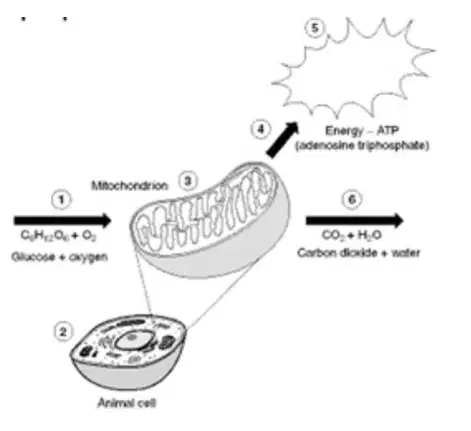
The figure to the right, best represents what important cell process?
photosynthesis
osmosis
fermentation
cellular respiration
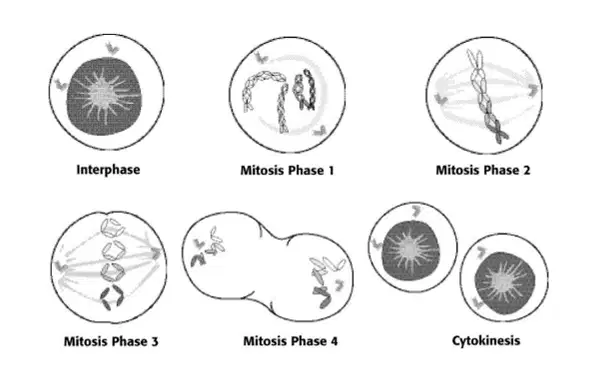
What is the name of the process above?
Interphase
The Cell Cycle
Cytokinesis
Mitosis
Which stage are chromosomes copied?
Interphase
Prophase
Metaphase
Anaphase
What is another name for the four stages of cell division?
The Cell Cycle
Cytokinesis
Meiosis
Mitosis
The division of cytoplasm is called
Cytokinesis
Mitosis
Meiosis
Telophase
The stage at which the chromatids separate and move to opposite sides of the cells is known as
Interphase
Anaphase
Prophase
Telophase
What is a collection of tissues that work together to carry out a specialized function in the body?
a cell
connective tissue
an organ
a team
The one thing that Gregor Mendel realized could explain the results of his experiments was that
the traits were appearing at random.
the male traits were always the dominant ones.
each trait had two sets of instructions, one from each parent.
his important research would open the door to modern genetics.
What carries the genes that determine sex?
homologous chromosomes
pedigree
sex chromosomes
phenotype
Instructions for an inherited trait are called
alleles.
phenotype.
albinism.
genes.
The different forms of a gene that decides a characteristic are known as
alleles.
phenotypes.
albinism.
genes.
What did Mendel discover about recessive traits?
Recessive traits reappear in the second generation.
Recessive traits disappear altogether.
Recessive traits never appear in the second generation.
Recessive traits become dominant.
Which one of the following is the name for the way cells divide in asexual reproduction?
twins
mitosis
meiosis
homologous
A diagram used to trace a trait through generations of a family.
pedigree
selective breeding
meiosis
generation square
What are chromosomes that carry the same sets of genes?
twin chromosomes
homologous chromosomes
ordinary chromosomes
asexual chromosomes
What is a feature that has different forms in a population?
pedigree
characteristic
fertilization
trait
Sex-linked disorders are caused by males’ having
only one X chromosome.
two Y chromosomes.
two X chromosomes.
one X and two Y chromosomes.
What is a trait?
different forms of meiosis
different forms of a pedigree
different forms of chromatids
different forms of a characteristic
When a plant fertilizes itself, it is called a(n)
allele plant.
true-breeding plant.
self-pollinating plant.
cross-pollinating plant.
When there is incomplete dominance,
one allele has more influence than the others.
each allele has its own degree of influence.
the alleles have no influence.
there are no alleles present.
Which word means the physical characteristic in an organism?
heterozygous
Punnett square
homozygous
phenotype

What is the role of the ribosome in a cell?
Cell division
Protein synthesis
Energy production
Waste removal
How many chromosomes do human somatic cells (body cells) have?
23
48
46
92
Who discovered and named cells while looking at cork?
Captain Hook
Robert Hooke
Matthais Schleiden
Rudolf Virchow
Protists, Plants, Animals are examples of
Eukaryotes
Prokaryotes
Which of the following is NOT a gamete?
egg
sperm
skin cell
all of the above are gametes
What is the function of a flagellum in prokaryotic cells?
To allow movement
To provide energy for the cell
To duplicate quickly
To protect the cell from pathogens

Am autotroph can:
Make its own food
Make its own water
Make its own oxygen
Make its own carbon
Where does photosynthesis occur?
In the mitochondria
In the chloroplast of animal cells
In the chloroplast of plant cells
In the mitochondria of plant cells
True or false: ATP is produced during photosynthesis
True
False
Which of the following are products of photosynthesis?
glucose and oxygen
glucose and water
carbon dioxide and water
ATP and sunlight
Which of the following is a reactant of photosynthesis?
oxygen
carbon dioxide
ATP
glucose
Which of the following equations represents the overall chemical reaction for photosynthesis?
6O2+ 6H2O → C6H12O6+ 6O2
C6H12O6 + 6H2O→ 6O2+ 6O2
6CO2+ 6H2O→ C6H12O6+ 6O2
6O2 + 6H2O→ C6H12O6 + 6CO2
Which of the following is the correct equation for PHOTOSYNTHESIS?
light + carbon dioxide + water --> glucose + oxygen
carbon dioxide + sugar + water --> oxygen + light
oxygen + light + water --> carbon dioxide + sugar
carbon dioxide + oxygen + water --> Light+ Sugar
How many molecules of carbon dioxide does a plant need to make one molecule of glucose?
6
55
100
1
What is the correct equation for photosynthesis?
carbon dioxide + oxygen + sunlight = glucose + water
water + oxygen = sunlight + carbon dioxide + soil
glucose + oxygen = sunlight + carbon dioxide + water
water + carbon dioxide + sunlight = glucose + oxygen
What is the chemical in plants' leaves that performs photosynthesis and causes plants to be a green color?
stomata
chlorophyll
carbon dioxide
glucose

What needs to be placed where the X is in the formula?
oxygen
glucose
carbon
sunlight

