wayground logo

Free Printable Worksheets

Font size

S
M
L
XL
Worksheets

Newton's & PE & KE

Total questions: 50

Worksheet time: 50mins
Name
Class
Date
1.
The golf ball will remain at rest unless acted upon by a force. Which of Newton's laws explain this example?
a)
1st law
b)
2nd law
c)
3rd law
d)
law of gravity
2.
The golf ball will remain in motion unless acted upon by a force. Which of Newton's laws explain this example?
a)
1st law
b)
2nd law
c)
3rd law
d)
law of gravity
3.
Two objects with different masses accelerate at the same rate but with different forces. Which of Newton's laws explain this example?
a)
1st law
b)
2nd law
c)
3rd law
d)
law of inertia
4.
A larger car takes more force to move. Which of Newton's laws explain this example?
a)
1st law
b)
2nd law
c)
3rd law
d)
law of inertia
5.
A person is pushed forward into their seat belt when a car stops. Which of Newton's laws explain this example?
a)
1st law
b)
2nd law
c)
3rd law
d)
law of gravity
6.
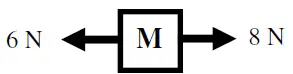
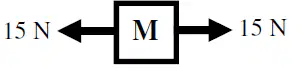
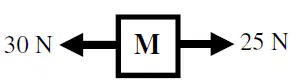
Which direction will block M move?
a)
left
b)
right
c)
no movement
7.
Which direction will block M move?
a)
left
b)
right
c)
no movement
8.
Which direction will block M move?
a)
left
b)
right
c)
no movement
9.
When does an object move?
a)
When the object is at rest
b)
When the object has unbalanced forces
c)
When the object has potential energy
d)
When the object has balanced forces
10.
When does an object not move?
a)
When the object has velocity
b)
When the object has unbalanced forces
c)
When the object has kinetic energy
d)
When the object has balanced forces
11.

Ava drops a ball from a height. Which example of force is acting on the ball as it falls?

a)

force of gravity

b)

Push force

c)

Pull force

d)

centripetal force

12.
For every action, there is an equal and opposite reaction. Which of Newton's laws explain this example?
a)
1st law
b)
2nd law
c)
3rd law
d)
law of inertia
13.
Action-reaction force pairs make it possible for which of the following examples to happen?
a)
flying bird
b)
rocket launch
c)
falling rock
d)
book resting on a table
14.
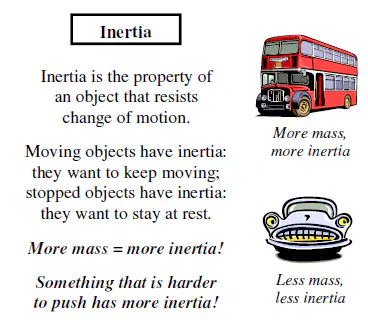
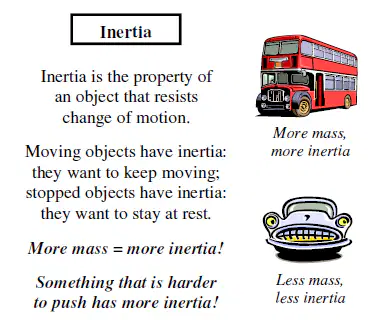
Read the article about inertia. Which object will have more inertia, the bus or the car? Explain your reasoning.
4 lines
15.
What type of force does the following example show?
a)
unbalanced
b)
balanced
16.
What type of force does the following example show?
a)
unbalanced
b)
balanced
17.
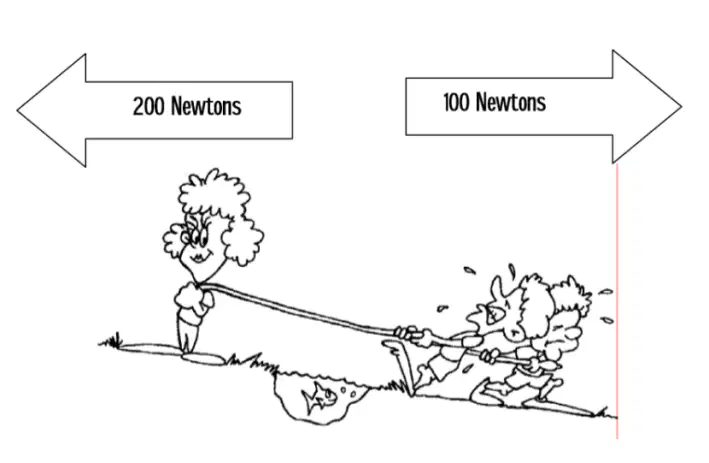
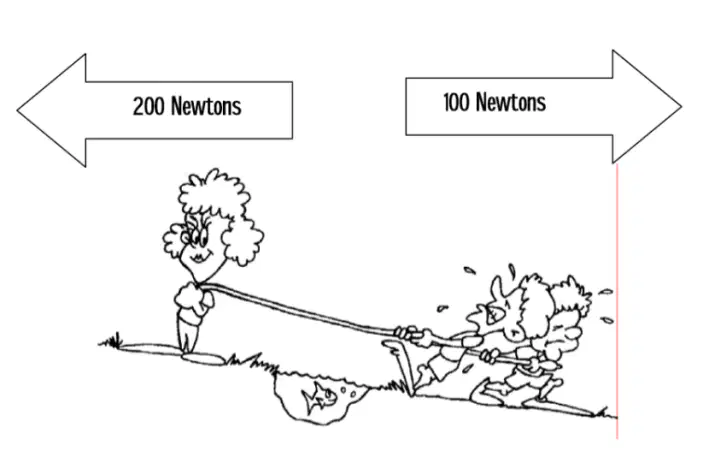
Are the forces shown are acting in the SAME DIRECTION or OPPOSITE DIRECTIONS.
a)
The forces shown are acting in the same directions
b)
The forces shown are acting in the opposite directions
18.
Are the forces are EQUAL or NOT EQUAL.
a)
The forces shown are equal
b)
The forces shown are not equal
19.
Choose the best answer. It is more difficult to start a 50 kg box sliding across the floor than a 2 kg box because the 50-kg box has greater ________________? (Read the article as a hint for your answer)
a)
size
b)
mass
c)
friction
d)
inertia
20.
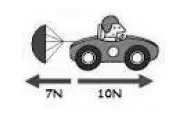
Look at the diagram, determine the net force and direction acting on the object
a)
2 N right
b)
18 N right
c)
18 N left
d)
8 N right
e)
8 N left
21.

Determine the accelerations that result when a 12-N net force is applied to a 3-kg object.

a)

3 ft/s

b)

4 ft/s

c)

26 m/s

d)

4 m/s

22.
What is the tendency of an object to resist a change in motion?
a)
coffee
b)
motion
c)
inertia
d)
gravity
23.

Which car is accelerating?

a)

A car that is not moving

b)

A car that rounds a curve at a constant speed

c)

A car traveling at a constant speed

d)

A car that has a set speed of 60mph

24.
How does friction affect speed?
a)
more friction decreases speed
b)
more friction increases speed
c)
less friction decreases speed
d)
less friction doesn't affect speed
25.

A 10 kg, 15 kg, and 20 kg rock are rolling down a hill. Which rock will require the most force to stop?

a)

10 kg rock

b)

15 kg rock

c)

20 kg rock

d)

All 3 rocks will require the same force

26.
Objects with greater _________ also have greater inertia.
a)
speed
b)
mass
c)
temperature
d)
friction
27.
When all the forces on an object are equal and opposite, & the net force is zero, that's...
a)
balanced forces
b)
unbalanced forces
c)
terminal velocity
d)
reaction forces
28.
An archer pulls the bowstring back, then releases the string and the arrow flies forward. Pulling the string back is the...
a)
action force
b)
reaction force
c)
net force
d)
inertia
29.
An archer pulls the bowstring back, then releases the string and the arrow flies forward. The arrow flying forward is the...
a)
action force
b)
reaction force
c)
net force
d)
inertia
30.

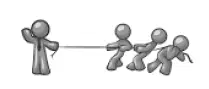
The picture is an example of Newton's...

a)

1st Law

b)

2nd Law

c)

3rd Law

31.

I have the most potential energy if I am:

a)

5 feet high

b)

10 feet high

c)

15 feet high

d)

20 feet high

32.

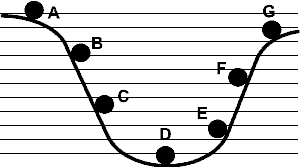
At which point does the ball has the greatest gravitational potential energy (GPE)?

a)

A

b)

G

c)

D

d)

C

e)

G

33.

How could you increase the gravitational potential energy of an object without changing its mass and gravity?

a)

Make the object larger

b)

Lower the object towards the ground

c)

Raise the object farther off the ground

d)

Allow the object to roll on the ground
34.
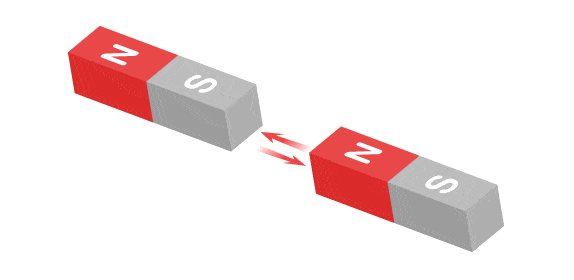
What will happen to the potential energy of the magnets as the N and S get close?
a)
increase
b)
decrease
c)
stay the same
d)
there is none
35.
What happens to the magnetic potential energy when the same poles are far apart?
a)
increases
b)
decreases
c)
stays the same
36.
What is kinetic energy?
a)
When an object is in motion
b)
When an object is not in motion
c)
all of the above
d)
none of the above
37.

Kinetic energy is...

a)

energy carried in ultraviolet waves

b)

energy stored in food

c)

energy in motion

d)

energy from splitting an atom

38.

The faster an object moves, the ________ kinetic energy it has.

a)

more

b)

less

c)

none of the above

d)

all of the above

39.

Which letter shows where kinetic energy is stored or at its maximum point?

a)

Y

b)

W

c)

X

d)

Z

40.

Click to look at the picture.

The picture is an example of _____ .

a)

gravity

b)

potential energy

c)

kinetic energy

d)

friction

41.

(Using Fnet=ma), What net force is required to accelerate a car at a rate of 2 m/s2 if the car has a mass of 3,000 kg?

a)

6,000 N

b)

1,500 N

c)

3,002 N

d)

2,998 N

42.

(Use Fnet=ma). Sally has a car that accelerates at 5 m/s2. If the car has a mass of 1,000 kg, how much force does the car produce?

a)

5,000 N

b)

200 N

c)

0.005 N

d)

1,005 N

43.

(Use Fnet=ma). What is the mass of a truck if it produces a force of 14,000 N while accelerating at a rate of 5 m/s2?

a)

2,800 kg

b)

0.0004 kg

c)

70,000 kg

d)

13,995 kg

44.

(Use Fnet=ma). If an object was accelerating at 10 m/s2, and a force of 10 newtons was required to accelerate it, what was the object's mass? (m=F/a)

a)

1 kilogram

b)

10 kilograms

c)

2 kilograms

d)

5 kilograms

45.

What is the equation to solve for FORCE?

a)

F=ma

b)

F=m/a

c)

F=a/m

46.
The larger the mass you have the _____ force you need to change its motion.
a)
more
b)
less
47.

Which of the following objects has the least amount of acceleration?

a)

an empty shopping cart pushed with a large force

b)

a full shopping cart pushed with a large force

c)

an empty shopping cart pushed with a weak force
d)

a full shopping cart pushed with a weak force

48.
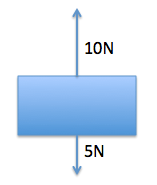
What is the net force on the block? (click on the words to view the picture)
a)
5 Newtons up
b)
5 Newtons down
c)
15 Newtons up
d)
15 Newtons down
49.

What is the net force on the box shown below?

a)

10 N left

b)

10 N right

c)

110 N left

d)

110 N right

50.

Which of the following example increases friction?

a)

waxing skis

b)

adding grease to gears on a bike

c)

throwing sand on an icy driveway

d)

oiling a squeaky door