
 Worksheets
Heredity Quest Prep
Total questions: 54
Worksheet time: 29mins
What term is used to describe a change in the structure of a chromosome or the gain or loss of an entire chromosome?
Gene
DNA
Chromosomal mutation
Gene mutation
Which term refers to the concept that some versions of genes are dominant over others?
Dominant
Recessive
Genotype
Phenotype
What do we call a person that has the gene for a trait or disease but doesn't show it?
Carrier
Multiple Alleles
Homozygous
Recessive
What term describes the chromosomes that determine sex?
Chromosome
Sex chromosome
Autosome
Chromosomal mutation
What is the term for the alleles you inherit (gg, Gg, or GG)?
Protein
Allele
Genotype
Phenotype
Which term is used when the heterozygous genotype results in a phenotype where the two alleles are blended together?
Codominance
Incomplete Dominance
Law of Independent Assortment
Law of Segregation
What is the macromolecule that has the instructions for making you who you are?
Gene
DNA
Protein
Allele
What term describes a genotype resulting from the inheritance of the same alleles from your parents?
Homozygous
Recessive
Genotype
Phenotype
At the end of meiosis, what should each gamete formed contain?
Four gametes with half the # of chromosomes
Four gametes with 2x the # of chromosomes
Two gametes with half the # of chromosomes
Two gametes with 2xthe # of chromosomes
What term is used when more than 2 versions of a gene (more than just "dominant" or "recessive") impact a trait expression?
Multiple Alleles
Polygenic Inheritance
Codominance
Incomplete Dominance
What is the term for a section of a chromosome that codes for a specific trait?
Gene
DNA
Protein
Allele
What term describes a genotype resulting from the inheritance of two different alleles from your parents?
Genotype
Phenotype
Homozygous
Heterozygous
What term is used for the macromolecule that runs your body and expresses your traits?
Gene
DNA
Protein
Allele
What term describes the random alignment of chromosomes during metaphase, allowing any combination of chromosomes to be passed on from parent to offspring?
Law of Independent Assortment
Law of Segregation
Law of Dominance
Law of Codominance
Which term refers to genes that travel on the X chromosome?
Sex-Linked
Multiple Alleles
Polygenic Inheritance
Codominance
What term is used when the heterozygous genotype results in a phenotype where both alleles are fully and separately expressed?
Codominance
Incomplete Dominance
Law of Independent Assortment
Law of Segregation
What term is used to describe the influence of several genes on a single trait, such as height?
Polygenic Inheritance
Multiple Alleles
Sex-Linked
Karyotype
What term is used to describe a change in a single gene?
Gene mutation
Chromosomal mutation
Autosome
Sex chromosome
If a male heterozygous polled cattle (Pp) breeds with a female non-polled cow (pp), what is the probability of producing a polled offspring?
A) 0%
B) 25%
C) 50%
D) 100%
In fruit flies, if a homozygous red-eyed male (RR) is crossed with a heterozygous red-eyed female (Rr), what is the probability of producing red-eyed offspring?
A) 25%
B) 50%
C) 75%
D) 100%
Why are men never heterozygous for an X-linked trait?
A) Because men have two X chromosomes
B) Because men inherit X-linked traits only from their fathers
C) Because men have only one X chromosome
D) Because X-linked traits are not expressed in men
Why must men always inherit an X-linked trait from their mother?
A) Because the Y chromosome is not involved in X-linked inheritance
B) Because men inherit their X chromosome from their mother
C) Because men inherit their Y chromosome from their mother
D) Because the X chromosome is only passed down from father to son
How can a mother who is a carrier of the colorblindness gene affect her children's chances of being colorblind?
A) Her daughters may become carriers but will not be colorblind
B) Her sons cannot inherit the condition since it's carried on the X chromosome
C) Her sons have a 50% chance of being colorblind if she is a carrier
D) Both sons and daughters have an equal chance of being colorblind
What is required for a female to be color blind?
A) She must inherit the color-blindness allele from her father only
B) She must inherit the color-blindness allele from both parents
C) She must inherit the color-blindness allele from her mother only
D) She cannot be color blind under any circumstances
What type of inheritance pattern is exhibited when black feathers and white feathers in chickens are both expressed in the offspring?
Dominant-recessive inheritance
Codominance
Incomplete dominance
Multiple alleles
In carnations, when red and white flowers are crossed and produce pink flowers, this is an example of which inheritance pattern?
Codominance
Incomplete dominance
Complete dominance
Multiple alleles
If Maria has Type A blood (IAIA) and her husband Juan has Type O blood (ii), what is the probability that they will have a child with Type O blood?
0%
25%
50%
100%
In a certain species of fish, if blue scales (BB) and red scales (RR) are codominant, what would be the genotype for a fish with patchwork scales of blue and red?
BB
BR
RR
None of the above
Snapdragons are flowers that express incomplete dominant, where red and white are dominant. If the genotype for flower color is Rr, what is the phenotype of the plant?
Pink
Red
White
Cannot be determined
What is the genotype of a person who is homozygous for the "B" blood type allele?
IBIB
IBi
ii
IAIB
What is the genotype of a person who is heterozygous for the "A" blood type allele?
IAIA
IAi
IBIA
ii
What is the genotype of a person with type O blood?
IAIA
IAi
IBIB
ii
What is the genotype of a person with type AB blood?
IAIA
IAIB
IBIB
IAi
If a person with type A blood had a type O parent, what is their genotype?
IAIA
IAi
It's impossible to determine
IAIB
If Draco is homozygous for the type B allele and Hermoine is type "O," what are all the possible blood types of their offspring?
(a)
What is the likelihood (in percent) that a male with hemophilia (sex-linked recessive) and a female carrier will have a child with hemophilia?
25%
50%
75%
100%
When a tall green pea plant that is homozygous dominant for both traits (TTGG) is crossed with a short yellow pea plant that is homozygous recessive for both traits (ttgg), what is the expected phenotypic ratio of the offspring?
A) 9:3:3:1
B) 3:1
C) 1:2:1
D) All offspring will be tall and green
If two pea plants that are both heterozygous for color and height are crossed, what is the expected phenotypic ratio of the offspring?
A) 9:3:3:1
B) 3:1
C) 1:2:1
D) All offspring will be short and yellow
What symbol represents a male in a pedigree chart?
Circle
Square
Triangle
Rectangle
What symbol represents a female in a pedigree chart?
Circle
Square
Triangle
Rectangle
How is a marriage or reproduction indicated in a pedigree chart?
A line connecting a circle and a square
A dotted line between symbols
A double line between symbols
A single line connecting two squares
What does a filled symbol represent in a pedigree chart?
A person who does not express the trait
A person who is a carrier of the trait
A person who expresses the trait
A person who is unaffected by the trait
What is a mutagen?
A substance or factor that can cause a mutation in DNA
A type of mutation where a chromosome is removed
A beneficial mutation that enhances an organism's survival
A process by which genetic material is exchanged between organisms
Match the type of chromosomal mutation with the correct description: Deletion
A portion of the chromosome is removed
Segments of two chromosomes are exchanged
A segment of a chromosome is removed and then replaced within the chromosome in reverse order
Part of chromosome is copied
Match the type of chromosomal mutation with the correct description: Translocation
A portion of the chromosome is removed
Segments of two chromosomes are exchanged
A segment of a chromosome is removed and then replaced within the chromosome in reverse order
Part of chromosome is copied
Match the type of chromosomal mutation with the correct description: Inversion
A portion of the chromosome is removed
Segments of two chromosomes are exchanged
A segment of a chromosome is removed and then replaced within the chromosome in reverse order
Part of chromosome is copied
Match the type of chromosomal mutation with the correct description: Duplication
A portion of the chromosome is removed
Segments of two chromosomes are exchanged
A segment of a chromosome is removed and then replaced within the chromosome in reverse order
Part of chromosome is copied
What is the difference between a gene mutation and a chromosomal mutation?
A gene mutation affects the entire chromosome, while a chromosomal mutation affects only one gene
A gene mutation involves changes in the DNA sequence of one gene, while a chromosomal mutation involves changes that affect large segments of a chromosome or whole chromosomes
A gene mutation is always harmful, while a chromosomal mutation is not
A gene mutation occurs during cell division, while a chromosomal mutation occurs during DNA replication
Which of the following is an advantage of sexual reproduction over asexual reproduction?
It requires only one parent and is less complex
It produces genetically identical offspring, which can be advantageous in a stable environment
It results in genetic diversity, which can increase the chances of survival in changing environments
It is faster and requires less energy than sexual reproduction
Which of the following is a disadvantage of asexual reproduction compared to sexual reproduction?
It results in genetic diversity, which can be disadvantageous in a stable environment
It requires two parents and is more complex
It produces genetically identical offspring, which can be disadvantageous in changing environments
It is slower and requires more energy than asexual reproduction

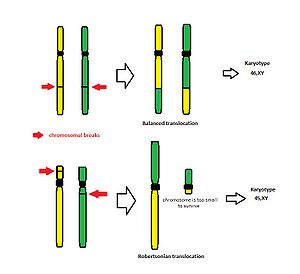
What type of chromosomal mutation occurred?
chromosomal insertion/duplication
chromosomal deletion
chromosomal inversion
chromosomal translocation

Will a father who is colorblind (XbY) ever have a son who is also colorblind, assuming the mother is not a carrier and is also not colorblind?
Yes, all his sons will also be colorblind.
Yes, but there is only a 50% chance.
No, because the father could pass on a dominant, non-affected allele for colorblindness to his son.
No, because the father will pass his Y chromosome to his son.

