
NEW
Font size
 Worksheets
Science Q3 Exam
Total questions: 59
Worksheet time: 59mins
What is another term for starting point?
Point of inquiry
Point A
Inference point
Reference point
The shortest path from start to end point is known as displacement. In which of the following motion do we usually make use of displacement?
Acceleration
Velocity
Speed
Distance
The football player was running 10 miles an hour towards the end zone. Which of the following choices below best describes the mentioned statement?
It is scalar because it has magnitude.
It is vector because it has magnitude and direction.
It is scalar because it has magnitude and direction.
It is vector because it has magnitude.
Which of the following statements about displacement and distance is correct?
Displacement can never be equal to distance.
Displacement always follows a straight line while distance does not.
Displacement can either be greater or shorter than the distance taken from point of origin to the destination.
Displacement measures the length of the straight line from point of origin to its point of destination while distance is the length of path traveled.
What is the standard unit measure used for speed and velocity?
Kilometer per hour squared
Kilometer per hour
Meter per second
Meter per second squared
Which of the following statements is true about the object moving with constant speed?
The distance traveled by the object increases uniformly.
The speed of the object remains the same throughout the travel.
The object is not accelerating.
The speed of the object is equal to zero.
What is the formula in solving for acceleration?
initial velocity-final velocity/time
initial speed-final speed/time
final velocity-initial velocity/time
final speed-initial speed/time
Which of the statements below does NOT describe acceleration?
A biker speeding up.
A man standing in the escalator.
A swimmer changing his direction.
A car slowing down.
Rebecca covered 15 meters in 60 seconds while Sammy covered 10 meters. Which of the following statements is true?
Rebecca was faster than Sammy.
Sammy was faster than Rebecca.
Rebecca was able to cover less distance in shorter time.
Sammy was able to cover more distance in shorter time.

The object travels 6 meters up, 3 meters to the left and 6 meters down. The ______________ of the object is equal to 15 meters, this is considered as scalar quantity.
Acceleration
Displacement
Distance
Velocity
The object travels 6 meters up, 3 meters to the left, and 6 meters down. The object’s _____________ is equal to 3 meters to the right, which is then considered as it’s vector quantity.
Acceleration
Displacement
Distance
Velocity
Suppose the kid changes velocity from 2 m/s to 5 m/s in 3 seconds, what was the kid’s acceleration?
-1 m/s2
0.6 m/s2
1 m/s2
1.33 m/s2

A physics teacher walks 4 meters East in 5 seconds, 2 meters South in 2 seconds, 4 meters West in 6 seconds, and finally 2 meters North in 3 seconds. What was the total distance traveled by the teacher?
12 meters
10 meters
4 meters
none
A physics teacher walks 4 meters East in 5 seconds, 2 meters South in 2 seconds, 4 meters West in 6 seconds, and finally 2 meters North in 3 seconds. What was the teacher’s displacement?
12 meters
10 meters
4 meters
none
A physics teacher walks 4 meters East in 5 seconds, 2 meters South in 2 seconds, 4 meters West in 6 seconds, and finally 2 meters North in 3 seconds. What was the average speed of the physics teacher?
0.75 m/s
0.63 m/s
0.25 m/s
none
A physics teacher walks 4 meters East in 5 seconds, 2 meters South in 2 seconds, 4 meters West in 6 seconds, and finally 2 meters North in 3 seconds. What was the teacher’s velocity?
0.75 m/s
0.63 m/s
0.25 m/s
none
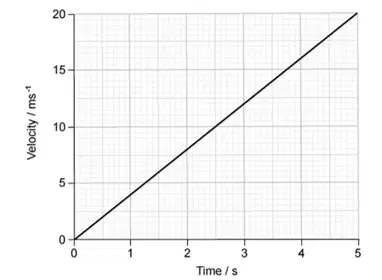
The velocity of an object during the first five seconds of its motion is shown on the graph. What is the displacement of the object at this time?
4 meters
20 meters
60 meters
100 meters
Motion graphs show a change in an object’s location over time. In this type of graph, where is the variable “time” usually placed?
In the middle
Slope
X-axis
Y-axis
What part of the graph reveals an object's motion?
In the middle
Slope
X-axis
Y-axis
Which of the following motion graphs show the speed of an object?
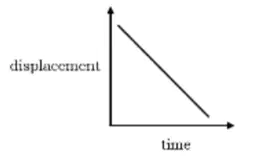

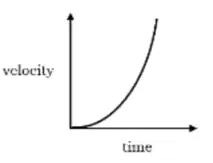

Which of the following shows an object’s acceleration?
What graph is used to show if an object is going backwards or forwards (direction), which cannot be shown on a distance-time graph?
Distance-time graph
Displacement-time graph
Speed-time graph
Velocity-time graph
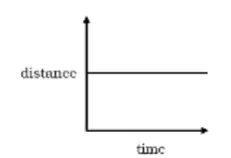
Identify the motion of an object as shown by the graph.
The speed of the object is constant.
The time is continuous.
The distance is increasing.
The object is not moving.
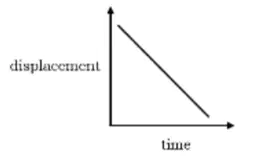
Identify the motion of an object as shown by the graph.
The object has constant speed but moving in an opposite direction.
The object is having negative acceleration.
The object’s velocity is decreasing.
The time is going backwards.
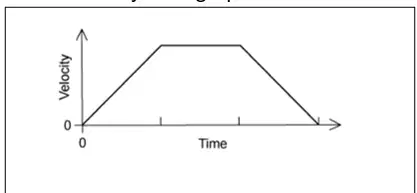
Using the data presented above as a guide, what is the corresponding displacement-time graph for the velocity-time graph shown below?
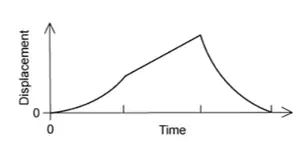
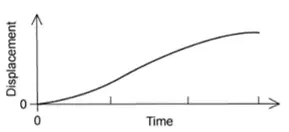

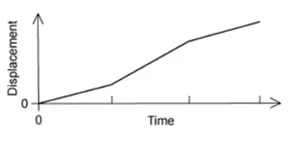
A wave is a rhythmic disturbance that requires a source and carries energy with it. What classification of wave requires medium to propagate?
Mechanical wave
Electromagnetic wave
Surface wave
Sound wave
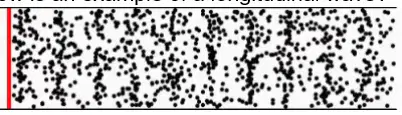
A longitudinal wave’s particles move in a direction parallel to the direction that the wave moves. Which of the following illustrations below is an example of a longitudinal wave?


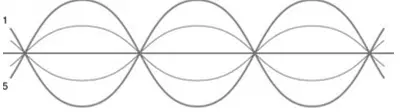
A transverse wave’s particles move in a direction perpendicular to the direction that the wave moves. What is the mechanism of a transverse wave?
Back and forth
Circular
Erratic
Up and down
The surface wave’s particles of the medium undergoes a circular motion. What causes the circular motion in surface waves?
Available energy from the source
Combination of transverse and longitudinal waves
Depending on the medium used
Force exerted in the wave
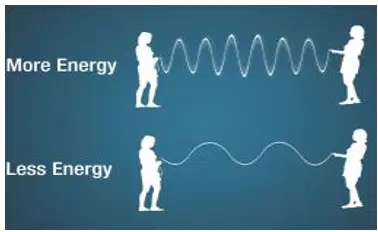
Based on the illustration below, how can one tell if the energy of a wave is greater or lesser?
The higher the amplitude, the greater the energy.
The higher the frequency, the lower the energy.
The lower the amplitude, the greater the energy.
The higher the frequency, the greater the energy.
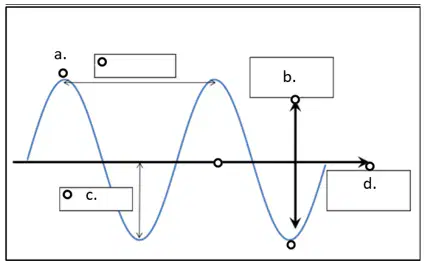
What is the part of the wave labeled as “c.”?
Amplitude
Crest
Trough
Wave height
What is the part of the wave labeled as “a.”?
Amplitude
Crest
Trough
Wave height
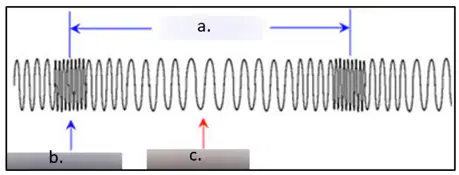
What is the part of the wave labeled as “a.”?
Compression
Frequency
Rarefaction
Wavelength
Sound waves are mechanical waves that goes through the motion of back and forth. What type of wave is sound?
Longitudinal wave
Electromagnetic wave
Surface wave
Transverse wave
What is the region in a sound wave where there is high pressure, and particles are closer to each other?
Amplitude
Compression
Crest
Rarefaction
What can be said about the pitch of sound?
The higher the frequency, the greater is the pitch.
The higher the amplitude, the greater is the pitch.
The higher the frequency, the lower is the pitch.
The higher the amplitude, the lower is the pitch.
Noise has the highest energy among all the notes. Which of the following choices below BEST supports this statement?
It demonstrates irregular rhythm.
It has the widest wavelength.
It shows the greatest number of waves.
It shows the maximum amplitude.
Sound waves require medium to propagate. Which of the following statements about sound wave is NOT true?
Louder sound is produced in liquids than in gases.
Sound can be heard only in air, not in liquids and solids.
Sound cannot travel in a vacuum or in empty space.
Without any medium there is no sound that can be transmitted.
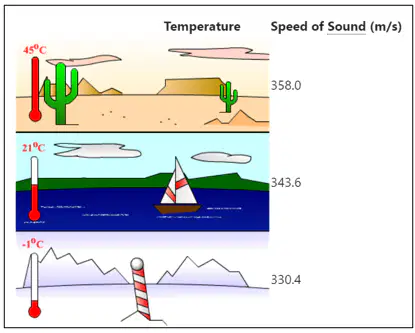
The speed of sound is affected by different factors. What can be said about the speed of sound based on the illustration below?
Sound travels faster in cold regions because the particles are clumped together.
Sound travels faster in temperate regions because the particles are moving freely.
Speed of sound is uniform.
Sound travels faster in hot areas because the temperature is higher.
Playing middle C on the piano keyboard produces a sound with a frequency of 256 Hz. Assuming the speed of sound in air is 345 m/s, determine the wavelength of the sound corresponding to the note of middle C.
0.74 m
1.35 m
0.74 m/s
1.35 m/s
There were many physicists/scientists who contributed to the study of light’s properties. Who among them stated that light behaves as wave and particle?
Christiaan Huygens
Isaac Newton
James Clerk Maxwell
Louis de Broglie
The brightness or luminous of light is measured by the light’s amplitude. The higher the amplitude, the brighter is the light. What is the standard unit measure for luminous?
Candela
Decibel
Hertz
Nanometer
Sound wave is characterized by its intensity and pitch. What is true about sound wave?
The higher the amplitude, the greater is the intensity.
The higher the amplitude, the greater is the pitch.
The lower the amplitude, the greater is the intensity.
The lower the amplitude, the greater is the pitch.
It is regarded as a discrete particle having zero rest mass, no electric charge, and an indefinitely long lifetime. What is this particle called?
Electron
Neutron
Photon
Proton

Which statement is true for the illustration?
I, II, III, IV
I, II, III
I, II
I
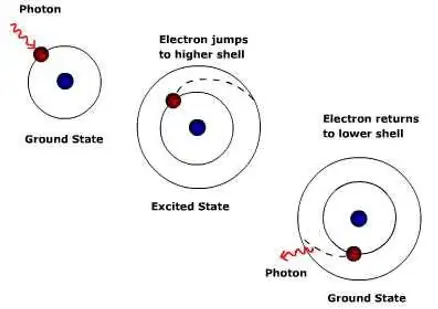
Based on the illustration, what excites an electron to jump from one orbit to another?
Change in environment
Change in temperature
Energy present in the atom
Force applied to the electron
Heat transfer occurs when there are two bodies with different temperatures. What is the usual movement of heat transfer?
Hot to cold body
Cold to hot body
Hot to warm body
Cold to freezing body
There are three types of heat transfer. What heat transfer usually occurs in solids?
Conduction
Convection
Friction
Induction
Applying cold pack in an injury uses the idea behind heat transfer. Which of the following reasons about applying cold pack to an injury is NOT true?
Eases pain by numbing the affected area.
Reduces joint stiffness and muscle spasm.
Reduces swelling and inflammation.
Reduces bleeding.

Based on the illustration, which of the following statements is NOT true for light?
All colors originated from white light.
It is only by mixing yellow, cyan, and magenta we get white light.
Red, blue, and green are also known as primary colors.
Shining the colors blue, green and red will give you a white light.
Convection occurs when warm fluids move from one place to another carrying heat. What happens to warm air as it expands?
Replaces the cool air.
Rises as it becomes less dense.
Sinks as it becomes denser.
Warm air contracts and becomes denser.
Which of the following illustrations is impossible for conduction to occur?
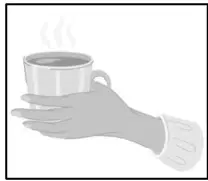
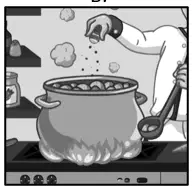


6. Which of the following illustrations best demonstrates radiation?
The atom has three subatomic particles. Which of the following about the subatomic particles is true?
Electron is the only free moving particle in the atom.
Neutrons have opposite charge with protons making them clumped together.
Photons are the only particle that has no mass.
Protons are negatively charged particle.
Which of the following illustrations show charging by conduction?
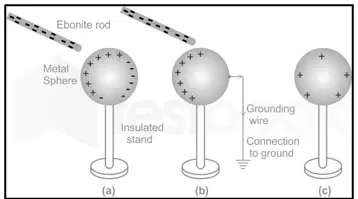
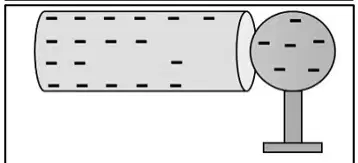
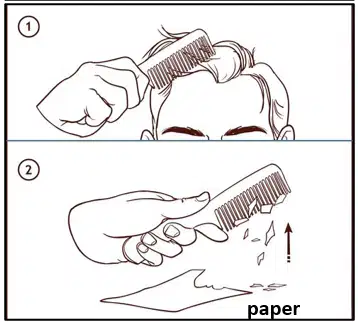

Which of the following illustrations show charging by friction?
Triboelectric series is used for verifying the charge of a particular object. Which of the following materials in the triboelectric series is the most negatively charged?
Air
Polyester
Skin
Teflon
What must a person do to escape lightning in an open area?
Crouch low with your feet close together.
Hide under the tree.
Lie on the ground.
Wear a medieval coat of armor.
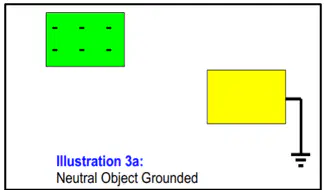
Based on the illustration below, what is the importance of grounding wire in this type of charging process?
To let the electrons escape making the neutral object positively charged.
To let the protons escape making the neutral object positively charged.
To let the electrons escape making the neutral object negatively charged.
To let the protons escape making the neutral object negatively charged.

