
Font size
 Worksheets
Light and Sound Waves
Total questions: 38
Worksheet time: 38mins
As the volume of a sound wave increases, which of these also increases?

Which type of behavior does light display when striking a transparent object?
scattering
reflection
transmission
absorption

Why does this car appears red under a white light?
The car is absorbing the red light and reflecting the blue and green.
The car is reflecting only the red light while absorbing the blue and green.
The car is absorbing the red and green light while reflecting the blue.
The car is absorbing the red, blue and green, but our eyes can only see the red.

Gamma Rays are
High energy
Low energy
Medium energy
Just right

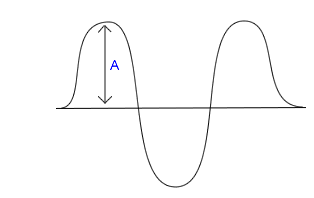
What is the amplitude of this model wave?
20 mm
5cm
15cm
10mm
The number of times a wave passes a point in a second is its
frequency.
wavelength.
pitch.
amplitude.
How do the sound waves of the higher pitch notes compare to the sound waves of the lower pitch notes?
The sound waves of notes with higher pitches have higher amplitudes.
The sound waves of notes with higher pitches travel at higher speed.
The sound waves of notes with higher pitches have higher wavelengths.
The sound waves of notes with higher pitches have higher frequencies.
What happens to the speed of light as it exits the air and enters a glass of water?
It speeds up
It remains constant
It slows down
It first slows down and then speeds up

There is only one fish in the fishbowl below. When Joseph looks down at the fish, the image he observes is closer to the surface than the actual location of the fish.
Which wave characteristic does Joseph’s observation demonstrate?
amplitude
diffraction
reflection
refraction

How are sound waves different from light waves?
sound waves send signals to the brain through a special nerve
sound waves need a medium, such as water or metal, to move through.
sound waves move energy through space and time
sound waves are part of the electromagnetic spectrum
Which cup is opaque?


Which cup is translucent?
Which cup is transparent?


When a wave strikes a surface and does not reflect or transmit it, it _____

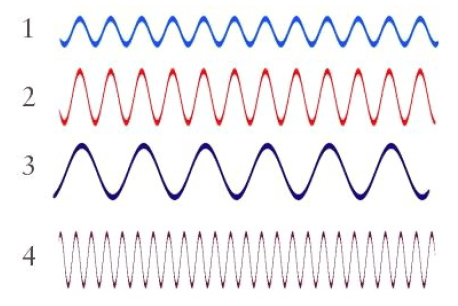
How do the waves compare?


Which of the following properties makes a light wave different from a mechanical wave?
A light wave slows down in a vacuum
A light wave is able to transmit energy
A light wave exists as a transverse wave
A light wave can travel without a medium

_____?_____ materials allow ALL light waves to pass through easily.
Opaque
Transparent
Translucent

Which letter shows a wave being reflected?
A
B
C
Which letter shows a wave being transmitted?
A
B
C
which of the following does NOT belong in the electromagnetic spectrum:
X-ray
sound wave
ultra violet rays
microwaves


Why does it take much less space to store digital information than analog information?
Digital devices only record pieces of sound waves, not full waves
Digital devices record sounds at lower volumes than analog devices
Digital devices decrease the amplitudes of sound waves, making them smaller
Digital devices automatically eliminate all background noise from the sounds they record
Select all that apply: Why are digital signals more reliable than analog signals?
They can be transmitted over long distances
They are better for long term storage of data (pictures, music, files, etc)
They are not as influenced by signal inference (noise)
They are not as reliable and analog signals are supreme in all ways. (Vinyl records, physical photos and clocks)

