
 Worksheets
MEB multiple choice
Total questions: 230
Worksheet time: 38hrs 20mins
The heat of reaction remains the same even if stoichiometric coefficients are changed
True
False
Why do heats of reaction change if different phases are given for products and reactants?
The heat of reaction must account for the phase change
The reaction occurs fundamentally differently and has a completely different heat of reaction if different phases are involved
Phases do not affect the heat of reaction
What conditions are used for the standard heat of reaction?
It depends on the reaction
0 C and 1 atm
25 C and 1 atm
20 C and 1 atm
At the conditions of interest, the heat of reaction for the equation A + 2B -> C is -140 kJ. What is the enthalpy change in kJ if 2 moles of A are consumed in the reaction?
140 kJ
-140 kJ
280 kJ
-280 kJ
At the conditions of interest, the heat of reaction for the equation 2A + 3B -> is -100 kJ. What is the enthalpy change in kJ if 9 moles of B are consumed in the reaction?
-100 kJ
300 kJ
-300 kJ
900 kJ
What is the main problem with using a calorimeter to determine heat of reaction?
They are hard to construct and operate
It can be hard to isolate the reaction of interest
Calories are not an SI unit
Given the following reactions, what is the enthalpy change for the reaction 3D -> A + 3B + 5C in kJ?
(1) A -> 3B + C, Hr = 100 kJ
(2) A + C -> D + B, Hr = -200 kJ
-600 kJ
-300 kJ
100 kJ
800 kJ
Given the following reactions, what is the enthalpy change for the reaction 4A + 2C -> 3D + 6B in kJ?
(1) A -> 3B + C, Hr = 100 kJ
(2) A+ C -> D + B, Hr = -200 kJ
800 kJ
-500 kJ
300 kJ
400 kJ
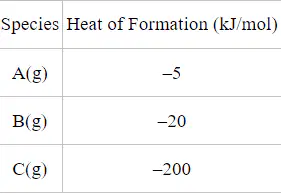
Given the following data, what is the heat of reaction for A (g) + B(g) + O2 (g) -> C (g) in kJ?
255 kJ
180 kJ
-150 kJ
-175 kJ

What expression would give the heat of reaction for the reaction CH4 (g) + Cl2 (g) -> CH3Cl (g) + HCl (g)?
A
B
C
D
E
The standard heat of formation for the oxygen atom is zero.
True
False
Which of the following are assumptions made when determining and using heats of combustion? Select all that apply.
All hydrogen forms H2
All sulfur forms SO2
All nitrogen forms N2
All carbon forms CO
All sulfur forms H2S
For which of the following reactions would the heat of reaction be equal to the heat of combustion? Select all that apply.
CH4 + 2O2 -> 2H2O + CO2
H2S + 3/2 O2 -> SO2 + H2O
C2H2 + 3/2 O2 -> 2 CO + H2O
NH3 + 3/4 O2 -> 1/2 N2 + 3/2 H2O
C2H6 + 4 O2 + H2 -> 4 H2O + 2 CO2
Select all methods discussed for choosing enthalpy reference states and calculating specific enthalpies
Heat of fusion method
Heat of reaction method
Heat of combustion method
Heat of formation method
In the heat of formation method, what reference states are most convenient to choose when there are reacting species?
Any convenient temperature and pressure
The state of the elemental species constituting the products and reactants at STP
The reactant and product species in the states for which the heat of reaction is known
In the heat of formation method, what is specific enthalpy determined from?
Inlet - outlet enthalpy and heat of reaction
Inlet - outlet enthalpy only
When should the heat of formation method be used? Select all that apply.
When multiple reactions occur
When only a single reaction occurs
When a single reaction occurs and Delta Hr is unknown
In the heat of reaction method, what reference states should you choose?
Any convenient temperature and pressure
The state of the elemental species constituting the products and reactants at STP
The reactant and product species in the states for which the heat of reaction is known.
What does solving an adiabatic energy balance typically involve?
Finding expressions for the enthalpy at an unknown outlet temperature
Looking up enthalpies in tables at the outlet temperature
Setting all enthalpy changes to zero and solving for work
In an endothermic reaction, a greater extent of reaction would correspond to a higher outlet temperature?
True
False
The absolute value of the internal energy at specified state (temperature, pressure, and phase) can be determined by comparing its energy to a reference state.
True
False
A reference state is an arbitrary state set to have an internal energy of zero in order to aid in the determination of specific internal energies and enthalpies for different states
True
False
We are allowed to use hypothetical process paths in our calculations for using the specific internal energy and enthalpy because these are both state properties and do not depend on the path chose.
True
False
When constructing a hypothetical pathway for a system undergoing a phase change, in order to evaluate the change in specific enthalpy, Ĥ, one should first calculate the ΔĤ between the current state and the substance’s normal phase transition temperature and pressure, followed by the ΔĤ of the phase transition. Finally, one should calculate the between the state after its phase transition and its final state.
True
False
What is the reference state used in Table B.5 to determine specific internal energies and enthalpies
The triple point of water: T = 0.01 C, P = 0.00611 bar
The melting point of water: T = 0 C, P = 1.01325 bar
The boiling point of water: T = 100 C, P = 1.01325 bar
Which of the following can be used as part of a hypothetic process path to calculate the specific internal energy or enthalpy change? Select all that apply.
Changes in P at constant T and a state of aggregation
Changes in T at constant P and a state of aggregation
Phase change at constant T and P
Mixing of two liquids or dissolving of a gas or a solid in a liquid at constant T and P
Chemical reaction at constant T and P
Which of the following are hypothetical pathways that could be used to calculate the change in specific enthalpy for a system containing liquid ethanol (Etoh) at an initial state of (l, 20°C, 1 atm) to a final state of (g, 100°C, 1 atm)?
Etoh(l, 20°C, 1 atm) → Etoh(l, 78°C, 1 atm) → Etoh(g, 78°C, 1 atm) → Etoh(g, 100°C, 1 atm)
Etoh(l, 20°C, 1 atm) → Etoh(g, 20°C, 1 atm) → Etoh(g, 100°C, 1 atm)
Etoh(l, 20°C, 1 atm) → Etoh(l, 100°C, 1 atm) → Etoh(g, 100°C, 1 atm)
All of the above
Which of the following hypothetical pathways for the transition of ethanol (Etoh) from an initial state of (l, 20°C, 1 atm) to a final state of (g, 100°C, 1 atm) would be the easiest to calculate given the tables in Appendix B?
Etoh(l, 20°C, 1 atm) → Etoh(l, 78°C, 1 atm) → Etoh(g, 78°C, 1 atm) → Etoh(g, 100°C, 1 atm)
Etoh(l, 20°C, 1 atm) → Etoh(g, 20°C, 1 atm) → Etoh(g, 100°C, 1 atm)
Etoh(l, 20°C, 1 atm) → Etoh(l, 100°C, 1 atm) → Etoh(g, 100°C, 1 atm)
Which assumptions can be applied for the isothermal processes of O2 (l, 1 atm) → O2 (l, 1000 atm)?
ΔÛ and ΔĤ ~ 0
ΔÛ ~ 0 and ΔĤ ≠ 0
None of the above
Which assumptions can be applied for the isothermal processes of O2 (g, 1 atm) → O2 (l, 0.98 atm)?
ΔÛ and ΔĤ ~ 0
ΔÛ ~ 0 and ΔĤ ≠ 0
None of the above
Which assumptions can be applied for the isothermal processes of benzene (l, 1 atm) → benzene (l, 1000 atm)?
ΔÛ and ΔĤ = 0
ΔÛ = 0 and ΔĤ ≠ 0
None of the above

Answer
True
False

Answer
True
False

Answer
Solids and liquids
Non-ideal gas when P is constant
Ideal gas
All of the above
The relationship between Cv and Cp does not depend on phase.
True
False
If the heat capacity at constant pressure for an ideal gas is 38.01 J/mol K, what is the heat capacity at constant volume for this species?
46.32 J/mol K
38.01 J/mol K
29.70 J/mol K
None of the above

Estimate the heat capacity at constant pressure for liquid ethanol using Table B.10.
35.3 J/mol C
157 J/mol C
3.41 J/mol C
55 J/mol C
A solute has a heat capacity of 2 cal/g °C and is in a mixture with a solvent having a heat capacity of 3.5 cal/g °C. Knowing that the mixture contains 0.1% by mass solute, it can be said that the heat capacity of the mixture is 2.75 cal/g °C.
True
False

Answer
True
False
A spreadsheet program may provide an easier method of solving polynomial functions such as heat capacity formulas.
True
False
The trapezoidal rule method of numerical integration is more accurate than Simpson’s rule.
True
False
Equations should be solved analytically when a solution cannot be found using numerical integration.
True
False
The heat of freezing can be found by taking the negative of the heat of fusion found in the literature.
True
False
The latent heat is the enthalpy change associated with temperature changes for a single phase system.
True
False
The latent heat of a phase change is a constant value that represents the enthalpy change of the transition at any temperature and pressure.
True
False

Answer
Isothermal
Ideal gas
Solid or liquid species (isobaric and isochoric)
All of the above

Answer
Isothermal
Ideal gas
Solid or liquid species (isobaric and isochoric)
All of the above
Watson’s correlation allows you to estimate the heat of vaporization at a different temperature given an initial heat of vaporization at an initial temperature.
True
False
Calculating specific enthalpy changes in multiphase systems can be approached in a similar manner to single-phase systems with the addition of accounting for the phase transitions of all components.
True
False

Answer
True
False
Heat is defined as positive when it is transferred from the surroundings to the system.
True
False
What is meant by the term potential energy?
Energy that is due to rotational motion of a system
All energy possessed by a system
Energy that is due to the position of a system in a gravitational field
Energy that flows in response to any driving force
The law of conservation of energy states:
Two systems must be in thermal equilibrium with each other.
Energy can be neither created nor destroyed.
Energy lost from a system must be replaced in another form.
Heat and work exist only as a transfer of energy.
The rate of change in the kinetic energy of a fluid flowing in a system can be found by substituting the mass flow rate into the equation for kinetic energy.
True
False

Kinetic energy equals
A
B
C
What is the potential energy of water that has been pumped at a rate of 10 kg/s for 10 seconds from the ground to a point 10 m above the ground?
100 J
-100 J
9800 J
-9800 J

The basic form of the first law of thermodynamics is:
A
B
C
D

If a system is not accelerating, rising, or falling, then the first law reduces to:
A
B
C
D
A system to which no heat is added or withdrawn is said to be:
Isothermal
Isobaric
Adiabatic
Closed
Shaft work is the rate of work done by the process fluid on a moving part within the system.
True
False

Flow work is defined to be:
A
B
C
D
H = U - PV
True
False
If the volume of a fluid is 10 m3 and the mass of the fluid is 5 g, what is the specific volume of the fluid?
50 g.m3
0.5 g/m3
2 m3/g
A property that is defined on a specific mass or molar basis is what type of quantity?
Extensive
Intensive
Neither
The first law of thermodynamics for an open system at steady-state has the form “input = output.”
True
False
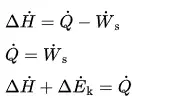
Simplify Eq. 7.4-15 for a system with all streams at the same height and no moving parts.
A
B
C
At the reference state, Ĥ = 0.
True
False
The changes in the enthalpy and internal energy of a substance depend on the path the substance follows from the initial state to the final state.
True
False
The specific enthalpy of vapor A relative to liquid A at 0°C and 1 atm is 2000 J/kg. What is the Ĥ of the liquid A at 0°C and 1 atm? The reference state for this liquid is 0°C and 1 atm.
2,000 J/kg
0 J/kg
1,000 J/kg

Which of the following are state properties? Select all that apply.
A
B
C
In the superheated steam table, there are temperatures and pressures where the water is a liquid.
True
False
In the superheated steam tables, if you are given a temperature and a pressure of water, you can locate the specific properties at the intersection of the column corresponding to the given temperature and the row corresponding to the given pressure.
True
False
The reference state for Û or Ĥ in the saturated steam tables is relative to liquid water at the triple point.
True
False
At points on the vapor–liquid equilibrium curve on a phase diagram, water may be:
Saturated liquid
Saturated Steam (vapor)
Mixture of both saturated liquid and saturated steam
All of the above
The difference between the specific enthalpy of saturated liquid and saturated steam is the:
Heat of vaporization
Heat of condensation
Heat of sublimation
The change in internal energy equals the heat (Q) in open systems.
True
False
What type of substance has a temperature above its critical temperature and a pressure above its critical pressure?
Liquid
Gas
Supercritical fluid
Mechanical and energy balances can be solved simultaneously.
True
False
When process streams contain several components, the specific enthalpies of each component must be determined separately and substituted in the energy balance equation when the total change in enthalpy in all components is evaluated.
True
False
It is important to distinguish the state of a species (i.e., solid, liquid, vapor) during energy balance calculations.
True
False
It is not common to neglect the kinetic and potential energy changes relative to enthalpy changes for processes that involve phase changes, chemical reactions, or large temperature changes.
True
False

Refer to Figure 6.1-1. If the pressure is 3 mm Hg, at what temperature(s) would you expect water to be a solid? Select all that apply.
-7 C
20 C
0.0098 C
260 K
Refer to Figure 6.1-1. If the temperature is 2°C, at what pressure(s) would you expect water to be a vapor?
1 atm
17.535 mm Hg
3 mm Hg
Above and to the right of the critical point is a phase called the supercritical fluid, which is where separate phases do not coexist.
True
False
“Volatility” means tendency to explode.
True
False
Which of the following is a measure of volatility?
Entropy
Density
Delta H rxn
p*
specific gravity
What does latent heat of vaporization measure?
The temperature at which a substance vaporizes
The energy per mole required to vaporize a liquid
The amount of energy left behind after a substance vaporizes
Equal temperature reference-substance plots are intended to do what?
Relate the vapor pressure of a substance of interest to the vapor pressure of a known (reference) compound.
Relate the vapor pressure of a substance of interest to temperature linearly.
Show that the vapor pressures of all substances change in exactly the same way.
Which of the following would be considered intensive variables? Select all that apply.
Temperature
Cost
Cost per pound
Pressure
Weight
Under which conditions should the Gibbs phase rule not be applied?
No reactions occur.
The compounds all have similar density.
The system contains a liquid phase.
None of the above
How many degrees of freedom are there if water and ethanol exist in equilibrium in both the liquid and vapor phases?
0
1
2
3
What term is applied to a gas phase saturated with a liquid that it coexists with?
At equilibrium
Wet
Vapor
Super-cooled
If the partial pressure of component A exceeds the vapor pressure of component A, which of the following will occur?
The substance will boil.
Temperature will increase.
The substance will condense.
Nothing; this is normal.
None of the above.
What is a possible cause of dry skin during the winter?
Furnaces remove water from the air.
There is less water in the air because the vapor pressure of water goes down, causing evaporation from skin.
Heating causes the vapor pressure of water to increase without raising the partial pressure of water in the air.
Which of the following systems most closely corresponds to having 100% humidity?
A bottle filled to the top with water, containing no air
A misty bathroom after a shower
A pot of boiling water
You cannot change the pressure of an incompressible liquid.
True
False
What does it mean for a substance to be “incompressible”?
The pressure of the substance cannot be changed.
The density of the substance is not significantly affected when pressure changes.
The substance is in its most compressed form.
The volume additivity assumption is most likely valid when dealing with which of the following?
Mixtures of liquids with similar molecular structures
Mixtures of liquids with different molecular structures
Mixtures of liquids with very large volumes
The ideal-gas equation of state provides accurate results under all conditions of temperature and pressure.
True
False
At what pressure will a gas deviate from ideal behavior?
At pressures above 1 atm
At pressures below 1 atm
Pressure does not affect ideal-gas behavior.
An equation of state relates the molar quantity and volume of a gas to:
Pressure
Temperature
Both temperature and pressure
For the SI system, standard temperature and pressure are:
273 K and 1 atm
273°C and 1 atm
273 K and 10 atm
What happens to the volume of an ideal gas if you halve the temperature at a fixed pressure?
The volume is halved.
The volume remains the same.
The volume doubles.
A volumetric flowrate of 20 SCMH represents:
20 mol/hr at STP
20 m3/hr at STP
For an ideal-gas mixture, the mole fraction equals the volume fraction.
True
False
The partial pressures of the component species of an ideal-gas mixture add up to the total pressure of the mixture.
True
False
For a mixture that is 70% N2 and 30% H2O by volume at a total pressure of 10 atm, what is the partial pressure of N2?
3 atm
7 atm
Need more information
The critical pressure is the pressure required to liquefy a gas at its critical temperature.
True
False
The terms gas and vapor can be used interchangeably; there is no technical difference between these terms.
True
False
Using Table B.1, what is the critical temperature of toluene in Kelvin (K)?
647.4 K
593.9 K
508.8 K
What is the term used to describe the temperature point above which a gas cannot be liquefied, whatever pressure is applied?
Critical temperature
Critical pressure
Supercritical temperature
If process conditions are such that the ideal-gas equation of state is a poor approximation, a more complex species-specific equation of state must be used.
True
False
The ideal-gas equation of state cannot be obtained from the virial equation of state.
True
False
The Pitzer acentric factor is a parameter that reflects the geometry and polarity of a molecule.
True
False
The second virial coefficient, B, in the virial equation of state is a function of:
Pressure
Temperature
Volume
All equations of state are approximations.
True
False
The compressibility factor, z, is a measurement used to determine the extent to which the gas is behaving nonideally.
True
False
An ideal gas has a compressibility factor of 1.
True
False
If the compressibility factor is greater than 1, the gaseous species behaves as:
A nonideal gas
An ideal gas
A vapor
The compressibility factor, z, depends on the temperature, pressure, and chemical species.
True
False
According to the generalized compressibility charts, as pressure approaches the critical pressure there are decreasing deviations from ideal-gas behavior.
True
False
Absolute temperature and pressure must be used when working with the law of corresponding states.
True
False
A compressibility chart for each species would be required to find the compressibility factor if the critical temperature and pressure were not converted to a generalized reduced temperature and pressure.
True
False
For which gas(es) must Newton’s corrections be used? Select all that apply.
Hydrogen
Oxygen
Helium
Carbon Dioxide
Kay’s Rule estimates pseudocritical properties of mixtures as simple averages of pure-component critical constants.
True
False
Pseudocritical constants can be calculated by weighting the critical constants for each mixture component by the mole fraction of that component in the mixture.
True
False
Kay’s Rule can be used to accurately describe mixtures of nonpolar compounds whose critical temperature and critical pressure are within a factor of 100 of one another.
True
False
Which values can be calculated using Kay’s Rule? Select all that apply.
Pseudocritical temperature
Pseudocritical pressure
Pseudocritical volume
A continuous process is considered to be transient during the start-up phase and immediately following process changes.
True
False
A continuous process is considered to be at steady-state during the initial start-up of a system and at unsteady-state after a long period of time has elapsed.
True
False
Continuous processes are most commonly used to produce a relatively small amount of a particular product on a single occasion.
True
False
Which of the following would be classified as a continuous process?
1 kg/s of salt is mixed with a stream of water flowing through a mixing chamber at a rate of 100 kg/s.
Water is stirred in a container to which sodium acetate is being slowly added.
Chicken is baked for 45 minutes at 400°F.
Which of the following would be classified as a semi-batch process?
1 kg/s of salt is mixed with a stream of water flowing through a mixing chamber at a rate of 100 kg/s.
Water is stirred in a container to which sodium acetate is being slowly added.
Chicken is baked for 45 minutes at 400°F.
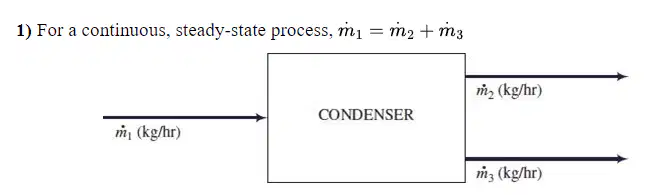
Answer
True
False
What kind of balance (differential or integral) should be used to determine how many gallons of water are purified per minute in a purification process that operates continuously at steady-state?
Differential
Integral
Both
Neither
Two gases are charged into a closed reaction chamber and allowed to react. What kind of balance (differential or integral) should be used to determine the mass of product produced after the system has come to equilibrium?
Differential
Integral
Both
Neither
For a continuous, steady-state reactor, a mass balance on a nonreactive species would yield the material balance equation to be: Input = Output
True
False
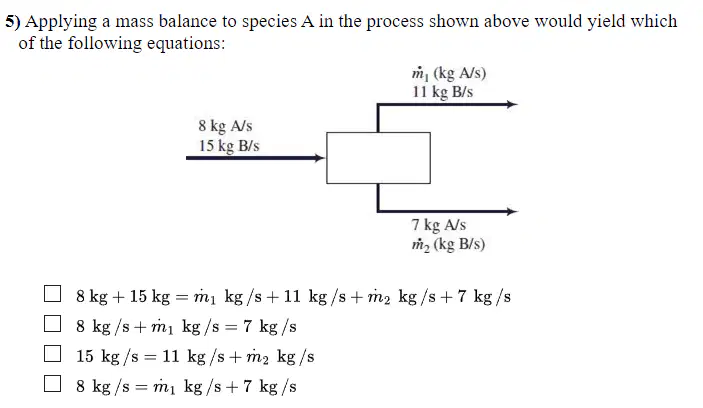
For a continuous, steady-state reactor, a mass balance on a nonreactive species would yield the material balance equation to be: Input = Output
A
B
C
D
Which statement(s) is(are) false about a semi-batch process?
It is neither a continuous nor a batch process.
Accumulation is always greater than zero for all species present in the system.
We can write a balance on the system between two intervals of time.
All of the above.
For a batch reactor, the material balance equation for a reactive species is the same as one for a continuous, steady-state reactor; therefore, we can conclude that accumulation is equal to zero in a batch reactor just as it is in a continuous, steady-state reactor.
True
False
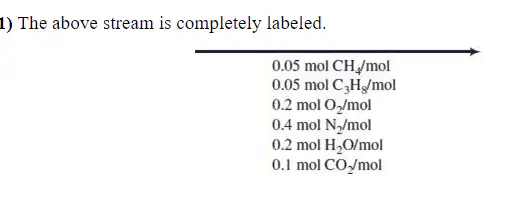
Answer
True
False
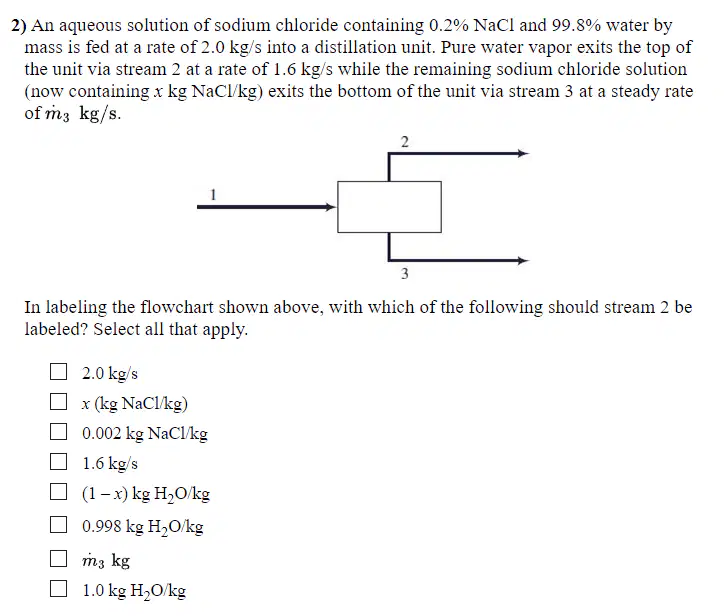
Answer
A
B
C
D
H
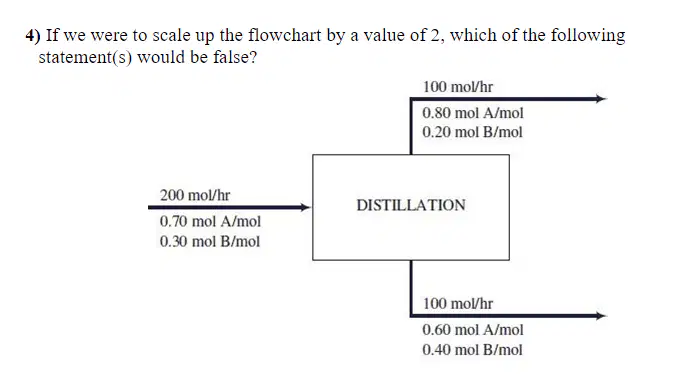
Answer
The input stream would have a molar flow rate of 400 mol/hr.
Both the output streams would have a molar flow rate of 200 mol/hr.
In a scale-up, the mole fractions do not change because A and B still exist in the same distribution ratio regardless of the amount of feed.
The input stream mole fractions would be 1.40 mol A/mol and 0.6 mol B/mol.
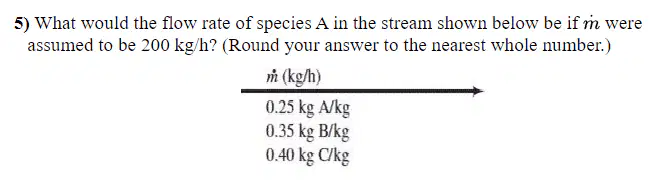
Answer
50 kg/hr
70 kg/hr
80 kg/hr
200 kg/hr

Answer
True
False
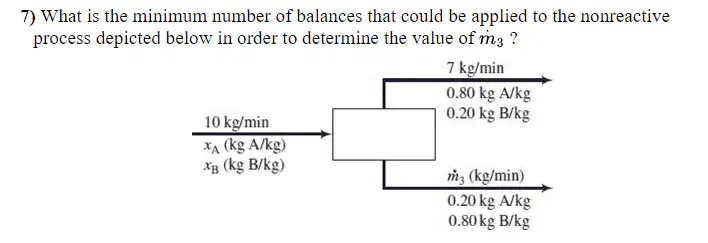
Answer
2
1
3
4
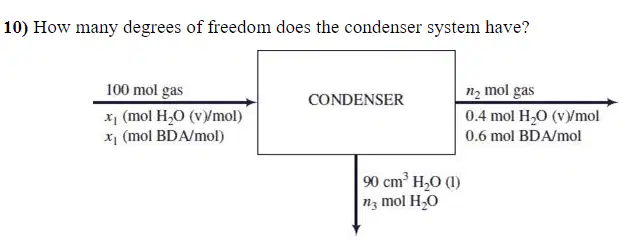
Answer
2
0
3
4
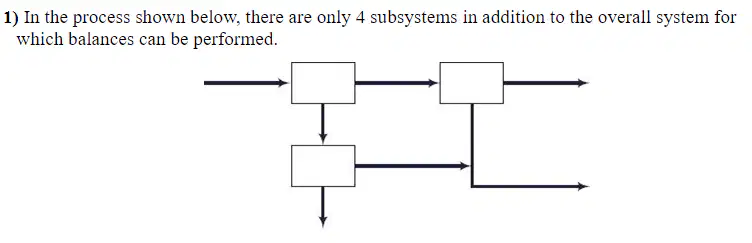
Answer
True
False
If the number of degrees of freedom in a system is greater than or equal to one, there is no point in doing any calculations, because a unique solution cannot be found for any of the unknowns in the system.
True
False
A degree-of-freedom analysis can be performed before any calculations are performed.
True
False
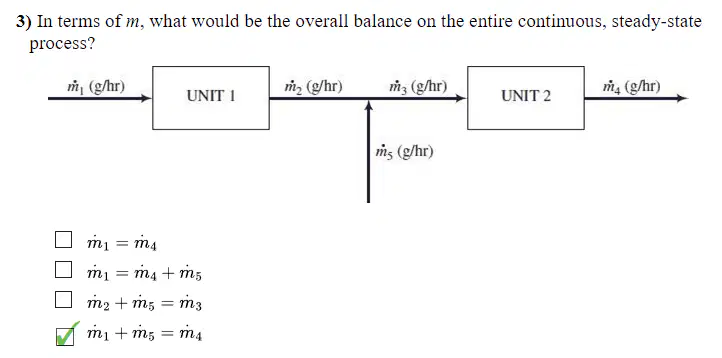
Answer
A
B
C
D
How should we approach the degree-of-freedom (DOF) analysis for multiple-unit processes?
Only carry out the DOF analysis on the overall process.
Only carry out the DOF analysis on each subsystem of the process.
Only carry out the DOF analysis on the individual process units.
Carry out the DOF analysis on the overall process and subsystems of the process.
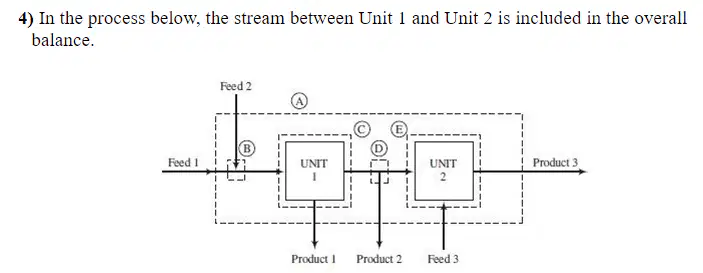
Answer
True
False

Answer
True
False
When analyzing a multiple-unit process, one is required to solve the overall balance first before solving other subsystems.
True
False
If the degrees of freedom for one subsystem are zero, one may assume that the variables in that subsystem are considered “known” when proceeding to solve the next subsystem.
True
False
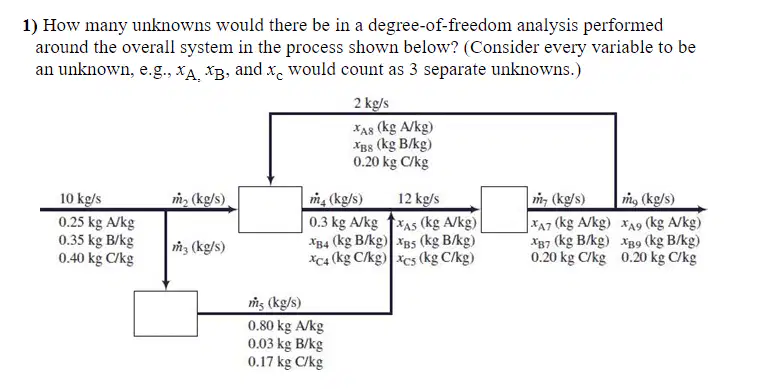
Answer
1
3
4
6

Answer
80
20
160
40
Which of the following cannot be said about a reactant that is present in 30% excess in the feed?
The fractional excess of the reactant is 0.30.
The reactant is present in more than its stoichiometric proportion relative to other reactants.
The reactant is present in less than its stoichiometric amount relative to other reactants.
0.30 is the ratio of the excess amount of reactant to the stoichiometric amount of reactant.
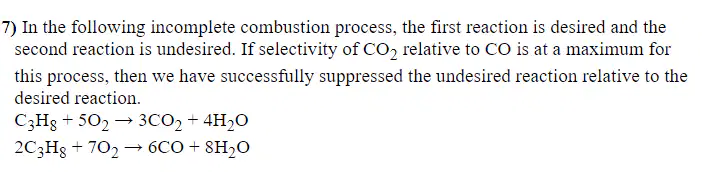
Answer
True
False
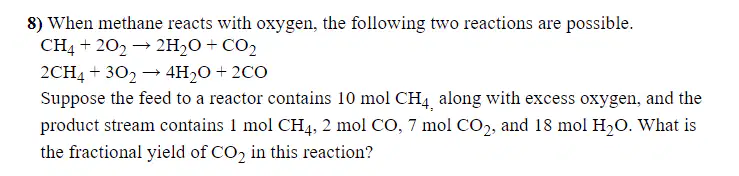
Answer
0.25
0.3
0.7
3.5
Systems that involve chemical reactions can be analyzed using atomic balances, which will reduce the general balance equation for a steady-state reactive process to be Input = Output.
True
False
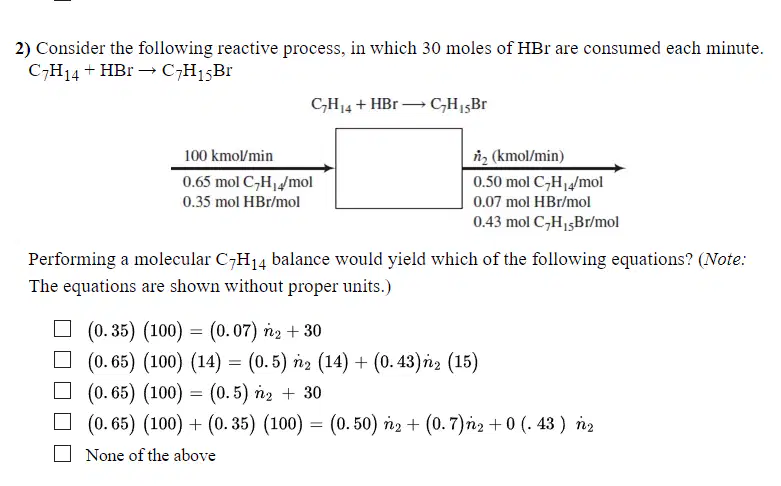
Answer
A
B
C
D
E
In order for two molecular species to be considered independent in a reactive process, they must be present in the same ratio to each other when they appear in the process.
True
False
When we utilize the technique of molecular species balance to determine unknown variables for a reactive process, then in the degree-of-freedom analysis, each chemical reaction introduces an additional unknown.
True
False
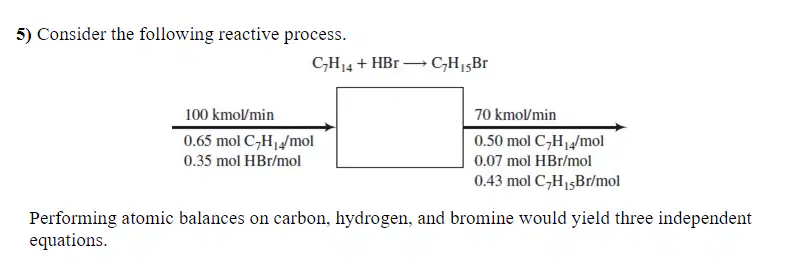
Answer
True
False
Every independent reaction in a system adds how many degrees of freedom?
0
1
1 for generation + 1 for consumption
The number of degrees of freedom depends on the stoichiometry of the reaction.
When we utilize the technique of atomic species balance to determine unknown variables for a reactive process, then in the degree-of-freedom analysis, each chemical reaction is an additional unknown.
True
False
Generally, in this course, we assume that atomic species are not created or destroyed.
True
False
Material balances carried out via the molecular species method, the atomic species method, or the extent of reaction method will always yield the same results.
True
False
When we utilize the technique of extent of reaction to determine unknown variables for a reactive process, then in the degree-of-freedom analysis, each chemical reaction introduces an additional unknown.
True
False
The overall and single-pass conversions are calculated separately for each individual reactant.
True
False
The single-pass conversion is based only on the streams entering and leaving the reactor, while the overall conversion is based on the streams entering and leaving the overall process.
True
False
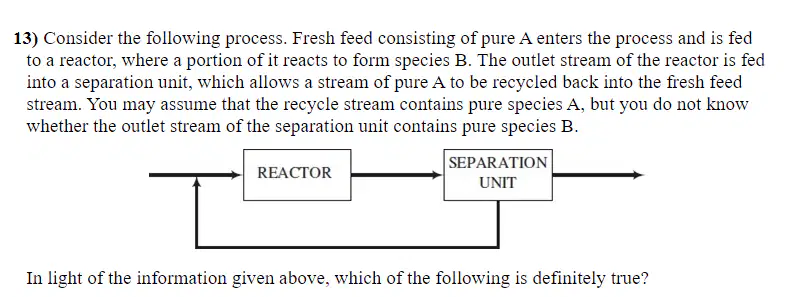
Answer
The overall conversion is 100%.
The overall conversion is less than 100%.
The single-pass conversion is 100 %.
The single-pass conversion less than 100%.
The overall conversion is greater than the single-pass conversion.
Purge streams are necessary mainly for inert or insoluble substances because they can accumulate and disrupt the steady-state process of a system.
True
False
A purge stream can be used_________.
In conjunction with a recycle stream
To avoid unwanted material buildup in a process
To allow some process to reach steady-state
All of the above
Partial combustion of butane will include CO2 as a product.
True
False
Theoretical air is the amount of O2 needed for the complete combustion of all the fuel fed to a reactor.
True
False
Which of the following is a product in the incomplete combustion reaction of ethane? Select all that apply.
Carbon dioxide
Carbon monoxide
Water
Ethane
Propane undergoes an incomplete combustion reaction. We are told that 200 mol/min of propane is fed to a combustion chamber, and the fractional conversion of propane is 0.3. What quantities and values would be needed to calculate the theoretical amount of oxygen? Select all that apply
The amount of propane fed to the reactor (200 mol/min)
The stoichiometric coefficients of propane and oxygen in the complete combustion reaction
The stoichiometric coefficients of propane and oxygen in the incomplete combustion reaction
The fractional conversion of propane (0.3)
The calculations for percent excess air and theoretical air do not consider the presence of incomplete combustion reactions.
True
False
The value for theoretical air (in moles) will always be greater than the value for theoretical oxygen.
True
False
The density of a given substance could either increase or decrease with an increase in temperature, depending on conditions and the nature of the substance.
True
False
Which of the following are units of density? Select all that apply.
g/cm3
m3/kg
lbm/km3
lbf/ft3
What is the most common reference density used in specific gravity calculations?
Ethanol at 20°C
Ethanol at 20°C
Water at 4°C
Mercury at 20°C
If 5.0 mL of benzene has a density of 0.879 g/cm3, what is its mass in mg?
5.7 mg
4400 mg
4.4 mg
5700 mg
It is possible to determine the volumetric flow rate from the mass flow rate and the specific gravity of a fluid.
True
False
What is the mass flow rate of diethyl ether (in kg/s) given a volumetric flow rate of 0.36 m3/h and a density of 708 kg/m3?
0.07 kg/s
250 kg/s
0.55 kg/s
2000 kg/s
A rotameter can be used to measure the flow rate of both liquids and gases.
True
False
Venturi meters measure flow rates by decreasing the cross-sectional area of a pipe and then increasing the area back to the original size and measuring the pressure drop between a point before the meter and when the pipe has the smallest diameter. Orifice meters also measure the pressure drop between two points to measure flow rates. However, between the measured points is an obstruction along the walls of the pipe. Which device, venturi or orifice meter, would you expect to have a lower pressure drop across the meter?
Orifice meter
Venturi meter
How many tons of CO2 are in 2 ton-moles of carbon dioxide?
56 tons
44 tons
22 tons
88 tons
The mass of a lb-mole is 1 lbm for every mole of substance.
True
False
What is the molar flow rate (in lb-mole/min) of ethylene glycol (C2H6O2) given a volumetric flow rate of 55.0 ft3/min? Ethylene has an SG of 1.113.
0.887
3820
61.6
0.987
A basis of calculation can be taken if needed to convert a set of mole fractions to mass fractions.
True
False
Mass and mole fractions are dependent on their units and require conversions to be expressed in alternate units.
True
False
The average molecular weight of a mixture can be calculated by summing the individual molecular weights of each species and dividing by the total number of species.
True
False
Which of the following have units corresponding to concentrations? Select all that apply.
mol/L
g/mL
kg of A/kg of solution
mL of A/L of solution
It is possible to calculate the volume of a species in a solution given the concentration and number of moles of the species.
True
False
All of the following are acceptable units of pressure except:
Pa
lbf/ft2
mm of H2O
N/m3
You must know the densities of two fluids in order to convert between pressures expressed as heads of each fluid.
True
False
An absolute pressure can have a negative value.
True
False
Which of the following is not a correct value of atmospheric pressure?
760 torr
14.696 psi
1.01325 kPa
1.01325 bar
Which of the following are equivalent to 15 torr of vacuum?
745 mm Hg absolute
14.696 psi
1.01325 kPa
1.01325 bar
Two points in a manometer at the same height that are connected by the same fluid always have the same pressure.
True
False
Suppose an angled differential manometer is made such that the U-shape of the manometer connects to a pipe at a 45-degree angle. Which manometer will more precisely detect a smaller difference in fluid heights?
The angled differential manometer is more precise.
The standard differential manometer is more precise.
Both manometers are equally precise.
Which of the following temperature scales have the same intervals? Select all that apply.
Rankine and Celsius
Fahrenheit and Rankine
Celsius and Kelvin
Kelvin and Fahrenheit
An equivalent temperature range of 293 to 310 Kelvin in Fahrenheit has a difference of 17 degrees
True
False
At what temperature are both the Fahrenheit and Celsius temperature scales equivalent?
-40°F
0°C
44°F
40°C
The bold term in the following statement is a dimension.“The acceleration due to gravity on earth is about 9.8 m/s2.”
True
False
Any valid conversion factor will reduce to the dimensionless numerical value 1.
True
False
m3, m/s, kg.m/s2, and cm are all examples of compound units.
True
False
The unit of distance “feet” is a base unit of the American engineering system of units.
True
False
When you multiply or divide two numbers, the number of significant figures in the result is equivalent to the lowest number of significant figures in either of the two numbers.
True
False
In general, the greater the value of sample standard deviation, the greater the accuracy of the associated experimental value.
True
False
In general, the more samples that are used to calculate a sample mean, the more accurate the sample mean will be.
True
False
The following is a valid equation.C (cm/min) = Co (cm/min) + g (m/s2) t(s)
True
False
The acceleration of gravity on earth is about 32.174 ft/s2. What would be the gravitational force (in lbf) of an object having a mass of 20 lbm, if that object were on the surface of a planet with a gravitational acceleration equal to 3 times that of Earth?
20/3 lbf
60 lbf
1930.44 lbf
20 lbf
Which unit system is the unit of distance “meters” a base unit of?
American Engineering
SI
CGS
The unit of time “s” is what kind of unit?
base
derived
multiple
Which of the reasons below best explains why the weight of an object would be different on the moon than at sea level but the mass would stay the same?
An object weighs more on the moon.
An object is heavier on the moon.
The scale to measure weight is different on the moon.
The gravitational constant g is not the same on the moon as it is at sea level.
The total mass of 6 identical cubes is reported to be 45.25 g. In order to determine the mass of a single cube, you enter 45.25/6 into your calculator. After completing the calculation, the screen of your calculator reads “7.5416666666667.” What is the mass of a single cube, rounded to the correct number of significant figures?
7 g
8 g
7.542 g
7.5416666666667 g
Which of the following solutions is not physically possible? (Note: more than one response can be selected.)
The density of an alloy comprised mainly of copper is calculated to be 100 g/m3.
The final temperature of steam at 1 atm in an expansion process is calculated to be 65°C.
CO2 emissions in a power plant are calculated to be 3000 tons/h.
The growth rate of a population is calculated to be negative.
You can validate quantitative results by:
Substituting the results back into the equation you used to solve for the values
Comparing the results to an estimated solution obtained using rounded values
Checking to see if the results are logical
All three choices
Suppose you are producing ammonia in a batch process. After 1 hour, the reaction terminates and you withdraw n moles of ammonia. You perform 20 successive trials (keeping everything constant in each trial) and find that the sample mean of n moles of ammonia after 1 hour is 0.175 moles. Which of the following will most likely take place?
In some runs, we withdrew 0.175 moles of ammonia after 1 hour.
In all runs, we withdrew 0.175 moles of ammonia after 1 hour.
In each successive run, the amount of moles of ammonia withdrawn after 1 hour could have been above or below 0.175.
In some runs, we withdrew 0.175 moles of ammonia after 1 hour, and in each successive run, the amount of moles of ammonia withdrawn after 1 hour could have been above or below 0.175.
Which is consistent through the following equation?W(Btu) = P(Pa)ΔV1(m3) + W0(Btu)
The dimensions
The units
Both
Neither
Linear extrapolation would provide a reasonable estimate for y(x), where the value of x lies far outside of any two consecutive plotted points in the following figure:
True
False
Exponential and power functions are just two examples of the many types of functions that can be rearranged to fit the form of a linear equation.
True
False
In order to get a straight line for the following function of y in terms of x: y = a exp(b/x)ln(y) would be plotted on the vertical axis, and b/x would be plotted on the horizontal axis.
True
False
Which of the following equations would appear as a straight line on a semilog plot? (Note: more than one response can be selected.)
y = 5 exp(2.3x)
y = 3x5
y = (2)·4x
y = 5 exp(1.1x) + 400
Suppose you have an exponential function in the form y = aebx. Plotting y vs. x using a semilog scale and plotting ln(y) vs. x using a rectangular scale will both yield the following formula for slope.Slope = ln (y2/y1)/(x2 − x1)
True
False

