
NEW
Font size
 Worksheets
intro to apes
Total questions: 59
Worksheet time: 1hrs 6mins
During a(n) ____ event, trade winds are much stronger than usual.
El Nino
La Nina
Normal
Partly sunny
During an El Nino, trade winds are typically...
about average
stronger
weaker

The image is of a(n):
El Nino event
La Nina event
Non-El Nino (normal conditions)

The picture below is of a(n) ____ event.
Non-El Nino (Normal)
El Nino
La Nina
Why do the fisherman of Peru and South America not welcome a strong El Nino?
El Nino poisons the fish
El Nino causes strong winds and currents which move fish westward
El Nino bring cold water to the surface which kills the base of the food chain
El Nino shuts off upwelling and nutrients needed for the marine food chain do not rise to the surface

Examine the diagram. This is what occurs during ______________.
El NIno
La Nina
La Chica

Which climograph has the most precipitation during the winter?
A
B
C
D

The picture represents a(n) ___ event.
El Nino
La Nina
Non-El Nino (normal conditions)
Why is upwelling important?
Upwelling regulates ocean temperature
Upwelling provides nutrient rich water that sustains life
Upwelling controls the tides
Upwelling helps sailors to navigate the seas
Regions closest to ________________ tend to have warmer year-round climates.
Forest Fires
South Pole
North Pole
the Equator
What landform causes the rain shadow effect?
Mountains
Lakes
Plains
Valleys
A rain shadow forms on the ___________ side of a mountain as a result of ___________ precipitation there.
windward; more
windward; less
leeward; more
leeward; less
As air rises it ______.
warms and condenses
cools and condenses
Which side of the mountain usually gets deserts and why?
windward, because of rising, moist air
leeward, because of rising, dry air
windward, because of sinking, moist air
leeward, because of sinking, dry air

Which of the following is the correct definition of density?
The amount of stuff in an object
The amount of space an object takes up
A measure of the force of gravity on an object
The amount of matter (mass) packed into a space (object)

Which object has the highest density in this picture?
A
B
C
Which of the following is an example of an object with a high density?
Pillow
Bowling Ball
Beach Ball
What is the density of an object if it has a mass of 6g and a volume of 3cm3? (Hint: Density = mass/volume)
6 g/cm3
3 g/cm3
2 g/cm3
1/3 g/cm3
Does 1cup or 6cups of water have a higher density?
1 cup
6 cups
They have the same density

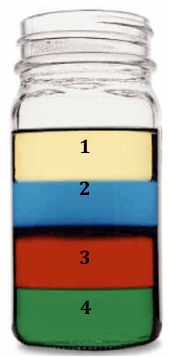
Which substance is the most dense in this picture?
Vegetable Oil
Dish Soap
Honey
Corn Syrup

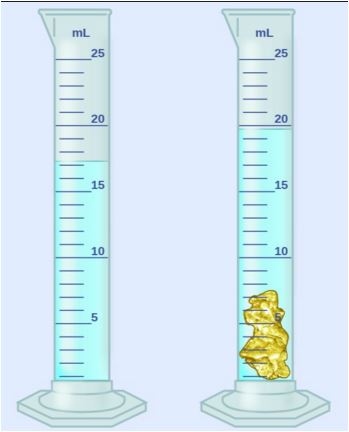
What is the formula for Mass?
Mass/Volume
Density x Volume
Mass/Density
What is the formula for Volume?
Mass/Volume
Density x Volume
Mass/Density
What layer of the earth is made of liquid magma?
innner core
mantle
crust
outer core
When matter gains energy (gets hotter), how does that affect the density?
The matter becomes less dense.
The matter becomes more dense.
Density isn't affected.
When matter loses energy (gets cooler), how does that affect density?
The matter becomes less dense.
The matter becomes more dense.
Density isn't affected.

Look at the image. The two continental plates are colliding. Why is the Indian Plate moving under the Eurasian Plate?
It's larger.
It's molten.
It's more dense.
It's less dense.

What processes create sedimentary rock?
Compaction and Cementation
Weather and Erosion
Melting and Cooling
Heat and Pressure

What processes create igneous rock?
Compaction & Cementation
Heat & Pressure
Weather & Erosion
Melting & Cooling
Tectonic plates consist of
continental crust
mesospheric crust
both continental and oceanic crust
oceanic crust
Pangaea was an ancient supercontinent made up of...
America, Greenland, and Europe
Antarctica, India, and America
all of Earth’s continents
South Africa, India, Australia, and South America
Which layer of the Earth consists of tectonic plates?
asthenosphere
mantle
mesosphere
lithosphere
The movement of the tectonic plates is caused by
the rotation of the Earth
convection currents in the Asthenosphere
the gravity of the iron-nickel core
the Moho discontinuity
The fact that similar fossils are found on both sides of the ocean is evidence of
magnetic reversal
global positioning
continental drift
oceanic drift


A map is provided that presents information on a certain region of the Earth. Based on the information on the map, at which location are mountains most likely to form?
A
B
C
D

Which oceanic plate in the above picture must be more dense? LEFT RIGHT
The plate on the left (the plate with the volcano on it)
The plate on the right (without the volcano)

Study this diagram carefully, noticing the direction of the arrows.The green bars are tectonic plates.What will happen at the place where the star is drawn on this diagram?
The plates will slide past each other (causing a major earthquake)
The plates will hit each other (one will subduct)
The plates will diverge (spread apart)

What type of event will occur at this boundary?
Earthquake
Volcano Eruption
Tornado
Mountain Building

What geologic process formed the Himalayas?
two continental plates converging
an earthquake in a subduction zone
a tectonic plate moving over a hot spot
movement at a transform fault boundary

