
 Worksheets
Last Science Test of 6th Grade
Total questions: 40
Worksheet time: 25mins
Which of the following best describes why some identical animal fossils have been discovered on opposite sides of the ocean?
Fossils over time, do fossilize into the same structures.
In the beginning, animals were close if not identical in different parts of the world.
The continents were one once large land mass.
As animals and people traveled for food, they took them there.
Name two things that support continental drift?
The seafloor is spreading.
Ice is melting from global warming at alarming rates
Volcanoes form islands.
Earthquakes make land mass drift off into the ocean.
The Earth's surface is slowly and constantly changing.
Check all that are true statements.
Divergent Plate boundaries cause a line of earthquakes and lines of volcanoes.
Movement of plate tectonics causing fault lines.
Volcanoes are one kind of feature that forms along convergent plate boundaries, where two tectonic plates collide and one moves beneath the other.
The theory of continental drift is most associated with the scientist Alfred Wegener.
Identical rock types, identical fossils, and very similar mountain ranges are found on different continents that are separated by a wide ocean. Which of these best explains these observations?
Ice covered most of the oceans, making land travel easy.
Animals were more aquatic and could all swim in the beginning of earth.
Pangea
Rock formations are the same when earth was formed and evolved over time.
A divergent boundary can cause or be caused by:
Create a new sea floor
A rift valley in a sea can get larger.
Two plates move away from each other
An underwater volcano is formed
The process of moving sediments by water or wind in the rock cycle.
compaction
crystallization
deposition
deformation
Weathering and erosion most likely cause what type of rock?
granite
metamorphic
sedimentary
igneous
Earthquakes in Calfornia are most likely caused from
The massive amount of Hollywood mansions
One oceanic plate moving beneath another oceanic plate at a trench
Ocean salt level
Two plates running into each other.
In order to find a rock or mineral in a particular location, what would be the first thing you might do as a scientist?
Look at what locations have had that rock or mineral found recently?
Google what natural disasters have factored into sediment distribution.
Conduct an experiment on the rock/mineral and see if it is flamable.
Find another local scientist interested in the same ideas.
As a glacier moves through certain areas, they can move away rock and make a valley look:
Have large peaks
Under water
Straight
U Shaped
Continental Drift can be caused by (multiple answer)
Animals searching for food and needing more land.
Major volcanoes erupting at the same time.
Convection currents
Pressure from plates can cause subduction.
New oceanic crust being formed.
A very "pointy" volcano can become flat due to
going from nonactive to active in less that 24 hours.
wind
lava burning its point away
extreme pressure
Thousands of years ago, plant decayed and under heat and pressured turned into:
fossils
very rich soil to grow crops
coal
diamonds
An aquifer hold ground water and how much is holds is determined by (multiple answer)
The terrain and surface
Precipitation
Types of layers that water must travel to underound
how large the empty magma chamber is
What are some ways water can be conserved?
Water plants with water collected from other sources.
Drink only sodas
Collect water when it rains or snows.
Limit the amount of water used daily in your household

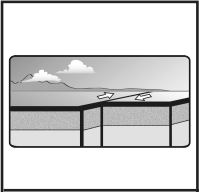
What type of boundary is this?
convergent
divergent
transform
What type of boundary is this?
convergent
divergent
transform

What type of boundary is this?
convergent
divergent
transform
Two plates scrape and slide past each other at
convergent boundaries
divergent boundaries
transform boundaries
magnetic boundaries
New crust forms along a(n)
subduction zone
divergent boundary
convergent boundary
transform boundary
___________, meaning "all land," is the name of the great landmass that existed millions of years ago.
lithosphere
Pangaea
subduction zone
tectonic
Wegener
A __________ plate is a large slab of crust and upper mantle that moves over the earth's surface.
lithosphere
Pangaea
subduction zone
tectonic
Wegener
____________ is the scientist credited with the theory of continental drift (which led to the theory of plate tectonics).
lithosphere
Pangaea
subduction zone
tectonic
Wegener
The point where one plate slides beneath another is known as the ______________.
lithosphere
Pangaea
subduction zone
tectonic
Wegener

Which model is depicting a convergent boundary between two plates?
top
middle
bottom

Which model is depicting a transform boundary between two plates?
top
middle
bottom

Which model is depicting a divergent boundary between two plates?
top
middle
bottom
What occurs between two oceanic plates at a divergent boundary?
rift valley
sea floor spreading
volcanic mountain range





What is an aquifer?
water well with a pump
An Impermeable layer of rock
A layer of soil or sand that stores water.
Rivers, lake, streams, and creeks

