
 Worksheets
Semester 2 Review 24-25
Total questions: 90
Worksheet time: 2hrs 2mins
The following is a scenario.
A local government wants to purchase privately owned homes to build a new business district. The district will create new jobs. Some of the owners do not want to sell their homes.
Under which amendment is the government given the power to purchase the home?
Fifth Amendment, Eminent domain
Sixth Amendment, right to speedy trial
Seventh Amendment, right to civil trial
Ninth Amendment, right to privacy


Which amendment guaranteed the right to vote for all men regardless of race or previous servitude?
13th Amendment
14th Amendment
15th Amendment
16th Amendment
The amendment which expanded suffrage rights to all citizens over the age of 18
14
15
19
26
Suffrage means...
Right to an education
Suffering of citizens
Right to Vote
Right to work
Amendment that ended slavery
13
12
14
10
Segregation is ...
separate facilities for minority groups
racial segregation separated african americans and whites
separate but equal, were usually not equal
all of the above


The 5th Amendment offers protection from what?
Free Speech
Unreasonable Search and Seizure
Clear and Present Danger
Self-Incrimination (remain silent)
This amendment defined citizenship and granted citizenship rights to former slaves. Voters are defined as male, at least 21 years old and citizens.
13th
14th
15th
24th
This amendment gave women the right to vote in federal and state elections.
15th
26th
24th
19th
This amendment guarantees that the right to vote in federal elections will not be denied for failure to pay any poll tax.
13th
14th
15th
24th
Which amendment is described below?
"SECTION. 1. The right of citizens of the United States, who are eighteen years of age or older, to vote shall not be denied or abridged by the United States or by any State on account of age."
19th
24th
26th
14th
Which of the following is NOT an example of rule of law?
"When the President does it, it is not illegal."
"I prefer to follow the law, not men."
"Anywhere, anytime ordinary people are given the chance to choose, the choice is the same: freedom, not tyranny; democracy, not dictatorship; the rule of law, not the rule of the secret police.
The government must work within the guidelines of the law.
What do the 15th , 19th , 24th and 26th amendment all have in common?
They all gave more citizens the right to vote
They all limited citizens' right to vote
They all helped people in poverty
They all related to racial discrimination

Establishes the Right to Privacy, free from unlawful searches & seizures.
2nd Amendment
4th Amendment
6th Amendment
8th Amendment

Which characteristic serves as a long-term protection against tyranny (cruel and oppressive government) and is a foundation of liberty in the United States?
The Commerce Clause
The Elastic Clause
The Rule of Law
The Right to Trial

Which is a benefit of the rule of law?
Government officials must listen to everything that citizens say.
Government decisions limit people's freedoms
Government officials can act on their own instincts in emergencies.
Citizens are protected from oppressive uses of government power.

3.11 What is the correct order of Florida's courts, from lowest to highest authority?
Circuit courts, Florida Supreme Court, county courts, District Court of Appeals
County courts, circuit courts, District Court of Appeals, Florida Supreme Court
District Court of Appeals, Florida Supreme Court, county courts, circuit courts
Florida Supreme Court, circuit courts, District Court of Appeals, county courts

The main job of the judicial branch is to…?
interpret the laws
make the laws
provide a jury
enforce the laws

Of the following, what may happen following a guilty verdict in a criminal case?
A U.S. Court of Appeals asks to review the case.
The criminal case becomes a civil case.
The defendant appeals the case to a higher court.
The U.S. Supreme Court automatically reviews the case

What is it called when a court has the authority to hear a case before any other case?
jurisdiction
original jurisdiction
judicial Review
judicial authority

What is the only level of federal courts that has a jury?
Circuit Court of Appeals
Divorce Court
Supreme Court
District Court

From which of the following courts is there no appeal (you can't take it any higher)?
U.S. Court of Appeals
U.S.Supreme Court
U.S.District Court
U.S. High Court

Which of the following cases would the federal court system have original jurisdiction over?
disputes between two citizens of the same state
disputes between two states
violations of local ordinances
violation of state laws
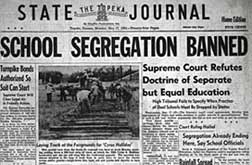
Ruled that “Separate but Equal” was unconstitutional - in effect overturning Plessy vs. Ferguson.
Hazelwood v Kuhlmeier
Marbury v Madison
Gideon vs. Wainwright
Brown v Board of Education

In which court would you find a panel of 3 judges?
Circuit Court of Appeals
US Supreme Court
Florida Supreme Court
Circuit Court

What is the correct order of the federal court system from lowest authority to highest authority?
U.S. Appeals Courts, U.S. District Courts, U.S. Supreme Court
State Supreme Court, U.S. Appeals Court, U.S. Supreme Court
U.S. District Courts, U.S. Appeals Courts, U.S. Supreme Court
State Supreme Court, Court of Federal Claims, U.S. Supreme Court
What is it called when the U.S. Supreme Court declares whether something is legal (constitutional) or illegal (unconstitutional)?
supreme court review
due process
segregation
judicial review

The decision in Marbury v. Madison (1803) expanded the power of the Supreme Court by
establishing the power of judicial review.
restricting the use of the elastic clause.
upholding the constitutionality of the National Bank.
interpreting the interstate commerce clause.

Favoring one view of thinking over another...
non-partisan
mass media
bias
propaganda

What is propaganda?
A technique used to sway your opinion either for or against someone or an idea.
A technique used only during political campaigns.
A technique used only during wartime.
A technique used strictly in commercials.

Why is it important to analyze political ads carefully before choosing a candidate?
Political ads are designed to convince you to vote for a candidate & may not present all sides of an issue.
Political ads are usually an afterthought for a campaign & probably do not contain up to date information.
Political ads often present a balanced viewpoint of all issues & therefore can be a good source of information.
Political ads contain only propaganda & lies & should not be a factor when selecting a candidate.

When the media only shows/publishes one side of an issue, the media is
displaying bias
offering a forum
evaluating sources
holding government officials accountable

Who has the power to declare war?
President
Congress
The People
Senate

What was the series of terrorist attacks by al Qaeda using hijacked planes?
December 7th
September 11th
August 2nd
August 8th

The United States joined World War II after which event?
Signing of the Paris Treaty
Japan bombed Pearl Harbor military base
Invasion of Florida
A strong military alliance was formed with Germany

Why did the US get involved in the Vietnam War?
South Vietnam invaded North Vietnam
South Vietnam wanted to increase trade with the United States
to prevent the spread of communism
the US feared military conflict

What method did the US use to deal with the Cuban Missile Crisis?
foreign aid
military action
economic pressure
diplomacy

Americans often refer to a country that is not the United States as a ___________ country.
Foreign
Domestic

Which involves issues or concerns within one's own country?
treaty
foreign affairs
domestic affairs
policy

Which of the following is defined as a country's actions, words, or beliefs toward/about other countries?
Foreign Policy
Domestic Interests
Military
Treaties

When Congress makes decisions on taxes, education, healthcare, and the economy which type of policies are they creating?
domestic policies
presidential policies
diplomacy policies
military policies

Any negotiations or talks between countries is referred to as...
diplomacy
treaty
domestic policy
embassy

The policy of giving economic and military assistance to other countries is known as...
domestic affairs
foreign aid
negotiations
espionage
"I'm 34 years old. My mother and father are both citizens of Russia. I have been a permanent resident in the U.S for 3 years."
Am I already a citizen, eligible for naturalization, or must I wait to apply?
already a citizen
eligible for naturalization
must wait to apply
"I'm 20 years old, and I was born in Korea. My parents are both U.S. citizens."
Am I already a citizen, eligible for naturalization, or must I wait to apply?
already a citizen
eligible for naturalization
must wait to apply
"I was born in the Philippines, but I've been living in the U.S. as a permanent resident for 6 years. I am 28 years old."
Am I already a citizen, eligible for naturalization, or must I wait to apply?
already a citizen
eligible for naturalization
must wait to apply
"I'm 20 years old, and I was born in Korea. My parents are both U.S. citizens."
Why am I already a U.S. Citizen if I was born in Korea?
Law of Blood
Law of Soil
Naturalization process
What is a right that ONLY citizens have?
Vote
Work
Attend school
Own property
Which case claimed blacks were not citizens and was overturned by 14th Amendment?
Brown v. Board of Education
Dred Scott v. Sanford
Hazelwood School District v. Kuhlmeier
In re Gault
What was the basis of the Supreme Court's decision in the Dred Scott case?
That slavery was taking away from American pride.
That African Americans' rights were protected by the Constitution.
That African Americans did not have the right to sue in federal court because they were not citizens.
That slavery should be abolished immediately.


Which economic system encourages high quality, achievement, and production?
Socialism
Communism
Capitalism

In which economic system are INDIVIDUALS in charge of owning land, resources, and factories?
Communism
Socialism
Capitalism

In which economic system is the GOVERNMENT in control of land, resources, and factories?
Socialism
Capitalism
Communism

