
Font size
 Worksheets
Nature of Science 2 4/30/2024
Total questions: 71
Worksheet time: 42mins
Scientific theories are usually
based on opinions and feelings.
supported by evidence and widely accepted by the community.
unable to change as new data or technology emerges.
claims posed by individuals.
Which of the following is a limitation of models?
It is often easier to study models rather than the objects or events that they represent.
Sometimes models provide data when data cannot be acquired from natural objects or events.
Models are often safer to study than the objects or events that they represent.
Models usually do not have exactly the same features as the objects or events that they represent.

Select the correct graph based on the data provided in the table for Bacteria Levels in Ohio Rivers.


Julia designed an experiment to find out if microwaving apple seeds keeps the seeds from sprouting. First, Julia separated 24 apple seeds into four groups. Next, she set aside the first group to use as a control. Then, she microwaved the second, third, and fourth groups for different amounts of time. If Julia's experiment showed that fewer seeds sprouted as microwave time increased, which table would best show her results?


What is the test variable (independent variable) in this experiment? Janet learned in science class that the amount of salt that can dissolve in a certain amount of water depends on the temperature of the water. She decides to do an experiment to test this. She carefully adds salt, 100 mg at a time, to a cup of water and stirs until all the salt dissolves. When she has added so much salt that it will not dissolve after 5 minutes, she measures the temperature of the water. She records the temperature and the final amount of salt. She does this with cold water, cool water, room-temperature water, warm water, and hot water.
the amount of salt
the temperature of the water
the amount of water
how long it took the salt to dissolve
Which of the following is an observation?
none of these
John honked his horn several times, turned into the oncoming lane, and sped around a stalled car.
John honked his horn several times and sped around a stalled car because he was angry.
John honked his horn several times at a stalled car to teach the other driver a lesson.
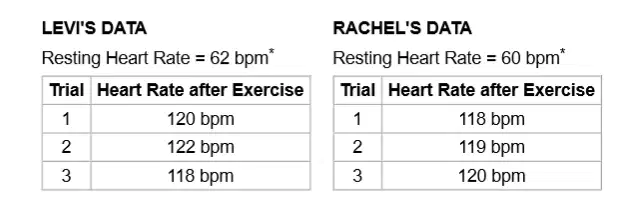
How do Levi and Rachel's results compare?
Their data is unreasonable.
The differences in their data are too significant to report.
Their data is exactly the same.
The differences in their data are not significant.

Mrs. Vega's science class incubated chicken eggs to see if any of the eggs would hatch. One of the eggs did hatch, and the class kept the chick. They measured the chick's weight each week using a spring scale. The measurements from the chick's weekly weigh-ins are shown in the table below: Week 1: 0.1 Newtons Week 2: 0.5 Newtons Week 3: 1.0 Newtons Week 4: 1.7 Newtons Select the correct graph that accurately represents the data from the table.

Graph A

Graph B

Graph C

Graph D

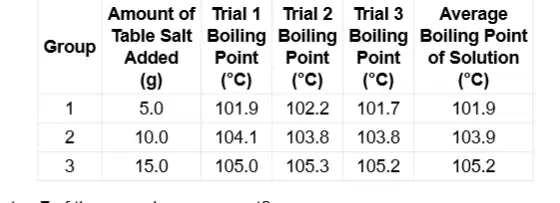
A science class conducted an experiment to learn more about solutions and their boiling points. The class broke up into three groups. Group 1 followed this procedure: 1. Place a 1-liter beaker filled with 500 mL of water on a hot plate. 2. Add 5.0 g of table salt, and stir until it is dissolved. 3. Carefully place a thermometer in the beaker with the solution. 4. Turn the hot plate on until the water boils, and then measure and record the temperature. 5. Turn off the hot plate, and allow 5 minutes for the solution to cool. 6. Pour out the solution and rinse the beaker. 7. Conduct steps 1-6 two more times. Other groups followed the same procedure, but each group added different amounts of table salt. The table below shows the data collected by each of the groups.
A. the time for the solution to cool
B. the volume of water in the beaker
C. the boiling point of the solution
D. the mass of the table salt added

Ivana is studying insect life cycles. She placed a male and a female gnat inside a terrarium. The female laid eggs. Ivana observed and recorded all of the stages she saw the eggs go through. Her results are shown in the table below.
A. A gnat is a crustacean, not an insect.
B. A gnat completes its life cycle in about 1 month.
C. A gnat life cycle has more than five stages.
D. A gnat generally does not live for more than 1 week.
What is a hypothesis?
a description of the steps involved in an experiment
a question that cannot be scientifically tested
a statement that summarizes the results of an experiment
a statement that can be tested through a scientific investigation

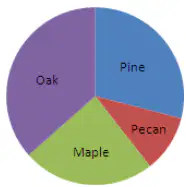
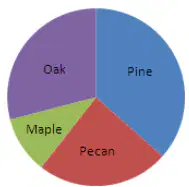
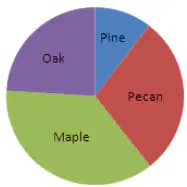
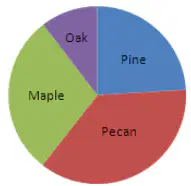
Select the correct graph. A biologist studied the trees in a nature preserve. She found that there were 4 different types of trees—pine, pecan, maple, and oak. The table below shows how many of each type of tree she found.
The scientific theory of plate tectonics states that the Earth's crust is composed of many plates, or slabs of rock. Interactions of these plates have created different landforms, or geologic features. Which of the following statements provides evidence for this theory?
The city of Pompeii is perfectly preserved under volcanic ash following the eruption of Mount Vesuvius.
An iceberg buckles the hull of the Titanic and allows water to enter between the steel plates.
A large earthquake off the coast of Japan induces a wave that is over twenty feet high.
Fossilized marine creatures can be found at the top of the Himalayan Mountains.
What is a hypothesis?
a statement that summarizes the results of an experiment
a description of the steps involved in an experiment
a statement that can be tested through a scientific investigation
a question that cannot be scientifically tested

According to the graph, which animal has a life span that is longer than a camel's?
chimpanzee
mouse
lion
giraffe
In 1839 a scientist named Theodor Schwann proposed a theory that later became known as the cell theory. The theory stated the following: 1. All living things are made up of cells. 2. The cell is the most basic unit of life. The theory at the time did not include where cells came from. In 1859, Louis Pasteur conducted an experiment that showed that living cells must come from other living cells. This idea was added to the cell theory. The other two points of the theory were not discarded, so the theory was modified. Why was the older cell theory modified and not discarded?
Scientific theories require the use of some older scientific knowledge in order to be valid.
The first two ideas of the theory cannot be changed since they are scientific laws.
Scientific theories cannot be discarded after a certain period of time has passed.
The first two ideas of the cell theory were still supported by evidence.
Scientists often repeat experiments multiple times. Why is this important?
Repeating an experiment helps to verify the results.
Repeating an experiment allows scientists to test different variables.
Repeating an experiment gives scientists something to do while they think of new hypotheses.
Repeating an experiment turns a hypothesis into a theory.
Some organisms that are alive today do not look exactly like organisms that lived in the past. However, if a comparison of DNA samples from two organisms that differ in appearance reveals that the organisms are nearly genetically identical, the samples may be used as evidence for which theory?
cell theory, or the theory that cells are the most basic units of life.
atomic theory, or the theory that atoms are the most basic units of matter.
the theory of evolution, or the theory that characteristics of populations can change over time.
the big bang theory, or the theory that life began as a clump of matter that exploded outwards.
Scientific inquiries usually begin with the formulation of a question. Can a scientific inquiry be constructed about any question?
No; only questions about supernatural events may be investigated.
Yes; one universal scientific method can be applied to any question.
Yes; it is possible to investigate any question through scientific inquiry.
No; the question must be testable or scientifically investigable.
In order for scientists to better investigate planets, they often use space probes. One such space probe, JUNO, arrived at Jupiter's atmosphere in 2016. The probe was able to detect lightning on the planet's surface. From the information gathered from JUNO, scientists determined that, unlike on Earth, most of the lightning on Jupiter occurs at its poles. Some scientists hypothesize that this is because there is more heat coming up at Jupiter's poles due to hot convection currents below its surface. What does this information about JUNO demonstrate?
Advanced technology is the only factor that helps in producing theories.
Space technology is limited to collecting information from planets.
Advanced technology helps in collecting data useful for interpreting events.
Space technology is limited to comparing astronomical bodies to Earth.
The observed results of an experiment that occur from changes in the test variable (independent variable) are known as _______.
controlled variables
constants
trials
outcome variables
Scientific theories and scientific laws are both based on extensive observations, experimentation, and reasoning. What is the primary factor that distinguishes scientific laws from scientific theories?
A. Scientific laws tend to be conceptual and rarely use mathematics.
B. Scientific laws are always true, even when conditions change.
A science class conducted an experiment to learn more about solutions and their boiling points. The class broke up into three groups. Group 1 followed this procedure:
1. Place a 1-liter beaker filled with 500 mL of water on a hot plate.
2. Add 5.0 g of table salt, and stir until it is dissolved.
3. Carefully place a thermometer in the beaker with the solution.
4. Turn the hot plate on until the water boils, and then measure and record the temperature.
5. Turn off the hot plate, and allow 5 minutes for the solution to cool.
6. Pour out the solution and rinse the beaker.
7. Conduct steps 1-6 two more times.
The other groups followed the same procedure, but each group added different amounts of table salt. The table below shows the data collected by each of the groups.
What does step 7 of the procedure represent?
A. repetition by doing multiple trials
B. interpreting data through observation
predicting outcomes using data
replication by other experimenters
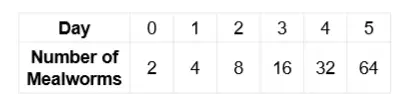
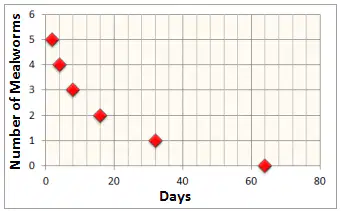
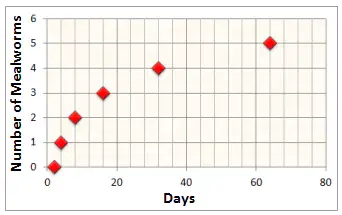
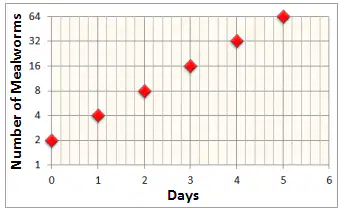
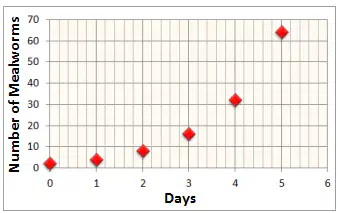
Select the correct graph. During an experiment, Walter measured the increase in a population of mealworms over time. The results of his experiment are shown in the table below: Day | Number of Mealworms 0 | 2 1 | 4 2 | 8 3 | 16 4 | 32 5 | 64 Which graph best represents the data Walter collected?
Which of the following is true regarding scientific theories, laws, and knowledge?
A. Scientific theories and laws develop from the acquisition of scientific knowledge.
B. New scientific knowledge is gained by memorizing scientific theories and laws.
C. Scientific knowledge must be proven by both scientific theories and laws.
D. Scientific theories can lead to scientific knowledge, but scientific theories are not related to scientific knowledge.
Gabriela wanted to conduct an experiment about magnetism. She stated the following hypothesis: "When heat is added to a magnet, its magnetic force increases." She followed these steps to conduct her experiment: 1. Place a bar magnet in a pile of steel paper clips. 2. Count and record how many paper clips the magnet picks up. 3. Repeat steps 1 and 2. Gabriela repeated the process with a magnet she heated up to 60°C. Her data showed that the hotter magnet picked up fewer paper clips than the magnet at room temperature. Which statement most accurately describes Gabriela's hypothesis?
A. It is of little value because it was incorrect.
B. It should allow her to change her data, so it has value.
C. It should be changed since it was incorrect.
D. It may lead to further investigations, so it has value.
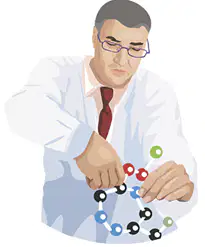
Mr. Stein builds a model of a molecule out of wooden beads and pegs. He uses the model to explain the shape of the molecule. Why does Mr. Stein use a model?
A. The real molecule is too small to easily observe.
B. The real molecule doesn't actually have a shape.
C. The model makes it more difficult to understand the molecule's shape.
D. The bonds between the atoms in the real molecule are too strong.

Scientific laws are not exactly the same as scientific theories. The table below shows an example of a theory and an example of a law.
Claim X is considered a theory and Claim Y is considered a law. Which statement best explains why this is?
Claim X is based on explanations of a process and Claim Y is based on direct observation.
Claim X is based on experimentation, and Claim Y is identical to a hypothesis.
Claim X states what always will happen, and Claim Y attempts an educated guess of an event.
Claim X makes a statement based on evidence, and Claim Y makes a statement based on opinions.
Jill hypothesizes that individual volcanoes produce igneous rocks with a certain chemical signature. She further hypothesizes that scientists could use an igneous rock's chemical signature to determine where the rock came from. What type of investigation should Jill perform to test her hypothesis?
model the formation of an igneous rock
collect and test rock specimens
perform a controlled experiment on a volcano
observe and describe a volcanic eruption
Scientists have been classifying living organisms for centuries. In the 1970s, organisms were classified in a five-kingdom classification scheme. However, two decades later, organisms called Archaeabacteria were discovered. This led to a three-domain system of classification that combined some of the previous five-kingdom schemes. What does this change in classification methods demonstrate?
In order for new evidence to become laws, old theories must be discarded.
Scientific theories that were proven at one time are no longer useful when new evidence arises.
In order for new evidence to become theory, it must prove that all other theories are wrong.
Scientific theories can change as new evidence arises, but previous information is still useful.
Denise wants to find out how the steepness of a hill's slope affects the amount of soil that erodes from it. She will use soil, a long pan, and several 4-inch-tall wooden blocks to build a model hillside. She will use a watering can to simulate rainfall. In her experiment, which factor should be Denise's variable?
A. the location she uses to test her model
B. the amount of water she pours on the model hillside
C. the type of soil with which she fills the pan
D. the number of blocks holding up the end of the pan
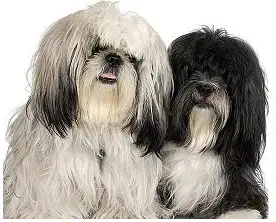
Addison has two dogs that are sisters. One of the dogs has white fur and the other dog has black fur. What scientific question could Addison ask based on this observation?
A. Which of the dogs is the most friendly?
B. Which color of fur is the prettiest?
C. How is fur color determined in dogs?
D. How fast do the dogs run?
Eva is performing an experiment to determine which type of disinfectant kills the most bacteria. She has six plates of the same kind and amount of bacteria. She adds one of five different kinds of disinfectant to each plate and leaves one plate without any disinfectant as a control. What role does the test variable (independent variable) play in this experiment?
A. The amount of bacteria killed determines the type of bacteria used.
B. The amount of bacteria killed determines the type of disinfectant used.
C. The type of disinfectant determines the amount of bacteria killed.
D. The type of disinfectant used determines the type of bacteria used.
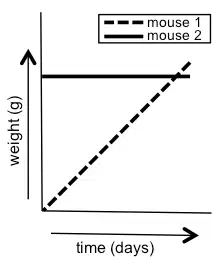
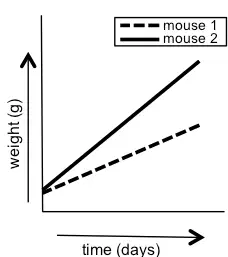
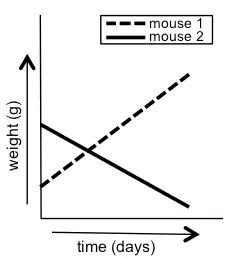
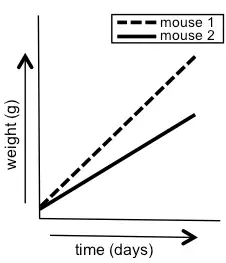
Select the correct graph. Mikey had two mice that were about the same age and weight. Mikey fed each of the two mice a different feed for a month. He measured how much the mice weighed every two days until the month was over. Mikey's results showed that although both mice gained weight over the month, mouse 2 gained more weight than mouse 1. Which graph below best shows these results?
Scientific inquiries usually begin with the formulation of a question. Can a scientific inquiry be constructed about any question?
A. Yes; it is possible to investigate any question through scientific inquiry.
B. No; the question must be testable or scientifically investigable.
C. No; only questions about supernatural events may be investigated.
D. Yes; one universal scientific method can be applied to any question.
Newton's law of universal gravitation, the law of conservation of mass, the law of superposition, and the laws of thermodynamics are all examples of scientific laws because:
they have been modified repeatedly over time.
there are no exceptions to these laws under specific stated conditions.
they have been approved and accepted by congress.
they are found in science textbooks.
Directions: Drag each tile to the correct box. Sarah wants to know if mice prefer peanut butter over cheese. In what order should she do the following steps?
Predict which food the mice will prefer.
Place a bowl of peanut butter and a block of cheese next to each other in a mouse cage.
One at a time, place ten mice in the cage and observe which food they eat.
Write a report on her findings.
Which of the following is an inference?
Once Tameka saw her birthday cake, she started to smile.
Everybody at the party wore red hats that had 'Happy Birthday!' in green letters.
The dog barked for 5 minutes once the candles on the cake were lit.
Even though Jennifer didn't say anything, I could tell by her expression that she was having a good time.
The conservation of energy is a ______ because it has been demonstrated without exception under certain stated conditions.
scientific hypothesis
scientific theory
scientific law
scientific variable
Scientists conduct experiments to collect evidence. Which of the following is the best definition of the word experiment as used by scientists?
a structured test of a hypothesis
a chance to try something new
the formation of a hypothesis
making a series of observations
A city government hired an independent company to test the city's air quality and report back with their findings. After the study, the company informed the city government that the air quality was acceptable by state standards. Which of the following would be the best way for the company to defend such a conclusion?
Provide the city with a survey showing that the public supports the study.
Provide the city with scientific data that clearly supports their findings.
Tell the city that the company has scientists who are experts in air quality.
Tell the city that the company has invested large sums of money in its tests.
Scientific inquiry includes many different activities. Which of the following is a process that is typically performed during a scientific inquiry?
communicating data
collecting data
constructing investigations
all of these
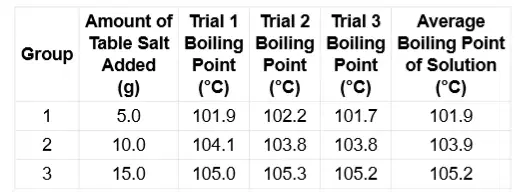
A science class conducted an experiment to learn more about solutions and their boiling points. The class broke up into three groups. Group 1 followed this procedure:
1. Place a 1-liter beaker filled with 500 mL of water on a hot plate.
2. Add 5.0 g of table salt, and stir until it is dissolved.
3. Carefully place a thermometer in the beaker with the solution.
4. Turn the hot plate on until the water boils, and then measure and record the temperature.
5. Turn off the hot plate, and allow 5 minutes for the solution to cool.
6. Pour out the solution and rinse the beaker.
7. Conduct steps 1-6 two more times.
The other groups followed the same procedure, but each group added different amounts of table salt. The table below shows the data collected by each of the groups.
If a student were to conduct an identical experiment, which amount of table salt would most likely result in a boiling point of 103°C?
A. more than 15 g
B. between 10 g and 15 g
C. less than 5 g
D. between 5 g and 10 g
Experiments are often performed in science to produce data or evidence. This evidence is then analyzed to draw conclusions. The use of evidence to formulate conclusions encourages ________.
A. bias
B. subjectivity
C. objectivity
D. partiality
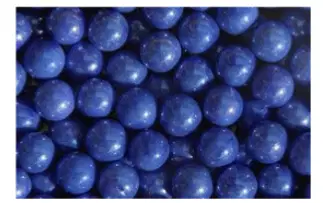
Kara built a model of how molecules behave when they are in solid form. She filled a clear plastic box with marbles to the very top and put the lid on the box. When she shakes the box, the marbles can barely move. Which of the following is a limitation of Kara's model?
A. The marbles must be held in a box, but solids hold together without a container.
B. The marbles have limited motion, but molecules in solids move a lot.
C. The marbles are made out of atoms, but molecules are not.
D. The marbles are all the same shape, but molecules all have unique shapes.

Peter visits his grandmother every Saturday. The diagram below shows a graph that describes the distance he travels over time.
Which of the following tables matches the information in the above graph?


A scientific theory explains how or why things happen in nature.
True
False

Scientific models are
Representations of objects or processes that are not easily observable
Fashion models who are also scientists
Testable ideas or explanations that lead to scientific invstigation
Dependent upon the dependent variable

The data collected supports which of the following questions that Squidward could have tested?
Which song does the audience prefer?
Which instrument does the audience like best?
Which reed length creates the best sound?
How do applause affect performance?
Match the following parts of an experiment set up
things kept the same in an experiment
controlled variables
factor the experimenter changes
independent variable
factor that is measured
dependent variable
does NOT receive the experiment treatment
control group
procedure done to test a hypothesis
experiment
Which of the following is a statement that describes something that happens in nature that seems to be true all of the time?
theory
hypothesis
scientific law
conclusion
What is the difference between a scientific theory and a scientific law?
Theories and laws are the same thing: there is no difference.
A theory will eventually become a law after a long period of time.
A theory is an explanation of the natural world and a law is a description of the natural world.
Theories and laws switch back and forth depending on the situation.
A scientific law is
describes a pattern in nature that is ALWAYS true
laws scientists need to follow to perform science correctly
the steps scientists follow to investigate our natural world
an explanation of observations or events gained through many observations and investigations
Which step of the scientific method involves making an educated guess about the outcome of an experiment?
Observation
Hypothesis
Experimentation
Conclusion
A series of steps used by scientists to solve a problem or answer a question.
scientific method
recipe
data collection
metric system
What is the smallest living unit of an organism?
Nucleus
Atom
Molecule
Cell
A pre-existing cell is one that is
already alive
Not alive
Newly created
divided
The (a) part of cell theory states that every (b) thing is made up of (c) or more (d)
The (a) part of cell thory states that all (b) come from (c) ones.
A hypothesis is a statement that can be tested through a scientific investigation. What is the purpose of writing a hypothesis?
Hypotheses help identify the variables.
Hypotheses give details about the data.
Hypotheses always match the conclusion.
Hypotheses suggest new questions for further investigations.
How is a scientific theory different from everyday theories proposed by random individuals?
Scientific theories must be supported by evidence or data.
Everyday theories can be proven beyond doubt.
Scientific theories are not different from everyday theories.
Everyday theories are based on facts, not opinions.
Laboratory experiments, observational field studies, and model-building are all examples of different forms of scientific investigations. In what way do laboratory experiments primarily differ from other forms of scientific investigations?
Studies about how things behave in nature or studies involving very large objects are best answered through laboratory experiments.
A laboratory experiment is the only accepted form of investigation within the scientific community.
Laboratory experiments involve the identification and control of variables.
Data can only be generated through laboratory experiments, not other forms of investigation.
In school, Jarrett learned that salt lowers the freezing point of water. He wants to test this in a home experiment. He combines 1.0 grams of salt and 500 milliliters of water in a container. In an identical container, he pours 500 milliliters of water and does not add salt to it.
What should Jarrett do next?
Place the pure water in a freezer and the salt water in a refrigerator.
Place both containers in a freezer, and record the temperatures at which they begin to freeze.
Mix the two samples of water together in a 1.0-liter container, and bring them to a boil on a stove.
Place the salt water in a freezer and the pure water in a refrigerator.

The graph below shows the number of common dolphins seen in the Santa Barbara Channel each year for 6 years.
Approximately how many common dolphins were seen in the Santa Barbara Channel in year 1?

Amir measured the air pressure every day for a week. The results are in the graph below.
Which of the following tables matches the data above?


Scientific knowledge can withstand the test of time because
it is open to change as new evidence or data is discovered.
advancements in technology have no impact on science.
exceptions can be made regarding scientific laws.
scientific theories have been proven beyond doubt.
The kidneys are organs that filter wastes out of the blood stream. Which of the following objects could best be used to make a simple model of a kidney?
coffee filter
plastic bag
block of wood
water pump
Which of the following objects would best be used to understand how the human heart works?
water pump
block of wood
plastic bag
coffee filter
Which of the following scenarios demonstrates the replication of a scientific investigation?
Dr. Kim performs an experiment in her laboratory. Then, Dr. Stevens performs the same experiment in his laboratory to verify the results.
Dr. Burgess reads about an experiment in a scientific journal. He performs a similar investigation in his own laboratory, but he changes some of the variables.
Dr. Abraham performs the same experiment in his own laboratory on five different occasions.
Dr. Jordan visits another scientist and watches the scientist perform an experiment in her own laboratory.

