
 Worksheets
Taxonomy
Total questions: 40
Worksheet time: 26mins

If two organisms belong to the same order, then they must also belong to the same...
Species
Class
Family
Genus
An organism's scientific name is based on how it is classified. Which of the following levels of classification determine the name?
kingdom & phylum
class & species
domain & order
genus & species
An organism's scientific name is based on how it is classified. Which of the following levels of classification determine the name?
kingdom & phylum
class & species
domain & order
genus & species
The more classification levels that two organisms share,
the closer together on earth they live.
the easier it is to tell them apart.
the more related they become because of many shared characteristics.
the more distance is between them due to lack of shared characteristics.
Who created the most commonly used system of taxonomy?
Niels Bohr
Watson and Crick
Charles Darwin
Carl Linnaeus
Which is the correct order?
Kingdom Phylum Order Class
Class Order Family Genus
Domain Phylum Kingdom Species
Order Family Species Genus
Identify the one that is NOT an archaea.
Methanogen
Thermophile
Halophile
Virus
You find a species that seems to be unicellular and is eating smaller cells around it. It has organelles and a nucleus. Which kingdom is it MOST likely a part of?
Fungi
Bacteria
Protists
Plants
Which of the following is NOT a unicellular kingdom?
Prokaryotes
Protists
Archaea
Fungi
You identify a small living organism that is eating something at your feet. It's visible but pretty tiny, you take it to a lab and find that it has cell walls made of chitin. Which is its domain and kingdom?
Prokaryote, Fungi
Eukaryote, Fungi
Prokaryote, Plant
Eukaryote, Plant
Which is NOT a eukaryote?
Plants
Animals
Archaea
Protists
Black panthers (Panthera onca) are a color variant of a species of large cats. Black panthers would be most closely related to what organism listed below?
Tiger (Panthera tigris)
Cheetah (Acinonyx jubatus)
Puma (Puma concolor)
Jaguar (Panthera onca)

Heterotrophs- obtain food from other animals.
Observing the table above, Fungi and Animals are________?

What is the order of the taxonomic levels from least specific to most specific?
Kingdom, Family, Species, Order, Class, Phylum, Genus
Kingdom, Phylum, Class, Order, Family, Genus, Species
Species, Order, Kingdom, Family, Genus, Phylum, Class
Species, Genus, Family, Order, Class, Phylum, Kingdom
Organisms whose cells do not have a nucleus are called _____.
Eukaryotes
Multicellular
Unicellular
Prokaryotes
What is the genus name here:
Canis lupus
Canis
lupus
What was the system Carolus Linnaeus invented called?
binomial nomenclature
binomiel nomencleaner
bionomal normanclure
nibromial clomanature
none of the answers are correct
Binomial nomenclature is always written in italics.
true
false
process of using water, light, and carbon dioxide to produce sugar
respiration
binomial nomenclature
photosynthesis
protista
cells that do have a nucleus
prokaryotic
eukaryotic
unicellular
bacteria
unicellular organisms that live in extreme environments
eubacteria
autotroph
archaebacteria
fungi
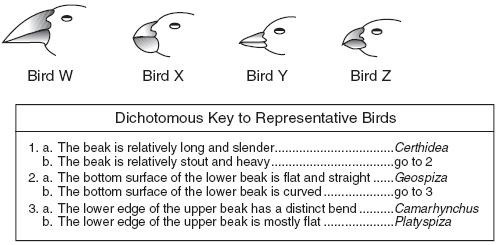
What is the name of bird W?
Certhidea
Geospiza
Camarhynchus
Platyspiza

Which of the following best describes the purpose of binomial nomenclature in biological classification?
To classify organisms based on their evolutionary history
To provide a unique and universally accepted name for each species
To identify the physical characteristics of organisms
To determine the genetic relationships between different species
All viruses are different, but what are two parts that a virus must have?
Genetic Information (DNA or RNA)
a lipid membrane
a nucleus
a protein coat

Which of these statements is true?
A virus is unicellular, it has only one cell.
A virus may sometimes be multicellular, have many cells.
A virus has no cells

Which sentence is true about this picture.
It shows a virus being made.
It shows a virus entering the cell of a human or animal.
It shows a virus being destroyed by soap.

At the top left of this picture, you can see the spike protein of a virus fitting perfectly into a receptor site on our cells. Which sentence below is true?
Humans have receptor sites for viruses on our cells because we want viruses to invade our cells.
Humans have receptor sites for viruses on our cells because those receptor sites were made for a different purpose, but viruses evolved to be able to use them.

Which viral cycle kills its host cell by lysing (exploding)?
lytic
mitosis
lysogenic
S phase

In a properly written scientific name, which part is written entirely in lowercase?
species
genus
phylum
family

community?

