
Font size
 Worksheets
SP8S Force and Motion
Total questions: 61
Worksheet time: 2hrs 12mins
Mechanical advantage is the ratio of:
Work input to work output
Force input to force output
Speed input to speed output
Distance input to distance output
Newton's First Law of Motion states that an object will remain at rest or in uniform motion in a straight line unless acted upon by an external force. This is also known as the law of:
Inertia
Acceleration
Action and reaction
Momentum
The relationship between force, mass, and acceleration is described by which law of motion?
Newton's First Law
Newton's Second Law
Newton's Third Law
Law of Inertia
Which of the following factors affect an object's motion?
Time
Distance
Weight
Volume
When analyzing the relationship between mass and gravitational force for falling objects, what happens to the gravitational force as mass increases?
It decreases
It remains constant
It increases
It fluctuates
Which of the following equations represents Newton's Second Law of Motion?
F = m* a
F = m/a
F = a/m
F = m + a
In a distance vs. time graph, a steeper slope represents:
Greater speed
Slower speed
Constant speed
Negative acceleration
When calculating mechanical advantage, which of the following formulas is correct?
Mechanical advantage Force input / Force output
Mechanical advantage = Force output / Force input
Mechanical advantage Distance input / Distance output
Mechanical advantage = Distance output / Distance input
Which of the following is a measure of an object's resistance to changes motion?
Velocity
Acceleration
Inertia
Momentum
Newton's Second Law of Motion states that the acceleration of an object is directly proportional to the net force acting on it and inversely proportional to its:
Speed
Mass
Volume
Density
Which of the following is NOT a unit of force?
Newton
Joule
Pound
Dyne
In which scenario would the mechanical advantage of a machine be greater than 1?
The output force is greater than the input force
The output distance is greater than the input distance
The input force is greater than the output force
The input distance is greater than the output distance
If an object is accelerating, what can be said about the net force acting on it?
The net force is zero
The net force is positive
The net force is negative
The net force is increasing
Which of the following best describes the relationship between work and mechanical advantage?
Work is the same as mechanical advantage
Mechanical advantage is the ratio of work to force
Mechanical advantage is the product of work and force
Work and mechanical advantage are unrelated concepts
What type of relationship exists between mass and gravitational force for falling objects, according to Newton's law of universal gravitation?
Directly proportional
Inversely proportional
Exponential
No relationship
When a force is applied to an object, what is the result if the object is at rest?
The object remains at rest
The object accelerates
The object decelerates
The object changes direction
Which of the following is an example of a first-class lever?
Wheelbarrow
Scissors
Nutcracker
Fishing rod


What is distance?
an object's overall change in position (start to end)
how much ground an object has covered during its motion
how fast an object is moving
how long it takes an object to move from start to end
What is speed?
an object's overall change in position (start to end)
how much ground an object has covered during its motion
how fast an object is moving
how long it takes an object to move from start to end
What is the equation to calculate speed?
speed = time ÷ distance
speed = distance ÷ time
speed = distance × time
speed = distance × velocity
What is the equation to calculate time?
time = speed ÷ distance
time = distance ÷ speed
time = speed × distance
time = distance × speed
Bruno sprinted down the hallway for a science project. He ran a total of 40 meters in 20 seconds. What was his average speed?
2 meters per second
20 meters per second
40 meters per second
10 meters for second

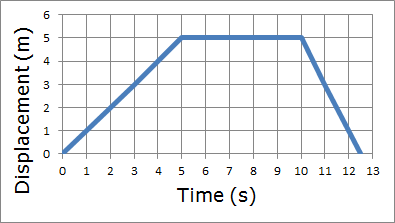
Match the description to the graph:
"The car is stopped."


Match the graph to the description:
"The car is stopped."
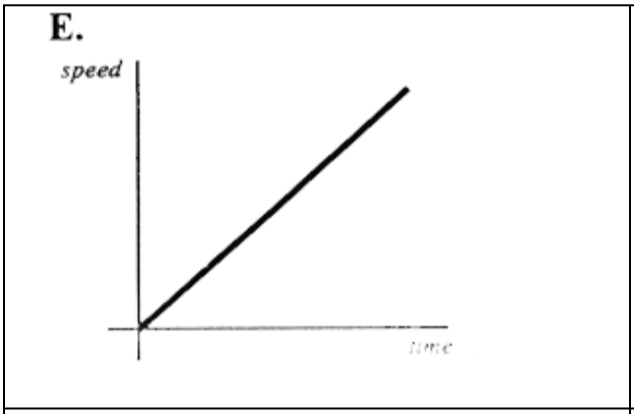
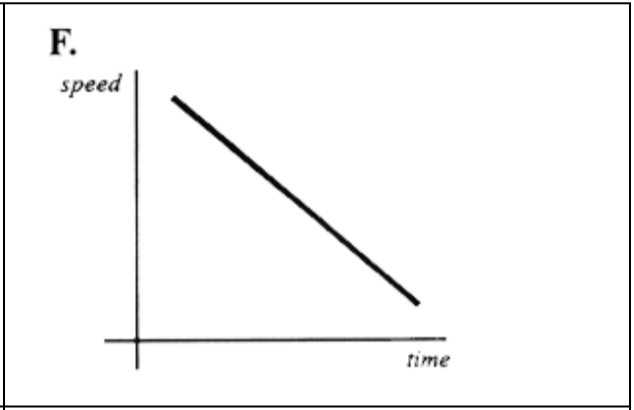
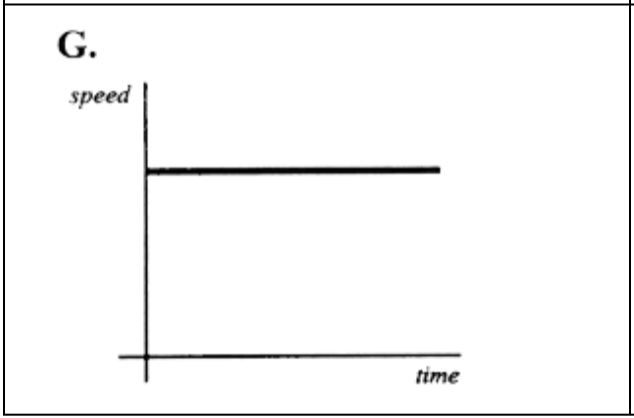
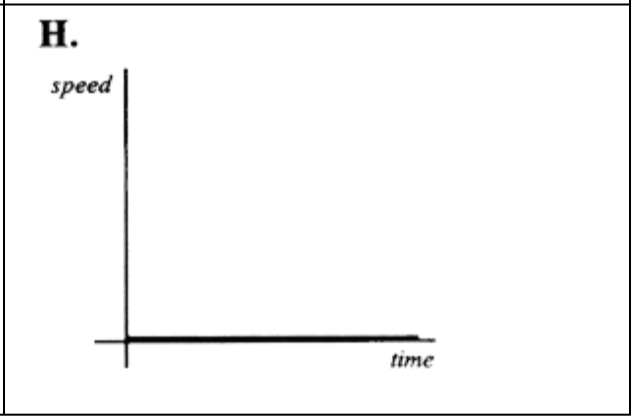
Match the graph to the description:
"The car is traveling at a constant speed."
Match the graph to the description:
"The car is accelerating speeding up (positive acceleration)."
Match the graph to the description:
"The car is slowing down (negative acceleration)."


What is a plausible story for this graph?
A student was jogging from school to home. She stopped to tie her shoe and take a drink from her water bottle, then continued at the same pace as before.
A student was jogging from school to home. She walked for a while, then continued jogging.
A sled rider was going down a hill. The hill was steep at first, then kind of flat. At the end, it was steep again.
A car was slowing down, then contued moving at a constant rate. Finally, it slowed to a stop,
A push or pull exerted on a object
Net force
Force
Inertia
sum of forces acting on a particle or body.
Net force
Balnced
Acceleration
one that causes a change in the motion of the object to which the force is applied
Action/Reaction
Unbalanced Force
Acceleration
the rate of change of velocity per unit of time
Acceleration
Balanced Force
Inertia
Which is an example of the law of inertia?
A rocket taking off from Earth
A crash test dummy flies through the windshield in a collision
A small rock skips on a pond faster than a large rock
What is inertia?
A property of matter which continues its existing state of rest or movement.
F = M x A
Getting faster, slower, or changing direction at a constant speed
What is the force of a baseball that has a mass of 142 kg and has an acceleration of 30 m/s2?
1 N
2 N
4260 N
3 N
Which is an example of the law of action/reaction?
A rocket taking off from Earth
A crash test dummy flies through the windshield in a collision
A small rock skips a pond faster than a large rock
Which example best describes Newton’s 3rd Law?
Paddling a canoe to make the boat move
A large truck takes longer to slow down than a car
Falling forward in a train that is slowing down quickly
Standing in line is an example of a ________ ________ since you are not moving forward, backward, or sideways.
negative acceleration
balanced force
unbalanced force
1st law of motion
The strength of the force of gravity between two objects depends on which two factors?
The mass of the objects and the distance between objects
The weight of the objects and the mass of the objects
The weight of the objects and the distance between the objects
The height of the objects and the mass of the objects
A crumpled piece of paper hits the ground before a flat sheet of paper because
the acceleration of gravity is greater on the crumpled paper
there is more air resistance against the flat paper
the crumpled paper is more massive
the crumpled paper is less massive
How does gravity affect how objects fall to the ground?
Heavy objects fall faster
Light objects fall faster
They fall at the same rate
Bigger objects fall faster
When you slide a box across the floor, what force must your push be stronger than?
Support Force
Friction Force
Gravity
Air resistance

Which ball will hit the ground first?
Metal first, then plastic, then wood last
Wood first, then plastic, then metal last
They will all hit at the same time
There is no way to tell
Which of these items is a first class lever?
scissors
fishing rod
tweezers
none of these
A wedge has an output force of 25 N when given an input force of 5 N. What's the wedge's mechanical advantage?
0.2
5
20
30
A simple machine has an input force of 12 N and an output force of 4 N. What is its mechanical advantage?
.33
3
8
16
The 3 parts of a lever are:
fulcrum, effort, and load
load, output, and input
input, effort, and fulcrum
pivot, output, and fulcrum
A device that helps us do work andand that has only one input is known as a:
simple machine
wheel and axle
mechanical advantage
really?
A teacher applies a force to a wall and becomes exhausted.


