
 Worksheets
AEPSY Lifespan psychology
Total questions: 140
Worksheet time: 1hrs 10mins
Who conducted the study on emotion over physiological needs with rhesus monkeys?
Ainsworth
Bowlby
Harlow
van Ijzendoorn
Who conducted a study on cross cultural patterns of attachment in 1988?
Ainsworth and Kroonenberg
van Ijzendoorn and Bowlby
van Ijzendoorn and Harlow
van Ijzendoorn and Kroonenberg
What does the "Strange Situation" study by Ainsworth classify Type B attachment as?
Insecure avoidant attachment
Secure attachment
Insecure resistant attachment
None of the above
According to Bowlby's theory of attachment, what concept describes a child's mental representations, specifically the worthiness of the self and expectations of others' reactions to the self?
Monotropy
Internal working model
Maternal deprivation
Evolutionary perspective
Which study is used to measure attachment types in children, as mentioned in the theories of social and emotional development?
Harlow's monkey study
Bowlby's 44 thieves study
Ainsworth's Strange Situation
van Ijzendoorn's cross-cultural analysis
What impact does an enriched environment have on social and emotional development?
No impact
Negative impact
Positive impact
Unpredictable impact
What was the primary aim of Harlow's 1958 study?
To determine the effects of enriched environments on infant monkeys.
To investigate the nature of attachment, focusing on contact comfort versus feeding.
To study the cognitive abilities of infant monkeys.
To explore different feeding techniques in primates.
According to Harlow's 1958 study, what aspect was considered to potentially lead to stronger attachments in infant monkeys?
Exposure to multiple surrogate mothers.
Exposure to multiple sources of milk.
Surrogate mothers providing nourishment.
Surrogate mothers providing comfort and security.
In what year did Harlow conduct his study on infant rhesus monkeys and their surrogate mothers?
1950
1958
1962
1970
What were the two types of surrogate mothers used in Harlow's 1958 study?
One made of plastic and one made of wood
One made of wire mesh and one covered in soft terry cloth
One made of glass and one made of fabric
One made of steel and one covered in cotton
According to Harlow's 1958 study, what did the wire mesh surrogate mother provide to the infant monkeys?
Warmth and comfort
Food
Tactile stimulation
None of the above
What did Harlow primarily observe about the infant monkeys' behaviour in his 1958 study?
Preference for one type of surrogate mother over the other
Their ability to climb
Their interaction with other monkeys
Their sleeping patterns
What aspect of the infant monkeys' behaviour did Harlow study when they were exposed to stressful situations?
Their vocalisations when overstimulated
Their ability to use a surrogate mother to feed
Their ability to use a surrogate mother to try calm themself and emotionally regulate
Their ability to use a surrogate mother to regulate through meditation
What was the purpose of the laboratory-constructed mother-substitutes used in Harlow's 1958 study?
To test the durability of different materials in a laboratory setting
To study contact comfort vs the provision of food in attachment
To improve the design of children's toys
To develop a new kind of pet for commercial purposes
How was the body of the wire-mesh mother designed in Harlow's experiment?
It was designed with multiple appendages to resemble a real monkey.
It was streamlined and stripped of unnecessary bulges and appendices.
It was covered with soft materials to make it cuddly.
It was equipped with mechanical parts to move around.
What feature of the "cloth mother" in Harlow's study was emphasised to benefit the infant monkeys?
The ability to move and interact with the infants
The emission of sounds similar to monkey calls
The warmth and tenderness provided by the heated lightbulb and soft materials
The colourful appearance to attract the infant monkeys
According to Harlow's 1958 study, what did infant monkeys prefer when given a choice between a wire surrogate and a cloth surrogate?
Wire surrogate
Cloth surrogate
No surrogate
Both surrogates equally
What behaviour did monkeys who were deprived of maternal contact exhibit, as found in Harlow's 1958 study?
Increased playfulness
Normal behaviour
Abnormal behaviour such as rocking back and forth and self-mutilation
Enhanced learning abilities
What does Harlow's 1958 study suggest about the role of 'contact comfort' in the development of attachment?
It is of negligible importance
It is moderately important
It is of overwhelming importance
It is not related to affectional responses
What was a significant contribution of Harlow's 1958 study on attachment?
It proved that attachment is solely based on nourishment.
It highlighted the significance of emotional bonding in attachment.
It confirmed that monkey studies directly translate to human behaviour.
It showed no significant findings on attachment.
According to the criticisms of Harlow's study, why might the findings from studies on monkeys have low external validity in relation to human behaviour?
Monkeys and humans do not show any similarities in behaviour.
Humans have more complex social and cognitive abilities than monkeys.
Monkeys are not capable of forming attachments.
Human studies are less controlled than monkey studies.
What ethical issues were raised by Harlow's attachment study?
The monkeys experienced no distress during the experiments.
The monkeys were not debriefed after completion of the study.
The monkeys subjected to maternal deprivation and social isolation experienced significant emotional distress.
The monkeys did not provide written consent.
What long-term psychological effects were observed in monkeys due to Harlow's study?
They chose mating partners who were warm and soft, but did not provide milk.
No observable long-term effects.
Issues with socialisation and behaviour in adulthood.
Enhanced cognitive abilities.
What is the definition of attachment, as described by Bowlby?
A biological instinct in which parents care for their offspring
The strong emotional bond between an infant and its caregiver, leading to feelings of security
A learned caring behaviour that develops through child and caregiver interactions
A social contract between family members to ensure mutual support
According to Bowlby, what is the primary function of attachment behaviours in infants?
To ensure that infants learn necessary skills from their caregivers
To provide infants with the ability to entertain themselves
To increase the likelihood of infant survival in threatening or dangerous environments
To develop independence from caregivers at an early age
What does the term "monotropy" refer to in the context of attachment theory as proposed by Bowlby?
The development of multiple attachment bonds by an infant
The notion that infants have an innate tendency to form a single, primary attachment bond with one specific caregiver
The ability of infants to adapt to different caregivers
The process by which infants detach from their primary caregiver
According to Bowlby's attachment theory, what role does the primary attachment figure play in an infant's life?
Provides occasional support to the infant
Plays a central role in the infant’s emotional and social development
Has minimal impact on the infant's development
Only provides physical care without emotional bonding
According to Bowlby's theory, what is the critical period for forming primary attachment bonds?
It's always critical
Infancy to early toddlerhood (0-2 years)
Early childhood (3-5 years)
Throughout childhood
What are the potential long-term consequences if attachment bonds are disrupted during the critical period?
Improved social skills
Enhanced resilience
Negative impact on emotional well-being and social functioning
Faster cognitive development
What does the sensitive period in attachment theory refer to?
Birth - 2 years
The period extending from infancy through early childhood (up to ~5 years)
The adolescent years
The first month of life
How can disruptions during the sensitive period affect a child's future?
They have no significant long-term effects
They can enhance the child's ability to adapt
They can increase the risk of attachment-related difficulties later in life
They can lead to monotropy
What term did Bowlby use to describe the effects of prolonged separation from the primary caregiver during early childhood?
Type-B-Attachment
Maternal deprivation
Estrangement of the situation
Developmental dislocation
According to Bowlby's theory, what are some potential negative outcomes of maternal deprivation?
Improved social skills and problem-solving abilities
Emotional disturbances such as anxiety and depression
Enhanced trust and communication in adulthood
Increased academic performance
Which of the following is NOT listed as a consequence of maternal deprivation according to the information provided?
Cognitive impairments
Behavioural problems like aggression
Secure attachment
Social maladjustment
According to Bowlby's Internal Working Model, what is a key belief about others that is formed based on early experiences with nurturing caregivers?
Others are unpredictable and distant
Others are unreliable and unavailable
Others are trustworthy and responsive
Others are indifferent and unresponsive
What does the Internal Working Model suggest about an individual's model of the self?
It is primarily influenced by peer interactions during adolescence.
It is shaped by the quality of early caregiving experiences.
It is determined by genetic factors and personality traits.
It is unaffected by early life experiences.
What outcome is associated with a model of the self as valuable in Bowlby's theory?
Decreased self-esteem and self-worth
Increased likelihood of social withdrawal
Increased self-worth, self-esteem, and self-compassion
Reduced ability to advocate for oneself in relationships
How does the model of 'the self as effective when interacting with others' influence an individual's social interactions if their parent is responsive?
It leads to feelings of incompetence and passivity.
It promotes feelings of efficacy, confidence, and assertiveness.
It encourages dependency and reluctance in social interactions.
It fosters a sense of alienation and isolation from others.
What was the primary aim of Ainsworth's 1978 study on attachment?
To analyse psychological disorders in infants
To investigate attachment patterns between infants and their caregivers
To study the nutritional impacts on infant development
To examine educational techniques in early childhood
What specific aspect of infant-caregiver relationships did Ainsworth's study focus on?
Long-term educational outcomes
Response to brief separations and reunions with their caregivers
Genetic influences on behaviour
Social interactions with peers
What was one of the objectives of Ainsworth's study regarding attachment styles?
To identify different attachment styles and understand the factors that influence their development
To correlate attachment styles with future academic performance
To develop new caregiving techniques
To promote better sleeping patterns in infants
What was the primary focus of the researchers in Ainsworth's 1978 study described in "The Strange Situation"?
Cognitive development of infants
Behavioural responses of infants to separation and reunion with caregivers
Language acquisition in toddlers
Physical growth measurements of infants
Which age group of infants was studied in Ainsworth's 1978 research using "The Strange Situation" method?
6 to 12 months
12 to 18 months
18 to 24 months
24 to 30 months
What type of environment was created for Ainsworth's 1978 study?
Natural home setting
Standard preschool classroom
Controlled laboratory environment
Outdoor playground
During "The Strange Situation" study, which behaviours were NOT specifically scored in episodes 5 and 8?
Proximity and contacting seeking
Contact maintaining; and avoidance of proximity and contact
Resistance to contact and comforting
Whether infants preferred surrogate mothers who provided comfort or nourishment
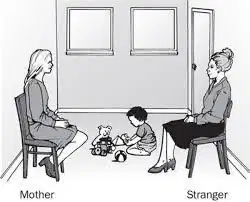
Study the image below. The window is:
a one-way window designed to covertly observe the actions of the child
a one-way window designed to covertly observe the actions of the stranger
a one-way window designed to allow a natural sunlight to enter the room
a one-way window to stimulate neuroplasticity
What is the first step in the strange situation procedure?
The mother and baby play freely.
The research assistant enters the room.
The mother and baby are introduced to the room.
The mother leaves the room.
How long does the mother sit and allow the baby to play freely in Episode 2?
1 minute
2 minutes
3 minutes
4 minutes
What role does the research assistant play during the procedure?
To scare the baby
To observe the baby from a distance
To engage with the baby, act as a companion, and demonstrate it is the specifically the caregiver that the child is attached to
To document the procedure
What happens if the baby seems too distressed when the mother says "bye bye" and leaves the room?
The procedure continues regardless.
The mother is called back into the room.
The research assistant leaves the room.
The baby is taken out of the room.
According to the procedure described, what is the primary purpose of Episode 7 in the experiment?
To test the baby's ability to play independently
To demonstrate that babies are not merely averse to being alone but seek their mother's return
To assess the stranger's ability to comfort the baby
To evaluate the mother's reaction to the baby's distress
What action does the mother take when she returns in Episode 8?
She waits for the baby to notice her before interacting
She immediately picks up the baby and comforts them
She leaves quietly if the baby does not respond
She tries to engage the baby with toys
Which episode is described as the most stressful for the infant?
Episode 5
Episode 6
Episode 7
Episode 8
What is indicated as the most useful behaviour for evaluating attachment security in infants?
The baby's reaction when the stranger leaves
The baby's play behaviour when alone
The baby's response to the mother's return
The stranger's interaction with the baby
According to Ainsworth's Strange Situation procedure, which attachment style describes infants who show little distress upon separation from the caregiver and may avoid or ignore the caregiver upon reunion?
Secure Attachment
Insecure-Resistant Attachment
Insecure-Avoidant Attachment
Ambivalent Attachment
What behaviour is characteristic of infants with Secure Attachment as identified in the Strange Situation procedure by Ainsworth?
They show intense distress upon separation and seek closeness upon reunion.
They show little distress upon separation and avoid the caregiver upon reunion.
They exhibit distress upon separation but are easily soothed and seek comfort upon reunion.
They exhibit ambivalence and resistance to the caregiver consistently.
Which attachment style is described by infants displaying intense distress upon separation and may persist in their distress upon reunion, according to Ainsworth's findings?
Secure Attachment
Insecure-Avoidant Attachment
Insecure-Resistant Attachment
Disorganized Attachment
What percentage of infants exhibit Type B: Secure Attachment behaviour according to the image?
50%
15%
70%
80%
How does a secure infant typically react when their mother returns?
Indifferent and unresponsive
Calmed and positive
Anxious and fearful
Aggressive and upset
What is a characteristic of a secure infant?
Avoids the mother
Is fearful of exploring
Seeks the mother in times of distress
Shows no preference for the mother over strangers
How does the mother of a secure infant typically respond to the infant's needs?
Responsive but neglectful
Inconsistently nurturing
Responsive and nurturing
Overbearing and controlling
Which of the following is a characteristic of an insecure-avoidant infant?
Seeks close contact with their mother when distressed
Shows high interest when mother returns
Is physically and emotionally independent of the mother
Is always comforted by the mother's presence
How does the mother of an insecure-avoidant infant typically respond to the infant's needs?
Is sensitive and responsive
Is often unavailable and withdraws help
Constantly provides emotional support
Encourages frequent physical contact
Consequences of maternal deprivation DO NOT include:
Physical health issues
Behavioural problems
Social maladjustment
Cognitive and emotional impairments
Ainsworth used a sample of infants aged 12 to 18 months and their primary caregivers, typically mothers.
100 middle-class American families participated
100 middle-class African families participated
100 lower-class American families participated
1000 middle-class American families participated
Which infants show little distress upon separation and may avoid or ignore the caregiver upon reunion?
Type A
Type B
Type C
Typo
Which infants may not seek comfort from the caregiver and may exhibit independent behaviour?
Type A
Type B
Type C
Typo
Which infants exhibit distress upon separation from the caregiver but are easily soothed upon reunion?
Type A
Type B
Type C
Typo
Which infants actively seek comfort from the caregiver and use them as a secure base for exploration?
Type A
Type B
Type C
Typo
Which infants display intense distress upon separation, and their distress may persist upon reunion?
Type A
Type B
Type C
Typo
Which infants may seek closeness to the caregiver while also showing resistance or ambivalence to the comfort?
Type A
Type B
Type C
Typo
Deprived environments provide:
an increased likelihood of significant cognitive and socioemotional delays and deficits
opportunities for cognitive stimulation, creativity, and resilience
enhanced synaptic connections and neural growth from exposure to diverse experiences and positive social interactions
an increased likelihood of advanced cognitive abilities, language skills, and coping mechanisms
Enriched environments provide:
an increased likelihood of advanced cognitive abilities, language skills, and coping mechanisms
an increased likelihood of significant cognitive and socioemotional delays and deficits
an increased likelihood of behavioural problems and vulnerability to mental health issues
long-term developmental challenges from hindered brain development
Which of the following is NOT true of Genie 'the wild child'?
She had basic self-care skills such as feeding herself, she was able to walk and speak coherently
She was raised in a severely abusive and neglectful environment by her parents
Isolated, she was severely deprived of social, linguistic, and cognitive stimulation
She was severely malnourished, underdeveloped, and had signs of physical and cognitive impairment
Before the first stage of development, is the:
adolescence stage
childhood stage
infancy stage
prenatal stage
The second stage of development is:
adolescence
childhood
infancy
prenatal
The first stage of development is:
adolescence
childhood
infancy
prenatal
The third stage of development is:
adolescence
childhood
middle age
early adulthood
The fourth stage of development is:
adolescence
older age
middle age
early adulthood
The fifth stage of development is:
adolescence
older age
middle age
early adulthood
The sixth stage of development is:
adolescence
older age
middle age
early adulthood
Identify the cognitive development milestones in Infancy:
stretching, kicking, basic hand movements
learning to roll, sit, crawl and then walk
babbling, progressing to meaningful words and sounds
forming attachment, separation anxiety, social smiling
Identify the physical development milestones in Infancy:
stretching, kicking, basic hand movements
learning to roll, sit, crawl and then walk
babbling, progressing to meaningful words and sounds
forming attachment, separation anxiety, social smiling
Identify the physical development milestones in Childhood
stretching, kicking, basic hand movements
learning to roll, sit, crawl and then walk
friendship development, learning to share, take turns and understand others’ perspectives
running, jumping, climbing
Identify the social-emotional development milestones in Childhood
rapid vocabulary expansion, grammar development, increased ability to express self and ideas
learning to roll, sit, crawl and then walk
friendship development, learning to share, take turns and understand others’ perspectives
running, jumping, climbing
Identify the social-emotional development milestones in Adolescence
rapid vocabulary expansion, grammar development, increased ability to express self and ideas
seeking independence from parents and family, peer relationships become more important, identity exploration, peer pressure
friendship development, learning to share, take turns and understand others’ perspectives
running, jumping, climbing
Developmental plasticity is
the developmental ability to adapt in response to environmental influences
the reorganisation of neural circuits to overcome deficits caused by injury, disease, or developmental abnormalities
a change from synthetic materials made from a wide range of organic polymers
the natural act of becoming greater over a period of time
Adaptive plasticity is
the developmental ability to adapt in response to environmental influences
the reorganisation of neural circuits to overcome deficits caused by injury, disease, or developmental abnormalities
a change from synthetic materials made from a wide range of organic polymers
the natural act of becoming greater over a period of time
The first stage of plasticity is:
proliferation
migration
synaptogenesis
synaptic pruning
The second stage of plasticity is:
proliferation
migration
synaptogenesis
synaptic pruning
The third stage of plasticity is:
myelination
migration
synaptogenesis
synaptic pruning
The fourth stage of plasticity is:
myelination
migration
synaptogenesis
synaptic pruning
The fifth stage of plasticity is:
myelination
migration
synaptogenesis
synaptic pruning
Proliferation is:
the rapid production and multiplication of neurons through mitosis (cell division)
the movement of neurons from their place of origin to their final location in the brain
the establishment of synapses (connections) between neurons to form functional neural circuits
the process of selectively eliminating weak or unnecessary synaptic connections and neurons while strengthening important ones
Migration is:
the rapid production and multiplication of neurons through mitosis (cell division)
the movement of neurons from their place of origin to their final location in the brain
the establishment of synapses (connections) between neurons to form functional neural circuits
the process of selectively eliminating weak or unnecessary synaptic connections and neurons while strengthening important ones
Synaptogenesis is:
the rapid production and multiplication of neurons through mitosis (cell division)
the movement of neurons from their place of origin to their final location in the brain
the establishment of synapses (connections) between neurons to form functional neural circuits
the process of selectively eliminating weak or unnecessary synaptic connections and neurons while strengthening important ones
Synaptic pruning is:
the insulation of axons with a fatty substance called myelin, which enhances the speed and efficiency of neural transmission
the movement of neurons from their place of origin to their final location in the brain
the establishment of synapses (connections) between neurons to form functional neural circuits
the process of selectively eliminating weak or unnecessary synaptic connections and neurons while strengthening important ones
Myelination is:
the insulation of axons with a fatty substance called myelin, which enhances the speed and efficiency of neural transmission
the movement of neurons from their place of origin to their final location in the brain
the establishment of synapses (connections) between neurons to form functional neural circuits
the process of selectively eliminating weak or unnecessary synaptic connections and neurons while strengthening important ones
In adolescence, the increase in sensitivity to social stimuli and social cues, stronger emotional responses to social situations and increased risk-taking behaviours is due to changes in the:
cerebellum
amygdala
corpus callosum
frontal lobe
In adolescence, the increase in feelings of emotional intensity, being more reactive to stressors, and feeling fear, worry and embarrassment more intensely is due to changes in the:
cerebellum
amygdala
corpus callosum
frontal lobe
The theorist associated with child cognitive development is
Harlow
Ainsworth
Bowlby
Piaget
Piaget believed that children were...
mini-scientists
mini-doctors
mini-teachers
mini-scule
A schema is
a cognitive structure representing knowledge about an entity or situation, including its qualities and relationships
a physical structure representing knowledge about an entity or situation, including its qualities and relationships
a cognitive structure representing knowledge about birds and animals
an emotional structure representing knowledge about an entity or situation, including its qualities and relationships
taking in new information or experiences and incorporating them into existing schemas
assimilation
accommodation
equilibrium
disequilibrium
modifying existing schemas to incorporate new information or experiences that cannot be assimilated
assimilation
accommodation
equilibrium
disequilibrium
a state of cognitive balance where existing schemas can explain new information encountered
assimilation
accommodation
equilibrium
disequilibrium
when new information or experiences challenge existing schemas to the extent that they cannot be easily assimilated, leading to confusion and discomfort
assimilation
accommodation
equilibrium
disequilibrium
the stage associated with object permanence
sensorimotor stage
pre-operational stage
concrete operational stage
formal operational stage
the stage where the infant’s understanding of the world develops through sensory experiences and motor interactions
sensorimotor stage
pre-operational stage
concrete operational stage
formal operational stage
children in this stage engage in lots of imagination and pretend play, but struggle to understand morality, logical thinking, or abstract concepts
sensorimotor stage
pre-operational stage
concrete operational stage
formal operational stage
the stage associated with egocentrism, animism, symbolic thinking and centration
sensorimotor stage
pre-operational stage
concrete operational stage
formal operational stage
the stage associated with the abilities of logical thinking, problem-solving, mentally manipulating and transforming information, conservation, reversibility, seriation and classification
sensorimotor stage
pre-operational stage
concrete operational stage
formal operational stage
A three month old is probably in the
sensorimotor stage
pre-operational stage
concrete operational stage
formal operational stage
A nine year old is probably in the
sensorimotor stage
pre-operational stage
concrete operational stage
formal operational stage
A thirteen year old is probably in the
sensorimotor stage
pre-operational stage
concrete operational stage
formal operational stage
A three year old is probably in the
sensorimotor stage
pre-operational stage
concrete operational stage
formal operational stage
the stage characterised by abstract thinking, hypothetical deductive reasoning, scientific reasoning, relativistic thinking, and metacognition
sensorimotor stage
pre-operational stage
concrete operational stage
formal operational stage
the ability to order items by length, size or weight
abstract thinking
object permanence
conservation
seriation
the understanding that objects continue to exist even when they are no longer visible
abstract thinking
object permanence
conservation
seriation
the ability to realise that certain properties of objects (such as volume, mass, and number) remain the same even when their outward appearance changes
abstract thinking
object permanence
conservation
seriation
the ability of individuals to consider nonphysical hypothetical situations, ideas, and concepts; as well as understand and manipulate abstract ideas and symbols
abstract thinking
object permanence
conservation
seriation
the tendency for children to view the world exclusively from their own perspective (they have difficulty understanding that others have different thoughts, beliefs, or viewpoints)
animism
symbolic thinking
centration
egocentrism
the tendency to focus on only one aspect of a situation, neglecting other relevant aspects/ important characteristics
animism
symbolic thinking
centration
egocentrism
the ability to use words or gestures to represent objects, actions, or ideas
animism
symbolic thinking
centration
egocentrism
the attribution of lifelike qualities to inanimate objects (believing objects such as toys have feelings and consciousness)
animism
symbolic thinking
centration
egocentrism
The Piagetian task used to assess object permanence
invisible displacement
three mountains
conservation
pendulum problem
The Piagetian task used to assess egocentrism
invisible displacement
three mountains
conservation
pendulum problem
The Piagetian task used to assess the understanding that certain properties of objects remain the same despite changes in appearance
invisible displacement
three mountains
conservation
pendulum problem
The Piagetian task used to assess the ability to systematically test hypotheses and understand variables affecting outcomes
invisible displacement
three mountains
conservation
pendulum problem
A child who understands that other people have different viewpoints
passed the three mountains task
failed the three mountains task
passed the invisible displacement task
failed the invisible displacement task
A child who searches for the toy where it was originally hidden rather than where it is currently
passed the three mountains task
failed the three mountains task
passed the invisible displacement task
failed the invisible displacement task
A child who systematically tests different variables and formulates hypotheses
passed the pendulum problem
failed the pendulum problem
passed the conservation task
failed the conservation task
A child who believes that the taller glass now contains more liquid
passed the pendulum problem
failed the pendulum problem
passed the conservation task
failed the conservation task
Which is NOT true of Piaget's theory of cognitive development
each stage is characterised by distinct cognitive abilities and changes in thinking
You must move through the stages in a particular order
There are four stages
Adolescents progress through stage four, to reach stage five in adulthood
Which statement is NOT characteristic of Adolescence?
rapid vocabulary expansion and grammar development
growth spurts and puberty
seeking independence from parents and family
mood swings and emotional challenges
Which statement is NOT characteristic of Childhood?
rapid vocabulary expansion and grammar development
learning to understand others’ perspectives
friendship development; learning to share and take turns
mood swings and emotional challenges
What did van Ijzendoorn and Kroonenberg complete a study on, in 1988?
Cross cultural patterns of attachment
The creation of the Strange Situation
The Internal Working Model
The long term consequences of maternal deprivation
Which of the following is NOT a finding of Ijzendoorn and Kroonenberg (1988)?
most cases of Type-C attachment were from Western cultures
most infants across different cultures exhibited Type-B attachment
most cases of Type-A attachment were from Western cultures
most cases of Type-C attachment were from non-Western (collectivistic) cultures
Which of the following is NOT a finding of Ijzendoorn and Kroonenberg (1988)?
most cases of Type-A attachment were from non-Western (collectivistic) cultures
most infants across different cultures exhibited Type-B attachment
most cases of Type-A attachment were from Western cultures
most cases of Type-C attachment were from non-Western (collectivistic) cultures
Which of the following is true of Ijzendoorn and Kroonenberg (1988)?
they found that most infants across different cultures exhibited Type-B attachment
they conducted an experimental study examining cross-cultural patterns of attachment
they found that most cases of Type-C attachment were from Western cultures
they found that most cases of Type-A attachment were from non-Western (collectivistic) cultures

