
 Worksheets
Business Process Perspective Quiz
Total questions: 27
Worksheet time: 12mins
What is the primary focus of a business process perspective compared to a traditional, functional perspective?
It focuses more on individual tasks rather than the overall process.
It emphasizes the importance of departmental contributions.
It considers the process as a whole rather than individual functions.
It prioritizes financial outcomes over process efficiency.
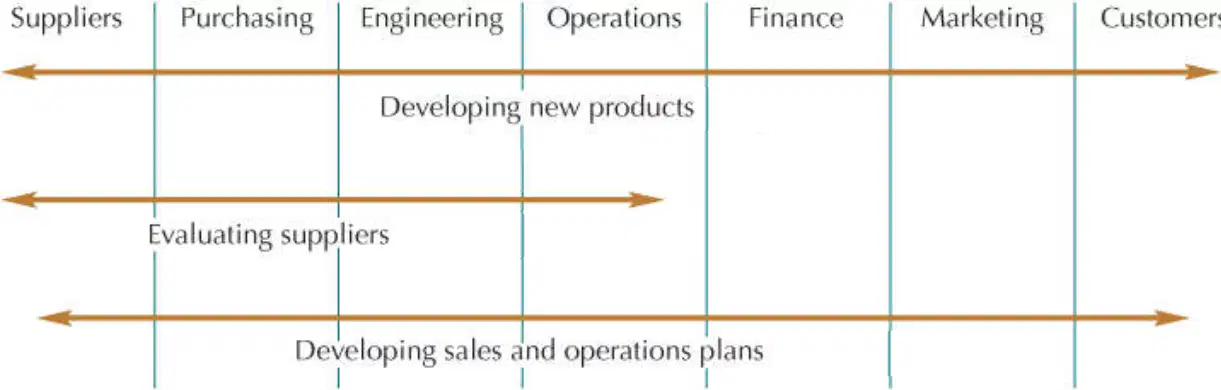
Which business process is primarily concerned with the activity "Developing new products" according to the diagram?
Suppliers
Purchasing
Engineering
Operations
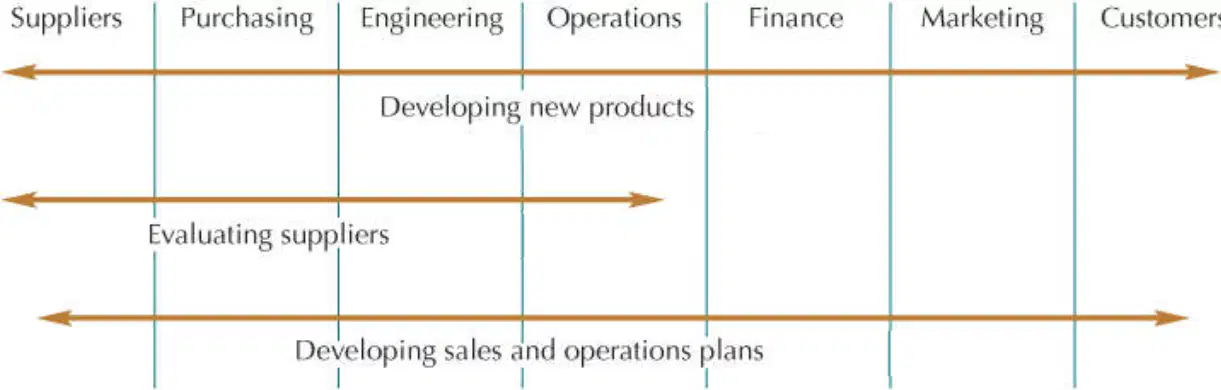
What is the main focus of the 'Marketing' function in the business processes diagram?
Evaluating suppliers
Developing sales and operations plans
Developing new products
None of the above

What shape is commonly used to indicate a "Delay" in process mapping?
D-shaped
Oval
Rectangle
Arrow

What is the first step in the process map for the Bluebird Café as shown in the image?
Host seats customer
Customer enters restaurant
Server takes drink and food orders
Server delivers food order to kitchen

According to the process map, what does the server do immediately after taking drink and food orders?
Server prepares drinks
Server delivers drinks
Server delivers food order to kitchen
Kitchen prepares food

Which of the following is the correct sequence of events after the kitchen prepares the food according to the process map?
Server picks up and delivers food, customer leaves restaurant
Kitchen signals that food is ready, server picks up and delivers food
Server delivers check, cashier processes check
Customer leaves restaurant, server prepares check

What is the final step in the customer service process at the Bluebird Café as depicted in the process map?
Server delivers check
Cashier processes check
Customer leaves restaurant
Server prepares check
According to the swim lane process map for the Order-Filling Process, what happens if the item is in stock after the order sits in the clerk's inbox?
The clerk notifies the dealer and passes the order to the plant
The order is cancelled
The worker picks the order immediately
The inspector checks the order
Who is responsible for delivering the order to the dealer according to the process map?
Sales Office
Picking Clerk
Transport Firm
Internal Mail
What is the role of the inspector in the Order-Filling Process as shown in the swim lane process map?
To pick the order
To check the order
To deliver the order
To create the order
What is the primary purpose of examining each delay symbol in a business process?
To identify the responsible team members
To determine the cause and duration of the delay and explore reduction strategies
To increase the delay for process optimization
To document the delay for annual reports
When analyzing an activity symbol, what aspect is crucial to evaluate?
The color of the symbol
The location of the activity in the office
Whether the activity is unnecessary or redundant and its cost-value ratio
The number of employees involved in the activity
What does examining a decision symbol in a process help to determine?
The effectiveness of the marketing department
Whether the step requires a real decision or is merely a checking activity
The number of decisions made in a day
The decision-making skills of the manager
What should be considered when looking for loops within a business process?
The aesthetic appeal of the loop symbols
Whether repeating activities due to errors could be avoided and the associated costs
The popularity of the loops among employees
The speed at which loops operate
How can a business determine if its processes are meeting customer needs effectively and efficiently?
By conducting annual financial audits
By evaluating employee satisfaction
By assessing customer feedback and process efficiency
By increasing marketing efforts
What is essential for organizing business process improvement?
Defining clear roles and following structured steps
Increasing the budget for new technology
Reducing the number of employees
Expanding the product line
Which approach should businesses take to manage their processes?
Based on opinions of senior management
Based on historical traditions
Based on factual data and rigorous analysis
Based on competitor actions
Which of the following is NOT a measure of process performance in business processes?
Quality
Cost
Time
Efficiency
What does 'flexibility' in the context of business process performance primarily refer to?
Financial adaptability
Mix flexibility, changeover flexibility, and volume flexibility
Employee skill versatility
Marketing strategies
Under the 'Cost' category of business process performance measures, which of the following is NOT included?
Labor
Material
Quality-related costs
Environmental impact costs
Which aspect of business process performance is indicated by 'Delivery speed' and 'Delivery reliability'?
Quality
Cost
Time
Flexibility
What is productivity in the context of business processes?
The cost of inputs required to generate outputs
The ratio of outputs to inputs in a process
The time taken to complete a business process
The number of people involved in a business process
What does single-factor productivity measure?
Output levels relative to multiple inputs
Input levels relative to single output
Output levels relative to single input
Efficiency of input utilization
What is the difference between single-factor productivity and multifactor productivity?
Single-factor productivity measures output relative to one input, while multifactor productivity measures output relative to multiple inputs
Single-factor productivity measures input relative to one output, while multifactor productivity measures input relative to multiple outputs
There is no difference; both measure the same aspects
Single-factor productivity is a financial measure, while multifactor productivity is a non-financial measure
What does the single-factor productivity ratio measure in the context of business processes?
The ratio of total sales to the number of employees
The number of customer calls handled per support staff hour
The ratio of net profit to total capital invested
The efficiency of production machinery
What is included in the calculation of the multifactor productivity ratio?
Total revenue and customer satisfaction levels
Labor, material, and machine costs
Number of products produced and defect rates
Employee turnover rates and operational costs

