
 Worksheets
Waves Unit Test
Total questions: 40
Worksheet time: 31mins

A wave can travel through space and ______ transferring energy from one place to another.
Matter
Air
Time
Ears

Waves transfer _____ , not matter.
time
water
energy
space
_____ waves travel through matter and vibrate our eardrums so we can hear.
Ocean
Seismic
Energy
Sound
Which is NOT a type of waves?
Radio Waves
Sound Waves
Light Waves
Kinetic Waves
What's the difference between SOUND waves and LIGHT waves?
Sound waves travel as photons
Light waves make our eardrums vibrate
Sound waves are electromagnetic waves
Light waves are electromagnetic waves that travel as photons
A wave that has the vibration perpendicular to the direction of the wave is called:
Longitudinal
Transverse
A wave that has the vibration parallel to the direction of the wave is called:
Longitudinal
Transverse

What does point C represent?
Amplitude
Trough
Crest
Wavelength

What does point A represent?
Amplitude
Wavelength
Crest
Trough

Which letter is represents amplitude?
A
B
C
D
E
A wave with a high frequency has...
a long wavelength
a short wavelength
Waves with the highest energy have...
short wavelength, high frequency, and large amplitude
long wavelength, low frequency, and short amplitude

When light passes through a prism, why do you see different colors?
Each color has a different wavelength, so they all bend at different angles
Because Stone Cold said so
Because the prism is magical and allows you see the colors


Select the correct order of waves on the EMS from low to high energy
Radio, Micro, Infra, Visible, Ultra, X-ray, Gamma
Gamma, X-ray, Ultra, Vis, Infra, Micro, Radio
Vis, Micro, Infra, Ultra, X-ray, Gamma, Radio
Micro, Radio, Vis, Infra, Ultra, X-ray, Gamma
Which has the LONGEST wavelength and, therefore, the LOWEST frequency/energy
Gamma Rays
Ultraviolet
Visible Light
Infrared rays
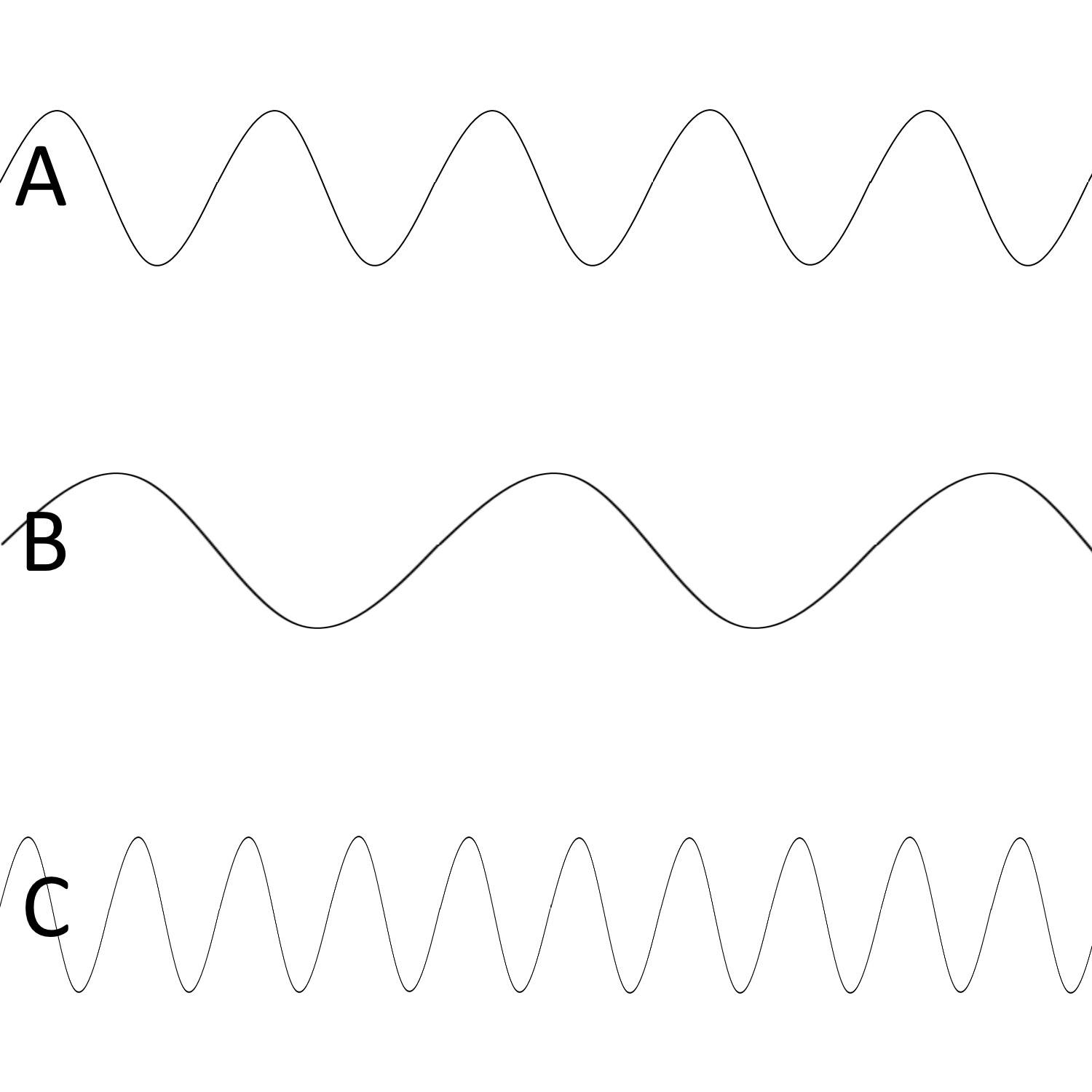
How are Electromagnetic waves different from Mechanical waves?
EM waves have very short wavelengths
EM waves transmit energy instead of matter
EM waves can travel through the vacuum of space (without particles)
EM waves can change direction by reflection
A student asks a series of questions about a wave. The answer to which question will allow the student to determine whether the wave is electromagnetic or mechanical?
Does it require a medium in order to travel?
Can it pass through air and water?
Does it have a measurable speed?
Does it have a measurable frequency?
A student is measuring the distance between the crest and the rest position of both a mechanical wave and an electromagnetic wave. Which question is the student trying to answer?
What is the speed of the waves?
What is the amplitude of the waves?
What is the wavelength of the waves?
What is the frequency of the waves?
What do radio waves, microwaves, X-rays, and gamma rays all have in common?
They all have the same wavelength.
They are electromagnetic waves.
They are detected in the same way.
They store the same amount of energy.

Which part of the spectrum is letter D?
Ultraviolet Rays
Microwaves
Visible Light
Radio Waves
Infrared Waves
Longer wavelengths than infrared. Used for heating food.
Ultraviolet Rays
Microwaves
Gamma Rays
Radio Waves
X-Rays
A wave with a SHORTER wavelength has _________ energy than one with a longer wavelength.
More
Less
The Same
Which part of the electromagnetic spectrum has the LEAST amount of energy?
Gamma Rays
X-Rays
Microwaves
Radio Waves

Area of a longitudinal wave where the particles are FAR apart.
Rarefaction
Wavelength
Compression
Area of a longitudinal wave where the particles are CLOSE together.
Rarefaction
Wavelength
Compression
Moderate frequency. Used in remotes.
Ultraviolet Rays
Microwaves
Gamma Rays
Radio Waves
Infrared Waves

