wayground logo

Free Printable Worksheets

Font size

S
M
L
XL
Worksheets

Health and wellness

Total questions: 83

Worksheet time: 45mins

Name
Class
Date
1.
What is the definition of Health?
a)
Combination of physical, mental/emotional and social health.
b)
Not taking care of your body, mind and relationships.
c)
Helping others to do their best.
d)
Balancing all sides of the health triangle.
2.
What is the definition of Wellness?
a)
Combination of physical, mental/emotional and social wellbeing.
b)
Practicing healthy behaviors to balance the health triangle.
c)
Living an unhealthy lifestyle.
d)
Focusing on two of the three sides of the health triangle.
3.
How can you describe physical health?
a)
Our interaction with others
b)
How we think and feel
c)
Condition of our body
4.
How can we describe social health?
a)
Condition of our body
b)
How we relate to others
c)
How we think and feel
5.
What is mental/emotional health?
a)
How we relate to others
b)
The condition of our body
c)
How we think and feel
6.
An example of social health...
a)
Eating nutritious foods
b)
Exercising regularly 
c)
Working with others
d)
Listening to music
7.
An example of mental/emotional health...
a)
Managing stress
b)
Getting 8-10 hours of sleep
c)
Hanging our with friends
d)
Walking the dog
8.

Which statement best applies to social health?

a)

How you express thoughts and feelings

b)

How you treat your body

c)

How you interact with others

9.

Which word below fits best with mental/emotional health?

a)

exercise

b)

feelings

c)

communication

10.

Which is an example of a POSITIVE impact on your physical health?

a)

staying up all night playing Fortnite

b)

eating ice cream for breakfast

c)

washing your hands frequently

d)

binge watching your favorite show

11.
Going to a movie with friends represents what side of the health triangle?
a)
Mental/emotional
b)
Physical 
c)
Social 
12.
Eating plenty of fruits and vegetables represents what side of the health triangle?
a)
Physical
b)
Mental/emotional
c)
Social
13.
Staying up late every night affects what side of the health triangle the most?
a)
Physical 
b)
Mental/Emotional
c)
Social
14.
Showing sadness when someone you care about dies represents what side of the health triangle?
a)
Physical
b)
Mental/emotional
c)
Social
15.
One key to good ______________ health is being able to identify, express, and manage feelings in healthy ways.
a)
mental/emotional 
b)
social 
c)
physical 
d)
financial 
16.
____________ health can be improved by working out and eating healthy 
a)
mental/emotional 
b)
physical 
c)
social 
17.
If you are stressed out and have a lot of anxiety, this will affect MAINLY your: ____________ health 
a)
mental 
b)
physical 
c)
social 
18.
An example of this side of the health triangle is:  supporting others and asking for help when needed is _________ health 
a)
emotional/emotional 
b)
physical 
c)
social 
19.
Sleeping at least 6-8 hours a day will be great for your ________ health 
a)
mental 
b)
physical 
c)
social 
20.
Being able to accept who you are and like yourself is MAINLY good for your _________ health 
a)
physical 
b)
mental 
c)
social 
21.
Your ____________ health involves how you relate to others.
a)
mental 
b)
social 
c)
physical 
d)
emotional 
22.

How many food groups are there?

a)

2

b)

3

c)

5

d)

6

23.

Which food groups do most Americans not eat enough of? Check all that apply

a)

Dairy

b)

Vegetables

c)

Fruits

d)

Protein

24.

Which type of food is best for getting a variety of nutrients?

a)

A Sandwich

b)

An apple

c)

Apple Sauce

d)

A pack of Goldfish

25.

What are foods that have a lot of calories but not a lot of nutrients?

a)

Empty Calories

b)

Nutrient Density

c)

Carbohydrates

26.

Which is a great example of a nutrient dense food?

a)

A bag of chips

b)

An avocado

c)

Pizza

d)

Blueberry muffin

27.

Which type of foods provide a lot of nutrients but not a lot of calories?

a)

Empty Calorie foods

b)

Nutrient Dense foods

c)

The food groups

d)

Processed foods

28.

When planning meals, which should you not take into consideration?

a)

variety

b)

moderation

c)

balance

d)

color

29.

What is the standard measure of food?

a)

Serving Size

b)

Pattern of food

c)

How much you eat

d)

Diet quality

30.

What is energy balance?

a)

When you eat the same calories that you burn

b)

when food supplies energy

c)

looking at the foods you eat as a whole

d)

the measurement of calories

31.

How many different tastes can your taste buds taste?

a)

3

b)

4

c)

5

d)

6

32.

What are substances that help the body grow, regulate functions, repair tissues, and give energy?

a)

Nutrients

b)

Food Groups

c)

Tastes

d)

Diet

33.

Which is not an example of a macronutrient?

a)

Carbohydrates

b)

Fats

c)

Vitamins

d)

Proteins

34.

Which nutrient provides fuel for the body?

a)

Fats

b)

Minerals

c)

Carbobydrates

d)

Proteins

35.

Which food group does not have carbohydrates?

a)

vegetables

b)

proteins

c)

fruits

d)

grains

36.

Which nutrient protexts cells and helps the nervous system function properly?

a)

Fats

b)

Vitamins

c)

Minerals

d)

Proteins

37.

Which nutrient is the building block of cells?

a)

Proteins

b)

Carbohydrates

c)

Minerals

d)

Fats

38.

Which food group has all 3 of the macronutrients?

a)

Dairy

b)

Protein

c)

Fruits

d)

Grains

39.

How much sleep should a teenager get a night?

a)

6 hours or less

b)

6-8 hours

c)

8-10 hours

d)

more than 10 hours

40.

When eating breakfast, what do you need to do to be eating a healthy breakfast?

a)

Use the 3 out of 5 model

b)

Eat from the grains and protein groups

c)

Eat from all 5 food groups

d)

As long as you eat breakfast you are fine.

41.

Which is an example of an endurance exercise?

a)

jumping rope

b)

yoga

c)

karate

d)

doing push ups

42.

Which exercise is an example of a strength building exercise?

a)

sit ups

b)

dancing

c)

stretching

d)

playing basketball

43.

Which type of exercise is when you help full range of motion, allowing the muscles to be used alongside the rest of the body?

a)

Endurance

b)

Strength Training

c)

Flexibility

d)

Physical

44.

Sugar is addictive.

a)

True

b)

False

45.

Found attached to bones throughout the body

a)

smooth

b)

cardiac

c)

skeletal

d)

all

46.

Found in the heart

a)

smooth

b)

cardiac

c)

skeletal

d)

all

47.

Found in the walls of hollow organs; also called visceral

a)

smooth

b)

cardiac

c)

skeletal

d)

all

48.

Use to move materials through contractions

a)

smooth

b)

cardiac

c)

skeletal

d)

all

49.
What are the 3 types of muscles?
a)
Skeletal, muscular, ligament
b)
Skeletal, smooth, cardiac
c)
Smooth, Cellular, Cerebrum
d)
Cardiac, smooth, brain stem
50.
Skeletal muscles always work _____.
a)
in groups
b)
in pairs
c)
singly
d)
none of the above
51.
Smooth muscle and cardiac muscle are considered _____ muscles because we can’t control them consciously.
a)
Immovable
b)
Involuntary
c)
Skeletal
d)
none of the above
52.
A ______________________ attach bones to each other at joints.
a)
Ligament
b)
Bone
c)
Joint
d)
Cell
53.
A ______ is a strong connective tissue that attaches muscle to bone.
a)
Tendon
b)
Ligament
c)
Cartilage
54.

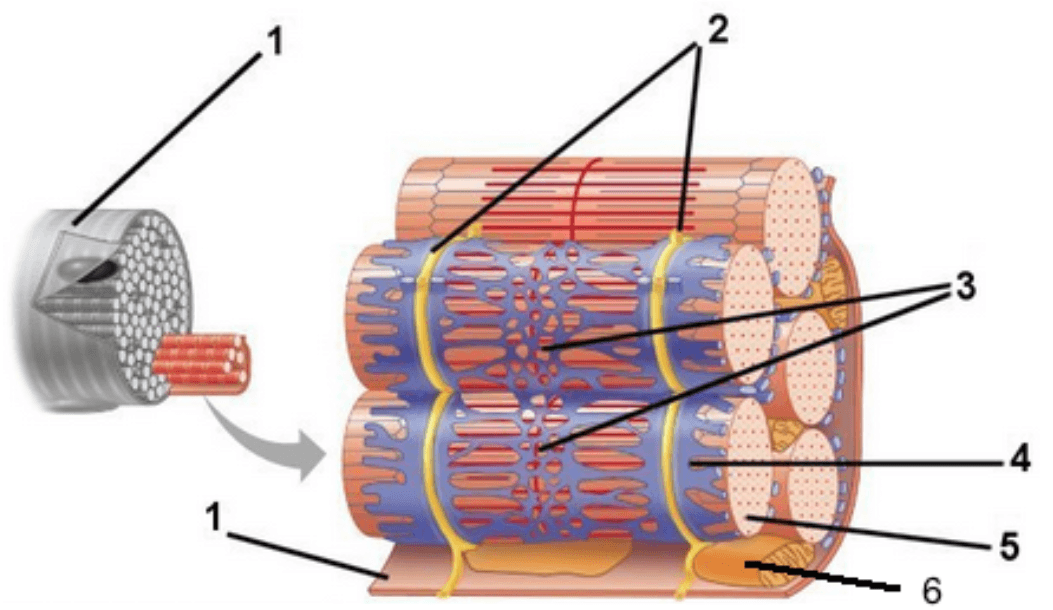
What is shown in the colored part of this diagram?

a)

a whole muscle

b)

five muscle fibers

c)

five muscle fascicles

d)

five myofibrils

55.

What is labeled "4" (the blue/purple part) in the diagram?

a)

sarcolemma

b)

sarcoplasmic reticulum

c)

transverse tubules

d)

myofibril

56.

Name the following in order from largest to smallest:

a)

muscle, muscle fascicle, muscle cell, myofibril, filaments

b)

muscle, muscle fascicle, muscle cell, filaments, myofibril

c)

muscle, muscle cell, muscle fascicle, myofibril, filaments

d)

muscle, muscle cell, muscle fascicle, filaments, myofibril

57.

What is the length between Z-lines of an actin molecule called?

a)

fascicle

b)

sarcomere

c)

myosin binding site

d)

sarcoplasmic length

58.

____________ attaches to actin to form the cross bridge.

a)

Troponin

b)

Tropomyosin

c)

Myosin

d)

Calcium

59.
What is the biggest muscle in your body?
a)
femur
b)
Gluteus Maximus
c)
Gluteus
d)
Biceps
60.
What is the biggest tendon in your body and where is it?
a)
Achille's Tendon, ankle
b)
Achille's
c)
Brain
d)
Achilles' Tendon, Spinal Cord
61.
What are muscles like?
a)
rocks
b)
rubber bands
c)
water
62.
What kind of muscle do you move on purpose?
a)
voluntary
b)
involuntary
c)
cardiac
d)
heart
63.
What is your cardiac muscle?
a)
heart
b)
brain
c)
lungs
d)
gluteus maximus
64.
What ties muscles to bones?
a)
cartilage
b)
tendons
c)
ligaments
d)
flexors
65.
About how many muscles are in your body?
a)
206
b)
300
c)
over 600
d)
1,000
66.
How many muscles does it take to smile?
a)
17
b)
43
c)
100
d)
2
67.
How many types of muscles do you have?
a)
two or three
b)
ten
c)
600
d)
206
68.
What could you not do if you did not have muscles?
a)
move
b)
think
c)
feel
69.
Where are smooth muscles?
a)
lungs
b)
heart
c)
stomach
d)
all of these answers are true
70.
What muscle is on your femur?
a)
Abs
b)
Bicep
c)
Gluteus Maximus
d)
Quads
71.
Skeletal muscles are attached to _________.
a)
organs
b)
heart
c)
bones
d)
lungs
72.
What is another name for your voluntary muscles?
a)
skeletal
b)
involuntary
c)
smooth
d)
cardiac
73.

What muscle is covered in red in the picture?

a)

Lats

b)

Deltoid

c)

Pectoral

d)

Abs

74.

What muscles are covered in red in the picture?

a)

Biceps

b)

Triceps

c)

Deltoid

d)

Lats

75.

What muscles are covered in red in the picture?

a)

Hamstring

b)

Quads

c)

Calf/

gastrocnemius

d)

Gluteus Maximus

76.

What muscles are covered in red in the picture?

a)

Trapezius

b)

Deltoid

c)

Lats

d)

Abs

77.

What muscle is covered in red in the picture?

a)

Gluteus Maximus

b)

Abs

c)

Pectoral

d)

Deltoid

78.

What muscles are covered in red in the picture?

a)

Hamstring

b)

Quads

c)

Calf

d)

Gluteus Maximus

79.

What muscles are covered in red in the picture?

a)

Trapezius

b)

Gluteus Maximus

c)

Lats/

latissimus dorsi

d)

Abs

80.

What muscles are covered in red in the picture?

a)

Deltoid

b)

Lats

c)

Abs

d)

Pectoral

81.

What muscles are covered in red in the picture?

a)

Hamstring

b)

Quads

c)

Calf

d)

Gluteus Maximus

82.

What muscle is covered in red in the picture?

a)

Lats

b)

Trapezius

c)

Deltoid

d)

Hamstring

83.

What muscles are covered in red in the picture?

a)

Bicep

b)

Tricep

c)

Quads

d)

Hamstring