
 Worksheets
7th Grade LEAP 2025 Science Review
Total questions: 52
Worksheet time: 1hrs 25mins

What organelle contains your genes?
DNA
Genomes
Proteins
Alleles

Where does the food chain begin?
Insects
The sun
Mice
Birds of prey

The process of which plants intake energy from the sun and convert it to glucose (sugar)
Solar conversion
Energy intake
Photosynthesis
I don't know

What are the stages of cell division (mitosis)?
Prephase, Metaphase, Intraphase, Aphase, Telophase
Interphase, Prophase, Metaphase, Anaphase, Telophase, Cytokinesis
Dualphase, Metaphase, Cellular Division, Cytokinesis, Prophase
Before, during, and after

What is the main control center of cells?
Nucleolus
Nucleus
Golgi Body
Lysosomes
Both primary and secondary succession begin with pioneer species that
use up all the existing resources and prevent establishment of non-native organisms
modify the area and allow larger and more complex organisms to appear
change the area and make it safer from predatory organisms
invade the area so that new organisms cannot be established
Frederick is studying how ecological succession will change a freshly-plowed piece of land. Which data table represents what Frederick is most likely to record about the plant life in each stage of ecological succession?


The picture shows where oranges are grown in the United States. Oranges require a very long growing season with mild to hot weather.What is the most likely reason many of the oranges are grown in California?
There are more organisms that eat oranges in California than in any other states.
California has a climate that creates a good environment for growing oranges.
Oranges will only grow in states on the coast with environments near water.
Oranges will only grow in sandy soil that few of the other states have.
When an ecosystem contains many different species, there are usually a high number of links in its food web. How does this affect the sustainability of the ecosystem?
Typically, if one link in the food web is removed, the ecosystem will no longer exist.
Typically, if one link in the food web is added, the ecosystem will destabilize.
Typically, if one link in the food web is removed, the ecosystem will remain stable.
Typically, if one link in the food web is added, the ecosystem will change its location.
An ecosystem's sustainability is most dependent on?
warm temperatures.
the amount of water there.
having a large number of a single plant species.
the number and variety of organisms that live there.

Which ecosystem would most likely survive if the grasses were destroyed by a plant virus?
Ecosystem 2, because there are not many predators.
Ecosystem 2, because the grasses could grow back quickly.
Ecosystem 1, because there is a variety of producers that support the ecosystem
Ecosystem 1, because there are fewer primary consumers.
Which is a Physical change?
Color
Rusting
Burning
Reactions with acid
An example of a decomposer is a(n)
Fungi
Fox
Rabbit
Grass

What type of storm front is this?
Warm Front
Cold Front
Stationary Front
occluded front
Which of these human activities will help to improve air quality?
Planting Trees
Burning Trash
Installing Windmills
Burning fossil fuels
What Factors impact global temperatures over time?
Distance from Sea
latitude
Closer to the sun
warmer area

According to the Law of Conservation of Mass,
matter is always created in a chemical reaction
matter is always destroyed in a chemical reaction
matter is created and then destroyed in a chemical reaction
matter is not created or destroyed in a chemical reaction

The diagram below shows a balance being used to measure a burning candle in a sealed glass ball before and after the burning is complete. As the candle burns, the size of the candle decreases, but the reading on the balance does not change. Which of the following is demonstrated by this experiment?
The total mass of the system is constant.
Energy is converted to mass when the candle is burned.
Smoke particles have more mass than molecules of candle wax.
Kinetic energy is converted to potential energy when the candle is burned.
Examine the following chemical reaction: H20 + CO2 → C6H12O6 + O2 What are the reactants?
H20 + CO2
→
C6H12O6 + O2
H20 + CO2 → C6H12O6 + O2
Examine the following chemical reaction: H20 + CO2 → C6H12O6 + O2 What are the products?
H20 + CO2
→
C6H12O6 + O2
H20 + CO2 → C6H12O6 + O2
The law of conservation of mass can be demonstrated by a chemical reaction. Which of the following models of a chemical reaction best represents the law of conservation of mass?


Substances created, or made, during a chemical reaction are known as the
reactants
products
chemicals
substances

Looking at the graph of the pigeon population, which statement is TRUE?
The maximum pigeon population was 275
The largest decrease was between years 4 and 5
The largest decrease was between years 7 and 8
The population decreased from years 2 to 3
What is Global Warming?
Increasing temperature in Earth's atmosphere
Decreasing temperature in a city
Increasing rain rates in Earth
Decreasing temperature rates
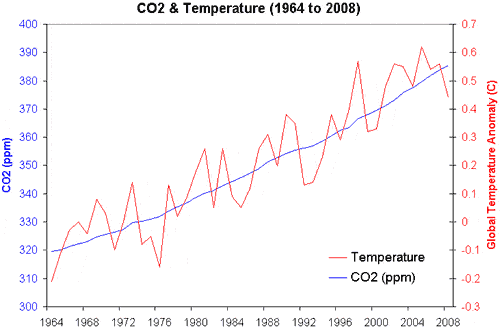
The graph below shows CO2 emissions and temperatures from 1909 to 1949. What conclusion is best supported by the graph?
There is no relationship between carbon dioxide concentrations and temperatures
As carbon dioxide concentrations increase, temperatures increase
As carbon dioxide concentrations increase, temperatures decrease
As carbon dioxide concentrations decrease, temperatures increase

Carbon Dioxide, CO2, comes from
Burning fossil fuels
Cold water
Animal manure
Plastic
In which state of matter are the molecules spaced farthest apart?
Solid
Liquid
Gas
All are equal
Which statement correctly describes both gases and liquids?
Their shapes stay the same in any container.
Their shapes change when they are in different containers.
Their volumes stay the same in any container.
Their volumes change when they are in different containers.
Brian's family has a compost pile at home. They put all the weeds they pull up from the garden in it as well as any vegetable waste they gather from the kitchen. If they keep it moist, all this vegetation will eventually turn into organic soil by the chemical process of decay. Since decay involves a variety of chemical reactions, how might temperature affect the rate at which the compost turns into soil?
Temperatures near freezing would make it speed up.
It would happen faster at warmer air temperatures.
Changing temperatures would not affect the chemical reactions.
Warm summer air temperatures would make it slow down.
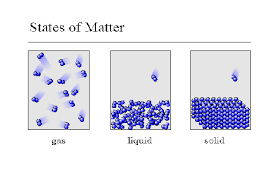

Which number has the particles moving the fastest?
1
2
5
4
3

