
NEW
Font size
 Worksheets
HESS Unit 9 Review
Total questions: 44
Worksheet time: 53mins
What is the primary component of the Earth's atmosphere?
Oxygen
Carbon dioxide
Nitrogen
Argon
What percentage of the Earth's atmosphere is kept within 32 km of the Earth's surface by gravity?
A) 99%
B) 75%
C) 50%
D) 25%
What occurs to the atmosphere at higher altitudes?
A) It gets thicker
B) It remains unchanged
C) It gets thinner
D) It turns into a solid state
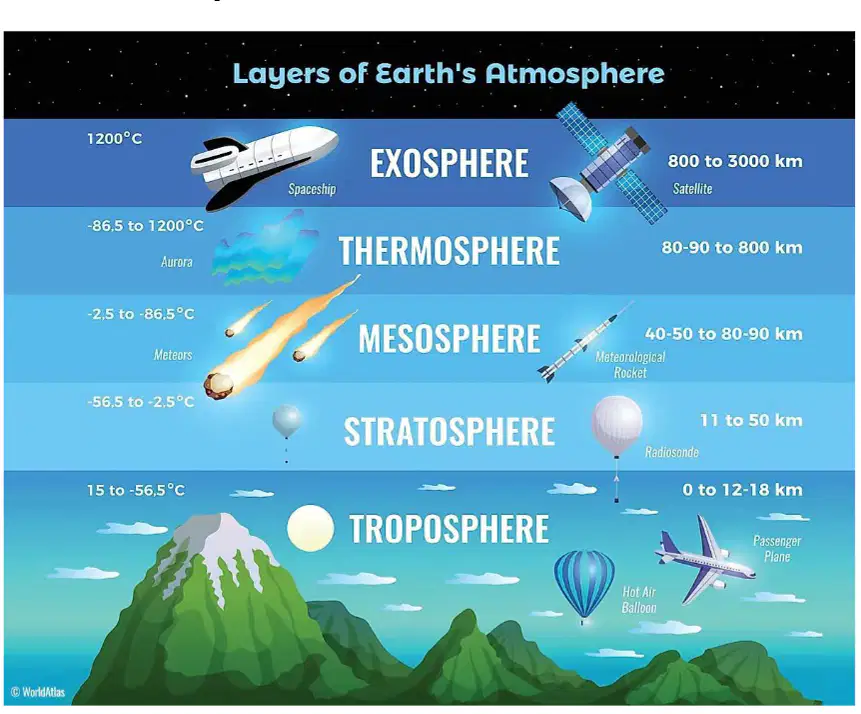
What is the highest layer of the Earth's atmosphere as shown in the image?
Exosphere
Thermosphere
Mesosphere
Stratosphere
In which atmospheric layer does nearly all weather occur?
Stratosphere
Mesosphere
Troposphere
Thermosphere
Which layer of the atmosphere contains almost all of the ozone?
Troposphere
Stratosphere
Mesosphere
Thermosphere
What is located directly above the stratosphere?
Mesosphere
Troposphere
Exosphere
Ionosphere
As altitude increases in the Mesosphere, what happens to the temperature?
It increases
It decreases
It remains constant
It fluctuates
What is the upper region of the Thermosphere known as?
Exosphere
Stratosphere
Ozonosphere
Mesosphere
What happens when water vapor condenses in the atmosphere?
It forms clouds around dust particles and aerosols.
It falls immediately as rain.
It increases the temperature of the atmosphere.
It absorbs more sunlight.
What occurs when the air can no longer hold water vapor?
It leads to a decrease in atmospheric pressure.
It causes water vapor to rise higher in the atmosphere.
It results in precipitation.
It triggers the formation of hurricanes.
Which statement is true about the temperature of air and its capacity to hold water vapor?
Cold air can hold more water vapor than warm air.
Warm air and cold air hold the same amount of water vapor.
Warm air can hold more water vapor than cold air.
The temperature of air does not affect its capacity to hold water vapor.
Which part of the water cycle is represented by the sun heating the ocean and causing water to rise as vapor?
Condensation
Evaporation
Precipitation
Collection
What was the primary composition of Earth's early atmosphere according to our notes?
Oxygen and hydrogen
Carbon dioxide, nitrogen, and water vapor
Methane and ammonia
Helium and neon
Which organisms were primarily responsible for decreasing of carbon dioxide and release of oxygen through photosynthesis 2.7 billion years ago?
Algae
Cyanobacteria
Fungi
Mosses
Why did carbon dioxide not completely disappear from the atmosphere despite the process of photosynthesis?
It was continually produced by volcanic activity
It was reintroduced by meteor impacts
It was stabilized at low levels due to the metabolism of living things
It was absorbed by the oceans
What effect do blowing winds have on rock surfaces?
They cause weathering and erosion
They polish the surface to a smooth finish
They deposit large boulders
They have no effect
Which landforms can winds produce?
Sand dunes
Volcanic mountains
River valleys
Coral reefs
Why is the sun less intense at the poles compared to the equator?
The sun is closer to the equator
The equator receives more direct sunlight
The Earth's surface at the poles is more reflective
The poles receive more direct sunlight
How does the Earth's surface absorb the sun's radiation?
Equally at all points
More at the poles
Unequally
Only at the equator
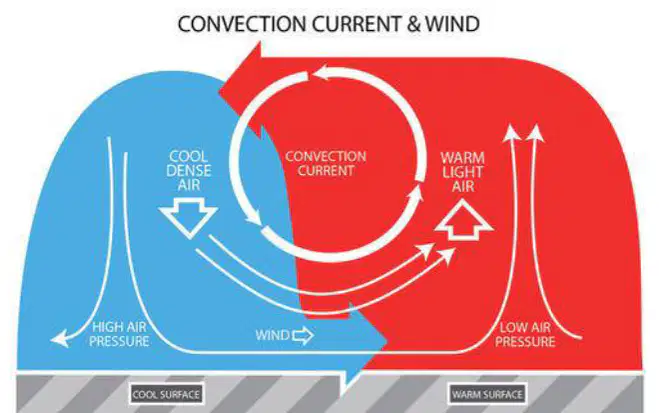
What causes wind according to the image?
Solar radiation only
Rotation of the Earth
Pressure differences caused by unequal heating
Gravitational forces
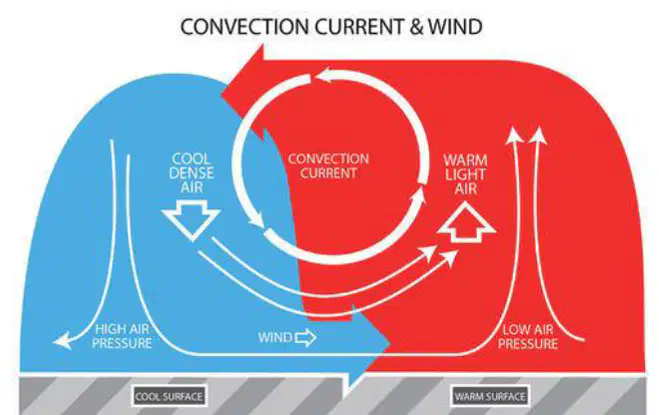
According to the image, in which direction does wind flow?
From areas of low pressure to areas of high pressure
From areas of high pressure to areas of low pressure
From north to south
From east to west
What is the Coriolis Effect?
A) The tendency of an object to take a straight path because of Earth's rotation
B) The tendency of an object to take a curved path because of Earth's rotation
C) The tendency of an object to remain stationary due to gravitational forces
D) The tendency of an object to move outwards due to centrifugal force
Where is the Coriolis Effect stronger?
A) Near the equator
B) Near the poles
C) At the International Date Line
D) At the Prime Meridian
In which direction do objects veer in the Northern Hemisphere due to the Coriolis Effect?
A) Left
B) Right
C) Straight
D) Downward
What factors combine to yield global patterns of air circulation?
Differences in solar heating, temperature, and pressure
Differences in ocean currents and mountain ranges
Differences in vegetation types and urban development
Differences in moon phases and tidal forces
Convert 1350 mmHg to atm (1 atm = 760 mmHg)
You shipped your Ferrari Spider from Europe and its tire pressure in Europe was 207 kPa. What would be an equivalent pressure, in psi, here in the US? (1 atm = 101.325 kPa, 1 atm = 14.7 psi)

Based on the weather map, which city will most likely experience decreasing temperatures during the next 24 hours?
Denver, because it is raining there
Minneapolis, because a cold front is approaching
Atlanta, because a warm front is approaching
Houston, because it is in a high temperature area
When a warm front passes through, what usually happens?
The temperature increases (gets warmer) and brings gentle, steady rain over a few days
The temperature decreases (gets cooler) and brings storms (heavy rain or snow)

Look at the image. Which city is about to have a cold front?
El Paso
Los Angeles
Tampa
Chicago


Name the climate zone that is found on the west coast of mid-latitude continents.
Subarctic
Humid Subtropical
Mediterranean
Marine West Coast

Which climate zone, found in the southeastern United States, has hurricanes as a possible natural hazard?
Highland
Humid Subtropical
Marine West Coast
Steppe

A wide variety of plants (trees, fruits, olives, and vegetables) are grown in this climate zone that can be found near the Mediterranean Sea.
Mediterranean
Marine West Coast
Humid Subtropical
Tundra
Ginny enjoys mountain climbing. Today, she is climbing Mt. Sheridan, which is the tallest mountain she’s ever climbed. When Ginny makes it to the top of the mountain, she notices that it is more difficult to catch her breath. At higher elevations, why is it harder for Ginny to breathe?
At higher altitudes, the air is very cold.
At higher altitudes, the air pressure is lower.
At higher altitudes, the air contains more nitrogen.
At higher altitudes, the air contains more carbon dioxide.

The picture shows a map of the United States that was created using data gathered from a satellite in space. The satellite measures surface and air temperatures. Which question can be studied using this information?
Which states can expect a rise in sea level?
Which states are experiencing a heat wave?
Which states are experiencing strong winds?
Which states can expect flooding after a storm?

About how much of Earth's atmosphere is oxygen?
20%
40%
60%
80%
Why do cirrus clouds have more ice crystals in them than the other clouds?
they are "snow" weather clouds
they are the highest in the sky where it is colder
they are the biggest clouds, so they can hold more water

This mid-level cloud that covers the sky is called
Altostratus
Cirrostratus
Cumulus
Stratus

This rain cloud fills the entire sky
Nimbostratus
Stratocumulus
Altostratus
Cumulus

