wayground logo

Free Printable Worksheets

Font size

S
M
L
XL
Worksheets

ICP 2nd Semester Test

Total questions: 51

Worksheet time: 28mins
Name
Class
Date
1.
What happens at a temperature of 0 K?
a)
water freezes (i.e turns into a solid)
b)
the particles get less dense
c)
the pressure increases
d)
the particles stop moving
2.
Specific heat capacity is related to the amount of internal energy _____.
a)
transferred by one molecule
b)
transferred by one object
c)
needed to change the temperature of one gram of a substance one degree
d)
one molecule contains
e)
a specific object has
3.
Which releases the most energy, 100 grams of 100°C water cooling to 50°C, or 100 grams of iron at 100°C cooling to 50°C? (The specific heat of iron is 0.50 J/g°C and water is 4.186 J/g°C)
a)
Iron
b)
Water
c)
Both
4.
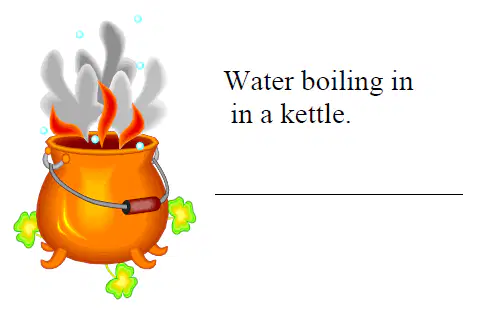
How is heat being transferred through the object?
a)
conduction
b)
convection
c)
radiation
5.
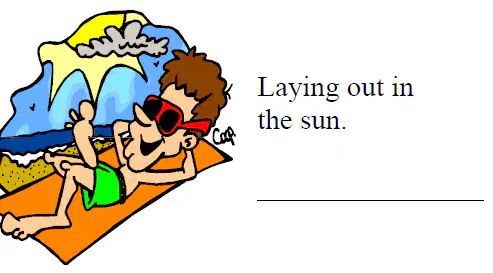
How is heat being transferred to the person?
a)
conduction
b)
convection
c)
radiation
6.
The ______ of an object is a measure of the average kinetic energy of the particles in the object.
a)
heat
b)
temperature
c)
conductivity
d)
charge
7.
Which picture has the highest temperature?
a)
Option 1
b)
Option 2
c)
Option 3
8.
Compressed air from a scuba tank cools off as a diver swims to deeper levels. What happens to the pressure of the air in the tank?
a)
the pressure goes down
b)
the pressure stays the same
c)
the pressure goes up
d)
it is impossible to tell
9.
In car engine, the piston pushes down the gas vapors causing the volume of the gas to decrease. What will happen to the gas's pressure?
a)
nothing will happen to the pressure
b)
the pressure will decrease
c)
the pressure will increase
d)
it is impossible to tell
10.
Suppose the temperature of the air in a balloon is increased. If the pressure remains constant, what quantity must change?
a)
volume
b)
compressibility
c)
adhesion
d)
size of the molecules
11.
What type of matter is made up multiple substances but you cannot see the parts?
a)
Element
b)
Compound
c)
Heterogeneous Mixture
d)
Homogeneous Mixture
12.
When a substance combines with another to form a new substance.
a)
physical property
b)
physical change
c)
chemical property
d)
chemical change
13.
Which of the following choices best fits the picture?
a)
physical property
b)
physical change
c)
chemical property
d)
chemical change
14.

A piece of plastic has a density of 1.5 g/cm^3 and a volume of 250 cm^3. What is the mass of the plastic? (no units)

(a)  

15.
Classify the following particle diagram.
a)
Element
b)
Compound
c)
Heterogeneous Mixture
d)
Homogeneous Mixture
16.
What is the name of the state change when a substance goes from a gas to a liquid?
a)
Condensation
b)
Melting
c)
Freezing
d)
Vaporization
e)
Sublimation
17.
What is the name of the state change when a substance goes from a liquid to a gas?
a)
Vaporization
b)
Melting
c)
Freezing
d)
Condensation
e)
Sublimation
18.
Which is Dalton's model?
a)
A
b)
B
c)
C
d)
D
19.

How many protons does the following element have?

(a)  

20.

How many neutrons does the following element have?

(a)  

21.

How many electrons does the following element have?

(a)  

22.

What is the mass number of the element?

(a)  

23.
What is the name of the group of atoms in the E column?
a)
Alkali Metals
b)
Halogens
c)
Transition Metals
d)
Alkaline Earth Metals
e)
Noble Gases
24.
Who is the first to propose the existence of atoms?
a)
Dalton
b)
Democritus
c)
Thomson
d)
Aristotle
25.
What is the same between these two nitrogen atoms?
a)
Same number of neutrons
b)
Same number of protons and neutrons
c)
Same number of protons
d)
Same number of neutrons and electrons
26.
What is the mass number of at atom below?
a)
3
b)
6
c)
7
d)
10
27.

What is the full name for this atom?

(a)  

28.
Which subatomic particle has a positive charge?
a)
neutron
b)
proton
c)
electron
29.
What is the correct formula for magnesium fluoride?
a)
A
b)
B
c)
C
d)
D
30.
What is the correct formula for boron trichloride?
a)
A
b)
B
c)
C
d)
D
31.
Name the following compound.
a)
dinitrogen oxalate
b)
dinitrogen tetroxide
c)
nitrous oxide
d)
dinitrogen oxide
32.
Which of the following is a covalent compound?
a)
A
b)
B
c)
C
d)
D
33.
What are the correct coefficients to balance the equation?
a)
1-1-2-3
b)
1-3-2-3
c)
1-2-2-3
d)
2-6-4-6
34.
What is the classification for the following reaction?
a)
synthesis
b)
combustion
c)
double displacement
d)
single displacement
35.
Which atom is the smallest?
a)
Rb
b)
I
36.
What charge will a group 1A element have when it becomes an ion?
a)
+1
b)
+2
c)
-1
d)
-2
37.
Which region below contains the alkaline earth metal family of elements?
a)
A
b)
B
c)
C
d)
D
e)
E
38.
An anion is
a)
negative
b)
positive
39.
Horizontal rows of the periodic table are called ___.
a)
clusters
b)
families
c)
groups
d)
periods
40.
What charge will a group 7A element have when it becomes an ion?
a)
+1
b)
-1
c)
+7
d)
-7
41.
Calcium has ____ valence electrons.
a)
1
b)
2
c)
10
d)
20
42.
How many valence electrons are in an phosphorus atom?
a)
3
b)
4
c)
5
d)
6
43.
What type of compound is made of only nonmentals?
a)
Metallic
b)
Ionic
c)
Covalent
44.
What type of bond is found at #3?
a)
Ionic
b)
Single Covalent
c)
Double Covalent
d)
Triple Covalent
45.
Which of the following choices best fits the picture?
a)
physical property
b)
physical change
c)
chemical property
d)
chemical change
46.

What is the volume of the block? (No units)

(a)  

47.

If the mass of the same cube from above was 713.6 g, what substance is it likely to be?

(a)  

48.
Which state of matter would this picture be?
a)
Solid
b)
Liquid
c)
Gas
49.

100.0 mL of 4.0°C water is heated until its temperature is 37°C. If the specific heat of water is 4.18 J/g°C, calculate the amount of heat energy needed to cause this rise in temperature. (no units in answer)

(a)  

50.

If 15.0 liters of neon at 298 K is allowed to expand to 45.0 liters, what must the new temperature be to maintain constant pressure? (No units in answer)

(a)  

51.

Organize these options into the right categories

Categorize the following

salad dressing

liquid medicine that has to be shaken

Apple juice

3% Hydrogen Peroxide Solution

Copper (Cu)

NaCl + H2O

H2OH_2O  

Sodium

Lithium

Baking Soda

Hydrochloric Acid (HCl)

Soil

Heterogeneous Mixture
Homogeneous Mixture
Element
Compound