
 Worksheets
ES Final Exam Review ('23-24)
Total questions: 133
Worksheet time: 1hrs 7mins
Longleaf is located at 35 degrees N, 78 degrees W. Which of these is its longitude?
35 degrees N
78 degrees W
both
neither
The 0 degree latitude line is called the
Equator
Prime Meridian
Tropic of Cancer
Tropic of Capricorn
What force brings tiny gas particles together when they're far away from any large objects?
EM radiation
fusion
gravity
fission
How many years old is the universe?
3.8 million
13.8 billion
15 trillion
6.4 octillion
The most common element in our universe is
oxygen
carbon
hydrogen
helium
Which of the following causes us to experience seasons?
Precession
Tilt of Earth's axis
Barycenter
Solstices
When one celestial body orbits another, they are actually both orbiting around the middle point of their combined mass, which is called the
precession
equinox
barycenter
tidal force
How many equinoxes are there every year?
1
2
3
4
The day of the year with the shortest period of daylight is called the
Vernal Equinox
Autumnal Equinox
Winter Solstice
Summer Solstice
The higher the frequency of a wave, the
higher the energy
lower the energy
shorter the wavelength
longer the wavelength
Light behaves as both a _________ and a _________.
tidal force
particle
barycenter
wave
Which of the following has the longest wavelength?
visible light
X-rays
gamma rays
microwaves
Which of the following has the shortest wavelength?
radio waves
ultraviolet (UV)
infrared (IR)
visible light
Which of the following types of EM radiation do not make it through the Earth's atmosphere? Choose all that apply.
radio waves
visible light
gamma rays
X-rays
Where are the Earth's magnetic fields strongest?
the Equator
the Prime Meridian
evenly strong everywhere
the poles
Which types of EM radiation are emitted by the Sun? Choose all that apply.
radio waves
infrared
microwaves
gamma rays
X-rays
What kind of reaction fuels nuclear power plants?
fusion
chemical combustion
fission
The Earth comes directly between the Moon and the Sun during a
lunar eclipse
solar eclipse
new moon
full moon
How many low tides are there every 24 hours, 50 minutes?
1
2
3
4
Tides occur at the same times in a given place every day.
True
False
What gas makes up 78% of the atmosphere?
Oxygen
Nitrogen
Ozone
Carbon Dioxide
When heat is transferred via warm matter rising and cold matter sinking in a continuous cycle, this is called
conduction
insolation
convection
radiation
If an air mass is sinking, it must be
cold and less dense
cold and more dense
warm and more dense
warm and less dense
Air masses are different in many ways. Which of these is NOT different?
moisture contents
ratio of oxygen/nitrogen
density
temperature
If I blew up a balloon in a 72°F classroom and then took it outside where it is 100°F, what would happen to the volume of air in the balloon?
It would shrink.
It wouldn't change size.
It would expand.
A front is
where warm air is cooling at earth's surface
a line where hot and cold air are separating
a line where two different air masses meet
where cold air is rising and forming rain clouds
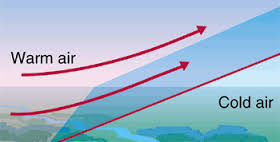
When a cold front or a warm front stays in place for several days without invading another front, it becomes a/n ______.
stationary front
cold front
occluded front
warm front


Winds are caused by differences in
precipitation
humidity
air pressure
turbulance
High pressure areas tend to have what kind of weather? Select two answers.
rain
overcast
clear skies
windy
no wind
Low pressure areas tend to have what kind of weather? Select two answers.
rain
overcast
clear skies
windy
no wind
Warm fronts tend to bring what kind of precipitation?
prolonged, light rain
short bursts of hard rain
Which of the following symbols represents an occluded front?


Which of the following symbols represents a warm front?
Which of the following symbols represents a cold front?
Which of the following symbols represents a stationary front?
Where does the vast majority of our weather occur?
Troposphere
Stratosphere
Mesosphere
Thermosphere
Exosphere
Where is most of the water vapor in our atmosphere?
Troposphere
Stratosphere
Mesosphere
Thermosphere
Exosphere
Wind blows from where to where?
high pressure to low pressure
low pressure to high pressure
When water changes from a liquid to a gas, this is called
condensation
precipitation
evaporation
freezing
The amount of water vapor in the air compared to how much could potentially be in the air is called
dew point
absolute humidity
relative humidity
heat index
Which can hold MORE water vapor?
relatively cooler air
relatively warmer air
"The lowest temperature at which air will reach 100% relative humidity" is a definition for which of the following terms?
heat index
condensation nucleus
dew point
absolute humidity
Why does high humidity make humans feel uncomfortable?
We first evolved in a dry climate.
Humidity is higher now than it ever used to be,
It makes it difficult for our sweat to evaporate.
We're just being whiny.
Heat Index takes into account which TWO factors?
(air) temperature
relative humidity
dew point
UV index
In order for water vapor to condense into liquid droplets, what is needed?
warm front
downdraft
stratus clouds
condensation nuclei
Why do water vapor molecules have a hard time sticking together on their own?
They're too heavy.
They're too fast.
They're too small.
They repel each other.
What TWO gases are the primary causes of acid rain?
carbon dioxide
sulfur dioxide
calcium oxides
nitrogen oxides
The largest source of sulfur dioxide and nitrogen oxides is . . .
using fossil fuels
extracting metal from ores
volcanoes
landfills
What is the pH of acid rain?
3
4.2-4.4
5.6
7

What would be the effect on the particles in the animation if more heat is supplied to the system?
They would slow down.
They would stop moving completely.
They would speed up.
There would be no effect.
Which of the following best explains why the sand at the beach is hotter than the water?
Sand has a higher specific heat than water.
Sand has a lower specific heat than water.
There is more water than sand at the beach.
There is more sand than water at the beach.
Water has a _____ specific heat.
high
medium
low
nonexistent
the North Pole
the South Pole
the Equator
upwelling
Decreasing water temperature causes the density of the water to ______.
increase
stay the same
decrease
Increasing water salinity causes the density of the water to ______.
increase
stay the same
decrease
What causes ocean currents in the Northern Hemisphere to rotate clockwise?
Great Ocean Conveyor Belt
upwelling
________ and _______ affect the ocean's density and cause the Great Ocean Conveyor Belt to travel.
gravity and the Coriolis Effect
temperature and salinity
wind and climate
temperature and the Coriolis Effect
The more scientific name of the Great Ocean Conveyor Belt is _____.
halinethermal circulation
thermohaline circulation
thermodensity circulation
upwelling
What percentage of the Earth's water is freshwater?
1%
2.5%
12%
25%
Most of the Earth's freshwater can be found . . .
in lakes and rivers
in groundwater
in glaciers and permanent snow cover
When exposed to the same amount of heat, which of the following substances will increase in temperature the MOST?
water
rubber
gold
cement
When exposed to the same amount of heat, which of the following substances will increase in temperature the LEAST?
water
rubber
gold
cement
Precipitation into the ocean would cause the water's salinity to . . .
increase
stay the same
decrease
Freezing ocean water would cause the remaining liquid water's salinity to . . .
increase
stay the same
decrease
You are standing in the transition zone of a river. If you walk towards the headwaters, you are headed
upstream
downstream
If excess fertilizer runs off from agricultural fields into a river, what type of pollution would that cause?
toxic
bacterial
sediment
nutrient
Pesticides that wind up in bodies of water fall under what category of pollution?
toxic
bacterial
sediment
nutrient
What are the best approaches for handling stormwater? (select TWO)
slow it down
speed it up
absorb/capture it
add more water to it
Stormwater is treated at wastewater treatment plants before it reaches bodies of water.
True
False
What are the benefits of managing stormwater appropriately? (choose TWO answers)
minimizes pollutants
slows down climate change
recharges groundwater
produces electricity
What is land subsidence?
When the land erodes dramatically because of water's movement.
When the ground sinks because of groundwater depletion.
When an area is being irrigated by groundwater.
When an area is being subjected to saltwater intrusion.
Arsenic can dissolve in water.
True
False
Water moving from wastewater pretreatment to primary treatment would be most appropriately referred to as . . .
sewage
aerated
infrastructure
effluent
During an El Nino, trade winds are typically...
about average
stronger
weaker
What are the most common two elements that make up the Earth's crust?
Iron and Silicon
Oxygen and Silicon
Iron and Magnesium
Oxygen and Aluminum
What type of rock can be formed from melting and crystallization?
igneous
sedimentary
metamorphic
What type of rock can be formed from erosion and weathering followed by compaction and cementation?
igneous
sedimentary
metamorphic
What type of rock can be formed from heat and pressure?
igneous
sedimentary
metamorphic
What is the difference between extrusive and intrusive igneous rocks?
Extrusive rocks have points sticking out, intrusive rocks are smooth.
Extrusive rocks are mainly one type of mineral with a 2nd type on the surface, intrusive have different minerals all mixed together.
Extrusive rocks can be found anywhere on the Earth's surface, intrusive rocks can only be found inside volcanoes.
Extrusive rocks cool above the Earth's surface, intrusive rocks cool beneath the Earth's surface.
When one lithospheric plate moves down into the asthenosphere under another plate at a convergent boundary, this is called . . .
convection
mantle
strike-slip
subduction
The Earth's magnetic field sometimes reverses itself
(north turns into south and south turns into north).
True
False
A single tectonic plate can have multiple types of boundaries (convergent, divergent, transform) along its borders.
True
False
Tectonic plates move at an average of a few ____ a year.
millimeters (mm)
centimeters (cm)
meters (m)
kilometers (km)
What is the main force driving the movement of tectonic plates?
slab pull
magnetic fields
ridge push
convection in the mantle
Which type of plate boundary is NOT prone to producing volcanoes?
convergent
divergent
transform

What type of fault is this?
Normal
Reverse
Strike-Slip AKA Lateral

What type of plate boundary is most likely to produce this kind of fault?
Convergent
Divergent
Transform

What type of fault is this?
Normal
Reverse
Strike-Slip AKA Lateral

What type of plate boundary is most likely to produce this kind of fault?
Convergent
Divergent
Transform

What type of fault is this?
Normal
Reverse
Strike-Slip AKA Lateral

What type of plate boundary is most likely to produce this kind of fault?
Convergent
Divergent
Transform
What is the difference between erosion and weathering?
Particles are not transported in erosion.
Particles are not transported in weathering.
Erosion takes place very quickly, weathering happens gradually.
Weathering takes place very quickly, erosion happens gradually.
Soil can vary significantly, but generally speaking, what percentage of soil is minerals?
5%
10%
25%
50%
75%
Soil can vary significantly, but generally speaking, what percentage of soil is organic material?
5%
10%
25%
50%
75%
Soil can vary significantly, but generally speaking, what percentage of soil is water?
5%
10%
25%
50%
75%
Soil can vary significantly, but generally speaking, what percentage of soil is air?
5%
10%
25%
50%
75%
Which soil particle is the largest?
Clay
Sand
Silt
Which soil particle is the smallest?
Clay
Sand
Silt
Mountaintop Removal (MTR) is an environmentally harmful method of extracting what resource?
oil
natural gas
coal
precious metals
True or false: Mining companies can legally dump toxic debris into valleys as "fill material".
True
False

Which of the following are non-renewable energy resources? (Check all that apply)
coal
wind
solar
nuclear
Examples of renewable energy sources include:
Bioethanol, natural gas, petroleum
Geothermal, wind, solar
Hydroelectricity, coal, nuclear
Oil is made from
dead plant and animal remains
sedimentary rocks
magma and lava
water
It takes ______ of years for oil to form.
tens
hundreds
thousands
millions
Fossil fuels are nonrenewable resources because they
take millions of years to form
are easily replaced
are in high demand
don't pollute the air
Fossil fuels come from the fossils of dinosaurs.
True
False
70-90% of all freshwater on Earth is used for
drinking water
meat production
industry
agriculture
Which type of meat requires the largest amount of water to produce?
chicken
beef
veal
pork
Which of the following is a BENEFIT of urbanization?
increased likelihood of disease spread
less air pollution
increased efficiency
decreased light pollution
Which of the following factors is very closely tied to the ability of a small town to grow into a city?
proximity to cropland
sports teams
law enforcement
transportation
healthcare
Explain what a "heat island" is.
(Where do they occur? Why do they occur?)
2-3 sentences recommended.
Ice cores are most useful for determining
the atmospheric composition in the past
plate tectonic movement of the past
number of species in the past
geographical species of the past
What are two things that ice cores reveal?
biodiversity levels and Earth's orbit data
carbon dioxide and global temperatures
Polar temperatures
and fossil records
volcanic activity and land subsidence
What part of ice cores tells us what the atmosphere was like in the past?
The water when the ice cores melt
Each thin layer of ice
The air bubbles trapped in ice cores
The rings of the ice core
The Earth has always had ice caps at the poles.
True
False
Rapid climate change in Earth's past has often been followed by
a larger number of predators
a change in Earth's tilt
mass extinctions
increased tectonic activity
The main influence on rising sea level is
melting polar ice caps
increased erosion
plastic pollution in the oceans
thermal expansion
increased rainfall
Which of the following is an abiotic component?
an eagle
a rock
a tree
leaf litter (dead leaves on forest floor)
Precipitation and Sunlight

Ecological efficiency from one trophic level to the next is generally:
1%
10%
75%
90%

__________ primary productivity = the organic materials that remain after photosynthetic organisms in the ecosystem have used some of these compounds for their cellular energy needs (cellular respiration).
Gross
Total
Net
Secondary

__________ primary productivity is the total amount of energy that producers convert to chemical energy in organic molecules per unit of time.
Net
Total
Gross
Secondary

Cultural

Provisioning

Supporting

Regulating

Cultural

Supporting

Regulating

Provisioning
Provide three ways to prevent the spread of invasive species.

