
 Worksheets
EDU222- Review Game
Total questions: 66
Worksheet time: 42mins

What is an Exceptional Learner?
A student who needs additional support and qualifies for special education services.
A student who wants to have accommodations and modifications within the classroom but doesn't qualify for special education services.
Someone who cannot participate in a general education classroom.
A student who can work independently without any additional support.

How is the term "Stakeholder" used in education?
Stakeholders are groups of individuals who protest on school grounds.
Stakeholders are those who do not support education or schools. They are competitors.
Stakeholders are individuals or groups who have an interest or concern in education.
Stakeholders are people or organizations that want to defund schools.

Who can be considered a stakeholder in education? *Select all that apply.*
Students.
The government.
Parents.
A local business that does not fund or support schools in any way.

Which of these different types of learners can be identified as exceptional learners? *Select all that apply.*
General education student.
Gifted learners.
Students with disabilities.
Students who do NOT speak English as their first language.

Approximately how many students in any given school receive special education services?
10%
5%
25%
2%
What does I.D.E.A. stand for?
Individuals With Disabilities Education Access.
Individuals With Disorders Education Act.
Individual Disabilities Education Access.
Individuals With Disabilities Education Act.

What does I.D.E.A. ensure for children?
Children with disabilities can be exempt from attending any type of schooling.
Children with disabilities receive a free and appropriate public education (FAPE).
Children with disabilities will have to pay extra for special education services.
Children with disabilities must go to a private school.

What was I.D.E.A. originally called?
Handicapped Children Act.
Disabled Students Of America.
It has always been known as: Individuals With Disabilities Education Act.
Individuals With Disorders Entitlement Act.

Who enacted I.D.E.A. and when?
Barack Obama in 2009.
Congress in 1990.
Congress in 1975.
Bill Clinton in 1995.
Which of these were/are laws enacted to better education for all. *Select all that apply.*
No Child Left Behind Act (NCLB).
Teachers of the Deaf Act of 1961.
Assistive Technology Act (AT).
Equal Rights for All Handicapped Children Act (ERHA).

What does the pre-referral process do? *Select all that apply.*
Eliminate inappropriate referrals to special education.
Guarantees a student's spot in special education.
Supports general education teachers who have students who demonstrate a possible need for special services.
Diagnoses a child immediately.

What is the correct order of the 6 stages of the pre-referral process?
Initial concern, information gathering, discussion of possible strategies, implementation and monitoring of strategies, information sharing, and evaluation and decision making.
Information gathering, information sharing and team discussion, strategy discussion, implementation and monitoring of strategies, evaluation and decision making, and documenting the findings.
Information gathering, information sharing and discussion, explaining concern to families, forming a plan of action, monitoring the plan of action, and final decision making.
Initial concern, information gathering, information sharing and team discussion, discussion of possible strategies, implementation and monitoring of strategies, and evaluation and decision making.
What does R.T.I. stand for?
Reason To Intervene.
Response To Intervention.
Reason To Interfere.
Response To Interaction.
What are the 2 goals of R.T.I.? *Select 2 answers.*
Prevent academic problems.
Single out students with a disability.
Interfere with a student's education when they begin to fail.
Determine students with a learning disability.

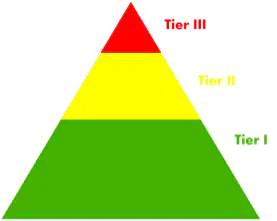
How many tiers exist in the R.T.I. Model?
3.
4.
2.
6.

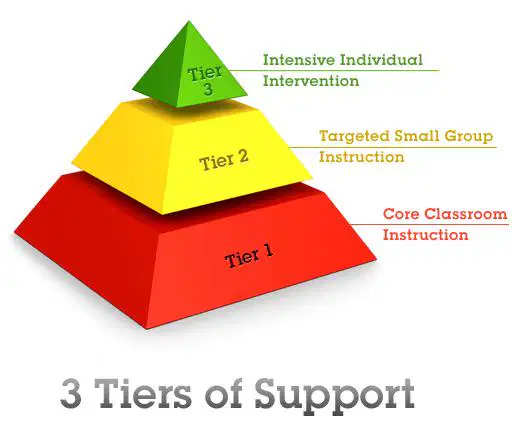
What are the 3 tiers of the R.T.I. Model?
1. Core Classroom Instruction. 2. Intensive Individual Intervention. 3. Targeted Small Group Instruction.
1. Core Classroom Instruction. 2. Targeted Small Group Instruction. 3. Intensive Individual Intervention.
1. Intensive Individual Intervention. 2. Targeted Small Group Instruction. 3. Core Classroom Instruction.
1. Pull-in Services. 2. Pull-out Services. 3. Inclusive Classrooms.

Do the tiers of the R.T.I. Model become more intense or less intense with the increasing of the levels?
Less intense.
More intense.

When there is a concern about a child's progression in school and you want to refer that student for special education testing, what is the first steps you should take?
Call their parents and have a meeting.
Conduct intervention for the student for 60 days and document your findings.
Talk with the principle and see what they suggest to do.
Conduct intervention for the student for 30 days and document everything.

Who does the M.E.T. (Multi-disciplinary Education Team) consist of?
Teacher, parent, special education teacher, administrator, and someone who is able to conduct and interpret testing.
Teacher, principle, special education teacher, someone who can conduct and interpret testing, and CPS.
Parent, special education teacher, general education teacher, and administrator.
Teacher, parent, student, and special education teacher.

How many days does the MET have to test a student for Special Education once they feel it is necessary?
No more than 30 school days.
No more than 30 calendar days.
No more than 1 semester.
No more than 60 calendar days.

What ages qualify for the Individual Family Service Plan (IFSP)?
Birth- 5 years.
3 years and up.
0-3 years.
6 months- 2 years.

What is one major difference between IFSPs and IEPs?
IFSPs are for for school-aged children and IEPs are for newborns.
IFSPs are centered around the student and IEPs are centered around a family.
IFSPs are centered around the family vs IEPs are centered around the individual student.
What special education law does IEPs fall under?
Civil Rights Law-Rehabilitation Act of 1973.
Individuals With Disabilities Education Act (IDEA).
How many categories of disabilities fall under I.D.E.A.?
10.
11.
12.
13.

Do parents need to give permission for their student to receive special education?
Yes.
No.

How are IEPs funded?
The districts issue special fundings for their schools.
The state receives federal funding.
Schools conduct fundraisers.
Parents pay for IEPs.
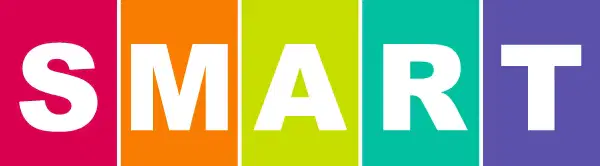
What does the S.M.A.R.T. in S.M.A.R.T. goals stand for?
S.hort
M.aintainable
A.ttainable
R.easonable
T.imely
S.pecific
M.aintainable
A.ttractive
R.eliable
T.rial
S.pecific
M.easurable
A.ttainable
R.elevant
T.imely
S.hort
M.easureable
A.ctive
R.eliable
T.rial

What law does the Section 504 Plan fall under?
Individuals With Disabilities Education Act (IDEA).
Federal law.
Civil Rights Law-Rehabilitation Act of 1973.

Which educational plan can be applied to temporary disabilities?
IEP.
Section 504 Plan.

Do parents have rights under I.D.E.A.?
Yes.
No.

What are some of a parent's rights under I.D.E.A.? *Select all that apply.*
Request for mediation.
Place their child in special education without testing.
Request due process.
Deny services for special education services and testing.

How often are IEPs evaluated?
Weekly.
Every quarter.
Bi-weekly.
Annually.
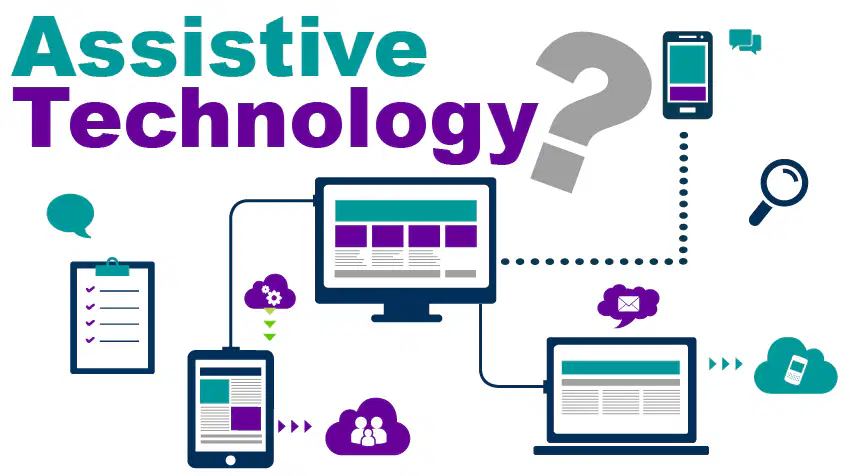
Which of these is NOT considered Assistive Technology according to I.D.E.A?
Surgically implanted medical devices.
Screen reading software.
Pencil grips.
Brail reading material.

What is Assistive Technology (AT)?
Electronic devices used to enhance education.
Anything that is used to maintain or improve the functional capabilities of a student who has a disability.
Accessories to technical devices.
Items and materials that make learning more difficult.

Another term for a reading disability?
Dysgraphia.
Dysphagia.
Dyscalculia.
Dyslexia.

Another term for written language disabilities?
Dysgraphia.
Dyslexia.
Dyscalculia.
Dysphagia.

What is a learning disability?
An emotional disorder that affects how a student behaves and feels.
A neurological disorder that only affects how a student responds to information.
A motor disorder that affects how a student talks.
A neurological disorder that affects how a student receives, processes, stores, and responds to information.

Which disorder effects a child's voice quality?
Voice disorders.
Stuttering (fluency) disorders.
Oral disorders.
Speech sound disorders.

Which disorder involves the interruption of the flow of speech?
Voice disorders.
Speech and language disorders.
Stuttering (fluency) disorders?
Hearing disorders.

Which disorder involves the difficulty with pronouncing sounds?
Stuttering (fluency) disorders.
Speech sound disorders.
Language disorders.
Motor disorders.

What is receptive language?
The ability to understand others' ideas, thoughts, and feelings.
The ability to hear sound.
The ability to communicate your own ideas, thoughts, and feelings.
The ability to learn new languages easily.

What is expressive language?
Watching a video.
The ability to understand others' ideas, thoughts, and feelings.
The ability to multitask.
The ability to communicate your own ideas, thoughts, and feelings.

Who are the experts that work with speech and language disorders?
Pediatricians.
Speech Language Pathologists (SLPs).
Physical therapists.
General education teachers.

Is the Autism Spectrum Disorder neurological or emotional?
Emotional.
Neurological.

Which gender is Autism more prevalent in?
Girls.
Boys.
Both.

Which of these are common characteristics of Autism? *Select all that apply.*
Ability to adjust quickly to change.
Resistance to changing their routine.
Sensitivities to certain senses.
Trouble with socializing in a typical or "normal" way.

What does special consideration mean?
Considering the individual needs of a student who has been identified to need modifications and/or accommodations and applying techniques within the lessons and environment to help them succeed.
Considering to change the assignments to fit every single students' needs and likes.
Making suggestions to apply certain modifications and/or accommodations within the classroom and sending permission to the parents.
Which of these disabilities can fall under the category of "Other Health Impairment" according to I.D.E.A? *Select all that apply. *
Epilepsy.
ADD.
Emotional disturbance.
Lead poisoning.

With which disability is it more common that a diagnosed student will be taught outside of a general education classroom? *Hint it involves the emotions and behaviors of a student.*
Traumatic Brain Injury (TBI).
Learning Disabilities (LD).
Hearing Disorders.
Emotional Disturbance (ED).
What does ADA stand for?
Americans With Disabilities Act.
Academic Disorders Act.
Academic Disabilities Act.
Americans With Down Syndrome Act.

What does ADA do?
Prevents individuals with disabilities from participating in normal classroom activities.
Prevents parents from making final decisions in regard to individuals with disabilities care and education.
Prohibits discrimination of individuals with disabilities.
Provides a free and appropriate education to individuals with disabilities.

Are gifted students covered under I.D.E.A.?
Yes.
No.

Who identifies and decides the "appropriate" education for gifted learners?
The students.
Teachers.
Federal law.
The state.

What is a gifted learner?
Someone who performs, or can perform, at a higher level than their peers.
Students who need additional support and assistance in the classroom.
Someone who learns at a "normal" pace.
Students who have caught up to their peers in the classroom.

Which of these is NOT a model of delivering special education?
Pull-out services.
Pull-in services.
Push-in services.
Exclusive education.

Are all schools required to offer all 6 models of delivering special educaiton?
No.
Yes.

Which service delivery model of special education has a cluster of special education students in a general education class?
The push-in model.
Exclusive education model.
Pull-out model.
The inclusive classroom model.

What is differentiation?
Meeting the individual needs of students by providing every student with their own assignment.
Calling a student out for their differences.
Meeting the individual needs of students by developing different ways to teach. It's a flexible approach to educating a diverse group of students.
Removing students from the classroom for special education services.

Which service delivery model of special education has a special education teacher come into the classroom to provide their services to the students in need?
The pull-out model.
The push-in model.
The inclusive classroom model.
The exclusive education model.

What are the 4 ways to differentiation instruction?
Content, product, presentation, environment.
Content, process, lesson, and enviornment.
Math, reading, science, and writing.
Content, process, product, and environment.
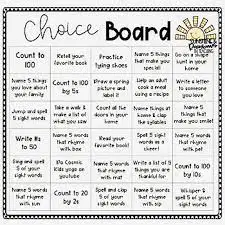
Are choice boards considered a differentiation strategy?
Yes.
No.

Are reading groups a differentiation strategy?
Yes.
No.

Would providing every student with a different assignment be considered an effective differentiation strategy?
Yes.
No.
What are co-teachers?
Special education teachers who split their work between classrooms.
Two general education teachers who work together to plan lessons so one of them can execute them.
A general education teacher and a special education teacher who work as a team to plan and execute lessons to all students in their environment.
A substitute teacher who picks up a few classes for a teacher who is sick.

Accommodations change what?
How the material is taught.
Why the material is taught.
Who teaches the material.
What is being taught.

Modifications change what?
How the material is taught.
What is being taught.
Who is being taught.
When the material gets taught.

