wayground logo

Free Printable Worksheets

Font size

S
M
L
XL
Worksheets

NYSSLS Plate Tectonics and Continental Drift

Total questions: 62

Worksheet time: 45mins

Name
Class
Date
1.
Who is the person credited with developing the theory of continental drift?
a)
Harry Hess
b)
Galileo
c)
Alfred Wegener
d)
Newton
2.
What two specific continents fit together most noticeably?
a)
Africa and North America
b)
South America and Europe
c)
South America and Africa
d)
 Antartica and Africa
3.

What is this a picture of?

a)

plate tectonics

b)

continental drift

c)

pangaea

d)

glacier scaring

4.
How does fossil evidence support Wegener's hypothesis of continental drift?
a)
Similar fossils are found along continental margins that appear to join together.
b)
Fossils are found in areas where the present-day climate could not have supported the organisms that made the fossils.
c)
Similar fossils of giant, land-dwelling dinosaurs are found on continents separated by oceans.
d)
all of the above
5.
The theory of continental drift named a key part of this idea Pangaea. What is Pangaea?
a)
One of the ancient animals that helped Wegener prove that fossils from different continents originally came from the same location
b)
 supercontinent that existed in Earth's distant past
c)
The underwater ocean range in the middle of the ocean
d)
The hot spot which gave rise to the Hawaiian Islands, among others
6.
Why was Wegener's theory not accepted?
a)
He had no proof of how they were moving
b)
He had no evidence
c)
He was married
d)
He was not a Scientist
7.
The Theory of Continental Drift states that Pangaea broke apart and the continents "drifted" away from each other
a)
True
b)
False
8.

Scientists think that the continents once formed a giant landmass that broke apart, and then slowly drifted apart. What is the name given to this hypothesis?

a)

sea-floor Spreading

b)

plate tectonics

c)

continental drift

d)

Pangaea

9.

Most geologist think that the movement of Earth's tectonic plates is caused by

a)

the rotation of the Earth.

b)

the Earth's magnetic field.

c)

subduction.

d)

convection currents.

10.

Ocean crust is made of _______ and is _______ dense than continental crust.

a)

basalt, less

b)

basalt, more

c)

granite, less

d)

granite, more

11.

Most tectonic plates have both oceanic and continental crust. How are they different?

a)

Oceanic is thinner and less dense than continental.

b)

Continental is thinner than more dense than oceanic.

c)

Continental is thicker and less dense than oceanic.

d)

Oceanic is thicker and more dense than continental.

12.
What do you call the evidence of Wegener's Theory that tells about the remains of an organism that lived long time ago?
a)
Ashes
b)
Bones
c)
Follicles
d)
Fossils
13.
What is the force that moves the continents? 
a)
Conduction 
b)
Convection 
c)
Radiation 
d)
Conveyor belts 
14.
What does the theory of continental drift state?
a)
The continents were once joined in a super-continent and have moved over time
b)
Continents are stationary and do not move
c)
The Earth is broken into lithospheric plates that move due to convection currents
d)
none of the above
15.

Earthquakes are most common around plate boundaries.

a)

True

b)

False

16.

Fossil records support continental drift.

a)

True

b)

False

17.

Evidence of continental drift includes:

a)

plants and animals match

b)

the shape of the continents

c)

the oceans are close together

d)

rocks match

18.

Ridges are the sites where plates move

a)

together

b)

apart

19.

When plates collide we get ________.

a)

crumbles

b)

volcanos

c)

trenches

d)

mountain ranges

20.

Tectonic plates consist of

a)

continental crust

b)

mesospheric crust

c)

both continental and oceanic crust

d)

oceanic crust

21.

The region where two lithospheric plates meet

a)

Continental Drift

b)

Plate tectonics

c)

Plate Boundaries

22.

Pangaea was an ancient supercontinent made up of...

a)

America, Greenland, and Europe

b)

Antarctica, India, and America

c)

all of Earth’s continents

d)

South Africa, India, Australia, and South America

23.

Why did no one believe Wegener's thoery that the continents were once together?

a)

He could not explain HOW the continents moved

b)

He didn't have evidence

c)

His data was wrong

d)

He didn't use the right technology to gather data

24.

The movement of the tectonic plates is caused by

a)

the rotation of the Earth

b)

convection currents in the Asthenosphere

c)

the gravity of the iron-nickel core

d)

the Moho discontinuity

25.

Which layer of the Earth consists of tectonic plates?

a)

asthenosphere

b)

mantle

c)

mesosphere

d)

lithosphere

26.

Tectonic plates “float” on

a)

the lithosphere

b)

the mantle

c)

the ocean

d)

the asthenosphere

27.
Associated with transform boundaries.
a)
Volcanoes
b)
mountains
c)
trenches
d)
earthquakes
28.
A location where two tectonic plates collide is known as a _________ boundary.
a)
Convergent
b)
Divergent
c)
Transform
d)
Spreading
29.

Which layer of Earth flows slowly and causes the crust to move?

a)

Crust

b)

Mantle

c)

Inner Core

d)

Outer core

30.
What is an earthquake?
a)
When the earth causes an upward thrust in the epicenter.
b)
When the earth moves up and down along the ocean floor.
c)

When tectonic plates slide against each other causing the earth to move. 

d)
None of the above
31.

Subduction means.....

a)

one plate goes under another plate

b)

two plates slide past each other

c)

two plate collide and form folded mountains

32.

Sea-floor spreading explains how.....

a)

new crust is created at a divergent boundary

b)

volcanoes are formed on continents

c)

deep sea trenches are formed

33.

An opening on the Earth's crust through which hot molten rock flows out from deep inside the Earth.

a)

Volcano

b)

Fault line

c)

Fold

d)

Crater

34.
The diagram shows what can occur when two continental plates collide.Which characteristic of the Indian Plate explains why it moves under the Eurasian Plate?
a)
It is larger.
b)
It is denser.
c)
It is molten.
d)
It is younger.
35.
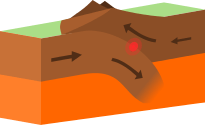
What type of event will occur at this boundary?
a)
Earthquake
b)
Volcano Eruption
c)
Tornado
d)
Mountain Building
36.
What type of plate boundary is this?
a)
Plate
b)
Divergent
c)
Convergent
d)
Transform
37.
A divergent boundary occurs when plates ....
a)
Pull apart
b)
Come together
c)
Slide past each other
d)
subducting
38.
What geologic feature/event would you most likely to find at a divergent boundary between two pieces of oceanic crust?
a)
Rift Valley
b)
Mid-Ocean Ridge
c)
Island Arc
d)
Flat land
39.
What geologic feature/event would you most likely to find at a convergent boundary between two pieces of continental crust?
a)
Volcano
b)
Mountain
c)
Rift
d)
Island Arc
40.
This layer is divided into pieces called tectonic plates.
a)
Mesosphere
b)
Asthenosphere
c)
Mantle
d)
Lithosphere
41.
Which piece of evidence did Wegener use to prove continental drift?
a)
The shape of the continents
b)
Similar fossils found on separate continents
c)
Tree fossils found in odd places
d)
All of the above
42.
Convection currents in the mantle are thought to be the driving force behind tectonic movement. At which location do the convection currents cause the plates to diverge?
a)
strike-slip fault
b)
subduction zone
c)
mid oceanic ridges
d)
folded mountains.
43.
The diagram shows what can occur when two continental plates collide.Which characteristic of the Indian Plate explains why it moves under the Eurasian Plate?
a)
It is larger.
b)
It is denser.
c)
It is molten.
d)
It is younger.
44.

What do we call an area where more then two plates interact in different ways

a)

plate boundary zones

b)

hot spots

c)

convergent boundaries

d)

subduction

45.

Solid, outer layer and is made of both the oceanic and continental crust.

a)

Hydrosphere

b)

Core

c)

Mantle

d)

Crust

46.

Hot fluid or semi-fluid material below or within the earth's crust from which lava and other igneous rock is formed on cooling.

a)

Convection Current

b)

Lithosphere

c)

Core

d)

Magma

47.

The thick part of the earth's crust that forms the large landmasses. It is generally older and more complex than the oceanic crust.

a)

Oceanic Crust

b)

Continental Crust

c)

Magma

d)

Inner Core

48.

In the region where two continental plates collide, what geological feature MOST often forms?

a)

an ocean

b)

a volcano

c)

a river valley

d)

a mountain chain

49.

Crustal plates that pull apart from one another MOST likely form

a)

volcanic island arcs

b)

strike-slip faults

c)

oceanic trenches

d)

rift zones

50.

Which of these tectonic plate boundaries is most likely to form a volcano.

a)

a continental plate colliding with a continental plate

b)

an oceanic plate sliding past a continental plate

c)

a continental plate sliding past a continental plate

d)

an oceanic plate colliding into a continental plate

51.

Which statement best describes why fossils of the same land-dwelling species have been discovered in both South America and Africa?

a)

The organism migrated to two continents

b)

The organisms were separated by the formation of new mountain ranges

c)

The organisms became extinct due to climate change on these continents

d)

These organisms once lived on one large landmass that later split into two continents

52.
What forms at a divergent boundary between two oceanic plates?
a)
rift valley
b)
mountain
c)
mid-ocean ridge
d)
trench
53.
What is the process in which hot molten rock rises, then cools and sinks back to the core?
a)
plate tectonics
b)
continental drift
c)
convection
d)
divergence
54.
A trench forms at a _________ boundary.
a)
convergent
b)
divergent
c)
transform
d)
vertical
55.
What type of boundary is shown at A?
a)
transform
b)
convergent
c)
divergent
d)
subduction
56.
What is happening at point B?
a)
subduction
b)
a divergent boundary
c)
convection
d)
an earthquake
57.

What landform would most likely form at this plate boundary? Choose 2 correct answers.

a)

mountains

b)

volcanoes

c)

trenches

d)

mid-ocean ridges

58.

This type of crust is thick, less dense, and made mostly of granite.

a)

continental crust

b)

oceanic crust

c)

convergent boundary

d)

divergent boundary

59.

This type of crust is dense, thin, and made of basalt.

a)

continental crust

b)

oceanic crust

c)

convergent boundary

d)

divergent boundary

60.

Match the following words with their definitions.

a)

CORE

1.

center made of Iron & Nickel

b)

CRUST

2.

part of the Earth we walk on

c)

ASTHENOSPHERE

3.

contains thick liquid, plates move here

d)

MANTLE

4.

Largest layer of the Earth

61.

The San Andreas Fault in California is a...

a)

Convergent Plate Boundary

b)

Divergent Plate Boundary

c)

Transform Plate Boundary

62.

The San Andreas fault in California is a transform fault. Students were asked to make maps predicting which way land would most likely move over thousands of years. Which one is correct?

a)

b)

c)

d)