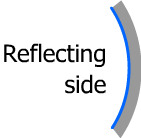
Worksheets
Ch 14 Optics
Total questions: 38
Worksheet time: 47mins

Which one is a concave lens?

The process of light bouncing off a surface
refraction
reflection
diffraction
diffusion

Which figure represents the path light takes through a converging lens?
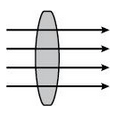
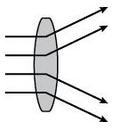
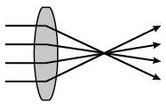
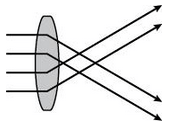
Which lens represents the path light takes through a diverging lens?


When light passes at an angle to the normal from one medium into another in which its speed is higher
it is bent toward the normal.
it always lies along the normal.
it is unaffected.
it is bent away from the normal.
When light passes at an angle to the normal from one medium into another in which its speed is lower
it is bent towards the normal.
it always lies along the normal.
it is unaffected.
it is bent away from the normal.

The angle of reflection is (a) to the angle of incidence.

The diagram below represents a light ray being reflected from a plane mirror. From the data provided in the diagram, what is the angle of reflection?
10 degrees
40 degrees
50 degrees
100 degrees
When the angle of refraction is 90 ° the angle of incidence is called the...
Angle of incidence
Critical angle
Angle of total internal reflection
Angle of refraction
For total internal reflection to occur, light must
travel from a more dense to a less dense medium
travel from a less dense to a more dense medium
Fiber optic cables work because of the principle of _____.
total internal refraction
incomplete internal refraction
total internal reflection
partial internal reflection

_____ cables transmit beams of light without allowing any of the light to escape until it gets to the end of the cable.
Ethernet
Fiber optic
Armored
Coaxial

Which diagram correctly describes the critical angle c for air-water surface?
A
B
C
D

A real image is always
erect
upright
inverted
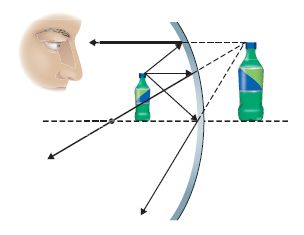
An image behind the mirror is...
virtual
real
inverted
upright
Refraction occurs when a light wave crosses a boundary and changes
speed and direction.
intensity.
frequency.
amplitude.
A mirror used as surveillance mirrors in groceries and parking spaces
concave
convex
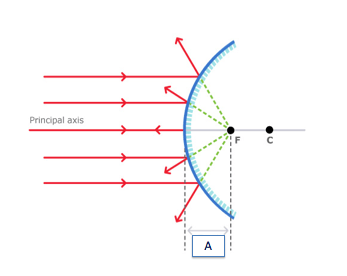
This image is showing a convex mirror because the image is (choose 2 answers)
rays meeting behind the mirror
image is real
image is virtual
A lens that is thicker in the middle than on the outside is called ___.
diverging
concave
convex
achromatic
A lens that is thinner in the middle than on the outside is called ___.
diverging
concave
convex
achromatic
What word means to bend light rays away from each other?
Converging light
Diverging light
Virtual Light
Real Light
What word means to bend light rays toward each other?
Converging light
Diverging light
Virtual Light
Real Light
The side view mirrors on your car help shrink the image on both sides of the car, allowing you to see a larger field of view. What type of mirror is this?
a convex mirror
a concave mirror
a convex lens
a concave lens