wayground logo

Free Printable Worksheets

Font size

S
M
L
XL
Worksheets

Environmental Systems Spring Final Review

Total questions: 58

Worksheet time: 1hrs 9mins
Name
Class
Date
1.
1.Unlike in terrestrial biomes, the factor limiting photosynthesis in marine biomes is
a)
sunlight
b)
nutrients
c)
heat
d)
salinity
2.
2.In this zone of the ocean, photosynthesis occurs but at a lower rate than that of cellular respiration.
a)
euphotic zone
b)
disphotic zone
c)
aphotic zone
3.
3.Net primary productivity= gross primary productivity - ____________________________________
a)
Cellular Transpiration
b)
Cellular Respiration
c)
Cellular Movements
d)
Both A & B
e)
Both B & C
4.
5.What causes coral bleaching?
a)
Coral bleaching is caused by the gathering of zooxanthellae algae from the coral bodies due to stress.
b)
Coral bleaching is caused by the nourishment of zooxanthellae algae from the coral bodies due to stress.
c)
Coral bleaching is caused by the expulsion of zooxanthellae algae from the coral bodies due to stress.
d)
Coral bleaching is caused by the sunlight of zooxanthellae algae from the coral bodies due to stress.
5.
6.Which colors of light are most able to penetrate deep into the ocean?
a)
blues and greens
b)
reds, oranges, and yellows
6.
7.Which of the following are 2 benefits to aquaculture and 2 drawbacks?
a)
1. Can Alter Genetic Diversity if farmed fish and wild fish interbreed. 2 Can introduce diseases into surrounding wild fish populations. 3 Excess nutrients and antibiotics from feed and wastes can pollute surrounding waters. 4. Puts pressure on wild fish populations used to make fish feed.
b)
1. Creates jobs. 2. Increases stabiliyt of income for fishermen. 3. Feeds a growing world population without pressure on wild fish species. 4. Reduces fuel consumption required for fishing.
c)
1. Requires smaller areas of water for fish populations. 2 Can introduce diseases into surrounding wild fish populations. 3 Excess nutrients and antibiotics from feed and wastes can pollute surrounding waters. 4. Puts pressure on wild fish populations used to make fish feed.
d)
1. Feeds a growing world population without pressure on wild fish species. 2. Reduces fuel consumption required for fishing.3 Excess nutrients and antibiotics from feed and wastes can pollute surrounding waters. 4. Puts pressure on wild fish populations used to make fish feed.
7.
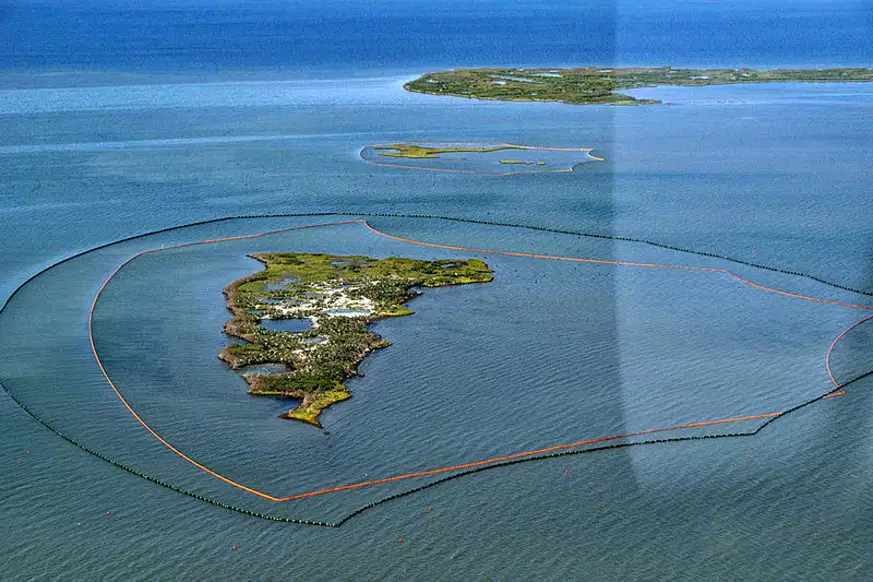
8.Which method of oil spill clean up is shown in this picture?
a)
Sorbents
b)
Disperants
c)
Skimmers
d)
Booms
8.
9.Give 2 ways that oil spills can affect the ecosystems.
a)
Contamination of food supply increases and contamination of habitat increases.
b)
Benthic organisms thrive and fisheries and tourism increases
c)
Oil does not pollute the environment and the Clean Water Act is affected
d)
None of the above
9.
10. The distinguishing feature in a polar compound is its unequal
a)
electrical charge
b)
temperature
c)
pH
d)
number of atoms
10.
11. The common term "surface tension" is created by which property of water?
a)
capillary action
b)
condensation
c)
adhesion
d)
cohesion
11.
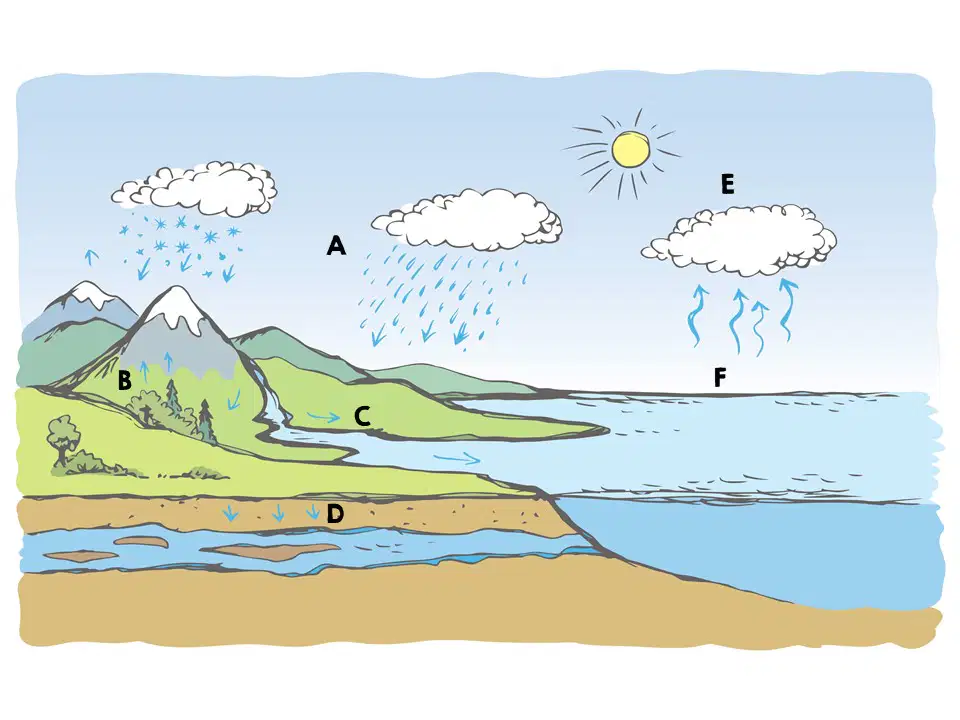
12. In the following picture, which letters are correctly matched to the right processes? (Select all correct answers.)
a)
B- transpiration
b)
C- runoff
c)
E- condensation
d)
A- evaporation
e)
D- precipitation
12.
13. At which point in the picture below could acid deposition occur?
a)
A
b)
B
c)
F
13.
14. What percent of the total amount of Earth's water is found in rivers? (Hint: WebQuest Surface Water Resources)
a)
15%
b)
5%
c)
2.5%
d)
.0002%
14.
15. Which of the following would you expect to increase after a forest has been clear-cut?
a)
surface temperature
b)
annual precipitation
c)
amount of runoff
d)
amount of transpiration
15.
17. Which of the following is the correct order for the evolution of energy-efficient lightbulbs?
a)
a. CFL, incandescent, halogen, LED
b)
b. CFL, LED, halogen, incandescent
c)
c. incandescent, CFL, LED, halogen
d)
d. incandescent, CFL, halogen, LED
16.
18. Which of the following are the three largest sources of energy for the United States?
a)
a. petroleum, natural gas, and coal
b)
b. solar, natural gas, and coal
c)
c. petroleum, hydroelectric, and natural gas
d)
d. solar, wind, and hydroelectric
e)
e. nuclear, hydroelectric, and coal
17.
19. Which of the following is NOT true of coal?
a)
a. The burning of coal produces high amounts of air pollution.
b)
b. Energy produced from coal is inconsistent and unreliable.
c)
c. The burning of coal contributes to climate change.
d)
d. Electricity production from coal is less expensive than other energy sources such as solar and wind.
18.
20. Which of the following is NOT true of solar energy?
a)
a. Solar energy is most efficiently collected in highly populated areas.
b)
b. Solar energy is difficult to store.
c)
c. There is plenty of solar radiation to fuel the whole world with the correct technology.
d)
d. One of the drawbacks to solar energy is the cost of producing photovoltaic cells.
19.
21. Which of the following is NOT true of wind energy?
a)
a. Electricity produced from wind can be inconsistent and unreliable.
b)
b. Coastlines, valleys, and agricultural fields are all good locations for wind power generation.
c)
c. Small wind turbines are less destructive to bird populations than large turbines.
d)
d. Wind turbines convert thermal energy into electrical energy.
20.
22. Which of the following IS true of nuclear energy?
a)
a. Nuclear meltdowns can affect large areas, but are easily cleaned up.
b)
b. Nuclear power is a renewable energy source.
c)
c. Nuclear power produces radioactive waste that must be disposed of properly.
d)
d. Nuclear power produces more carbon dioxide and other greenhouse gases than oil or coal power.4
21.
23. Which of the following NOT true of oil?
a)
a. The transportation of oil has caused several environmental disasters.
b)
b. Oil is refined to produce petroleum products for cosmetics, transportation, and plastics.2
c)
c. As oil deposits are consumed, extraction of oil becomes more costly.
d)
d. Oil deposits are most abundantly found in Europe and South America.
22.
24. Which of the following energy sources is incorrectly matched?
a)
a. oil- nonrenewable
b)
b. solar- renewable
c)
c. wind- renewable
d)
d. natural gas- nonrenewable
e)
e. geothermal- nonrenewable
23.
25. Which soil horizon would contain the least amount of organic matter?
a)
O
b)
B
c)
A
24.
26. Which soil particle is the largest?
a)
Sand
b)
Silt
c)
Clay
25.
27. During which type of wind erosion are soil particles in constant contact with the ground?
a)
Ephemeral
b)
Saltation
c)
Creep
d)
Suspension
26.
28. You take a drink of tap water and it tastes like dirt. What are you tasting?
a)
pollution
b)
geosmin
c)
antibiotics
d)
sand
27.
29. Which biome would you expect to have a thick O horizon?
a)
desert
b)
tundra
c)
forest
d)
grassland
28.
30. Select all that apply: What are the 2 types of weathering? (You must have both answers answered correctly in order to get the answer right)
a)
Physical Weathering
b)
Chemical Weathering
c)
Horizon Weathering
d)
Organic Weathering
29.
31. Saltwater biomes have around _____% salinity, while freshwater biomes have around .1%.
a)
3
b)
13
c)
30
d)
50
30.
32. The amount of saltwater on the earth’s surface is vastly larger than the amount of freshwater.
a)
True
b)
False
31.
33. The location in which freshwater and saltwater mix at the mouth of a river is known as a(n)
a)
Intertidal zone
b)
Productivty zone
c)
Euphotic zone
d)
Estuary
32.
34. In terrestrial biomes, the factor limiting photosynthesis is __________, whereas in marine biomes, it is __________.
a)
light, oxygen
b)
carbon dioxide, light
c)
light, nutrients
d)
nutrients, carbon dioxide
33.
35. The portion of the ocean where sunlight is able to penetrate the water is known as
a)
Aphotic zone
b)
Productivity zone
c)
Euphotic zone
d)
Estuary
34.
36. What type of relationship exists between stony marine corals and zooxanthellae?
a)
Commensalistic
b)
Parasitic
c)
Mutualistic
d)
Predatory
35.
37. Of the following ocean zones, which makes up the greatest percentage of the open ocean?
a)
Euphotic Zone
b)
Aphotic Zone
c)
Disphotic Zone
d)
Photic Zone
36.
38. Which wavelengths of light are able to penetrate deepest into the ocean?
a)
Red
b)
Purple
c)
Blue
d)
Yellow
37.
39. Which of the following is NOT a benefit that can be gained from aquaculture?
a)
Stable Income for fishermen
b)
Fewer diseases for fish
c)
Reduced fuel consumption for commerical fishing vesseles
d)
Requires less aquatic area to yield the same catcg
38.
40. _________ are used to redistribute oil after an oil spill, but they often cause oil to sink to the bottom, affecting aquatic habitats.
a)
Sorbents
b)
Booms
c)
Dispersants
d)
Skimmers
39.
41. A large farm near your house is contaminating the local stream with fertilizer runoff. This pollution could be categorized as
a)
Point source chemical pollution
b)
Nonpoint source nutrient pollution
c)
Point source sediment pollution
d)
Nonpoint source thermal pollution
40.
42. What type of pollution includes POPs?
a)
Biological Pollution
b)
Nutrient Pollution
c)
Chemical Pollution
d)
Sediment Pollution
41.
43. Which of the following is NOT a possible result of microplastic pollution in an aquatic ecosystem?
a)
The organisms get less nutrition
b)
The organisms get caught in the plastic pollution
c)
The organisms get endocrine disorders
d)
The organisms may have offspring with birth defects
42.
44 . The anoxic soils in wetlands allow them to be ___________ sinks.
a)
Carbon
b)
Nitrogen
c)
Photosynthetic
d)
Mitigation
43.
45. Which type of pollution could cause higher turbidity in a stream?
a)
Chemical
b)
Biological
c)
Thermal
d)
Sediment
44.
46. Water hardness is determined by the amount of __________ and ___________ in the water.
a)
Calcium and carbon
b)
Calcium and magnesium
c)
Magnesium and iron
d)
Iron and carbon
45.
47. Which of the following would be a concerning water quality condition in a local waterway?
a)
High dissolved oxygen
b)
Cold temperatures
c)
Low pH
d)
Low hardness
46.

Coral reefs are found in which type of biome?

a)

Freshwater Wetlands

b)

Marine Ecosystems

c)

Desert Ecosystems

d)

Temperate Deciduous Forest

47.
The population density of marine life is denser along the shorelines of the ocean than farther out in the deep waters of the ocean.  Which statement provides the BEST reason for this situation?
a)
Ocean currents prevent many smaller marine organisms from living in deep water.
b)
The shallow waters have fewer predators.
c)
Coastal waters are less polluted than the deeper waters of the ocean.
d)
There are more nutrients in shallow waters.
48.

The arrangement of organisms in the open ocean is determined by the

a)

increase in salt content from shallow to deep waters

b)

size of the benthic zone, where photosynthesis occurs

c)

amount of nutrients and sunlight that are available

d)

distribution of zooplankton

49.

Which ecosystem is this? : These ecosystems are the areas of shorelines that are left uncovered during low tide but which are underwater during high tide; they are usually rocky, but in tropical areas they may be sandy; organisms that live here need to adapt to the waves, the sun, and both marine and land predators

a)

Deep sea

b)

Open ocean

c)

Intertidal zone

d)

Coral reefs

50.

Which ecosystem is this? : These are areas of land that are covered/flooded by seawater for all or most of the year; the two primary types are salt marshes and mangrove swamps; many different marine and land organisms make their homes here

a)

Estuary

b)

Open ocean

c)

Wetlands

d)

Coral reefs

51.

The base of the food web in open ocean ecosystems is:

a)

Mangrove trees

b)

Phytoplankton

c)

Sea grass

d)

Zooplankton

52.
Why are few plants found on the bottom floor of the ocean?
a)
Floor has decomposers
b)
Sunlight doesn't reach the floor
c)
Water is a limiting factor
d)
Temperature is low
53.

Why is the oceanic zone not considered productive?

a)

There is little to no sunlight so photosynthesis is reduced

b)

Photosynthesis is reduced because of organisms eating all the photyplankton

c)

It's too hot for producers to use photosynthesis

d)

The organisms that use photosynthesis are found only in deep water

54.

Organisms that live ear or on the ocean floor are called ...

a)

Parasites

b)

Benthos

(What is Benthic)

c)

Plankton

d)

Mangroves

55.
Which would have barnacles, seaweed, and starfish?
a)
coastal ocean
b)
intertidal ocean
c)
open ocean
56.

In terrestrial biomes, the factor limiting photosynthesis is __________, whereas in marine biomes, it is __________.

a)

light, oxygen


b)

carbon dioxide, light

c)

light, nutrients

d)

nutrients, carbon dioxide

57.
What aquatic biome is characterized by flowing fresh water?
a)
Lakes/Ponds
b)
Mangroves Swamps
c)
Rivers/Streams
d)
Coral Reefs
58.
Which is NOT a freshwater wetland?
a)
estuary
b)
marsh
c)
bog
d)
swamp