wayground logo

Free Printable Worksheets

Font size

S
M
L
XL
Worksheets

Energy Review

Total questions: 110

Worksheet time: 55mins

Name
Class
Date
1.
Energy of moving particles of atoms that make up all  matter. 
a)
Thermal Energy 
b)
Chemical Energy 
c)
Electrical Energy 
d)
Electromagnetic Energy 
2.
Energy stored in atomic bonds that form molecules
a)
Thermal Energy
b)
Chemical Energy
c)
Electrical Energy
d)
Electromagnetic Energy
3.
Energy of electric charges moving through conductors
a)
Electrical Energy
b)
Electromagnetic Energy
c)
Thermal Energy
d)
Chemical Energy
4.
Energy that travels in waves( ex. microwaves, radio waves, energy from the sun)
a)
Chemical Energy
b)
Electrical Energy
c)
Electromagnetic Energy
d)
Thermal Energy
5.
Energy stored in the nucleus of an atom, released when protons or neutrons are added to or removed from the nucleus 
a)
Chemical Energy 
b)
Electrical Energy 
c)
Mechanical Energy 
d)
Nuclear Energy 
6.
Energy derived from sources that are continually replenished(* wind, solar, biomass, geothermal, hydropower)
a)
Nonrenewable Energy 
b)
Renewable Energy 
c)
Energy Transformation 
d)
Electromagnetic Energy 
7.
Energy harnessed from the sun ( radiant light and heat)
a)
Wind Energy 
b)
Hydropower
c)
Solar Energy 
d)
Nuclear Energy
8.
What type of energy is in this picture?
a)
Kinetic
b)
Potential
c)
Chemical
d)
Sound
9.
Can you create or destroy energy?
a)
Yes
b)
No
c)
only if you are really strong
10.
What does kinetic energy depend on?
a)
The weight and volume of an object
b)
The buoyancy of an object
c)
The mass and speed of an object
d)
The furriness of an object
11.
What is potential energy?
a)
The energy an object has due to its motion
b)
The stored energy of an object due to its position or condition.
c)
The energy an object might have if it existed 
d)
zombies coming
12.
On a roller coaster, where is maximum potential energy?
a)
At the bottom of a big hill
b)
When going around a corner
c)
When going upside down
d)
At the top of a big hill
13.
On a roller coaster, where is maximum kinetic energy?
a)
At the bottom of a big hill
b)
When going around a corner
c)
When going upside down
d)
At the top of a big hill
14.
The faster an object moves, the ________ kinetic energy it has. 
a)
more
b)
less
c)
none of the above
d)
all of the above 
15.
What kind of energy is in a rock at the edge of a cliff?
a)
Potential
b)
Kinetic
16.

What is energy?

a)

Something that takes up space.

b)

The ability to make something move or change.

c)

Anything that has mass.

17.
I have the most potential energy if I am: 
a)
5 feet high
b)
10 feet high
c)
15 feet high
d)
20 feet high
18.
At which point is potential energy greatest?
a)
W
b)
X
c)
Y
d)
Z
19.

The process of changing energy from one form to another.

a)

transmission

b)

transportation

c)

transformation

20.

Energy caused by moving electrons

a)

radiant

b)

chemical

c)

electrical

21.

Energy caused by fusion or fission of atoms' nuclei

a)

mechanical

b)

nuclear

c)

chemical

22.

Heat energy

a)

thermal

b)

radiant

c)

sound

23.

Bow and arrow

a)

radiant energy

b)

thermal energy

c)

chemical energy

d)

mechanical energy

24.

Fire

a)

thermal energy

b)

mechanical energy

c)

nuclear energy

d)

sound energy

25.

Microwave

a)

sound energy

b)

radiant energy

c)

chemical energy

d)

mechanical energy

26.

Talking

a)

thermal energy

b)

radiant energy

c)

sound energy

d)

mechanical energy

27.

Fuel

a)

chemical energy

b)

thermal energy

c)

mechanical energy

d)

sound energy

28.

Check the types of energy transformation we see when we use a hairdryer. (3)

a)

mechanical energy

b)

thermal energy

c)

electrical energy

d)

chemical energy

29.

Check the types of energy transformation we see when we use an electric keyboard. (2)

a)

electrical energy

b)

sound energy

c)

chemical energy

d)

nuclear energy

30.

Check the types of energy transformation we see when we use a hot air balloon. (3)

a)

chemical energy

b)

thermal energy

c)

mechanical energy

d)

electrical energy

31.

the measurement of the force of gravity on an object

a)

mass

b)

speed

c)

weight

d)

motion

32.

the standard international unit for energy

a)

newton

b)

joule

c)

kilogram

d)

m/s/s

33.

Potential energy depends on the ________ and ________ of the object.

a)

Height (position)

b)

Mass

c)

Speed

d)

Friction

34.
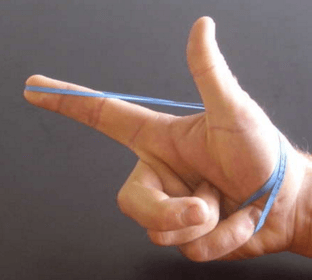
A stretched rubber band.
a)
Potential
b)
Kinetic
35.
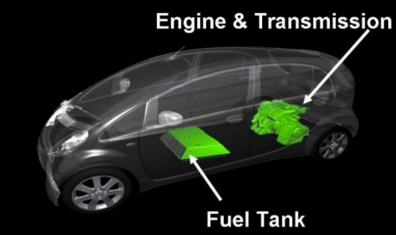
Gasoline in a car tank (car is not on).
a)
Potential
b)
Kinetic
36.

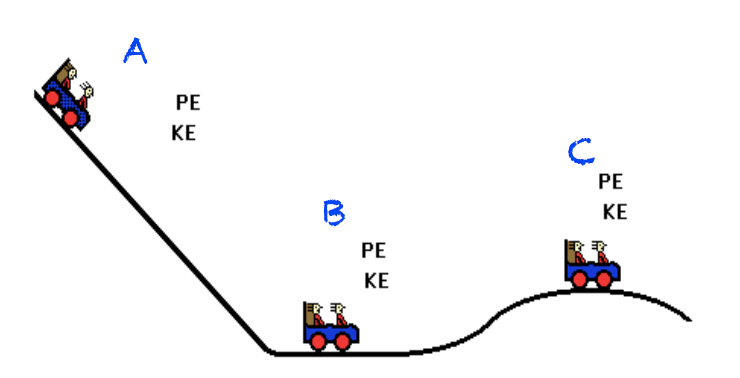
The coaster at B is at -

a)

Maximum PE, Minimum KE

b)

Minimum PE, Minimum KE

c)

Minimum PE, Maximum KE

d)

Maximum PE, Maximum KE

37.

The equation KE = 1⁄2 mass x velocity2 is used to find which type of energy?

a)

Kinetic Energy

b)

Potential Energy

38.

The equation PE = mass x gravity x height is used to find which type of energy?

a)

Kinetic Energy

b)

Potential Energy

39.
How much KE does a moving 6 kilogram object have if it moves with a velocity of 3 m/s?
a)
27 J
b)
18 J
c)
9 J
d)
2 J
40.
What is the mass of a moving object that has 100 Joules of KE and moves at a velocity of 2 m/s?
a)
50 kg
b)
200 kg
c)
25 kg
d)
100 kg
41.

How could you increase the gravitational potential energy of an object without changing its mass and gravity?

a)

Make the object larger

b)

Lower the object towards the ground

c)

Raise the object farther off the ground

d)

Allow the object to roll on the ground

42.
In the equation for gravitational potential energy, 'g' stands for...
a)
grams
b)

granola

c)

gravity

d)
energy
43.

A 50 kg jogger jumps 1.6 m off the ground. How much energy did they use to do this?

a)

80 J

b)

500 J

c)

160 J

d)

800 J

44.

A leaf has fallen off a tree and hit the floor of the woods. Why is PEg = 0 J ?

a)

The leaf is no longer being acted upon by gravity.

b)

The leaf no longer has any height off the ground.

c)

The leaf no longer has any mass.

d)

The leaf does not have 0 J of PEg.

45.

A 20 kg box is lifted 6 m above the ground. How much PEg does it have?

a)

120 J

b)

200 J

c)

1200 J

d)

60 J

46.

What is always the value for gravity on Earth?

a)

9.8 m/s^2

b)

8.9 m/s^2

c)

45 m/s^2

d)

19,345 m/s^2

47.

Which electromagnetic waves have the highest frequencies and the shortest wavelengths?

a)

microwaves

b)

visible light

c)

gamma rays

d)

x-rays

48.

Which type of waves are used in broadcasting?

a)

infrared rays

b)

X-rays

c)

radio waves

d)

gamma rays

49.

Select the correct order of waves on the EMS from the longest wavelength to the shortest wavelength

a)

Radio, Micro, Infra, Visible, Ultra, X-ray, Gamma

b)

Gamma, X-ray, Ultra, Vis, Infra, Micro, Radio

c)

Vis, Micro, Infra, Ultra, X-ray, Gamma, Radio

d)

Micro, Radio, Vis, Infra, Ultra, X-ray, Gamma

50.

Electromagnetic waves that help your body produce vitamin D are called?

a)

Ultraviolet rays

b)

X-rays

c)

Radio waves

d)

Gamma rays

51.

How are electromagnetic waves different from other waves?

a)

They have very short wavelengths

b)

They transmit energy instead of matter

c)

They can travel through empty space

d)

They can change direction by reflection

52.

Which section of the spectrum is the ONLY one we can see?

a)

Ultraviolet Rays

b)

Gamma Rays

c)

X-Rays

d)

Visible Light

53.

How much of the electromagnetic spectrum is visible?

a)

All of it

b)

None

c)

Only a small part

d)

Most of it

54.

Which electromagnetic waves are used in devices such as heat lamps & TV remote controls?

a)

Ultraviolet Rays

b)

Microwaves

c)

Infrared Rays

d)

Gamma Rays

55.

Which color has the shortest wavelength and highest frequency?

a)

Violet

b)

Yellow

c)

Orange

d)

Green

56.

The color of objects that we see is the color of the wavelength that is ___________ from its surface.

a)

refracted

b)

reflected

c)

absorbed

d)

dispersed

57.

When light traveling in straight lines passes through an object that is curved like a lens, the light is _________ at different angles.

a)

refracted

b)

reflected

c)

absorbed

d)

dispersed

58.

A/an _________ material absorbs all of the light that strikes it.

a)

opaque

b)

transparent

c)

translucent

59.

__________ objects transmit light.

a)

Transparent

b)

Opaque

c)

Translucent

60.

For an object to be visible, it must either __________ or ___________.

a)

produce its own light

b)

reflect light

c)

absorb light

61.

Visible light is the part of the _______________, between infrared and ultraviolet, that is visible to the human eye.

a)

electromagnetic spectrum

b)

visible light spectrum

c)

electrical light spectrum

62.

An example of a transparent object

a)

glass

b)

wood

c)

wax paper

63.

What color of light has the longest wavelength?

a)

red

b)

green

c)

yellow

d)

violet

64.

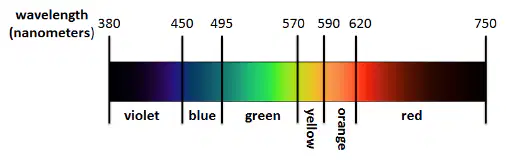
If a ray of light has a wavelength of 580 nanometers, what shade of visible light does it produce?

a)

red

b)

orange

c)

green

d)

yellow

65.

If a ray of light has a wavelength of 465 nanometers, what shade of visible light does it produce?

a)

yellow

b)

violet

c)

blue

d)

orange

66.

What do all waves transfer?

a)

Matter

b)

Heat

c)

Electricity

d)

Energy

67.

Which of the following can waves transfer energy through?

a)

solid

b)

liquid

c)

gas

d)

empty space

e)

all of the above

68.

What is the number of complete waves passing a fixed point in a given amount of time?

a)

Amplitude

b)

Intensity

c)

Wavelength

d)

Frequency

69.

What is the distance between the calm sea and the highest wave called?

a)

Wave

b)

Frequency

c)

Amplitude

d)

Magnitude

70.

What does #1 represent?

a)

Period

b)

Frequency

c)

Wavelength

d)

Amplitude

71.

What does #2 represent?

a)

Period

b)

Frequency

c)

Wavelength

d)

Amplitude

72.
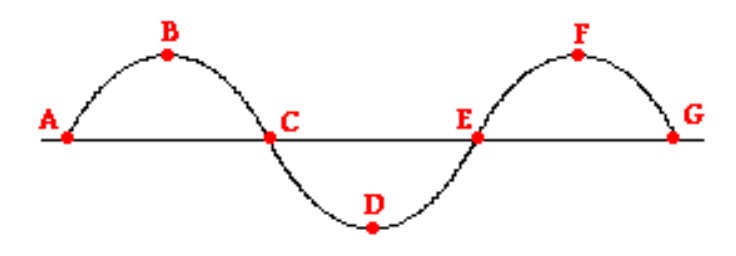
Which wave has a greater frequency?
a)
A
b)
B
73.

Which letter(s) represent the trough of the wave?

a)

A

b)

B & D

c)

D

d)

C & G

74.

The highest point on a wave is:

a)

the crest

b)

the trough

c)

the top

d)

the coast

75.
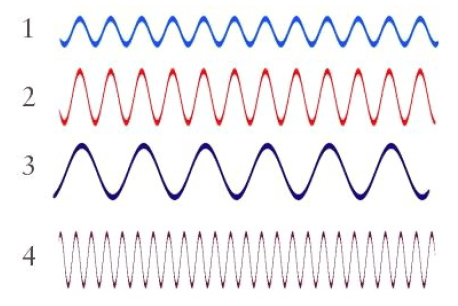
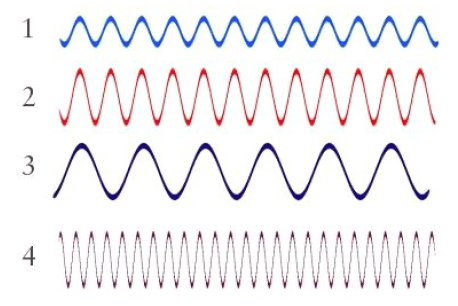
Which wave in the diagram has the greatest frequency?
a)
1
b)
2
c)
3
d)
4
76.

Which wave in the diagram has the greatest wavelength?

a)

1

b)

2

c)

3

d)

4

77.

____________ is a form of energy that you can hear and travels in waves.

a)

trough

b)

crest

c)

sound

d)

amplitude

78.

sound cannot travel through___________.

a)

solid

b)

empty space

c)

liquid

d)

gas

79.

The ________ of a sound is how high or low the sound is.

a)

volume

b)

amplitude

c)

wave

d)

pitch

80.

All Sounds are caused by vibrations.

a)

True

b)

False

81.
High Amplitude =__________________
a)
Louder sounds
b)
Quieter Sounds
82.
Low frequency = _______ Pitch
a)
Low
b)
High
83.

Which part of a wave is called the crest?

a)

The midpoint

b)

The lowest point

c)

The starting point

d)

The highest point

84.

What type of energy is stored in a stretched rubber band?

a)

Thermal Energy

b)

Potential Energy

c)

Kinetic Energy

d)

Sound Energy

85.

Which electromagnetic wave is commonly used for medical imaging?

a)

Infrared Rays

b)

Microwaves

c)

Radio Waves

d)

X-Rays

86.

the loudness or softness of a sound

a)

frequency

b)

volume

c)

pitch

d)

vibrations

87.

the high or low tone of a sound

a)

frequency

b)

volume

c)

pitch

d)

vibrations

88.

vibrations that travel through air, water, or objects and is detected by your ears

a)

air

b)

sound

c)

solid

d)

motion

89.

What can sound travel through? 

a)

solid

b)

liquid

c)

gas

d)

all correct

90.

Ryan is playing drums when his mother asks him to lower his volume. What should Ryan do to please his mom?

a)

Hit the drums with less force.

b)

Hit the drums with more force.

c)

Hit the drums slower but with more force.

91.

What happens when a rubber band on a cup is plucked?

a)

The cup changes shape.

b)

The rubber band always breaks.

c)

The cup will vibrate back and forth.

d)

The rubber band will vibrate back and forth.

92.

Sound does not travel through ___________ because there is no matter for it to travel through.

a)

water

b)

air

c)

space

d)

wood

93.
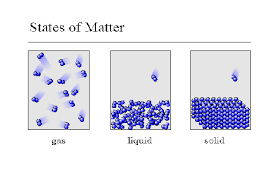
What are the states of matter?
a)
solid, liquid, and juice
b)
solid and liquid
c)
solid and gas
d)
solid, liquid, and gas
94.
Matter that has its own shape and takes up space.
a)
solid
b)
liquid
c)
gas
95.
How is a gas defined?
a)
no shape, no volume
b)
Definite shape, definite volume
c)
Found in stars
d)
Definite volume, no shape
96.
Molecules are closest together in a 
a)
Solid
b)
Liquid
c)
Gas
d)
plasma
97.
Define a liquid
a)
no shape, no volume
b)
Definite shape, definite volume
c)
Found in stars
d)
Definite volume, no shape
98.
What term describes a liquid changing to a solid?
a)
Deposition
b)
Sublimation
c)
Evaporation
d)
Freezing
99.
Water can be a solid, liquid, and a gas.
a)
True
b)
False
liquid
100.
Particles of a liquid
a)
are tightly packed together and stay in a fixed position.
b)
have no viscosity.
c)
decrease in volume with increasing temperature.
d)
are free to move around one another but still touch.
101.
At higher temperatures
a)
particles in an object have less energy
b)
particles in an object move faster
c)
a gas contracts
102.
Particles (molecules) in a ______________________ have more energy than the other states of matter.
a)
gas
b)
solid
c)
liquid
103.
Boiling
a)
liquid to gas
b)
gas to solid
c)
gas to liquid
d)
solid to liquid
104.
What is happening when my ice cream changes from a solid to a liquid?
a)
freezing
b)
melting
c)
burning
d)
evaporation
105.
What is condensation?
a)
gas to solid
b)
gas to liquid
c)
liquid to solid 
d)
solid to liquid 
106.
What is the definition of CONDUCTION?
a)
When heat is transferred from objects like rays of light or electromagnetically.
b)
a  hot liquid or air that  expands, becomes less dense, and rises or becomes more dense, and sinks.
c)
When heat transfers from objects that are touching.
d)
When heat transfers through the heater or AC in your house.
107.
What is the definition of CONVECTION
a)
When heat transfers through waves.
b)
When heat transfers from objects that are touching.
c)
a  hot liquid or air that  expands, becomes less dense, and rises or becomes more dense, and sinks.
d)
Heat traveling from the sun
108.
What kind of heat transfer happens when the sun is heating your body?
a)
Conduction
b)
Radiation
c)
Convection
d)
Density
109.
What heat transfer happens when you burn your hand by touching a fire?
a)
Radiation
b)
Conduction
c)
Convectio
d)
I don't know!!!!!!!!!!!
110.
The way the heat is moving from the hot coffee is called...
a)
convection
b)
radiation
c)
insulation
d)
conduction