wayground logo

Free Printable Worksheets

Font size

S
M
L
XL
Worksheets

Semester 2 Exam Review

Total questions: 179

Worksheet time: 8hrs 31mins

Name
Class
Date
1.

This is a decomposition reaction.

H2S(g) H2(g) + S(s)

a)

True

b)

False

2.
What type of reaction is the equation C + O→ CO2?
a)
Synthesis Reaction
b)
Decomposition Reaction
3.
Cu + 2Ag(NO3) → 2Ag + Cu(NO3)
a)
Decomposition Reaction
b)
Single Displacement Reaction
c)
Double Displacement Reaction
4.
Consider the chemical equation CH4 + 2 O2 → CO2 + 2 H2O. In this equation, CH4 is a
a)
product
b)
reactant
5.
Consider the equation 4 Fe+3 O2 → 2 Fe2O3 . In this equation, 3 O2 is a
a)
product
b)
reactant
6.
Which generalized equation represents a synthesis reaction?
a)
A + BC → AC+ B
b)
A + B → AB
c)
AB → A + B
7.
Which generalized equation represents a decomposition reaction?
a)
A + BC → AC+ B
b)
A + B → AB
c)
AB → A + B
8.
Which generalized equation represents a single displacement reaction?
a)
A + BC → AC+ B
b)
A + B → AB
c)
AB → A + B
9.
2 NH3+ 1 H2SO4 ----> 1 (NH4)2SO4
a)
Synthesis (or combination)
b)
Single displacement
c)
Double displacement
10.
Pb + FeSO4 ----> PbSO4 + Fe
a)
Synthesis (or combination)
b)
Decomposition
c)
Single displacement
d)
Double displacement
11.
P4 +  3 O2 ----> 2 P2O3
a)
Synthesis (or combination)
b)
Decomposition
c)
Single displacement
12.
This pictures simulates what type of reaction?
a)
Single Replacement
b)
Double Replacement
13.

What type of reaction involves 2 substances combining to form 1 new compound?

a)

Single Displacement Reaction

b)

Double Displacement Reaction

c)

Synthesis Reaction

14.

What type of reaction involves one element replacing another element in a compound?

a)

Single Displacement Reaction

b)

Double Displacement Reaction

c)

Decomposition Reaction

15.

What are the reactants in the chemical equation pictured?

(a)  

16.

What are the products of the chemical reaction pictured?

a)

CH4 and CO2

b)

CH4 and O2

c)

CO2 and H2O

d)

O2 and H2O

17.

The right side of the equation below is called the

a)

products

b)

reactants

18.

This type of reaction 2 NO2 ---> 2 O2 + N2

is called

a)

Single Replacement

b)

Decomposition

c)

Combustion

19.
Is this equation balanced?
a)
yes
b)
no
c)
Not enough information
d)
Left side is balanced
20.
Fill in the blanks with coefficient:
PCl5+_ H2O→_ HCl+H3PO4
a)
4, 5
b)
1, 6
c)
3, 8
d)
2,2
21.
Which problem is balanced?
a)
PbO2 + 2H2--> H2SO4
b)
SO2 + H20 --> H2SO4
c)
2Na + 2H2O --> 2NaOH + H2
d)
2Na + 2H2O --> 2NaOH + H
22.
What is a coefficient?
a)
The small number on the right of the chemical symbol.
b)
The large number to the left of a formula.
23.
Balance this equation
_Zn+_HCl-->_ZnCl+_H2
a)
1,1,2,1
b)
1,1,1,2
c)
1,2,1,1
d)
2,1,1,1
24.
Balance this equation.
_Mg + _Cl--> _MgCl2
a)
1, 2,1
b)
already balanced
c)
2,1,1
d)
1,1,2
25.
How many atoms of aluminum are on each side of the following equation: 4Al + 3O--> 2AlO3
a)
2
b)
6
c)
1
d)
4
26.
The blue numbers in the image below represent ________
a)
Charges
b)
coefficients
c)
subscripts
d)
none of the answers are correct
27.
Finish a blalanced equation:
Mg(OH)2 --> __________
a)
Mg(OH)--> MgOH
b)
Mg(OH)2 --> MgO+ H2O
c)
Mg(OH)2 --> MgO+ H2
d)
Mg(OH)2 --> Mg+ H2O
28.
Balance this equation:
P4+O2  -->  P2O3
a)
3 P4+ O--> 2 P2O3
b)
 P4+ O--> 2 P2O3
c)
 P4+ 3 O2 --> 2 P2O3
d)
 P4+ 2 O--> 3 P2O3
29.
At the end of chemical reactions, what is the total mass of the reactants compared to the total mass of the products?
a)
the product is doubled
b)
the product is half the mass of the reactants
c)
the mass is the same
d)
the mass changes depending on the reaction
30.
Balance this equation,            
Al2O3 --> Al + O2 
a)
Cannot be balanced
b)
2Al2O3 --> 2Al+3O2 
c)
2Al2O3--> 4Al+3O2 
d)
3Al2O3--> 2Al+O2 
31.
Which elements are(is) not balanced?
LiNO3 +CaBr2 --> Ca(NO3)2 +  LiBr   
a)
Li
b)
Ca and Li
c)
O and N
d)
Ca
32.
Which of the following has the most number of O?
a)
2Mg3(PO4)2
b)
4AlPO4
c)
3Al(NO3)3
d)
15KOH
33.
Balance the equation:
Si(OH)4+NaBr-->
 SiBr4+NaOH
a)
Si(OH)4+2NaBr--> SiBr4+NaOH
b)
Si(OH)4+4NaBr--> SiBr4+4NaOH
c)
Si(OH)4+NaBr--> SiBr4+4NaOH
d)
Si(OH)4+2NaBr--> SiBr4+2NaOH
34.
N2 + H2 = NH4
a)
Balanced
b)
Unbalanced
35.
What does the Law of Conservation of Mass state?
a)
Matter cannot be gained or lost in a chemical reaction.
b)
Matter can only be lost in a chemical reaction.
c)
Matter can only be gained in a chemical reaction.
d)
Matter can be gained and lost in a chemical reaction. 
36.
What are the products of this reaction?
Cu+ AgNO3--> 
a)
Cu(NO3)2+Ag
b)
CuNO3 + Ag
c)
CuAg+NO3
d)
Cu+ AgNO3
37.
Write a Balanced Equation for this reaction:
C2H4 + 2 O2 -->
a)
C2O2 + H4
b)
CO2 + HOH
c)
CO + H
d)
2 CO2 + 2H2O
38.
Predict the products for the this reaction:
K + HCl --> 
a)
KCl + H2
b)
KHCl 
c)
KH + Cl2
d)
KCl + H
39.
What type of reaction is this?
2 C6H14 + 19 O2 --> 12 CO2 + 14 H2O
a)
Single Replacement
b)
Double Replacement
c)
Combustion
d)
Decomposition
40.
Which of the following equations represents the balanced synthesis reaction of iron (III) and oxygen?
a)
Fe + 3 O2 → Fe2O3
b)
3 Fe + 3 O2 → 2 Fe2O3
c)
2 Fe + O2 → Fe2O3
d)
4 Fe + 3 O2 → 2 Fe2O3
41.
What are the correct formulas and coefficients for the products of the following single-replacement reaction?
Mg + Al(OH)3 →
a)
No Reaction
b)
Al + Mg(OH)3
c)
2 Al + 3 Mg(OH)2
d)
3 Al + MgOH3
42.
If an element is diatomic it should have a subscript of___
a)
2, always
b)
2, only when it is by itself
c)
it shouldn't have a subscript, it should have a coefficent
43.
What kind of reaction is this:
4Fe  +  3O2 →   2Fe2O3 
a)
Synthesis
b)
Decomposition
c)
Single Replacement 
d)
Double Replacement
44.
What kind of reaction is this:
2H2O2 →2 H2+ O2
a)
Synthesis
b)
Decomposition
c)
Single Replacement 
d)
Combustion
45.
What kind of reaction is this:
Fe + CuSO4 -> Cu + FeSO4
a)
Double Replacement
b)
Decompostion
c)
Single Replacement
d)
Combustion
46.
What is the product when rubidium and oxygen gas react?
a)
RbO2
b)
Rb2O
c)
RbO
d)
Rb2O2
47.
in a reaction, aqueous barium chloride reacts with aqueous potassium carbonate to produce solid barium carbonate and aqueous potassium chloride. what is the correct balanced equation.
a)
Ba2Cl(aq) + KCO3(aq) --> BaCO3(s) + KCl(aq)
b)
BaCl2(aq) + K2CO3(aq) --> BaCO3(s) + 2KCl(aq)
c)
BaCl(aq) + K2CO3(aq) --> BaCO3(s) + K2Cl(aq)
d)
Ba2Cl2(aq) + KCO3(aq) --> Ba2CO3(s) + KCl2(aq)
48.
 Predict the product(s):  H2O -->
a)
H and O
b)
H2 and O2
c)
H and OH
49.
Which of the following are PRODUCTS?
H2O + CO→ HCO + HO
a)
H2O and CO2
b)
HCO and HO
c)
H2O ONLY
d)
HCO ONLY
50.
When balancing equations a ____ can be placed to the left of a formula of a substance to make the equations balanced
a)
charge
b)
subscript
c)
random number
d)
coefficient
51.
Classify
Zn + H
2S → ZnS + H2
a)
synthesis
b)
combustion
c)
single replacement
d)
double replacement
52.
Classify
FeS + HCl → H
2S + FeCl2
a)
synthesis
b)
combustion
c)
single replacement
d)
double replacement
53.

What is Avogadro's number?

a)

6.02 x 10²³

b)

1 mole

c)

600 million

d)

6.02

54.

How many moles are in 6.02 x 10²³ molecules of H2O?

a)

1 mole

b)

2 moles

c)

6.02 moles

d)

602000000000000000000000 moles

55.

A mole is:

a)

The SI unit for mass

b)

The SI unit for the amount of a substance

c)

The SI unit for volume

d)

The SI unit for area

56.

What converting from moles to the number of particles, moles is multiplied by:

a)

an equivalent value

b)

a conversion factor

c)

the number of atoms in the formula

d)

the mass of the substance

57.

Which has the most particles?

a)

1 mole H2

b)

1 mole Na1+

c)

1 mole Al(OH)3

d)

These are all the same

58.

Why is the mole used in chemistry?

a)

The mass of atoms is in AMUs which is too hard to convert to grams.

b)

A dozen is not a scientific amount.

c)

Chemists needed to make chemistry easier to understand.

d)

It makes counting large numbers of small particles easier.

59.

How is moles abbreviated?

a)

M

b)

m

c)

mol

d)

ml

60.
What is the mole used for? 
a)
To measure the amount of grams in a substance
b)
To measure the amount of atoms or molecules in a substance
c)
To measure the amount of energy in a substance
d)
To measure the amount of bonding in a substance 
61.
How many atoms are in 1 mole of NaCl? 
a)
6.02 x 10²³
b)
58 
c)
11
d)
17
62.

How many atoms are in 1 mole of Iodine (I)?

a)

6.022 x 10²³

b)

4.022 x 10²³

c)

6.022 x 1025

d)

4.022 x 1025

63.
2NaClO3 (s)  2NaCl (s) + 3O2 (g)  
12.00 moles of NaClO3 will produce how many grams of O2?
a)
256 g of O2
b)
576 g of O2
c)
288 g O2
64.
Cl2 + 2KBr → Br2 + 2KCl
How many grams of potassium chloride (KCl) can be produced from 356 g of potassium bromide (KBr)?
a)
749 g
b)
223 g
c)
479 g
d)
814 g
65.
Fe2O3 + 3H2 → 2Fe + 3H2O
About how many grams of H2O will be produced from 150 grams of Fe2O3
a)
50 grams H2O
b)
60 grams H2O
c)
5000 grams H2O
d)
6000 grams H2O
66.
Given the following reaction, 2 NaClO3 (s) --> 2NaCl (s) +3 O2 (g)  12.00 moles of NaClO3 will produce how many grams of O2?
a)
256 g of O2
b)
576 g of O2
c)
288 g O2
67.
N2 +  3H2 −->  2NH3 
How many moles of hydrogen are needed to react with 2 moles of nitrogen?
a)
6
b)
2
c)
3
d)
1
68.
How do I move from grams to moles
a)
multiply by molar mass
b)
divide by molar mass
c)
multiply by Avo number
d)
divided by Avo number
69.
Use the following equation:
2NaOH(aq) + H2SO4(aq) --> 2H2O(l) + Na2SO4(aq)
How many grams of sodium sulfate will be formed if you start with 200 grams of sodium hydroxide?
a)
150.22 g Na2SO4
b)
593.44 g Na2SO4
c)
330.04 g Na2SO4
d)
297.65 g Na2SO4
70.
2 KClO3 → 2 KCl + 3 O2
How many moles of oxygen are produced when 6.7 moles of KClO3 decompose completely?
a)
6.7 mol
b)
1.0 mol
c)
10.1 mol
d)
4.5 mol
71.
 SiO2 + 3C → SiC + 2CO
I need to add 8 moles of Carbon to the reaction. How many grams of Carbon should I weigh?
a)
96 g
b)
0.67 g
c)
2.67 g
d)
48 g
72.

151 grams of Al2O3 are produced. How many grams of Al was needed in the reaction? Al + O2 -------> Al2O3 balance first.

a)

79.91 g

b)

22.4 liters

c)

57.8 g

d)

142.8 g

73.

What Mass of sulfur must burn to produce 3.42 L of SO2 @ 273K and 101 kPa?

Use the following Equation : S + O2 --> SO2

a)

2.45 g S

b)

5.00 g S

c)

4.88 g S

74.

Your parents decide that it's time you go visit your grandmother who lives an hour away. When you get to her house, your check the tires and notice what about their pressure.

a)

Increase

b)

Decrease

75.

You shake a can of soda & then open it, decreasing its pressure. What happens to the volume of the carbon dioxide in the soda?

a)

Increase

b)

Decrease

76.

The pressure decreases as a scuba diver ascends to the surface of the water. What happens to the volume of air in his lungs?

a)

Increase

b)

Decrease

77.

You forgot to bring your basketball inside after playing a game with your friends. When the sun when down, the temperature dropped & it got cold outside. What do you think happened to the volume of the ball?

a)

Increase

b)

Decrease

78.

When you press down the trigger on a can of spray paint, you are adding pressure. What happens to the volume of the contents inside the can?

a)

Increase

b)

Decrease

79.

Let's say you go on a cruise & the ship starts sinking. You inflate a rubber life raft so you will be able to stay afloat until help arrives. When you place the raft in the cold water, the raft shrinks slightly, decreasing its pressure. What happens to the volume of the raft?

a)

Increase

b)

Decrease

80.

You go camping & roast marshmallows over a campfire. What happens to the volume of the air bubbles inside the marshmallows?

a)

Increases

b)

Decreases

81.

The burner of a hot air balloon start heating the air inside the envelope. This continues heating the air, until the balloon inflates all the way & starts to lift off the ground. What happens to the pressure of the balloon as it is being inflated?

a)

Increases

b)

Decreases

82.

You release propane from a tank so you can start heating up the grill. When you do this, the pressure inside the tank decreases. As the pressure decreases, what happens to the temperature inside the tank?

a)

Increase

b)

Decrease

83.

You accidentally leave a can of soda in the car on a hot summer day. What will happen to the volume of the carbon dioxide ( CO2CO_2 ) in the soda?

a)

Increase

b)

Decrease

84.
What is the formula for Boyle's Law?
a)
P1V1=P2V2
b)
P1V1/P2V2
c)
P1V2=P2V1
d)
P1/V1=P2/V2
85.
What is the new volume of the gas if the pressure on 350 L of oxygen at 720 mm Hg is decreased to 600 mm Hg?
a)
420 L
b)
29.16 L
c)
4200.0 L
d)
291.6 L
86.
A gas at a volume of 4 liters is at a pressure of 2 atm. The volume is changed to 16 Liters, what must the new pressure be?
a)
2 atm
b)
12 atm
c)
10 atm
d)
0.5 atm
87.
What is the formula Charles' Law?
a)
V = T
b)
VT = VT
c)
T1 / V1 = T2 / V2
d)
V1 / T1 = V2 / T2
88.
What is 50 C in Kelvin?
a)
223
b)
323
c)
100
d)
50
89.
Tom Brady enjoys balloon animals from the carnival. He just received a balloon giraffe that has an initial temperature of 39.0°C and a volume of 1.28 L. If Gronkowski plays a trick on Tom, and puts his balloon giraffe into the freezer, what would be the new volume of the balloon if the temperature drops down to 8.0°C?
(Don’t forget about what must be done to temperatures!)
a)
1.42 L
b)
6.85 x 10⁴ L
c)
3.78 L
d)
1.15 L
90.
Edelman and Gronkowski want to play a game of beach volleyball. If the beach ball has a volume of  261 L at a temperature of 502 K, what will the temperature of the balloon be if the volume decreases to 176 L?
a)
744 K
b)
0.0030 K
c)
339 K
d)
512 K
91.

What is the formula for Gay–Lussac's Law?

a)

P1T1=P2T2P_1\cdot T_1=P_2\cdot T_2  

b)

P1T1=P2T2\frac{P_1}{T_1}=\frac{P_2}{T_2}  

c)

P1P2=T2T1\frac{P_1}{P_2}=\frac{T_2}{T_1}  

d)

P2P1=T1T2\frac{P_2}{P_1}=\frac{T_1}{T_2}  

92.

Gay–Lussac's Law is a direct relationship between temperature and pressure.

Assuming a constant volume, if the pressure doubles, then the temperature ________

a)

doubles in Kelvin units

b)

doubles in Celsius units

c)

halves in Celsius units

d)

halves in Kelvin units

93.
If 1.00 mol of He occupies 22.4 L at STP, what volume will 1.00 g of He occupy under same condition?
a)
22.4 L
b)
5.60 L
c)
10.2 L
d)
8.16 L
94.
A 2.00 L sample of pure oxygen gas (O2) is measured at STP.  How many moles of oxygen is this?
a)
24.4 mol
b)
0.007 mol
c)
1.44 mol
d)
0.09 mol
95.

If I initially have 4.0 L of a gas at a pressure of 1.1 atm, what will the volume be if I increase the pressure to 3.4 atm?

a)

1.29 L

b)

12.36 L

c)

1.29 atm

d)

12.36 atm

96.

If I have 5.6 liters of gas in a piston at a pressure of 1.5 atm and compress the gas until its volume is 4.8 L, what will the new pressure inside the piston be?

a)

1.8 atm

b)

3.27 atm

c)

1.8 L

d)

3.27 atm

97.

I’ve got a car with an internal volume of 12,000 L. If I drive my car into the river and it implodes, what will be the volume of the gas when the pressure goes from 1.0 atm to 1.4 atm?

a)

8571.43 L

b)

3210.26 L

c)

8669.0 atm

d)

3905.33 atm

98.
Calculate the volume that a 0.323-mol sample of a gas will occupy at 265 K and a pressure of 0.900 atm.
a)
7.18 L 
b)
7.81 L
c)
4.63 L
d)
4.36 L
e)

8 L

99.

Determine the temperature required for 0.0470 mol of gas to fill a balloon to 1.20 L under 0.998 atm pressure. 

a)

200 K 

b)
107 K 
c)
207 K 
d)

310 K 

e)

300K

100.

What does R stand for

a)

Ideal gas constant

b)

Real gas constant

c)

Temperature constant

d)

Ideal gas law

e)

Pressure constant

101.
Dalton's Law states...
a)
that at a constant temperature the volume of a confined ideal gas varies inversely with its pressure.
b)
that the total pressure exerted by the mixture of non-reactive gases is equal to the sum of the partial pressures of individual gases
c)
how gases tend to expand when heated
d)
that the density of an ideal gas at constant pressure varies inversely with the absolute temperature of the gas.
102.
Three gases, Ar, N2 and H2 are mixed in a 500L container. Ar has a pressure of 255 torr, N2 has a pressure of 228torr and H2 has pressure of 752torr. What is the total pressure in the container?
a)
483torr
b)
270torr
c)
1235torr
103.
Calculate the partial pressure of H2 at 20oC when the vapor pressure of water is 17.5torr. The total pressure of the gases is 750torr.
a)
767.5torr
b)
732torr
c)
42.86torr
104.
 A lone pair is defined as
a)
A pair of bonding electrons
b)
One non-bonding electron
c)
A pair of non-bonding electrons
d)
A pair of electrons on the central atom
105.
What is the VSEPR theory used to predict?
a)
Bond Strength
b)
Polarity
c)
Molecular Shape
d)
Electronegativity
106.
Which of the following shapes has an unshared pairs of electrons on the central atom? 
a)
Bipyramidal
b)
Bent
c)
Trigonal Planar
d)
Tetrahedral
107.
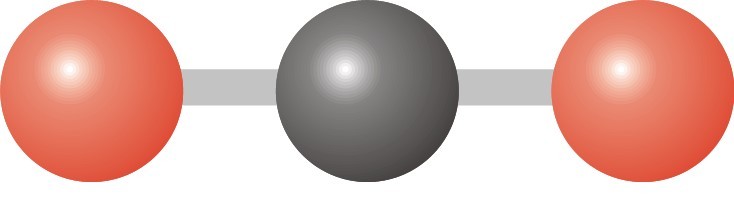
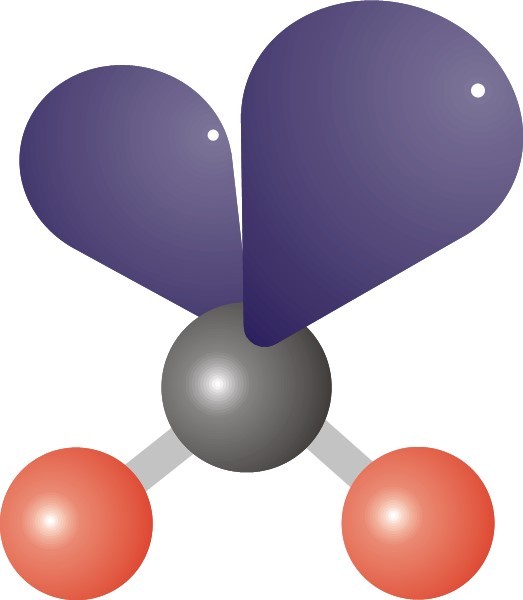
Which molecule would have this molecular geometry?
a)
BF3
b)
CH4
c)
PCl5
d)
CO2
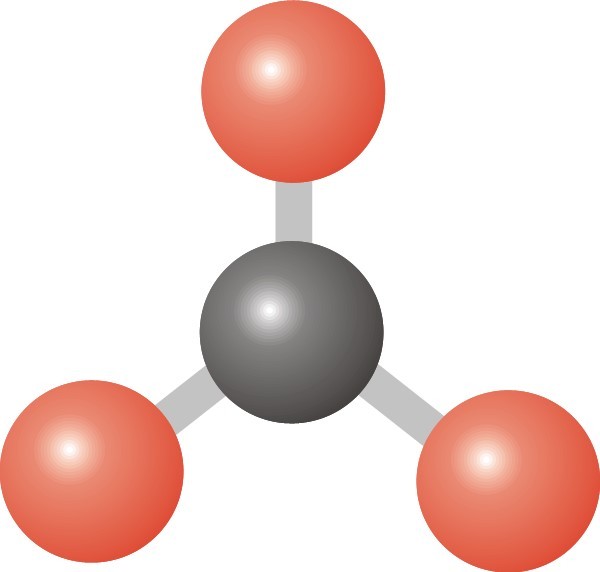
108.
What molecule could this be? 
a)
BF3
b)
CH4
c)
H2O
d)
CO2
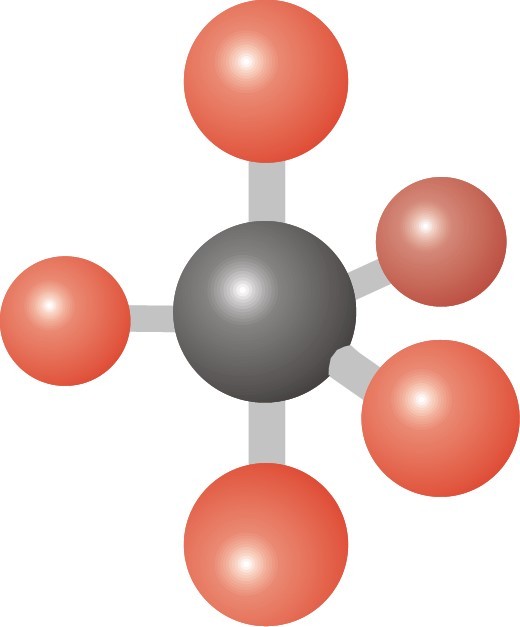
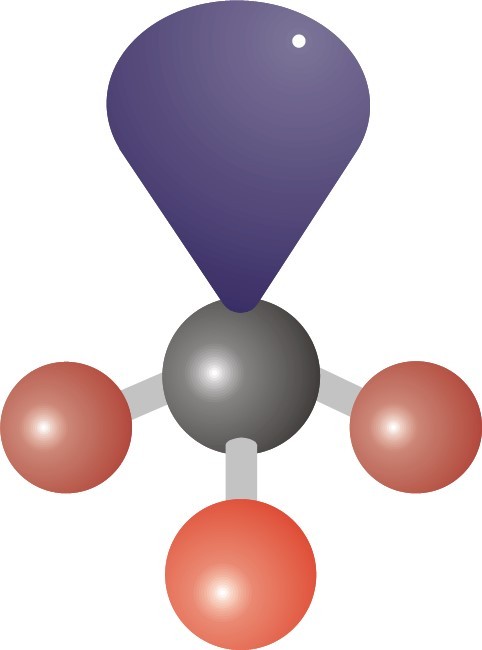
109.
What molecule could this be? 
a)
H2O
b)
CCl4
c)
PCl5
d)
NaCl
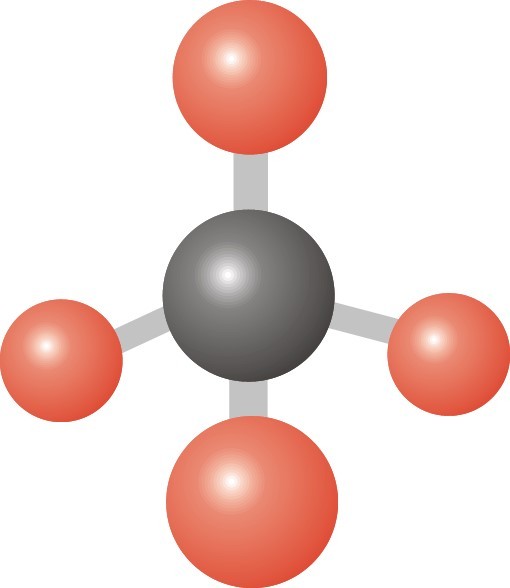
110.
Who could this molecule be?
a)
CH4
b)
CO2
c)
PCl5
d)
BF3
111.
Who could this be? 
a)
CO2
b)
NH3
c)
H2S
d)
CH4
112.
Who could this be?
a)
H2O
b)
NH3
c)
CO2
d)
CH4
113.

What molecular geometry would PH3 have?

a)

Trigonal Pyramidal

b)

Trigonal Bipyramidal

c)

Bent

d)

Linear

114.
A molecule with a lone pair on the central atom would have the same electron and molecular geometry
a)
True
b)
False
115.
How many lone pairs of electrons are on the P atom in PF3?
a)
1
b)
2
c)
3
d)
0
116.
Determine the electron geometry (eg) and molecular geometry (mg) of XeF4 (Lewis structure is shown) .
a)
eg = tetrahedral, mg = tetrahedral
b)
eg = linear, mg = linear
c)
eg = octahedral, mg = square planar
d)
eg = trigonal bipyramidal, mg = tetrahedral
117.
Consider the molecule below.  Determine the molecular geometry at each of the 2 labeled carbons.
a)
C1 = tetrahedral, C2 = linear
b)
C1 = trigonal planar, C2 = bent
c)
C1 = bent, C2 = trigonal planar
d)
C1 = trigonal planar, C2 = tetrahedral
118.

Is this molecule polar?

a)

Yes

b)

No

119.

Is this molecule polar?

a)

No

b)

Yes

120.

Name for NaH

a)

sodium hydrogen

b)

potassium hydride

c)

sodium hydride

d)

potassium hydrogen

121.

Formula for barium sulfide

a)

B2S3

b)

BaS

c)

Ba2S

d)

BaS2

122.

Name for Hg2S

a)

mercury (IV) sulfide

b)

mercury (III) sulfide

c)

mercury (II) sulfide

d)

mercury (I) sulfide

123.

Formula for lead (II) chloride

a)

PbCl2

b)

Pb2Cl

c)

Pb2Cl3

d)

Pb3Cl2

124.

Name for PBr2

a)

phosphorus bromide

b)

phosphorus dibromide

c)

phosphorus dibromine

d)

phosphorus bromine

125.

Formula for Disilicon Heptasulfide

a)

SiS6

b)

SiS7

c)

Si2S6

d)

Si2S7

126.

Name for LiOH

a)

lithium hydrogen oxide

b)

lithium hydroxide

c)

lithium (II) hydroxide

d)

lithium (I) hydroxide

127.

Formula for iron (II) carbonate

a)

FeCO3

b)

Fe2CO3

c)

FeCO2

d)

Fe2CO2

128.

Name for SrBr2

a)

strontium bromine

b)

strontium bromide

c)

strontium dibromide

d)

strontium dibromine

129.

Formula for Cobalt (II) bromide

a)

CoBr

b)

Co2Br2

c)

Co2Br

d)

CoBr2

130.

Name for CO

a)

carbon monoxide

b)

carbon oxide

c)

monocarbon oxide

d)

carbide monoxide

131.

Name for BaO

a)

Barium oxide

b)

Barium monoxide

c)

Monobarium oxide

d)

Monobarium monoxide

132.

Name the ionic compound, LiCl

a)

lithium chlorine

b)

lithium chloride

c)

lithium chlorate

d)

lithium monochloride

133.

Name the ionic compound, CaCO3

a)

calcium carbide

b)

calcium carbon trioxide

c)

calcium carbon oxide

d)

calcium carbonate

134.
K20 - name?
a)
potassium dioxide
b)
potassium oxide
c)
potassium oxygen
d)
dipotassium dioxide
135.
What is the proper name for CaCl2?
a)
Calcium dichloride
b)
Monocalcium dichloride
c)
Calcium chloride
d)
Calcium chlorine
136.

What is the correct formula of phosphorus trichloride?

a)

P2Cl3

b)

P3Cl3

c)

PCl3

d)

PCl5

137.

What is the correct molecular formula for barium hydroxide?

a)

Ba(OH)2

b)

Ba2OH

c)

BaOH

d)

Ba2OH

138.
Name this compound:
Cs2S
a)
cesium sulfide
b)
cesium sulfate
c)
cesium II sulfate
d)
cesium II sulfide
139.
Name this compound.
MgF2
a)
magnesium fluoride
b)
manganese Phosphide
c)
magnesium(III) fluoride
d)
magnesium fluoride(II)
140.

The name of FeCl₂ is

a)

iron chloride

b)

iron (II) chloride

c)

iron (I) chloride

d)

iron dichloride

141.

LiBr is called

a)

lithium bromine

b)

lithium (I) bromine

c)

lithium bromide

d)

lithuim (I) bromide

142.

Which of these combinations is an ionic compound made of?

a)

Metal and Metal

b)

Nonmetal and Nonmetal

c)

Metal and Nonmetal

d)

Cation and Cation

143.

Name the following ionic compound: BeCl2

a)

beryllium chlorine

b)

beryllium II chloride

c)

beryllium chloride

d)

beryllium dichloride

144.

Name the ionic compound SnSe2

a)

Tin diselenide

b)

Tin (IV) Selenide

c)

Tin selenide

d)

Tin (II) triselenide

145.

Name the following ionic compound: Cs2S

a)

cesium sulfide

b)

cesium sulfate

c)

cesium II sulfate

d)

cesium II sulfide

146.

Which of the following combinations would need roman numerals in the name?

a)

potassium + fluorine

b)

beryllium + oxygen

c)

boron + iodine

d)

gold + oxygen

147.

When naming ionic compounds with transition metals you need to include roman numerals to show the _____ of the metal..

a)

atomic number

b)

mass number

c)

charge

d)

ionization energy

148.

When naming a compound, which of these is written first?

a)

Metal

b)

Nonmetal

c)

Anion

d)

Cation

149.

When naming a compound, what must the last part be?

a)

the element with "ide" at the end

b)

the element with the ending "ite"

c)

the name of the element

d)

the element with "ide" at the end, unless its a polyatomic ion

150.

What is the name of the compound Na2(SO4)?

a)

Sodium sulfate

b)

Sodium sulfide

c)

Sodium sulfite

d)

Sodium sulfuroxide

151.

What is the name of the compound Sc(OH)3?

a)

Scandium (III) hydroxide

b)

Scandium (I) hydroxide

c)

Scandium (II) hydroxide

d)

Scandium hydroxide

152.

The name of the compound Ca3(PO4)2

a)

calcium phosphate

b)

tricalcium diphosphate

c)

calcium phosphorus oxide

d)

calcium phosphide

153.

The number that tells you if an ion has lost or gained electrons

a)

atomic number

b)

oxidation number

c)

mass number

d)

electron number

154.

If I gain electrons I become

a)

Positive because I've added to my atom

b)

negative because I've added electrons

c)

same because i'm balanced

d)

equal because now I have electrons

155.
Nonmetals tend to 
a)
gain electrons
b)
lose electrons
156.
Metals tend to 
a)
gain electrons
b)
lose electrons
157.
In most cases, when naming you change the ending of the second element to ________.
a)
-ate.
b)
-ite.
c)
-ide.
d)
-ine.
158.
Name this compound: 
KF
a)
Potassium fluoride
b)
Potassium fluorite
c)
Fluorine potasside 
d)
Potassium fluorate
159.
MgS 
a)
Magnesium sulfide
b)
Monomagnesium monosulfide
c)
Magnesium monosulfide
160.
What is the name of N2O3
a)
Nitrogen trioxide
b)
Dinitrogen oxide
c)
Dinitrogen trioxide
d)
Nitrogen oxide
161.
What is the chemical formula for Tetrasulfur pentoxide?
a)
SO
b)
S4O
c)
S4O5
d)
S5O4
162.
What is the name of C3Cl?
a)
Carbon octachloride
b)
Tricarbon octachloride
c)
Carbon trichloride
d)
Octacarbon trichloride
163.
What is the chemical formula for Nitrogen triiodide?
a)
NI
b)
N3I
c)
NI3
d)
None of these
164.
What is the name of Br6F10 ?
a)
Bromium fluoride
b)
Hexabromine fluoride
c)
Bromium decafluoride
d)
none of the above
165.
What is the name of CO
a)
Carbon oxide
b)
Carbon dioxide
c)
Carbon monoxide
d)
Carbon II oxide
166.
What is the chemical formula for CP ?
a)
Carbon phosphide
b)
Monocarbon phosphide
c)
Carbon monophosphide
d)
none of the above
167.
phosphorus trichloride
a)
KCl3
b)
PCl3
c)
K3Cl
d)
P3Cl
168.
The chemical formula of sulfur hexabromide is
a)
SBr₆
b)
S₆Br
c)
S(VI)Br
d)
S6Br
169.
The chemical formula of dinitrogen textroxide is
a)
Ni₂O₄
b)
NiO
c)
N₂O₄
d)
NiO₂
170.
The chemical formula of tetraphosphorus heptaoxide is
a)
F₄O₁₀
b)
P₄O7
c)
PO
d)
P₁₀O₄
171.
What's the formula for chlorine dioxide
a)
ClO2
b)
CLO
c)
ClO3
d)
HClO2
172.
What is the formula for Hexaboron Monosilicide
a)
B6Si
b)
BSi
c)
BSi6
d)
B6Si6
173.
What is the OFFICIAL name for H2O
a)
Hydrogen Oxide
b)
Oxygen Dinitride
c)
Agua
d)
Dihydrogen Monoxide
174.
BrO3
a)
bromine oxide
b)
monobromine trioxide
c)
bromine trioxide
d)
bromine (III) oxide
175.
What is the formula for Tricarbon Octahydride?
a)
Ca3O
b)
C2H8
c)
C3H8
d)
Ca3H8
176.
A binary covalent bond exists between
a)
2 metals
b)
1 metal and 1 nonmetal
c)
2 nonmetals
d)
Any 2 elements
177.
Which of the following is NOT an ionic compound:
a)
CaO
b)
NaOH
c)
BaCl2
d)
Br2
178.

Which following is a covalent compound?

a)
SO2
b)
K2O
c)
CaO
d)
BeO
179.
Which of the following is NOT an ionic compound:
a)
CaO
b)
NaOH
c)
BaCl2
d)
CH4