
 Worksheets
Biology Finals Reviewer
Total questions: 100
Worksheet time: 50mins

A baby turtle crawling towards the ocean right after it's born is called?
mimicry
camouflage
instinct behavior
Why would a bunnies fur be brown in the summer and white in the winter?
The rabbit likes to change fur color
The bunny learned it from his parents
The changing of fur color help the bunny blend in with it's surroundings.
What is NOT a physical adaptation?
A turtle having a hard thick shell.
Herons having long legs to wade in the water.
A bird having a sharp beak to help them catch their prey.
Baby Cheetahs learning to hunt from their mom.

Hibernation, migration, and dormancy or all examples of ___________ adaptations.
behavioral
physical
special
environmental

Both animals and people are born with ___________, like crying.
instincts
experiences
adaptations
dormancy

Camouflage and mimicry are examples of ___________ adaptations.
behavioral
special
physical
predatory
Which of the following responses is a plant growing toward or leaning toward light?
thigmotrophism
phototropism
gravitropism
hydrotropism
A plants roots grow thicker towards the stream than away from the stream. To what stimulus is the plant responding to?
thigmotropism
gravitropism
photoropism
hydrotropism
A bird stalks, kills, and then eats an insect. Based on its behavior, which ecological terms describe the bird?
herbivore, decomposer
carnivore, heterotroph
producers, heterotroph
autotroph, herbivore
An animal that consumes both plants and other animals is called a(n)
Carnivore
Omnivore
Herbivore
Producer
An organism that obtains organic food molecules without eating other organisms or substances derived from other organisms. They use energy from the sun.
Decomposer
Detritivore
Autotroph
Heterotroph

During which month is the amount of water gained from precipitation greater than the amount of water lost to evaporation?
September
December
November
February
Which animal can hide in the dry grass to hunt for its food?


During transcription, this type of ribonucleic acid is responsible for copying the DNA and brining it out of the nucleus.
tRNA
mRNA
rRNA
dRNA
When these bond together, they form a protein
Amino Acids
Peptide Bonds
Ribose
Nucleotides
A string of nucleotides that contain the information to make a specific protein
Ribose
Amino Acids
tRNA
Gene
During translation, this type of ribonucleic acid is responsible for delivering amino acids to help make a protein.
mRNA
rRNA
tRNA
dRNA
How many nucleotides code for 1 amino acid?
1
2
3
4
Choose the sequence of the mRNA strand that would match up with to the following DNA strand:
GTACAT
CATGTA
GAUCUA
CAUGUA
CUTGTU
Why must transcription occur in the nucleus?
because DNA can't leave the nucleus
because ribosomes are in the nucleus
because DNA polymerase is found there
because helicase unzips the DNA
The RNA codon AUG means
add amino acid methionine
start the protein here
add the amino acid tyrosine
end the polypeptide chain here
When RNA is being made, the RNA base ____ always pairs with the base ___ in DNA.
U-T
T-G
U-A
A-U
Which of the following is the complementary mRNA sequence to this DNA strand: AACTGAA
UUGACUU
TTGACTT
AACTGAA
AACUGAA
Which statement best defines a mutation?
a physical trait that negatively impacts the organism
an adaptive trait that allows the individual to be better fit for survival
a change in the order, number, or type of bases in the genetic code
an identical copy of the original DNA strand
Possible negative consequences of mutations could be genetic ____________________ and cancer.
diversity
disorders
dominance
duplication
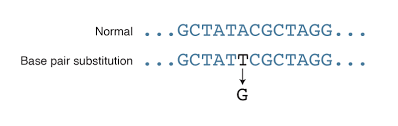
Mutations that change a single base pair, usually involving a substitution of one base for another:
chromosomal mutation
polyploidy
translocation
point mutation
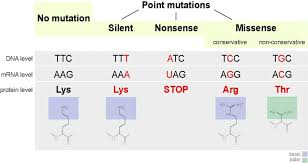
If a point mutation does not change the order of the amino acid sequence, this is called a:
nonsense mutation
silent mutation
missense mutation
frameshift mutation
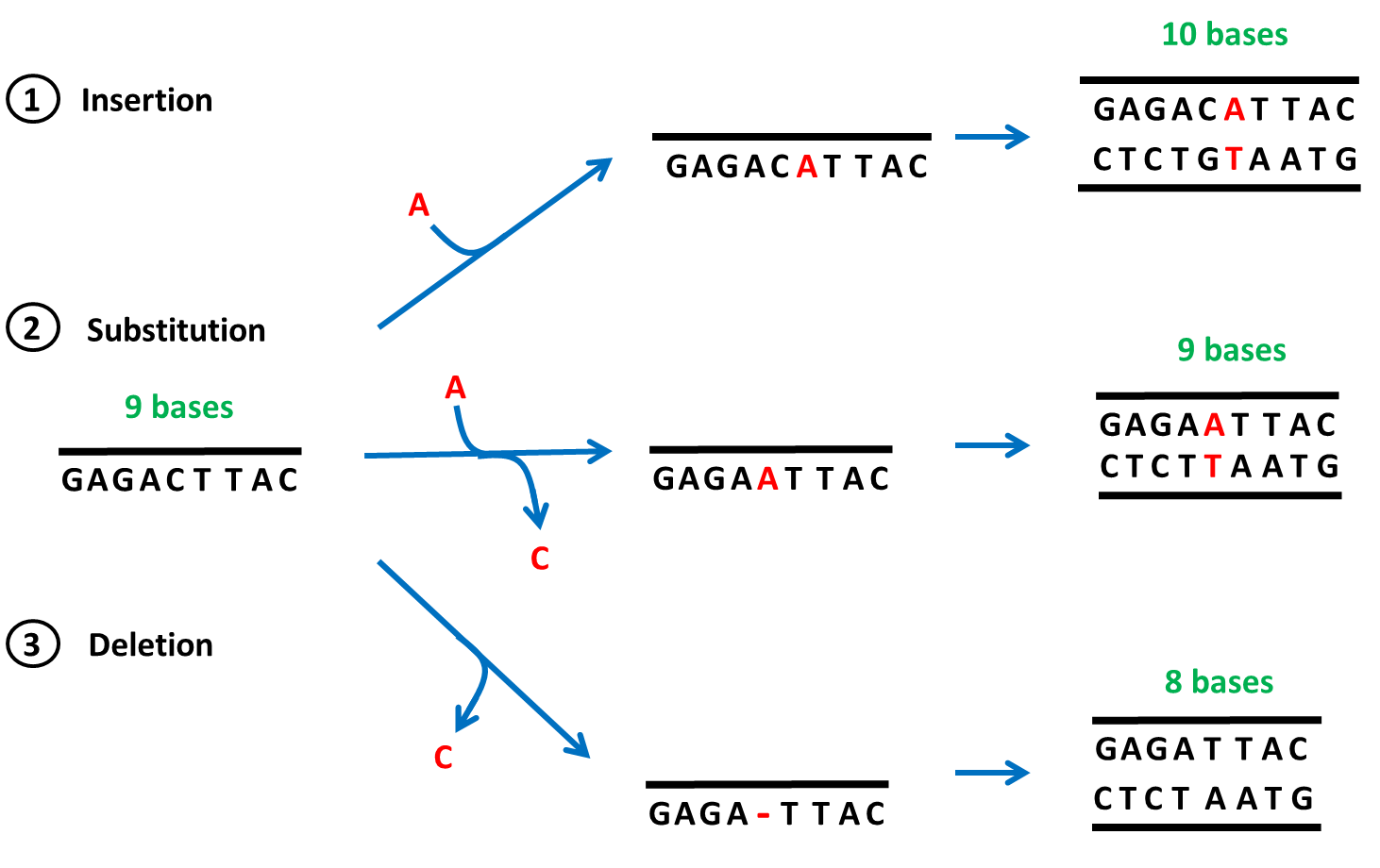
Insertions and deletions are also known as:
frameshift mutations
chromosomal mutations
silent mutations
polyploidy
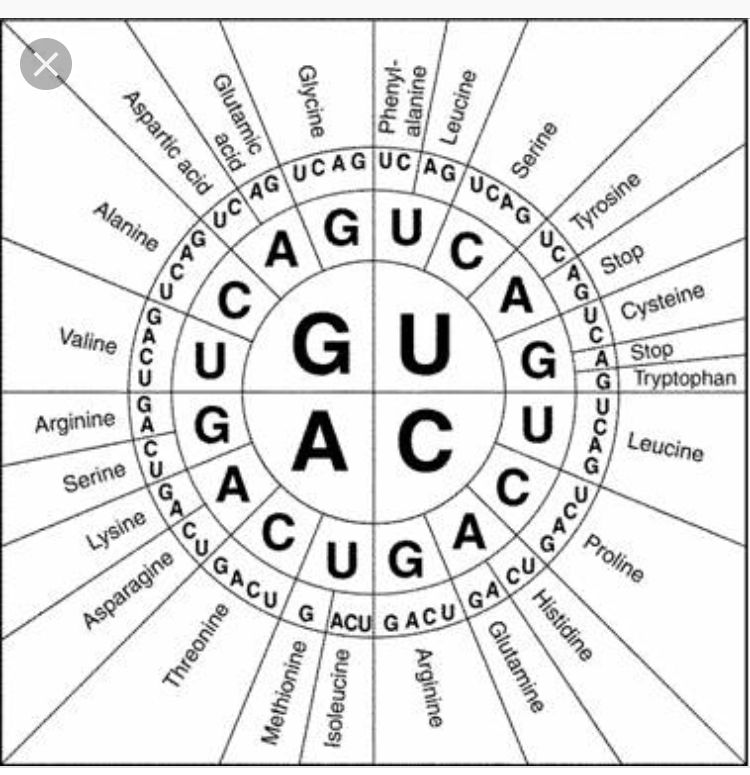
If a mutation codes for "stop" in the amino acid chain, this is called a:
nonsense mutation
missense mutation
silent mutation
frameshift mutation
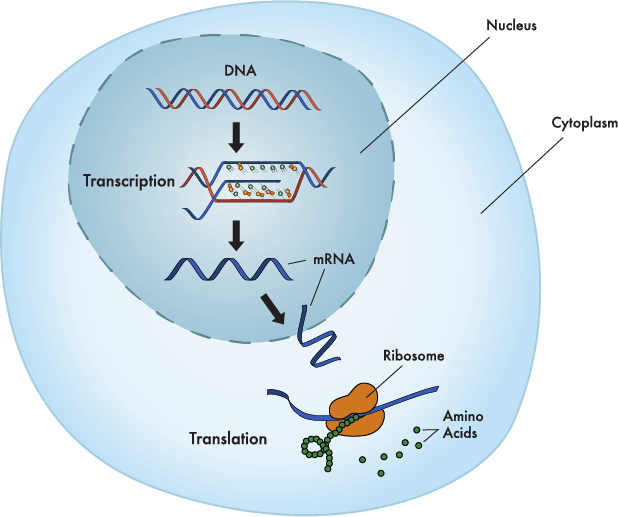
Which of the following mutations would be the most likely to affect the resulting protein?
substitution
silent mutation
frameshift mutation
all mutations affect the resulting protein
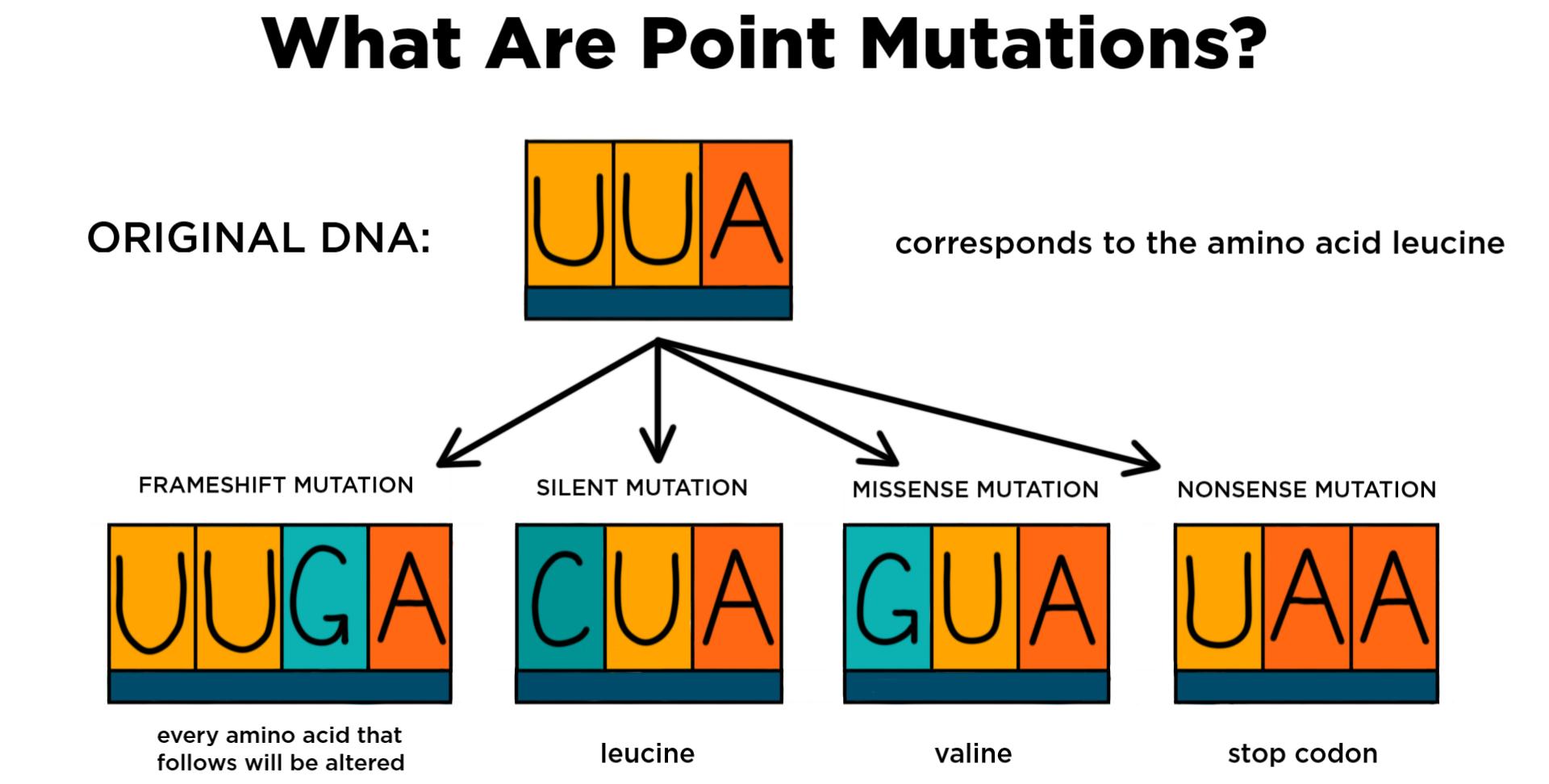
Mutations that change the amino acid specified by the codon, affecting the amino acid sequence, are called:
nonsense mutations
missense mutations
silent mutations
all of the above
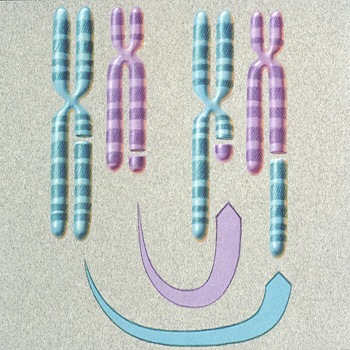
______________________________________ is a type of chromosomal mutation when part of the chromosome breaks off and attaches to another chromosome.
duplication
translocation
subtraction
deletion
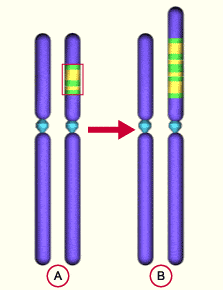
This type of chromosomal mutation produces an extra copy of all or part of the chromosome:
multiplication
replication
duplication
inversion
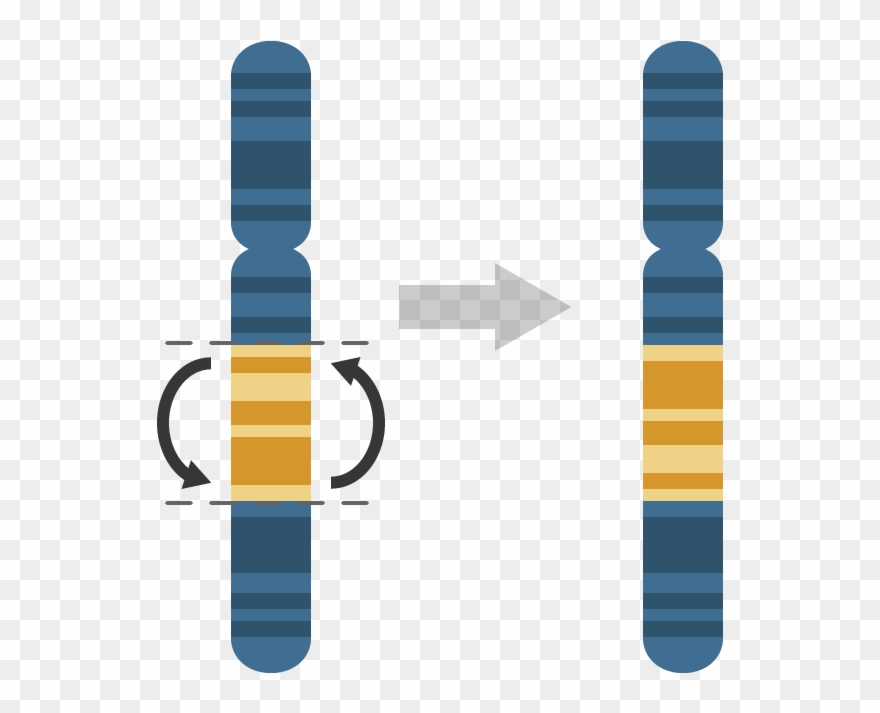
If part of the chromosome is turned around in the opposite direction this is called:
inversion
translocation
deletion
duplication
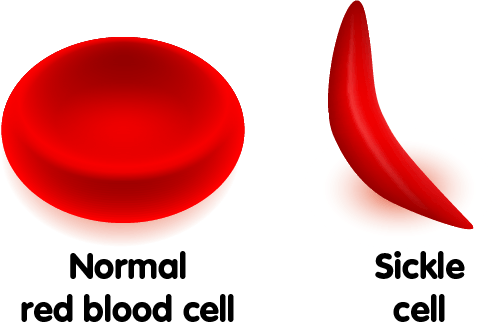
Individuals who inherit the gene for sickle shaped red blood cells from ____________________________, have an advantage in parts of the world where malaria is common.
only one parent
both parents
neither parent

Any change in the sequence of DNA is...
How are mutations passed on to offspring?
Genetic mutations can be...
beneficial, harmful, or neutral
beneficial only
harmful only
neutral only

What is the impact of crossing over?
destroys the chromosomes
causes cancer
causes that annoying twitch in your left eyelid
increases genetic variation in offspring
What are the six kingdoms of life?
Animals, Plants, Vertebrates, Invertebrates, Viruses, Fungi
Bacteria, Amoeba, Algae, Archaea, Protists, Nuclei
Archaea, Bacteria, Protists, Animals, Plants, Fungi
Archaea, Bacteria, Animals, Plants, Proteins, Fungi
Which of the following attributes is NOT accurate for members of the Animalia Kingdom?
multi-cellular
has a nervous system
uses photosynthesis to produce food
can move from place to place
The members of the ________ Kingdom use photosynthesis to create energy.
Fungi
Plants
Animals

Examples are mushrooms and mold
Fungi
Protista
Protista
Plantae
Animalia
Eubacteria cell walls are made out of ______.
Chitin
Cellulose
Peptidoglycan
Glucose
What is a characteristic of Archaebacterias?
Mostly dusease-causing.
They live just about everywhere.
They use sun to produce food and energy.
They thrive in extreme environment.


I sometimes get confused by others to be a plant, but I am not. I'm heterotrophic and digest decaying material. I have a cell wall made of chitin. What kingdom to I belong to?
Archaebacteria
Animalia
Fungi
Protista

The image shows an organism growing on the surface of the bread. Which kingdom would this organism belong to?
Kingdom Fungi
Kingdom Protista
Kingdom Animalia
Kingdom Plantae
The science of describing, classifying, and naming organisms is called _____________________.
organization
classification
life science
taxonomy
What are the eight levels of classification from general to specific?
domain, kingdom, phylum, class, family, order, genus, species
domain, kingdom, phylum, class, order, family, genus, species
species, genus, family, order, class, phylum, kingdom, domain
species, genus, family, order, phylum, class, kingdom, domain
Carolus Linnaeus is known for ___________________________.
discovering T. rex
discovering retractable claws
identifying the characteristics of rare species
founding the science of taxonomy
What can you find out by working through a dichotomous key in the correct order?
the identify, or name of the organism
how long slime mold can live
when a species first appeared on Earth
how many birds migrate north to south in winter
The scientific name of an organism comes from its ________________ and ____________________.
kingdom, phylum
genus, species
class, genus
family, genus
The scientific name for the common house cat is Felis domesticus. What is its species name?
domesticus
house cat
feline
Felis
This domain is made up of all eukaryotes.
Eukarya
Bacteria
Animalia
Archaea
The Phylum Chordata contains which common names of creatures?
Tunicates, Mammals, Birds, and more
house fly
arrow-worm
parasites
The Phylum Arthropoda contains which common names of creatures?
lobsters, arachnids, insects, millipedes, and centipedes
arachnids
starfish
earthworms
The Phylum Annelida contains which common names of creatures?
segmented worms
birds
amphibians
spiny headed worms
Why is the most specific taxonomy category?
Kingdom
Domain
Species
Order


What would the scientific name of this organism be?
Kingdom: Animalia
Phylum: Chordata
Class: Mammalia
Order: Carnivora
Family:Canidae
Genus: Canis
species: mesomelas
Mammalia carnivora
Canidae mesomelas
Canis mesomelas
Animalia chordata
Kingdom:Animalia
Phylum: Chordata
Class: Mammalia
Order: Rodentia
Family: Sciuridae
Genus: Ratufa
species: indica
Indica ratufa
Ratufa indica
Chordata Amimalia
Sciuridea rodenta
Who created the system of Taxonomy?
Albert Einstein
Carolus Linnaeus
Aristotle
Copernicus
What would the scientific name of this organism be?
Kingdom: Animalia
Phylum: Chordata
Class: Aves
Order: Charadriiformes
Family: Laridae
Genus: Thalasseus
species: maximus
thalassues maximus
Anamalia maximus
Aves chordata
Thalassues maximus
What would the scientific name of this organism be?
Kingdom: Animalia
Phylum: Chordata
Class: Reptilia
Order: Crocodila
Family: Alligatoridae
Genus: Alligator
species: mississippiensis
alligator Mississippiensis
Crocodila chordata
Alligator mississippiensis
Reptilia crocodila
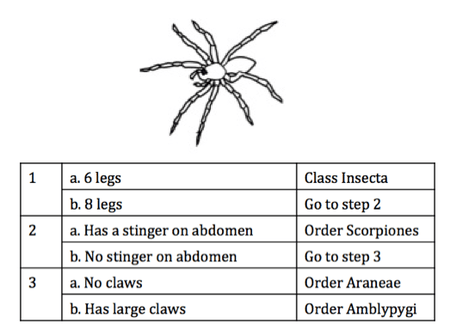

arachnids and insects?

