
NEW
Font size
 Worksheets
Zoology Lab Exam
Total questions: 50
Worksheet time: 26mins

What is number 3?
internal nares
tongue
vomerine teeth
esophagus
What is number 6?
eustachian tubes
internal nares
vomerine teeth
maxillary teeth
What is number 7?
eustachian tubes
glottis
tongue
esophagus

During the frog dissection lab, some students found these small round structures inside their frog (pictured). What do these structures tell us about this particular frog?
These are eggs. This frog is a female.
These are eggs. This frog is a male.
These are bugs. This frog ate just before it died.
These are bugs. This frog is being eaten by scavengers.

Identify the internal frog organ that is shown (in color) in this picture. It has 3 chambers and is a muscle responsible for pumping blood.
Lung
Liver
Heart
Stomach

Identify the internal frog organ that is shown (in color) in this picture. It is the largest internal organ in both humans and the frog.
Lung
Liver
Heart
Stomach

What is a special feature of a frog's skin, that allows it to live in water?
The skin is thin and smooth and can allow oxygen from the water to enter the frogs blood.
The skin is thin and smooth and protects it from predetors with sharp teeth.
The skin is thick and rough and acts as an armor against all predators that might eat it.
The skin thick and rough and provides friction while the frog is swimming to help it balance.

The frog has maxillary teeth and vomerine teeth in its mouth. What is the function of the frog's teeth?
The teeth are used for grinding up its food.
The teeth are used for smiling during school picture day.
The teeth are used for gripping and holding prey.
The teeth are used for filtering food out of the water.

What are the yellow, spaghetti shaped structures that were located on both sides of the frog?
Fat Bodies
Large Intestines
Lung Pockets
Liver Muscles
Which of the following organs were located on the bottom layer (the back) of the frog and are used to filter waste from the frog's blood?
Kidneys
Pancreas
Stomach
Bladder
Which of the following is NOT true?
A frog's tongue is attached at the front of its mouth.
A frog's lungs are used for filtering oxygen from the water.
A frog's webbed feet are used for swimming.
A female frog may have eggs inside her body cavity when opened.

Which picture shows the dorsal side of the bullfrog?
Left
Right

Find the location of the cloaca.
1
2
3
4

What is this organ?
Heart
Lungs
Stomach
Bladder

What is this organ? (There's another one that is hidden)
Heart
Lungs
Stomach
Bladder

What is this organ?
Small Intestines
Large Intestines
Liver
Kidney

What is this organ?
Small Intestines
Large Intestines
Liver
Kidney

Male or Female?
Male...these are the testes
Female...these are the oviducts
Male...these are the oviducts
Female...these are the testes

Male or Female?
Male...these are the testes
Female...these are the oviducts
Male...these are the oviducts
Female...these are the small intestines
How many chambers does a frog's heart have?
4 (2 atria, 2 ventricles)
3 (2 atria, 1 ventricle)
3 (2 ventricles, 1 atrium)
2 (2 atria)
What do you call the involuntary constriction and relaxation of the muscles of the intestine or another canal, creating wave-like movements that push the contents of the canal forward?
Peristalsis
Dialysis
Osmosis
Enteritidis
What is the correct order of the following processes?
ingestion, digestion, elimination, absorption
digestion, ingestion, absorption, elimination
ingestion, digestion, absorption, elimination
digestion, elimination, ingestion, absorption
Which layer of the stomach wall is responsible for the movement and mechanical digestion of food?
Mucosa
Submucosa
Muscularis
Serosa
The movement of air into and out of the lungs.
gas exchange
ventilation
dilation
diffusion
Are small air-filled chambers where the air and the blood come into close contact with each other.
bronchioles
bronchi
alveoli
lymphs
The process of diffusing oxygen from the blood, into the interstitial fluid and into the cells.
inspiration
expiration
internal respiration
external respiration
The process of exchanging oxygen and carbon dioxide in the lungs.
inspiration
expiration
internal respiration
external respiration
Which blood vessels carry deoxygenated blood to the lungs for oxygenation?
Pulmonary arteries
Pulmonary veins
Aorta
Superior vena cava

What feature of alveoli adapts them to efficient gas exchange?
They have muscles which pump air in and out regularly
Their membranes are more permeable to gases than water
A constant blood supply flows through them
A dense network of capillaries surrounds them
Arterioles
Venules
The bottom chamber of the heart is called
ventricle
atrium
The structure that prevents the backflow of blood in the heart
ventricle
atrium
The tubes that connect between the kidneys and urinary bladder is…………....
Renal tubule
Ureters
Urethra
Urinary bladder
What is the functional unit of the kidney responsible for urine formation?
nephron
renal corpuscle
juxtaglomerular cells
podocytes
The reabsorption process occurs in ………………………….
glomerulus
proximal convoluted tubules
Bowman's capsule
None of them
Which of the following is NOT a step in the blood filtering process?
Glomerular filtration
Tubular reabsorption
Tubular secretion
Glomerular reabsorption
Which of the following is NOT a function of the urinary system?
Regulation of blood pressure
Regulation of electrolyte balance
Regulation of body temperature
Regulation of blood pH
In male frogs, which is the correct pathway of sperms release?
Testes - Vasa efferentia - urogenital duct - cloaca
Testes - urogenital duct - cloaca - vasa efferentia
Cloaca - urogenital duct - vasa efferentia - testes
Seminiferous tubules - Epididymis - Vas deferens - Urethra
The outermost and thickest layer, a tough, fibrous membrane that surrounds and
supports the brain.
Dura mater
Pia mater
Arachnoid mater
Dark mater
What is the function of the central nervous system?
Send messages to the muscles and glands
Relay nerve impulses from the CNS to the rest of the body and back.
Reflex actions
Increase heart rate
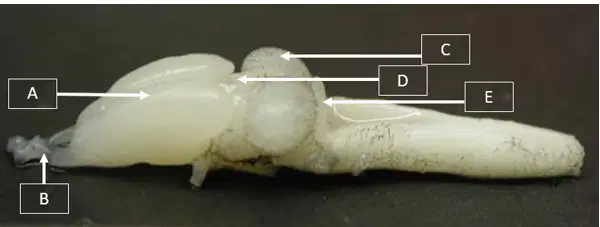
Identify Letter A
Olfactory lobe
Cerebral hemisphere
Optic lobe
Diencephalon
Identify Letter D
Olfactory lobe
Cerebral hemisphere
Optic bulb
Diencephalon
Identify Letter E
Cerebellum
Cerebral hemisphere
Optic bulb
Diencephalon
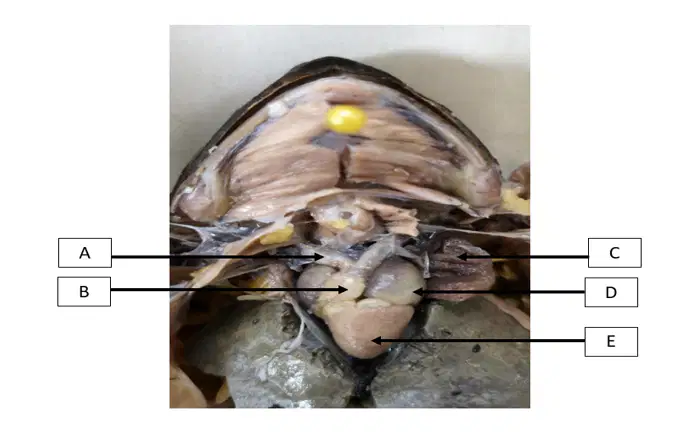
Identify Letter B
Atrium
Conus arteriosus
Ventricle
Truncus arteriosus
Identify Letter D
Atrium
Conus arteriosus
Ventricle
Truncus arteriosus

