
 Worksheets
LV21.Q Engines revision
Total questions: 20
Worksheet time: 10mins
What is the primary function of piston rings in an engine?
To increase the engine's power output
To seal the combustion chamber and prevent the escape of combustion gases
To reduce the engine's weight
To cool the engine
What does the "S" rating in API classification stand for?
Diesel
Petrol
Kerosene
Natural Gas
What does the "C" rating in API classification stand for?
Diesel
Petrol
Kerosene
Natural Gas
What does API stand for in the context of API classification?
American Petroleum Institute
Associated Petroleum Industry
Advanced Petroleum Information
American Petrol Industry
What does blue smoke from the exhaust typically indicate?
Oil being burned
Fuel mixture too rich
Coolant leak
Air filter blockage
What is the result of a water and oil mixture in the context of exhaust smoke?
Combustion
Emulsification
Oxidation
Vaporization
In how many ways does heat travel?
2
3
4
5
Through which medium does conduction occur?
Liquids
Solids
Gases
Plasma
Through which medium does convection occur?
Solids
Liquids
Gases
Plasma
Through which medium does radiation occur?
Solids
Liquids
Air
Plasma
What is the typical compression ratio range for a CI diesel engine?
10:1 to 15:1
16:1 to 21:1
12:1 to 18:1
14:1 to 20:1
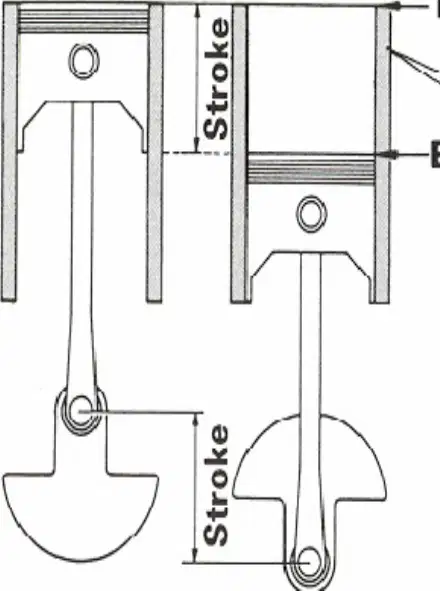
What influences the compression ratio in an engine cylinder?
The size of the engine cylinder and the swept volume of the piston.
The temperature of the engine.
The type of fuel used.
The color of the engine.
What does the swept volume of the piston refer to?
The volume of the piston itself.
The volume of the cylinder head.
The volume the piston displaces as it moves from BDC to TDC.
The volume of the fuel tank.
What two volumes are combined to give the total volume of the cylinder?
The volume of the fuel and the volume of the air.
The capacity of the cylinder and the volume of the combustion chamber.
The volume of the oil and the volume of the coolant.
The volume of the exhaust and the volume of the intake.
What does the term "TDC" stand for in the context of the diagram?
Top Dead Center
Total Displacement Center
Top Displacement Center
Total Dead Center
How is the compression ratio (CR) calculated according to the diagram?
(V1 + V2) / V1
(V1 - V2) / V1
(V1 * V2) / V1
(V1 / V2) + V1
If the combustion chamber volume (V1) is 32 cc and the cylinder volume (V2) is 315 cc, what is the compression ratio?
11:1
10:1
12:1
9:1
Which of the following is a requirement for performing a compression test on an engine?
Engine cold
Spark plugs in
Throttle closed
Engine warm
What should be done with the spark plugs before performing a compression test?
Leave them in
Remove them
Replace them
Tighten them
What does WOT stand for in the context of a compression test?
Wide Open Throttle
Wide Open Timing
Warm Over Temperature
Warm Open Throttle

