
Font size
 Worksheets
Grade 8 Life Science MCAS Review
Total questions: 78
Worksheet time: 54mins
All living things are composed of one or more cells.
True
Falso
The ________ controls the movement of materials into and out of the cell.
cell membrane
nucleus
cytoplasm
mitochondrion
What structure in a plant cell enables the cell to capture energy from the Sun?
cell wall
chloroplast
mitochondrion
central vacuole
Which type of cell can make its own food?
animal
plant
____________ is the gel-like substance found in a cell?
cytoplasm
chlorophyll
water
The _______________ surrounds the cell material.
chromosome
cell membrane
cytoplasm
What is the basic unit of structure and function in all living things?
cell
organism
atom
plasma
The __________ is the control center of a cell.
mitochondrion
nucleus
vacuole
Which cell part protects and provides shape for a plant cell?
nucleus
mitochondrion
vacuole
cell wall
The __________ produces energy in the cell.
mitochondrion
nucleus
vacuole
Both plant and animal cells have a cell membrane.
True
False
Which statement about plant and animal cells is correct?
Animal cells are irregular in shape; plant cells are regular in shape.
Animal cells are regular in shape; plant cells are irregular in shape.
Both animal and plant cells are irregular in shape
Both animal and plant cells are regular in shape.
Which one of these contains biotic and abiotic factors
Organ System
Population
Community
Ecosystem
What is an organ?
Groups of similar types of cells that work together to carry out a specific task
Groups of different organs working together to complete a series of tasks
Groups of different tissues working together to perform a particular job
The smallest unit of life
What is a tissue
Groups of similar types of cells that work together to carry out a specific task
The smallest unit of life
Groups of different tissues working together to perform a particular job
Groups of different organs working together to complete a series of tasks
What is an Organism
Smallest unit of life
Things that have all the characteristics of life
Group of specialized cells
A comet flying through space
What is the order of levels of organization of the body from SMALLEST to Largest?
cell, organ, tissue, organ system, organism
cell, organ, tissue, organ system, organism
organism, organ system, organ, tissue, cell
cell, tissue, organ, organ systems, organism
Which one of these is an abiotic factor
Rock at the bottom of a flowing river
Oak tree in the middle of a forest
An Ant found walking on top of concrete
Tadpole swimming around a pond

The living and nonliving parts of the environment and how they interact
ecosystem
adaptation
trait
When there are many populations in the same area, it is called _____.
animal
world
community
The environment where the organism would live ______.
Climate
habitat
House
Outside
A group of living things that interact in an ecosystem.
Ecosystem
Comunity
Population
Habitat

What is population?
Is all the members of one species that live within an area of an ecosystem.
It shows a savannah ecosystem in Africa.
Some plants and animals have adapted to the limited water supply.
Is all the living and non living things in an environment and the many ways they interact.
What is the function of the respiratory system?
To digest your food
To remove waste from the body
To take in oxygen and remove carbon dioxide
To fight disease
Which statement best describes the relationship between the nervous system and the muscular system?
The nervous system controls the muscular system.
The muscular system controls the nervous system.
The nervous system provides nutrients for the muscular system.
The muscular system provides nutrients for the nervous system.
Which two body systems work together to support the body and allow the body to move?
circulatory and respiratory
digestive and nervous
skeletal and muscular
circulatory and digestive
What body systems interact and work to expel wastes from the body?
nervous and circulatory
digestive and excretory
digestive and circulatory
nervous and excretory
In the body, system X takes in and breaks down food. System Y then transports the raw materials throughout the body. What systems do X and Y represent?
System X is the excretory system and system Y is the nervous system.
System X is the respiratory system and system Y is the circulatory system.
System X is the digestive system and system Y is the respiratory system.
System X is the digestive system and system Y is the circulatory system.
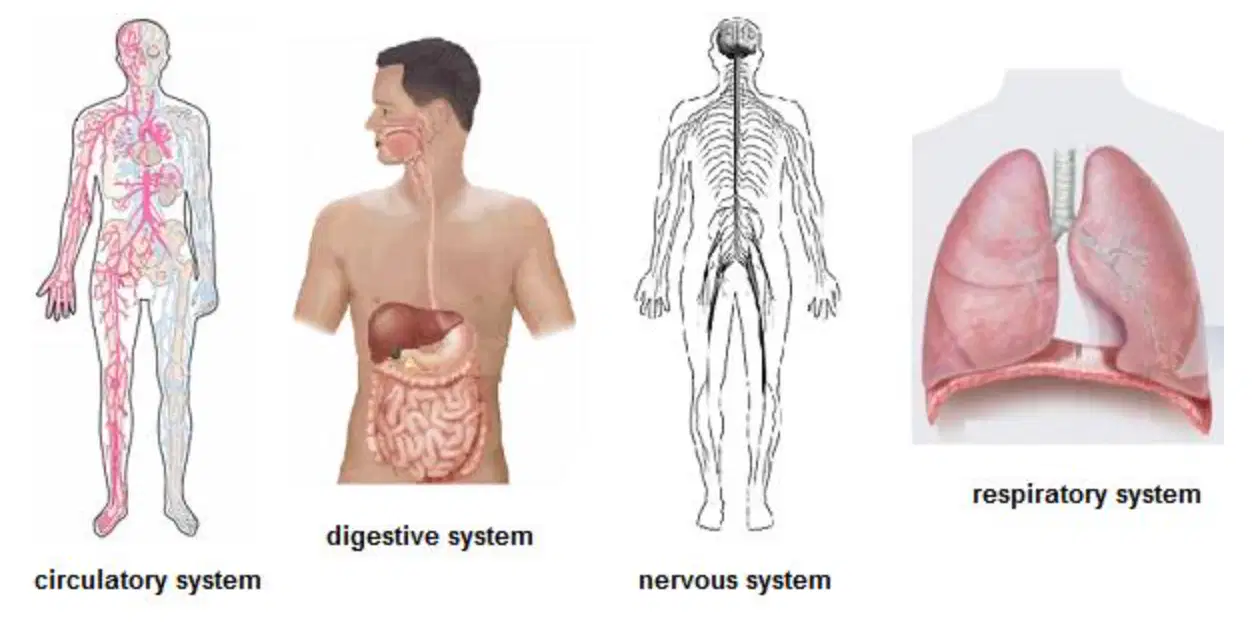
Which two body systems pictured interact with each other to break down and transport the nutrients found in food?
the digestive system and the nervous system
the respiratory system and the circulatory system
the circulatory system and the digestive system
the nervous system and the respiratory system
Paulo is writing an email to Sara about a science class she missed. He tells her the class was about how different systems of the body work together. Which of the following statements should he include in his email?
The blood transports wastes to the kidney.
The muscles pull on bones during movement.
The lungs provide a place for oxygen to get into the blood.
All of the above statements can be included in the email.
Aa, DD, Bb, yy are all examples of _______
genotypes
phenotypes
The physical expression of a trait is called the ...
genotype
phenotype

Cross 2 heterozygous tall pea plants. Tall (T) is dominant to short (t). What fraction of the offspring do you predict will be tall?
1/4
2/4
3/4
4/4
Which set of alleles are considered heterozygous?
HH
Hh
hh

In humans, freckles (F) on the skin are dominant to no freckles (f). If a heterozygous parent and a recessive parent conceive, what is the chances of having a child with NO FRECKLES?
0%
50%
100%
What is DNA (deoxyribonucleic acid)?
protein
phosphate
ribosome
genetic material
Mutations can be _______________.
Neutral
Harmful
Beneficial
All of the above
Which statement best describes DNA's relationship to a gene and chromosome?
A gene contains several chromosomes, and chromosomes are made from DNA.
A gene is a short section of DNA, and a chromosome is made from DNA.
DNA is made of chromosomes, and a gene contains DNA.
DNA is coiled into a chromosome, and a gene holds the chromosome together.
Asexual reproduction has
1 parent
2 parents
Sexual reproduction has
1 parent
2 parents
Asexual reproduction creates offspring that are
genetically identical to the parent
different from the parent
different from each other
formed by 2 parents
Budding, vegetative propagation, regeneration, and binary fission are all types of
sexual reproduction
asexual reproduction
Advantages of sexual reproduction are
selective breeding
saves time
saves energy
genetic variation

Structures or behaviors that help an
organism survive in its surroundings
adaptations
inherited traits
learned behaviors
structural behaviors
Selective breeding is...
a process to create an organism with desired traits from parents with those desired traits
natural method of producing offspring with desired traits
creating a new species
making organisms reproduce during times of stress
An example of selective breeding is
a dog breeder mating 2 dogs to make more dogs
a farmer grows bees to pollinate the plants on his farm
a person pollinates 2 white rose plants to only create white roses
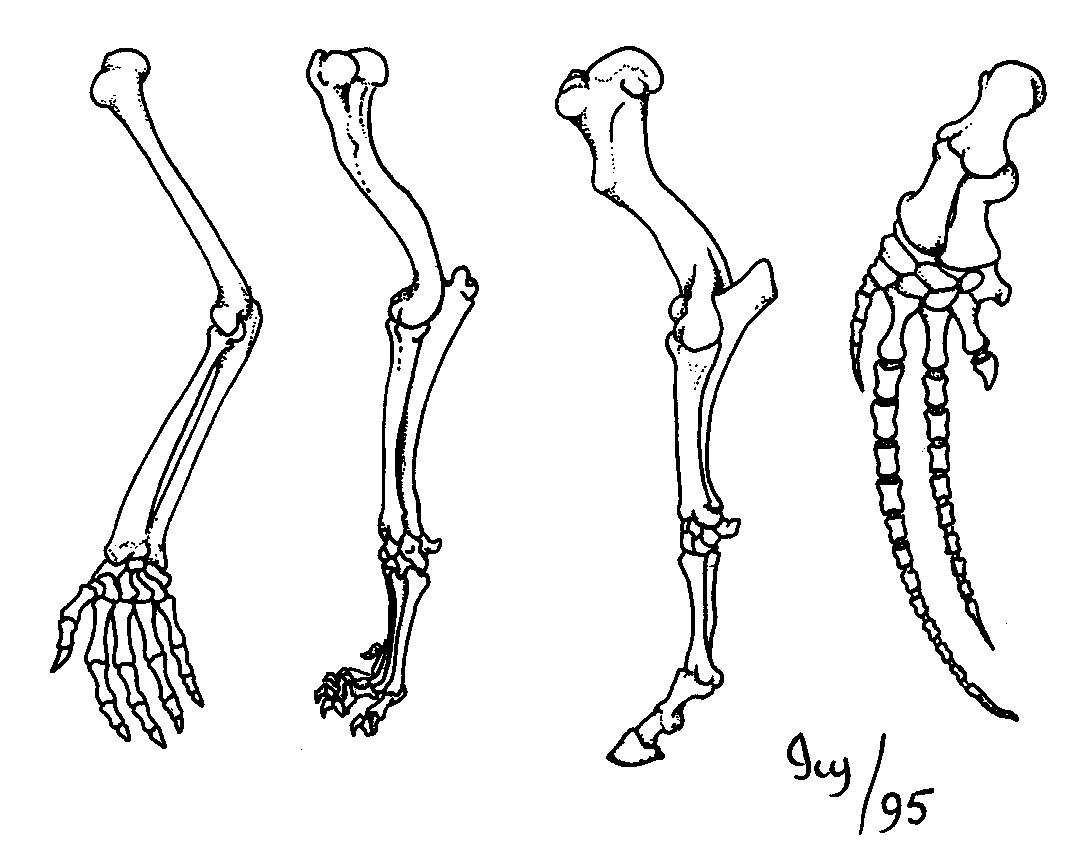


A food web shows...
How energy flows in a direct line
How energy flows through an entire ecosystem


What would happen to consumers if ALL of the producers were gone?
The consumers leave
The consumers just get food at the grocery store
The consumers die
The consumers wouldn't care

What kind of a consumer is Organism Z?
Omnivore
Carnivore
Decomposer
Herbivore

Which of the following food chains is in the correct order?
Red foxes → frogs → grasshoppers
Clover → goldfinches → weasels
Clover → frogs → red foxes
Clover → grasshoppers → frogs

According to the table, what role do grasshoppers play?
Producers
Consumers
Decomposers
Carnivores
Which of the following would have a negative impact on an ecosystem
deforestation
planting trees
recycling paper
What do scientist call organisms that are not native to an ecosystem and cause harm to native organisms?
native plants
invaders
invasive species
natural species
When a certain population becomes too large, and it harms or changes the quality of life in that environment, we have an...
a population
overpopulation
pollution

Huge areas of the Amazon Rainforest are being cut down. What effect could this have on the carbon-dioxide/oxygen cycle if the removal of so many plants and trees continues?
Carbon dioxide levels increase
Oxygen levels increase
Carbon dioxide levels decrease
Nitrogen levels decrease

