
 Worksheets
Quadratic practice
Total questions: 35
Worksheet time: 3hrs 50mins
x2 = 9 - 4x
What must you do to the "b" value to correctly complete the square?
square it
divide it by 2 and square the result
divide it by 2 and take the square root of the result
divide it by 2 only
a2 + 10a + 21 = 0
What does the discriminant determine?
Whether the graph goes up or down
The vertex
The number of Solutions
The y-intercept

What is the discriminant of this graph?
Positive
Zero
Negative

What is the discriminant of this graph?
Positive
Zero
Negative
Find the discriminant: 2a2 - 5a + 5 = 0
44
65
-15
-144
Factor and Solve
6x2 + 17x + 12 = 0
x = -4/3, x = -3/2
x = 9, x = 8
x = 4, x = 3
x = -4, x = -3
Solve the following by ISOLATION
4(x−5)2=12
(4x+20)2=12
x=5±3
x=−5±3
x=5±213
x2+ 6x - 4 = 36
When using factoring to solve a quadratic equation, what must be true?
The equation must be set equal to 1.
The equation must be set equal to 10.
The equation must be set equal to 0.
It is not necessary to set the equation equal to anything.

What is the color of the graph that has no real zeros?
black
green
purple
red
None of these graphs have no real zeros

What is the color of the graph that has exactly one real zero?
black
green
purple
red
None of these graphs has exactly one zero.
2x2=8x+3
Suzanne solved the equation using this process.
Did she make a mistake?
If yes, at which line did she make her first mistake?
(There are 5 steps in her process)
Suzanne made no errors.
Step 2
Step 3
Step 4
Step 5
3x2−10x+1=0
Solve by the method of your choice.
x=6−10±88
x=3−5±222
x=610±112
x=35±22
7x2=6x−1
Given this quadratic equation, what could be the values a, b, and c to use in the quadratic formula?
a = 7, b = −6, c = 1
a = 1, b = 6, c = −7
a = −7, b = 6, c = 1
a = 6, b = 7, c = 1
y = (x−5)2 + 4 Convert from Vertex to Standard form
x2+10x−25
x2−25x+25
x2−25x+4
x2−10x+29
Which equation shows vertex form of a quadratic function?
f(x)=a(x−h)2+k
f(x)=ax2+bx+c
f(x)=a(x−r1)(x−r2)
x=−2ab

Convert f(x) = 3x2+ 6x - 5 to vertex form.
f(x) = 3(x + 1)2 - 8
f(x) = 3(x - 1) 2 - 8
f(x) = 3(x + 2)2 - 8
f(x) = 3(x - 2)2 - 8
f(x) = x2 + 12x - 2
written in vertex form?
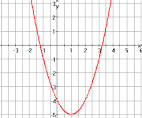

Which equation is graphed above?
y=−(x−1)2+4
y=(x−1)2+4
y=−(x−4)2+1
y=(x−4)2+1
f(x) = x2 - 8x + 1
written in vertex form?
Convert f(x) = 4x2 - 32x + 2 to vertex form.
f(x) = 4(x + 4)2 - 62
f(x) = 4(x - 4)2 - 62
f(x) = 4(x - 8)2 - 62
f(x) = 4(x + 8)2 - 62
The pathway of an arrow can be represented by the equation h = -16t2 + 80t + 25, where h is the height in feet and t is the time in seconds. What is the maximum height?
h = 125 feet
h = 80 feet
h = 95 feet
h = 140 feet
A rock is dropped from a bridge 320 feet above a river. The pathway that the rock takes can be modeled by the equation h = -16t2 + 320. How long will it take the rock to reach the river (ground)?
4.5 seconds
2.5 seconds
3.8 seconds
3.5 seconds
Joe Mauer hits a fly ball. You can track the height of the ball using the equation: h(t) = -16t2 + 140t + 2. What is the starting height of the ball?
-16 feet
140 feet
2 feet
0 feet
A baseball was thrown from a height of 5 feet with an initial velocity of 24 feet per second at an angle above the horizontal. Write an equation to represent the situation.
y= -16x2 + 24x + 5
y= -16x2 + 24x - 5
y= 16x2 + 24x + 5
y= x2 + 24x + 5
Charlie shoots a basketball from a height of 6 feet with an initial upward velocity of 18 feet per second. How long will it take the ball to reach the maximum height?
0.6 seconds
11 seconds
6 second
this graph has a minimum
The height of an object thrown into the air can be modeled by the formula y=−16x2+70x+95 , where y is in feet after x seconds.
What is the height of the object after 5 seconds?
95 feet
45 feet
70 feet
171.56 feet
A ball is thrown into the air with an upward velocity. Its height, h, after t seconds is given by the function below.
h=−16t2+64t+960
How many seconds did it take for the ball to reach its maximum height?
10 seconds
64 seconds
960 seconds
2 seconds
A ball is thrown into the air with an upward velocity. Its height, h, after t seconds is given by the function below.
h=−16t2+64t+960
What is the maximum height reached?
1024 feet
64 feet
960 feet
2 feet
A ball is hit into the air with an initial velocity of 100 ft/s. Its height, h, after t seconds is given by the function
h = -16t2 + 100t + 5
How many seconds did it take for the ball to reach its maximum height?
3.654 seconds
2.451 seconds
161.25 seconds
3.125 seconds

