
Font size
 Worksheets
PSH Day 1
Total questions: 68
Worksheet time: 2hrs 56mins
Matter that has a definite shape and a definite volume is:
Solid
Liquid
Gas
Plasma
A gas-like mixture with no definite volume or shape that is made up of positively and negatively charged particles is:
Solid
Liquid
Gas
Plasma
The phase change that occurs when a substance changes from a liquid to a gas is called:
Sublimation
Condensation
Evaporation
The particles that make up a solid move ___ than do the particles that make up a gas.
more slowly
faster
the same
The process by which a substance changes from a solid to a gas is:
freezing
sublimation
evaporation
All changes of the state of matter require:
Energy
higher temperatures
lower temperatures
(a) is the form of matter with the greatest amount of energy.
Which pair forms a homogeneous mixture?
sugar and water
oil and vinegar
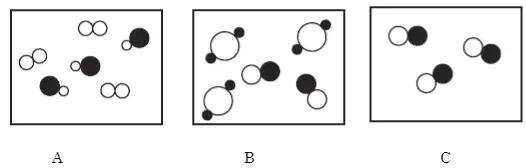
Which particle diagram best represents a mixture of one element and one compound?
A
B
C
A solid rubber stopper has a mass of 33.0 grams and a volume of 30.0 cm³. What is the density of rubber?
(a)
What is the mass of a pure platinum disk with a volume of 113 cm³? The density of platinum is 21.4 g/cm³.
(a)
The density of cork is 0.24 g/cm³. What is the volume of a 240-gram piece of cork?^
(a)
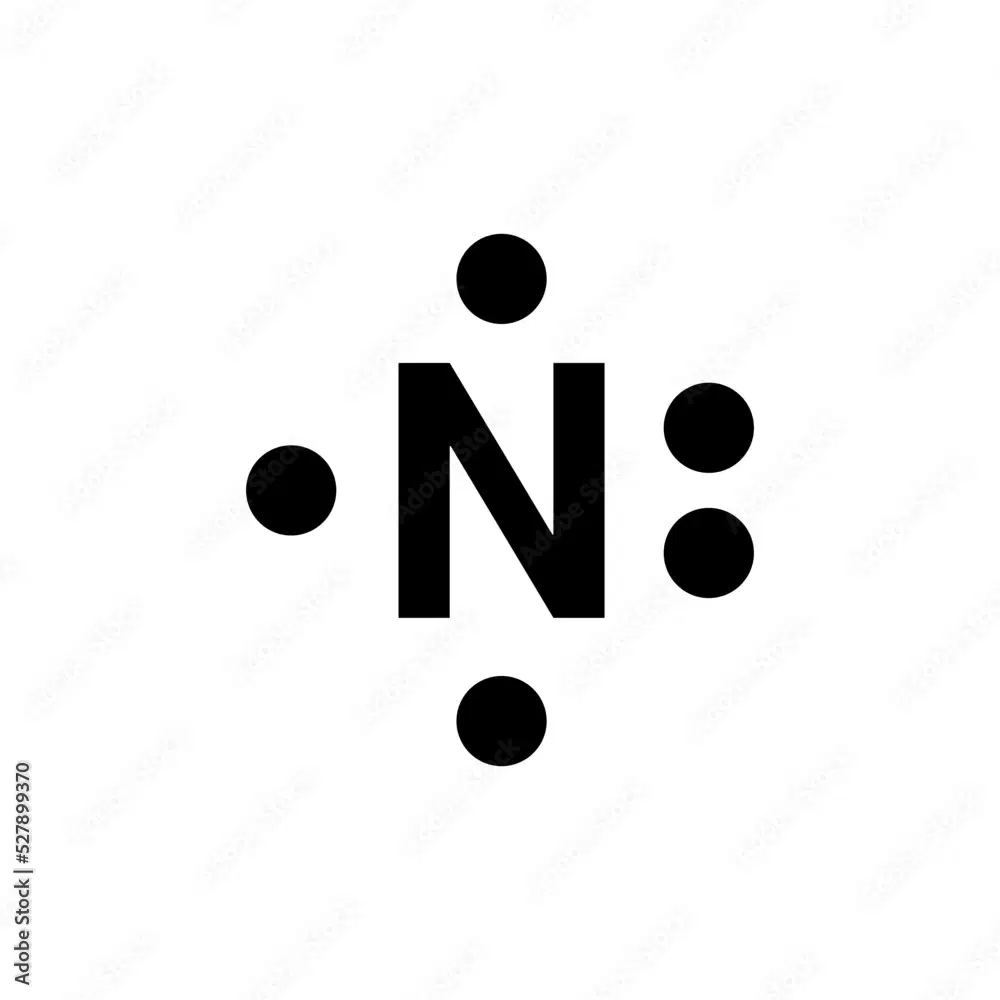
Draw an electron dot diagram of Nitrogen.
Which elements on the periodic table are the most stable – they don’t combine with others?
(a)
Noble on the periodic table are the most stable – Where are they located??
(a)
The mass of an atom is equal to what?
(a)
What do you call the horizontal rows & vertical columns on the periodic table? (Check 2)
groups
columns
periods
rows
What do you call the vertical columns on the periodic table? (Check 2)
groups
columns
periods
rows
What does the atomic number tell you for a neutral atom?
(a)
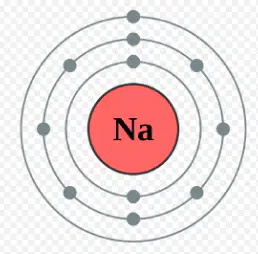
Draw the Bohr diagram for sodium.
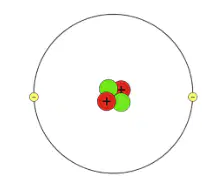
How many protons are in the model?
(a)
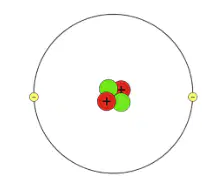
What is the mass of the atom?
(a)
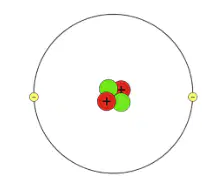
What element does this model represent?
(a)
How many neutrons are in Hydrogen-1?
(a)
How many neutrons are in Hydrogen-3?
(a)
Where are the metals located on the periodic table?
Middle of the periodic table
On the top right side of the periodic table
Bottom of the periodic table
Left side of the periodic table
Where are the metalloids located on the periodic table?
Along the stair line of the periodic table
On the top right side of the periodic table
Bottom of the periodic table
Left side of the periodic table
Where are the non-metals located on the periodic table?
Along the stair line of the periodic table
On the top right side of the periodic table
Bottom of the periodic table
Left side of the periodic table
How many energy levels do the following elements have: K, Ru, Ti, Ne?
What are group 17 elements called? What are group 1 elements called?
If an ion has a charge of -2, it has
two more electrons
two more protons
two less electrons
two less neutrons
The electron configuration shown is for which element? 1s² 2s² 2p⁶ 3s²
Hydrogen
Magnesium
Argon
Calcium
Determine what elements are represented by the following electron configurations:
Explain the behavior of the following trends as you go across the periodic table:
Draw the spin up/down orbital diagrams for each element below:
Nitrogen has three isotopes: N-14 (95%), N-15 (3%) and N-16 (2%). Determine the average atomic mass for Nitrogen. Round to 2 decimal places.
Given the balanced equation: FeO + CO → Fe + CO₂ The reactants in the equation are
FeO and CO
Fe and CO₂
FeO and CO₂
Fe and CO
Magnesium and bromine combine to form magnesium bromide. This is an example of _______ bonding.
covalent
hydrogen
ionic
London dispersion
How many atoms are in Na₂SO₄?
Given the name of the compound, write the chemical formula. Sodium Phosphate
Given the name of the compound, write the chemical formula. Copper II Oxide
Given the name of the compound, write the chemical formula. Dinitrogen pentoxide
Given the name of the compound, write the chemical formula. Ammonium Nitrate
Given the name of the compound, write the chemical formula. Boron hexafluoride
Given the chemical formula, write the name of the ionic compound. K₂S
Given the chemical formula, write the name of the ionic compound. CaSO₄
Given the chemical formula, write the name of the ionic compound. Cu₂O₃
Given the chemical formula, write the name of the ionic compound. CCl₄
Given the chemical formula, write the name of the ionic compound. CO
Balance the following equations.
Balance the following equation: 4 Al + 3 O₂ → (a) Al₂O₃
Balance the following equation: 2 KClO₃ → 2 KCl + (a) O₂
Write and balance the chemical equation for the following reactions.
Hydrogen gas reacts with nitrogen gas to produce ammonia gas (NH₃). ____ H₂(g) + N₂(g) → ____ NH₃(g)
(a)
Azomethane (C₂H₆N₂) decomposes to form ethane (C₂H₆) and nitrogen gas. C₂H₆N₂ → C₂H₆ + (a) N₂
Classify the following reaction: 4NaNO₃ → 4NaNO₂ + 2O₂
Decomposition
Single Replacement (SR)
Synthesis (S)
Double Replacement (DR)
Classify the following reaction: 2KI + Cl₂ → 2KCl + I₂
Decomposition
Single Replacement (SR)
Synthesis (S)
Double Replacement (DR)
Classify the following reaction: 4Al + 6S → 2Al₂S₃
Decomposition
Single Replacement (SR)
Synthesis (S)
Double Replacement (DR)
Classify the following reaction: FeS + 2HCl → FeCl₂ + H₂S
Decomposition
Single Replacement (SR)
Synthesis (S)
Double Replacement (DR)
List what is happening for each section of the heating curve graph.
List all the ways you can tell if a bond is an Ionic (crystalline) or Covalent (molecular) Bond.
Conservation of Mass: 50 grams of Reactants react and are used to make products of NaCl and H₂O. The scientist noticed that 30 grams of NaCl was produced. How much water was produced?
After three ½ lives, how much of the original radioactive material is remaining?
What is the ½ life for the radioactive isotope shown?
How many ½ lives would have happened if you only have 25 grams of the original isotope was left?
What is the mass of 6.0 moles CO₂?
What is the molar mass of Mg₃(PO₄)₂?
In a reaction where Iron (II) reacts with HCl it produces 3 moles of Iron (II) chloride and Hydrogen gas. How many moles of HCl as a reactant was used in this reaction?

